

Netball
Mastering the Art of Deception: A Netball Drill for Dodging and Leading
A comprehensive guide for Netball coaches to teach players how to create space, lose defenders, and receive critical passes through effective dodging and leading techniques.
What you need
Netball, Cones, Bibs
Overview
This drill is a cornerstone for developing intelligent and effective attacking players. Its primary focus is to teach the fundamental movements of dodging to create separation from a defender and leading into space to receive a pass. It is an essential skill for every position on the court but is particularly critical for Goal Attacks, Wing Attacks, and Centres who are frequently tasked with breaking free to maintain possession and create scoring opportunities. Use this drill when your team is struggling with static play, high turnover rates from intercepted passes, or a lack of effective movement in the attacking third.
Setup
Equipment:
- 1 Netball per group
- 6 cones to mark starting positions and movement channels
- Bibs to differentiate players if running with defenders
Court Setup:
- The drill can be run in a single third of the Netball court (10.16m x 15.25m), allowing multiple groups to work simultaneously.
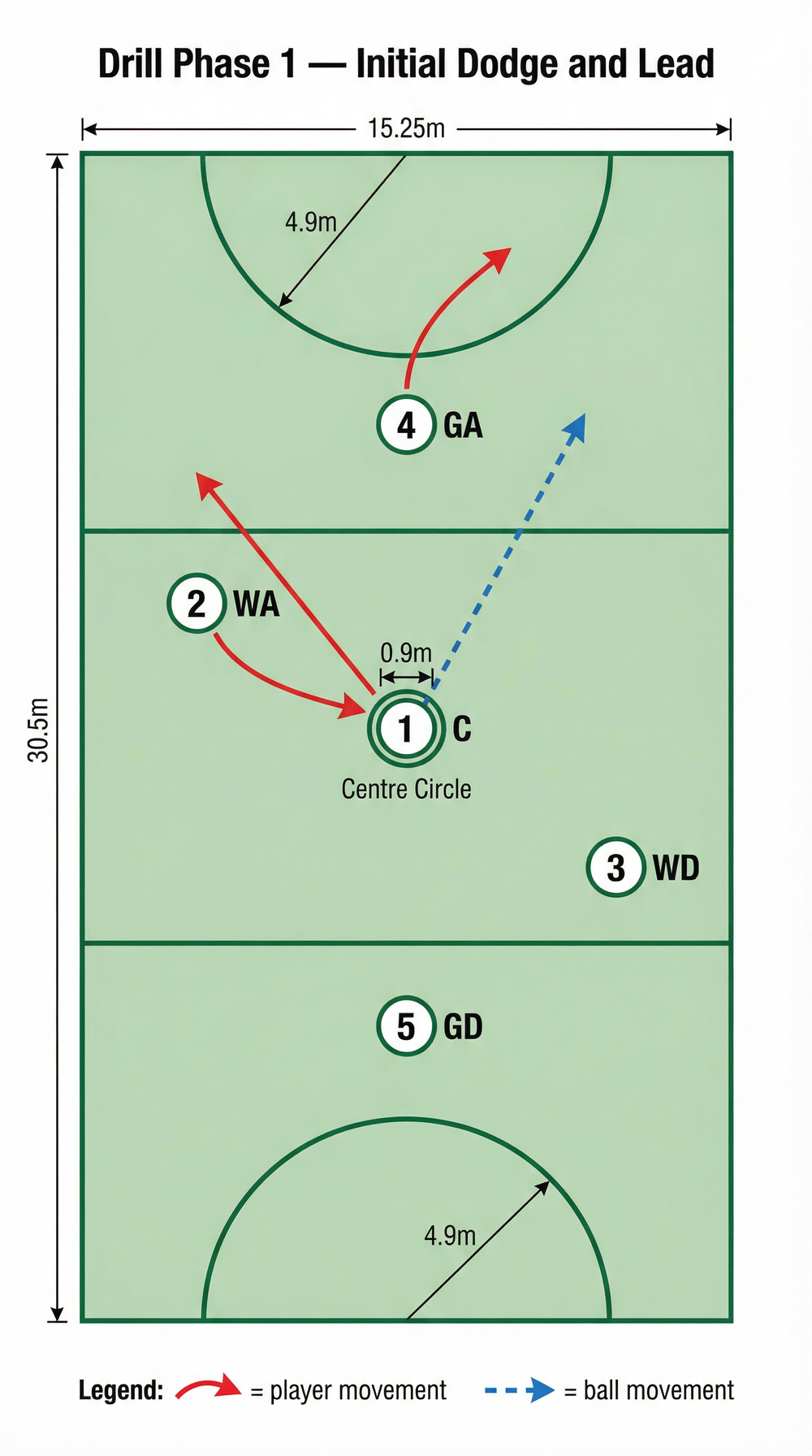
- Place a cone for the feeder (Player 1) in the centre of the area.
- Place two cones 3-4 metres to the left and right of the feeder, slightly ahead, for the starting positions of the working players (attackers).
- Place two more cones further down the court to create a channel for the lead run.
Player Positions:
- Player 1 (Feeder): Positioned at the central cone with the ball. This can be a Centre (C) or any player practicing their passing.
- Player 2 (Attacker 1): Starts at a cone to the side of the feeder. This could be a Wing Attack (WA) or Goal Attack (GA).
- Player 3 (Attacker 2): Starts at the opposite cone. (Optional, can start with one attacker).
- Player 4 (Defender): (Optional, for progression) Marks the attacker.
Step-by-Step Instructions
- Starting Position: The Feeder (1) stands at the central cone with the ball. The Attacker (2) starts at one of the side cones.
- The Preliminary Move: The Attacker (2) jogs or walks towards their defender (or the empty space if no defender) for 2-3 steps. This is a crucial setup move to lull the defender into a false sense of security.
- The Dodge (Change of Direction): The Attacker plants their outside foot hard and explosively pushes off in the opposite direction. This should be a sharp, decisive movement, not a rounded run. The aim is to create a sudden change of pace and direction that leaves the defender flat-footed.
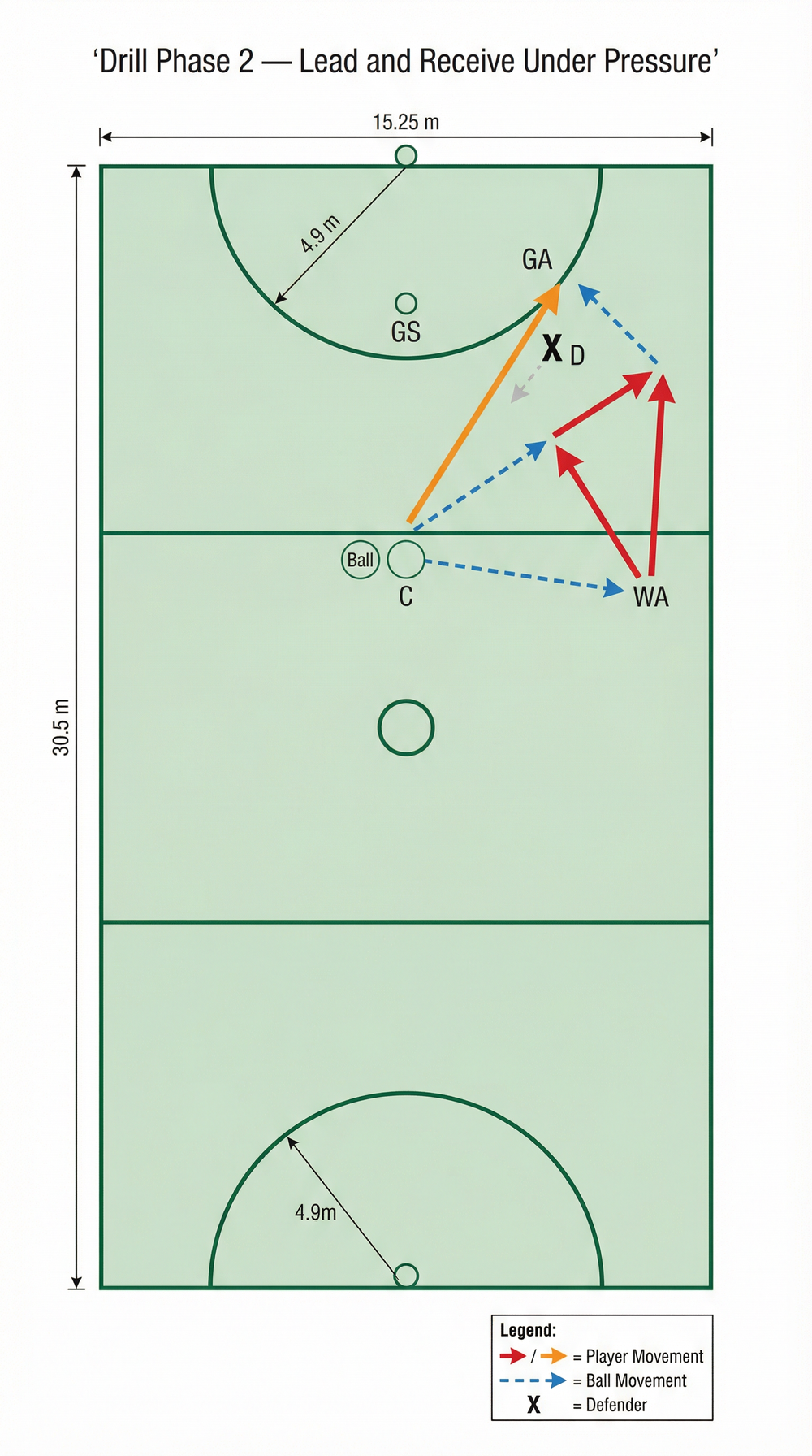
- The Lead: Immediately after the dodge, the Attacker accelerates into the open space, leading for the ball. The lead should be a straight, hard run towards the ball or into a designated channel. The Attacker should have their eyes on the Feeder and present a clear target with their hands.
- The Pass and Catch: The Feeder (1) delivers a sharp, accurate pass (chest pass or bounce pass) to the leading Attacker (2). The pass should be timed to meet the player as they run, not forcing them to stop or slow down. The Attacker catches the ball securely.
- Reset: The Attacker passes the ball back to the Feeder and returns to the starting cone or swaps roles. Repeat for a set number of repetitions (e.g., 10 successful leads) before switching.
Key Coaching Points
- Sharp Change of Direction: Emphasise planting the foot and driving off powerfully. The difference between a good dodge and a great one is the explosive power in the change of direction. Use the analogy of a car's handbrake turn.
- Sell the Dummy: The initial slow movement towards the defender must be convincing. Encourage players to use their eyes and body language to make the defender believe they are continuing in that direction.
- Lead with Intent: The run into space must be at maximum pace. Players should demand the ball with their voice and strong hands, creating a clear and inviting target for the passer.
- Timing is Everything: The Feeder must watch the Attacker's movement and release the ball at the precise moment they break free. A pass that is too early or too late will ruin the effort. The connection between passer and receiver is paramount.
- Low Body Position: Coach players to stay low during the dodge. A lower centre of gravity allows for a more powerful and stable change of direction.
- Eyes on the Ball: The receiver must keep their eyes on the ball throughout the lead and into the catch, ensuring a clean take.
Common Mistakes
- Rounded Dodge: Players run in a curve instead of making a sharp cut. Correction: Use cones to force a sharp angle change.
- No Change of Pace: The player runs at the same speed for the setup, dodge, and lead, making them easy to defend. Correction: Emphasise a 'jog-sprint' sequence.
- Telegraphing the Move: The player looks in the direction they intend to lead before they dodge. Correction: Drill players to look in the preliminary direction to fool the defender.
- Leading into a Crowded Space: The player leads into an area already occupied by other players. Correction: Improve court awareness and communication.
- Late Pass: The feeder holds onto the ball for too long, allowing the defender to recover and intercept. Correction: Work on the passer's timing and decision-making.
Variations & Progressions
- Add a Passive Defender: Introduce a defender who is instructed to only shadow the attacker without actively trying to intercept the ball. This helps the attacker get used to the pressure of being marked.
- Add a Full Defender: The defender now actively tries to intercept the pass or restrict the attacker's movement. This makes the drill fully contested and more game-like.
- Two-Way Dodge: The attacker can choose to dodge left or right, forcing the feeder to react and make a decision on the pass. This improves both the attacker's and the feeder's adaptability.
Age Adaptations
- Under 8 / Under 10: Focus purely on the movement pattern without a defender. Use fun analogies like 'dodging a tiger'. Keep instructions simple and focus on making a sharp 'V' shape. Use lots of positive reinforcement.
- Under 12 / Under 14: Introduce a passive defender and focus on the quality of the dodge and the timing of the lead. Start to introduce the concept of 'selling the dummy'.
- Under 16 / Open: The drill should almost always be run with full defensive pressure. Introduce tactical elements, such as dodging to create space for another player or setting up a second-phase play. Demand a high level of precision, speed, and communication.
