

Netball
Baseline Throw-In: The Double-Cut Overload Play
Master the attacking baseline throw-in with this structured set play designed to create space, confuse defenders, and guarantee a high-percentage shot on goal.
What you need
1 Netball, Set of positional bibs, Netball court with full markings
1. Overview
The attacking baseline throw-in is a critical scoring opportunity in Netball, yet many teams waste it due to a lack of structured movement. When taking a throw-in from your own attacking baseline (under the goal post), the area is naturally congested. The 'Double-Cut Overload' set play is designed to clear out the shooting circle, isolate defenders, and create a high-percentage scoring opportunity.
This play works by using the Goal Attack (GA) as a primary release option, which draws the defense out, followed by a sharp baseline cut from the Goal Shooter (GS) to receive the ball directly under the post. It is highly effective against a zone defense or tight one-on-one marking.
2. Setup
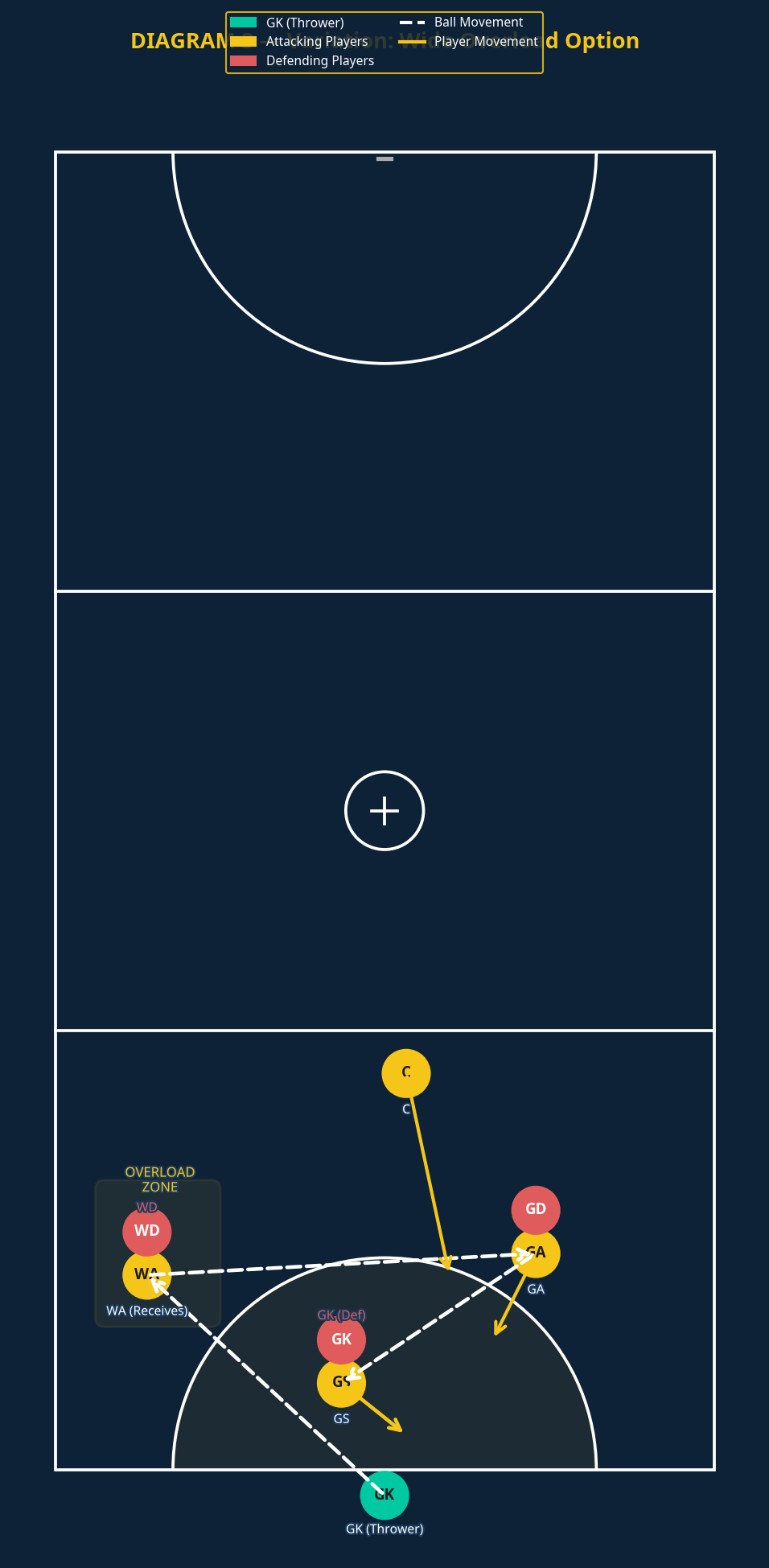
Court Setup: Attacking goal third, taking the throw-in from the baseline near the goal post.
Player Positions:
- GK (Thrower): Positioned on the baseline, ready to take the throw-in.
- GS: Positioned inside the goal circle, holding space near the post.
- GA: Positioned on the edge of the goal circle on the right side.
- WA: Positioned just outside the goal circle on the left flank.
- C: Positioned near the transverse line in the centre corridor.
3. Step-by-Step Instructions
Phase 1: The Initial Setup & First Pass

- The Call: The GK calls the play or gives a visual signal before stepping to the line.
- The Clear Out: As the whistle blows, the WA drives wide to the left flank, drawing the WD away from the circle edge.
- The Lead: The GA makes a sharp, angled drive toward the ball, coming off the edge of the circle to receive the first pass from the GK.
- The Hold: The GS holds their position near the post, keeping the defending GK engaged and preventing them from intercepting the first pass.
Phase 2: The Double-Cut Sequence

- The Catch: The GA receives the ball cleanly on the circle edge and immediately turns to face the post.
- The Baseline Cut: The moment the GA catches the ball, the GS makes a hard, explosive cut along the baseline, moving from the left side of the post to the right side (into the space vacated by the GA's initial drive).
- The Feed: The GA delivers a quick, precise pass into the space for the GS to run onto.
- The Shot: The GS receives the ball close to the post for a high-percentage shot.
- Rebound Support: The WA and C drive to the circle edge to offer support and prepare for any potential rebounds.
Phase 3: Variation - Wide Overload Option

If the GA is heavily marked and cannot receive the first pass, the team shifts to the Wide Overload Option.
- The Wide Release: The GK throws a longer, looping pass to the WA who has driven wide on the left flank.
- The Shift: The GA immediately drives across the top of the circle to receive the second pass from the WA.
- The Baseline Drive: The C drives hard down the centre corridor toward the baseline to create an overload on the right side.
- The Final Feed: The GS cuts to the post as before, receiving the feed from either the GA or the C, depending on how the defense reacts to the overload.
4. Key Coaching Points
- Timing is Everything: The GS must not start their cut until the GA has securely caught the ball and turned. Cutting too early closes the space.
- Strong Holds: The GS must use their body effectively to hold off the defending GK before making the explosive baseline cut.
- Vision on the Turn: The GA must catch and turn in one fluid motion, keeping their eyes up to spot the cutting GS immediately.
- Pass Placement: The feed into the circle must be placed out in front of the GS, leading them toward the post, away from the trailing defender.
- Use the Full 3 Seconds: The thrower (GK) should be patient. Don't rush the first pass; let the movement develop.
5. Common Mistakes
- Crowding the Circle: Players driving into the same space, bringing their defenders with them and clogging the shooting zone.
- Weak First Pass: A loopy or inaccurate first pass from the baseline allows the defense time to reset and intercept.
- Lack of Eye Contact: The GA and GS failing to connect visually, resulting in a missed feed or a turnover.
- Static Shooters: Shooters standing still and waiting for the ball rather than actively working to create separation from their defenders.
6. Variations & Progressions
- Progression 1 (Add Defender Pressure): Start with passive defenders, then progress to full 100% contested defense to test the play under game conditions.
- Variation 1 (The Fake Cut): The GS fakes the baseline cut, stops suddenly, and pops out to the top of the circle, while the GA drives baseline for the return pass.
- Variation 2 (The Screen): The WA sets a screen on the GD to free up the GA for the initial pass.
7. Age Adaptations
- Under 10s / Under 12s: Focus purely on Phase 1. Teach the importance of one player driving to the ball while the other holds space. Keep passes short and direct.
- Under 14s / Under 16s: Introduce the Double-Cut sequence. Focus heavily on the timing of the second movement and the quality of the catch-and-turn.
- Open / Advanced: Implement the Wide Overload Variation. Demand high-speed execution, deceptive eye movements, and precise placement on feeds into the circle.
