Netball
Centre Pass Quick Goal: Overload, Link and Finish
Train a fast, legally sound three-pass centre-pass pattern that creates a clean Goal Shooter receive and shot in under five seconds.
What you need
1 regulation netball, Two goalposts and a full 30.5m x 15.25m court, Attacking and defending bibs, 10–12 flat cones or throw-down lines, Stopwatch or phone timer
Overview
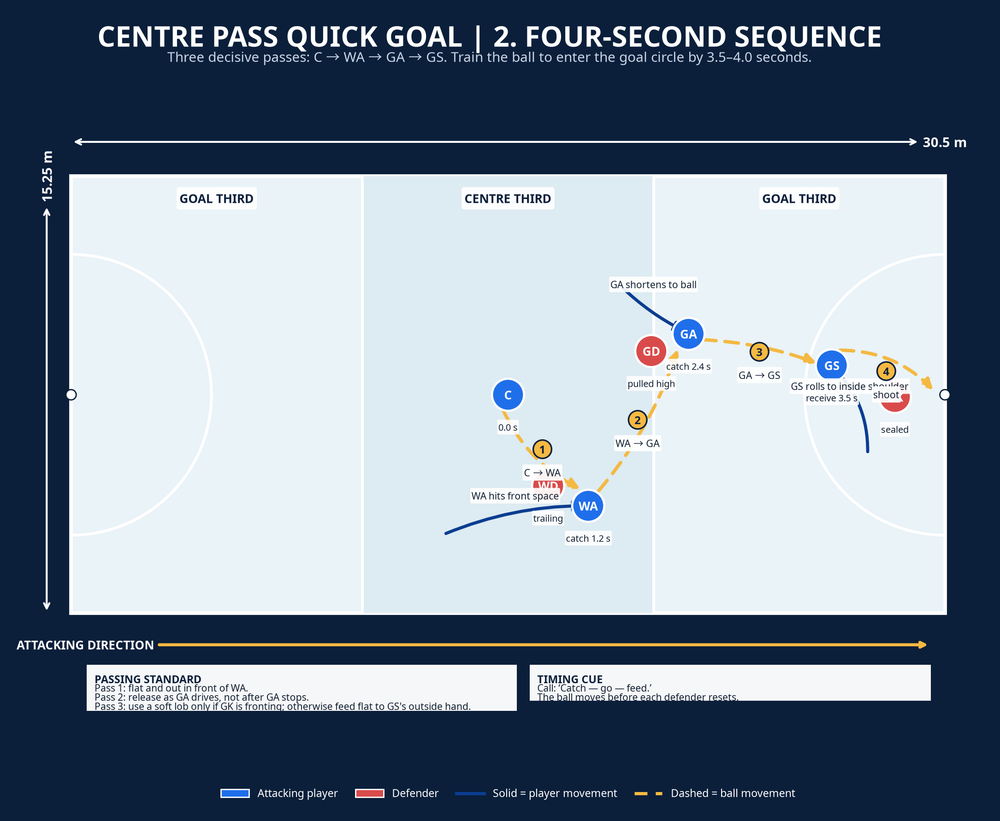
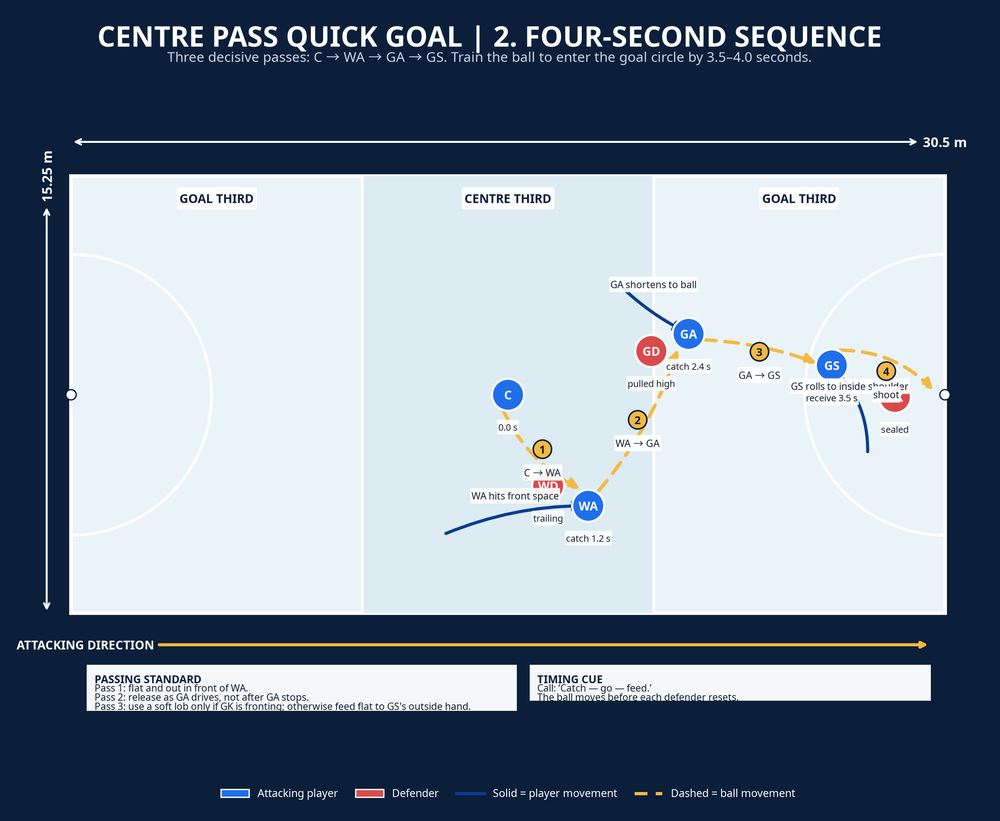
Overload, Link and Finish is a centre-pass set play for producing a clean Goal Shooter receive and a high-percentage shot before the defence has settled. It uses a sharp Wing Attack front cut, a delayed Goal Attack link, and a Goal Shooter seal-and-roll to move the ball from the centre circle to the goal circle in three decisive passes. The performance target is simple: the ball enters the goal circle in 3.5–4.0 seconds, with the shot released inside five seconds of the umpire’s whistle.
Use this play after a goal, at the start of a quarter, or against a side that sits high to deny the first centre pass. A regulation court is 30.5m x 15.25m, divided into three equal thirds of about 10.17m. The 0.9m centre circle and 4.9m-radius goal circles give you fixed landmarks for the movement pattern.1 The aim is to make defenders cover width and depth, rather than letting them collapse on a predictable central route.
Coach’s outcome: C finds WA in front space, WA releases GA in stride, and GA feeds GS after GD has been drawn up from the circle edge.
Setup
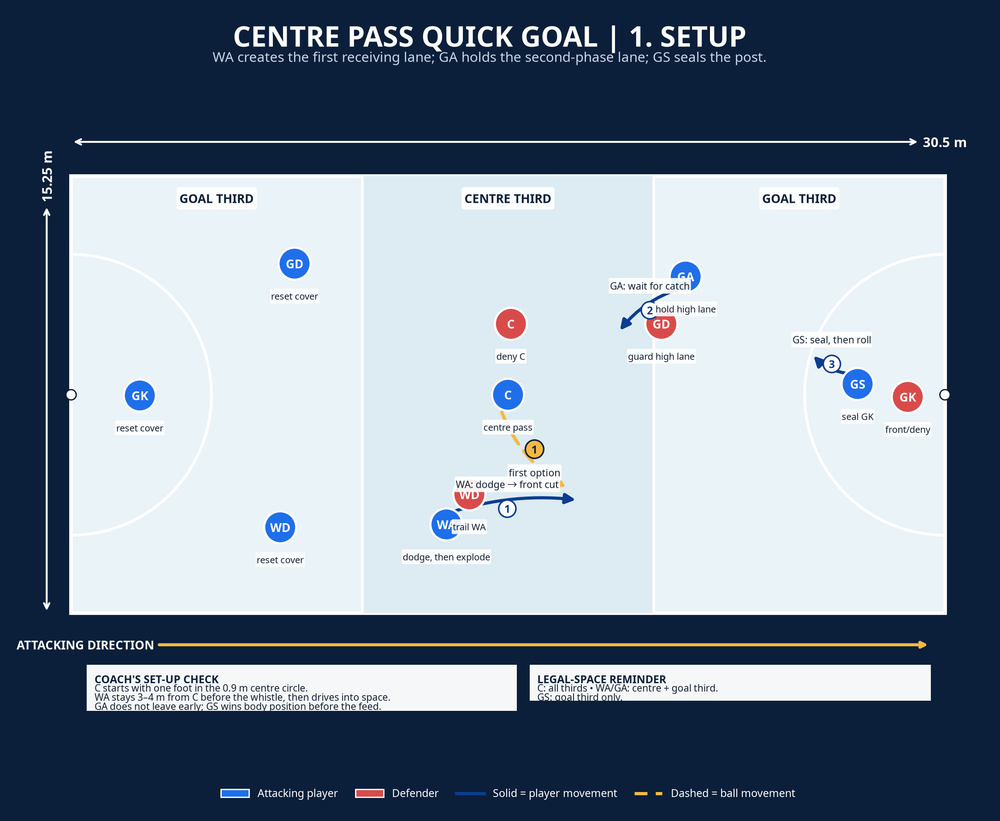
Use a full court, two goals, a regulation netball, bibs, 10–12 flat cones, and a stopwatch. Begin with seven attackers against WD, GD and GK, then add the defending C and remaining defenders when the timing is reliable. In this resource, 1 = C, 2 = WA, 3 = GA and 4 = GS are teaching cues; players retain their standard position bibs.
| Player | Exact start point | Job at the whistle |
|---|---|---|
| 1. C | One foot grounded in the centre circle, body facing the attacking end. | Scan WA, then GA; pass into the runner’s front space. |
| 2. WA | 3–4m wide of C and 2–3m toward the attacking transverse line. | Dodge away, then cut hard into a 2.5m front lane. |
| 3. GA | 2–3m inside the attacking goal third, 4–5m wide, near the transverse line. | Hold high until WA catches; then link down and inward. |
| 4. GS | Inside the goal circle, 1–1.5m off the post on the strong side. | Seal GK, then roll into the receiving window. |
Build legal movement into every repetition. C may use all three thirds but not either goal circle; WA may use the centre and attacking goal third but not the goal circle; GA may use the centre and attacking goal third including the goal circle; GS is restricted to the attacking goal third including the goal circle.2
Step-by-Step Instructions
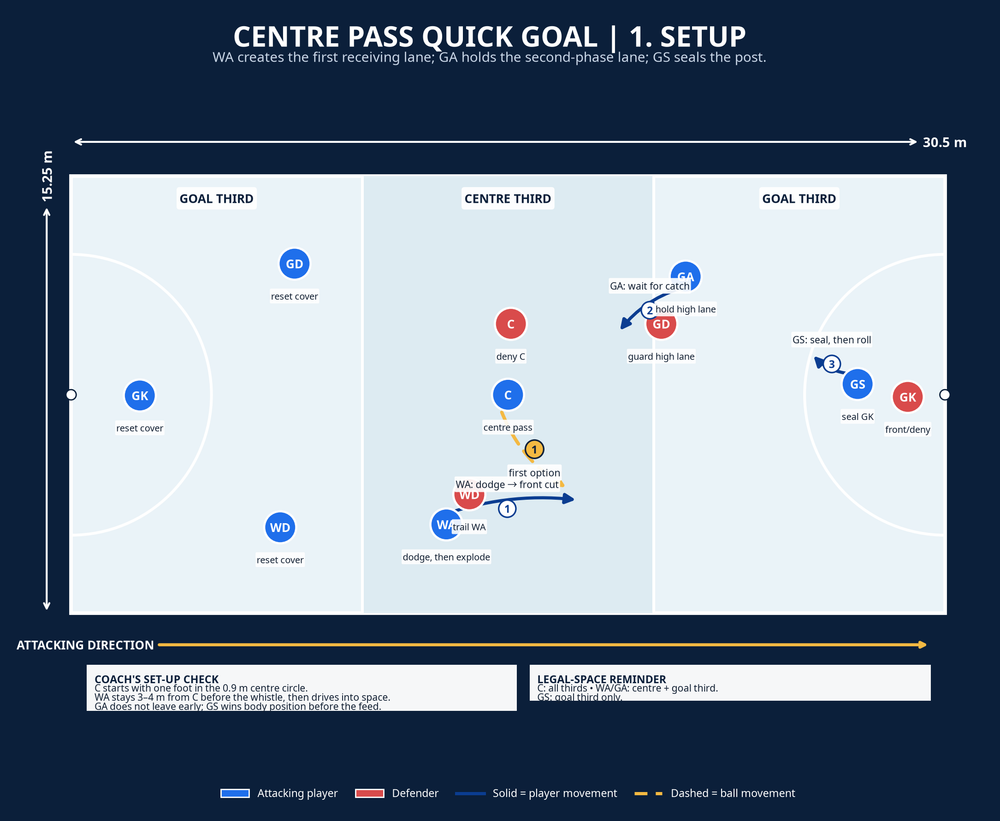
Call and trigger. Before the whistle, C calls the set, for example “Fire.” WA holds WD for one count; GA remains high; GS makes controlled body contact and keeps the post-side shoulder free. When the whistle goes, C steps into the pass and reads WA’s front space.
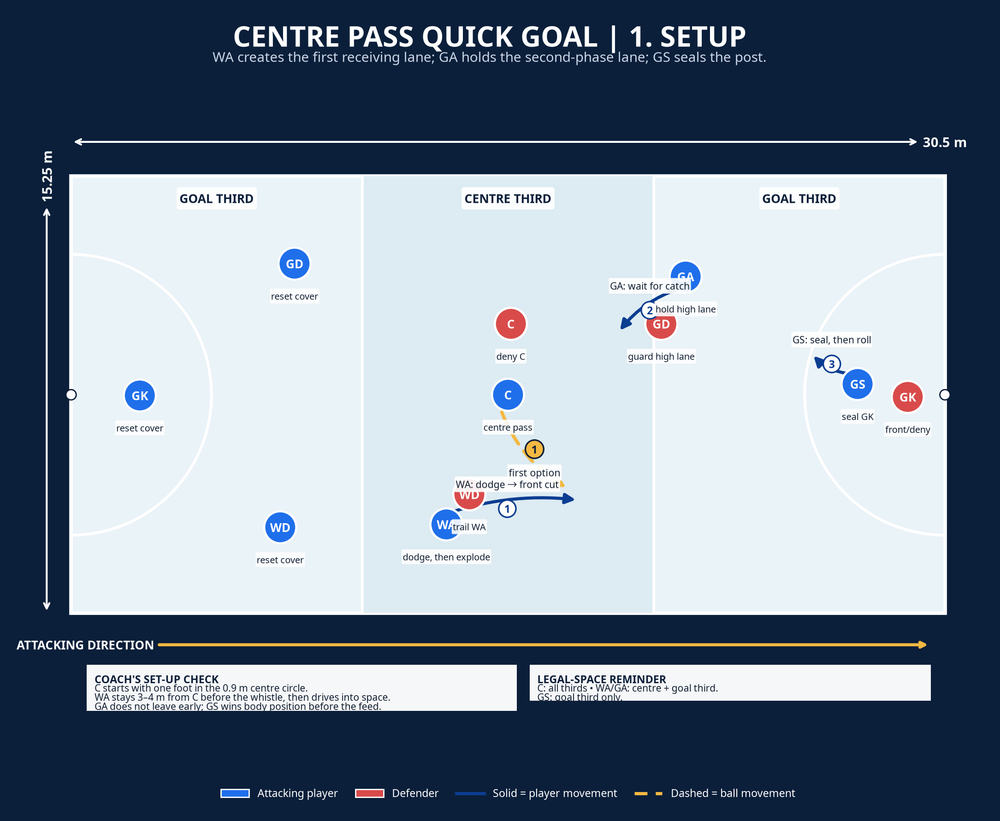
WA wins the first lane. From 0.0–0.8 seconds, WA uses a two-part movement: one short step away from the desired route to shift WD, followed by an explosive diagonal front cut. WA should not run sideways. Coach a shoulder-height catch, late hands, and a landing position that lets WA turn toward GA immediately.
C leads the pass. From 0.8–1.2 seconds, C delivers a flat chest or shoulder pass 3–4m in front of WA. The ball must lead WA into the centre third, not stop them under it. C follows two controlled steps as the safety outlet, but never drifts into WA’s driving lane.
GA links on the catch. GA waits until WA has secured the ball, then drives down and slightly inward from the high attacking lane. From 1.2–2.4 seconds, WA releases GA in stride toward the first 2–3m of the goal third. This delay is crucial: GD is pulled high, leaving a better window for the final feed.
GS seals and rolls. As GA receives, GS holds GK long enough to stop a clean step across the ball line. On GA’s first stable look, GS rolls to a 1–1.5m receiving window near the circle edge. GA feeds the outside hand flat if GK is behind or beside; use a controlled lob only when GK is clearly fronting.
Finish or reset. GS lands balanced and shoots. If GA cannot see a safe feed by 3.5 seconds, call “reset” and return the ball to WA or C. The quick goal is the first option, not a licence to force a circle pass. Repeat from both sides of the court.
Run it as a 25-minute coaching block
| Time | Organisation | Coach focus |
|---|---|---|
| 0–4 min | Walk through positions, then add the whistle trigger. | Legal areas, starting distance and WA’s preliminary step. |
| 4–10 min | 4v0: C, WA, GA and GS execute from both sides. | Pass in front, catch-and-go and the 4-second target. |
| 10–17 min | 4v3: WD, GD and GK defend at 50–70%. | Read pressure rather than memorise the route. |
| 17–25 min | 7v7 conditioned game; bonus point for a shot inside five seconds. | Reset discipline and match-tempo decision-making. |
Key Coaching Points
| Point | Coach language | Standard to see |
|---|---|---|
| Win space before speed | “Move them first; then move yourself.” | WA shifts WD before the front cut. |
| Lead every pass | “Pass to where the runner will be.” | Ball arrives in front of WA and GA. |
| Delay GA | “Catch—go.” | GA is not sprinting before WA secures it. |
| Keep one lane each | “Do not bring your defender to the ball.” | WA and GA have at least 2m separation. |
| Hold before rolling | “Seal, see the ball, then release.” | GS moves only when GA is stable. |
| Protect possession | “Quick is not rushed.” | A covered feed becomes a safe reset. |
Common Mistakes
| Error | Why it fails | Immediate correction |
|---|---|---|
| WA runs a straight line. | WD stays on the ball line. | Require a dodge, then a front cut. |
| C passes behind WA. | WA loses momentum and WD recovers. | Put a cone 3m ahead of WA; pass beyond it. |
| GA leaves early. | GD clogs the first goal-third lane. | Repeat the verbal cue “catch—go.” |
| GS rolls too soon. | GK closes the feed window. | Hold contact until GA receives and looks up. |
| GA forces the final feed. | Possession is lost under pressure. | Reward the reset in scoring. |
Variations & Progressions
For a corridor progression, mark a 2.5m WA lane and a 3m GA link lane with flat cones. Go 4v0 first, impose a six-second shot target, and stop the action whenever a player enters an illegal area. The visual channels give younger players a map before speed is added.
For a pressure progression, move to 7v7 and let WD and the defending C overplay the first WA lane. C must decide whether the front cut remains available or whether the safe reverse option is better. Award two points for a shot inside five seconds and one point for retaining possession after the original quick-goal option is denied.
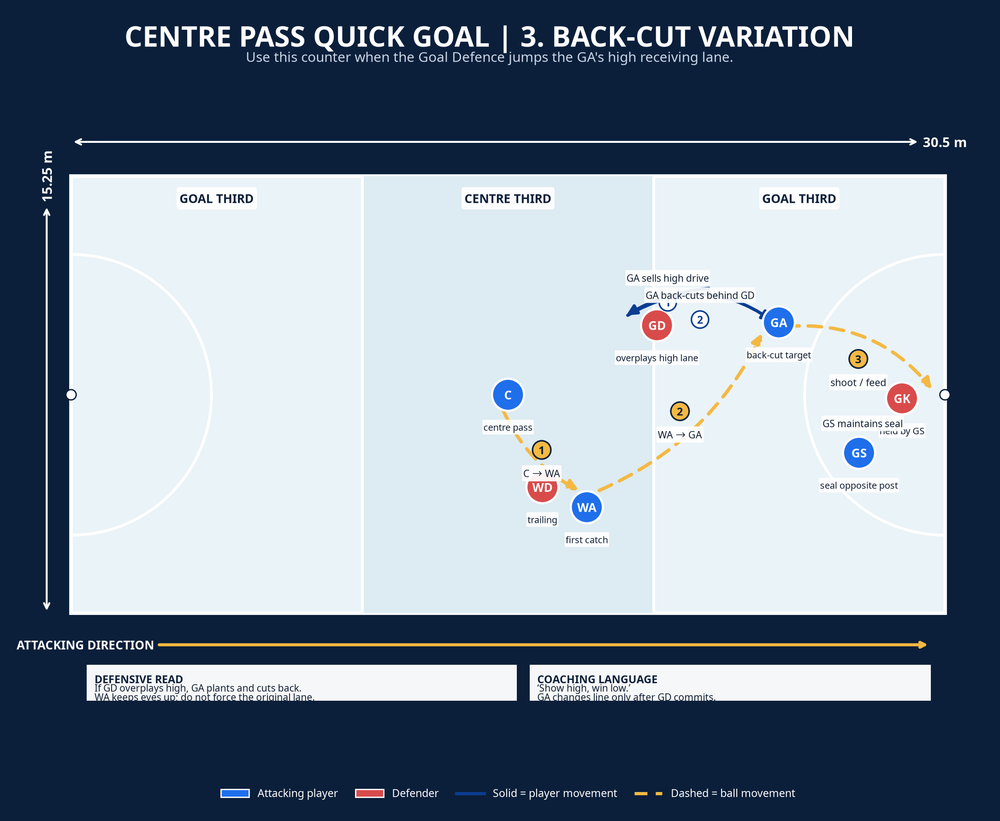
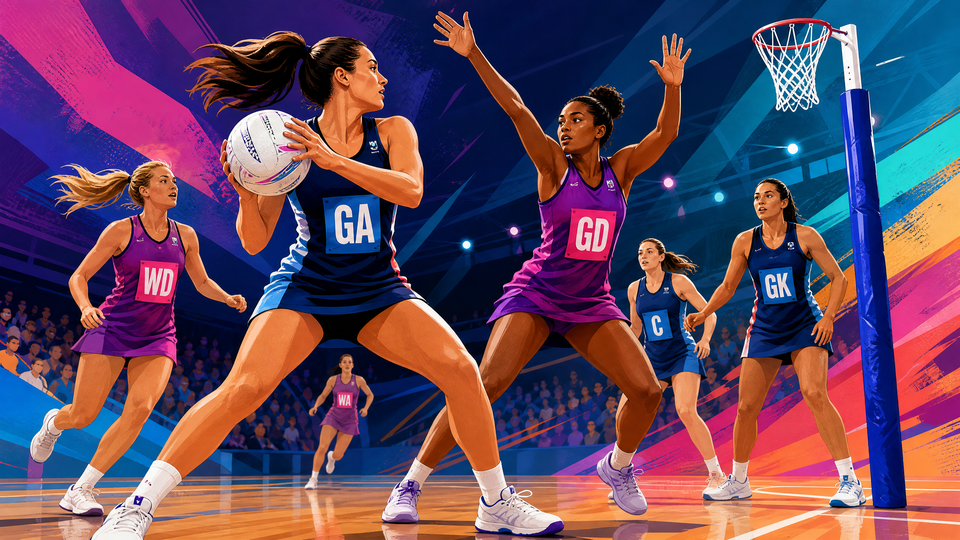
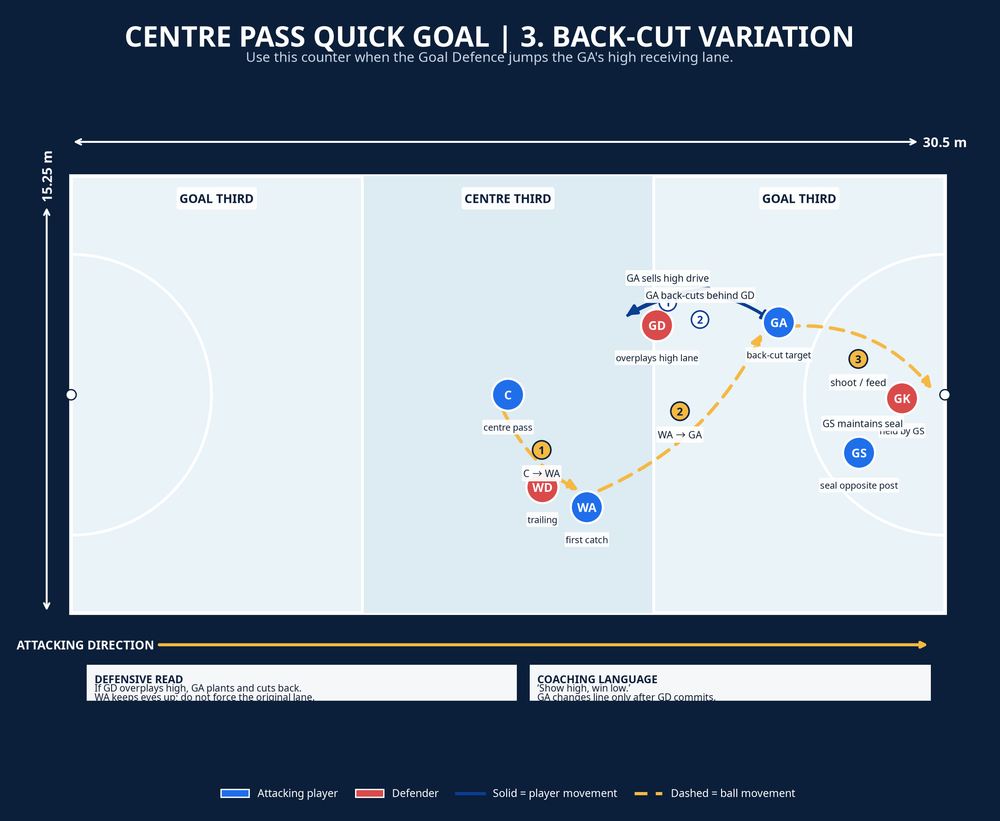
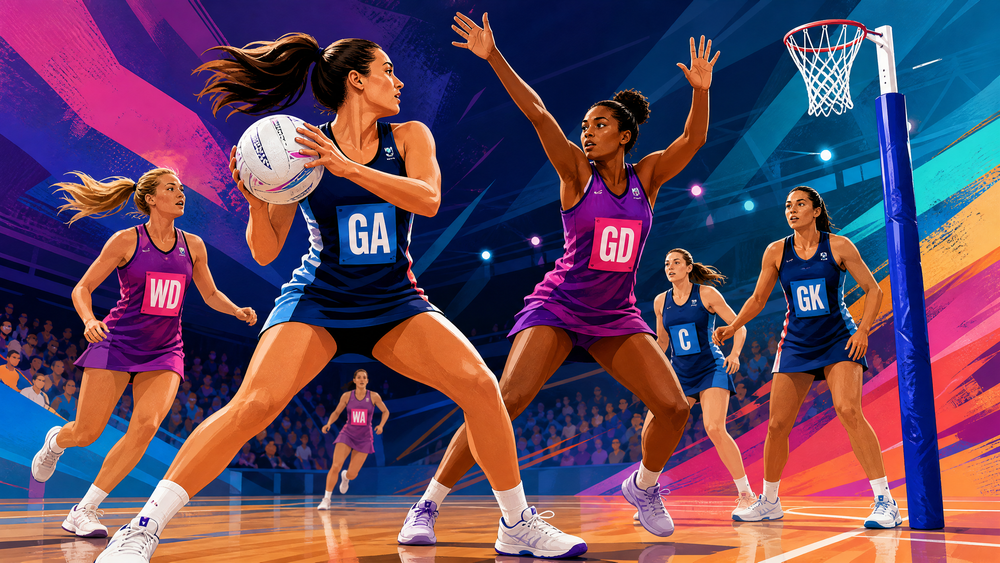
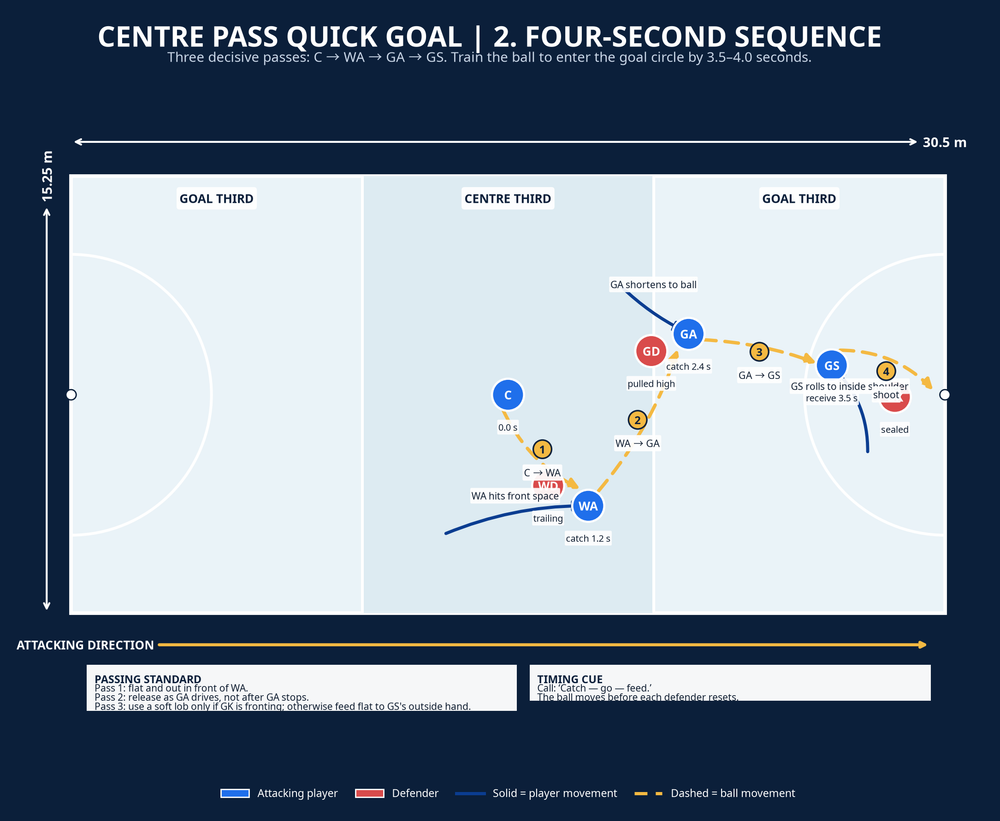
Use the Back-Cut Variation when GD jumps the high GA lane. GA sells the same high drive, plants the outside foot as GD commits, then cuts back toward the circle edge. WA keeps eyes up and delivers to the new line rather than forcing the original pass. The call is: “Show high, win low.”
Age Adaptations
| Age group | Adapt the task | Non-negotiable priority |
|---|---|---|
| Under 8 | Use a 15m x 10m channel, two passes, no defenders and a stationary GS target. | Safe catching, stopping and seeing a teammate. |
| Under 10 | Use two-thirds with C, WA, GA and GS; add passive WD and GK. | Dodge-and-drive timing and correct playing areas. |
| Under 12–14 | Use the full sequence against 50–70% pressure and time the ball into the circle. | Passing in front and delaying GA. |
| Under 16 / Open | Use full 7v7, an active defensive C, a live back-cut and a reset option. | Reading defenders and finishing under pressure. |
Final coach checklist
Run the play from both attacking sides and demand the same movement quality after a missed shot or turnover. Your core measure is that the ball moves faster than the defence can reorganise, while each player remains balanced enough to make the next decision.
References