Centre-Pass Quick Goal: WA Wide, GA Sweep, GS Front-Cut
A repeatable three-pass centre-pass pattern that creates an early goal-scoring feed before the opposition goal defence can organise the circle.
Equipment Needed
Overview
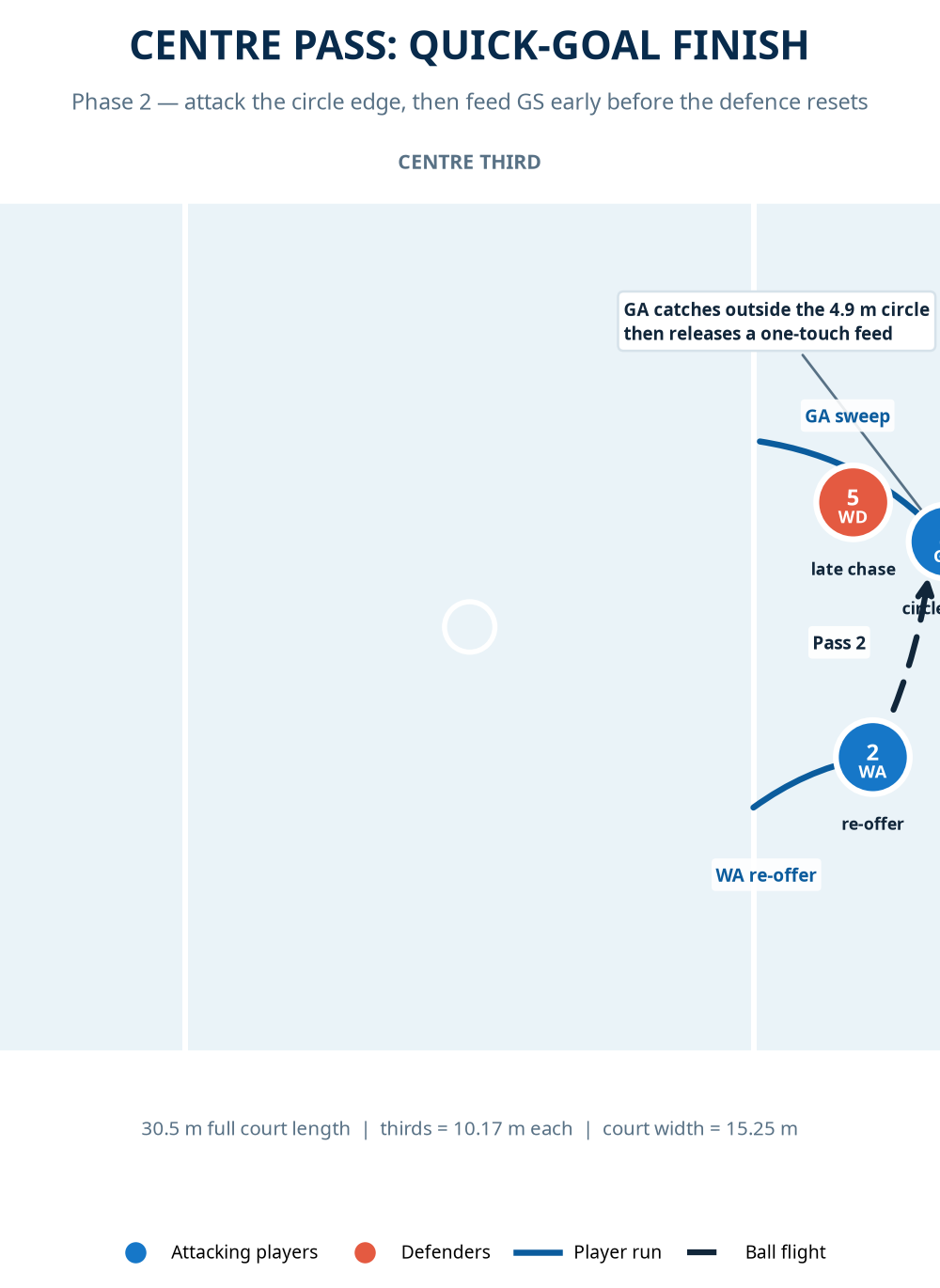
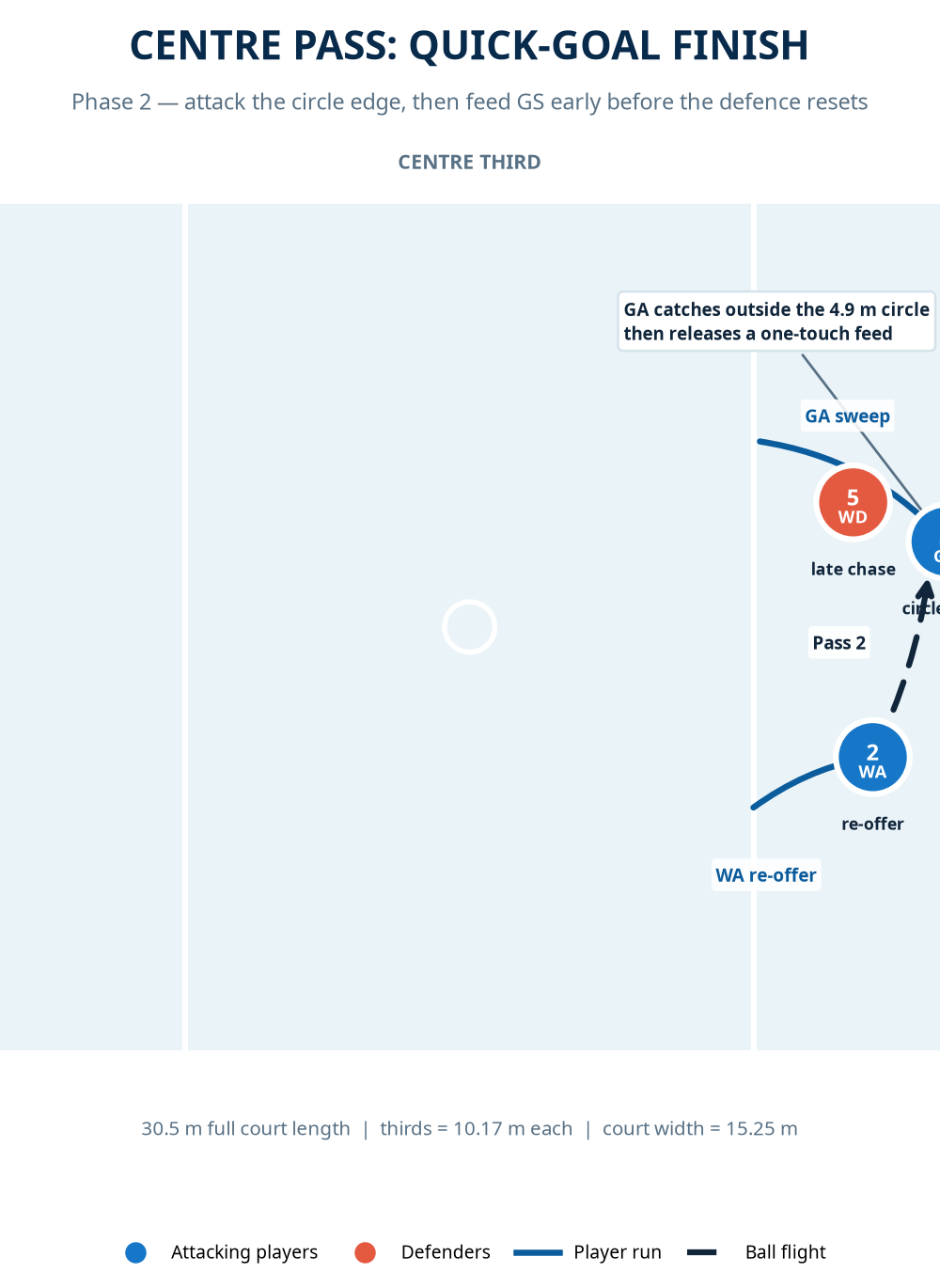
This Centre-Pass Quick Goal is a high-tempo, three-pass attacking pattern: C → WA → GA → GS. Its purpose is to make the first clean receive outside the centre circle, move the ball through the centre third without a second contested catch, and deliver a front-shoulder feed to the Goal Shooter before the goal defence and goal keeper have reset their circle shape. Use it after a goal or when the Wing Defence overplays the middle lane.
The play is not about throwing long; it is about winning the first metre. Your WA sprints wide early, your GA delays then sweeps into the channel, and your GS times one sharp lead across the defender’s front shoulder. On a regulation court, the side lines are 30.5 m long, the goal lines are 15.25 m, and the transverse lines divide the court into three equal thirds of approximately 10.17 m. The centre circle is 0.9 m in diameter and each goal circle has a 4.9 m radius.[1]
Success standard: from the centre-pass whistle to shot release in 6–8 seconds, using three purposeful passes and no static receiver.
Setup
Set this up on a full court. Use attackers 1 C, 2 WA, 3 GA and 4 GS against defenders 5 WD, 6 GD and 7 GK. These are standard positional initials recognised in the World Netball rules.[1] Begin with the C in the centre circle, WA one metre to the open-side of the circle, GA high and slightly opposite the WA, and GS at the circle edge in the attacking third. Put the WD on the WA’s inside shoulder, GD between GA and GS, and GK goal-side of GS.
| Item | Detail | Coach’s check |
|---|---|---|
| Court | 30.5 m × 15.25 m; thirds at 10.17 m | Mark the open-side lane with two flat cones, 3–4 m beyond the centre circle. |
| Ball and bibs | 1 match ball; two bib colours | Attackers in blue, defenders in contrast. |
| Entry lanes | WA wide lane; GA sweep lane; GS front-cut lane | Keep lanes at least 2 m apart so the defenders cannot mark two options with one body. |
| Work block | 18 minutes | 3 minutes walk-through, 8 minutes guided reps, 7 minutes live pressure. |
Starting Shape and Call
Call the play “Flash Three” before the centre pass. The C gives a closed fist, then opens the hand toward the chosen side. That signal tells WA which outside lane to win; GA and GS stay neutral until the C releases the first ball. Coach the players to start in a balanced athletic stance, not on their heels. The C’s eyes should go to WA first, then to the space WA is vacating—not straight at the body of the defender.
Step-by-Step Instructions
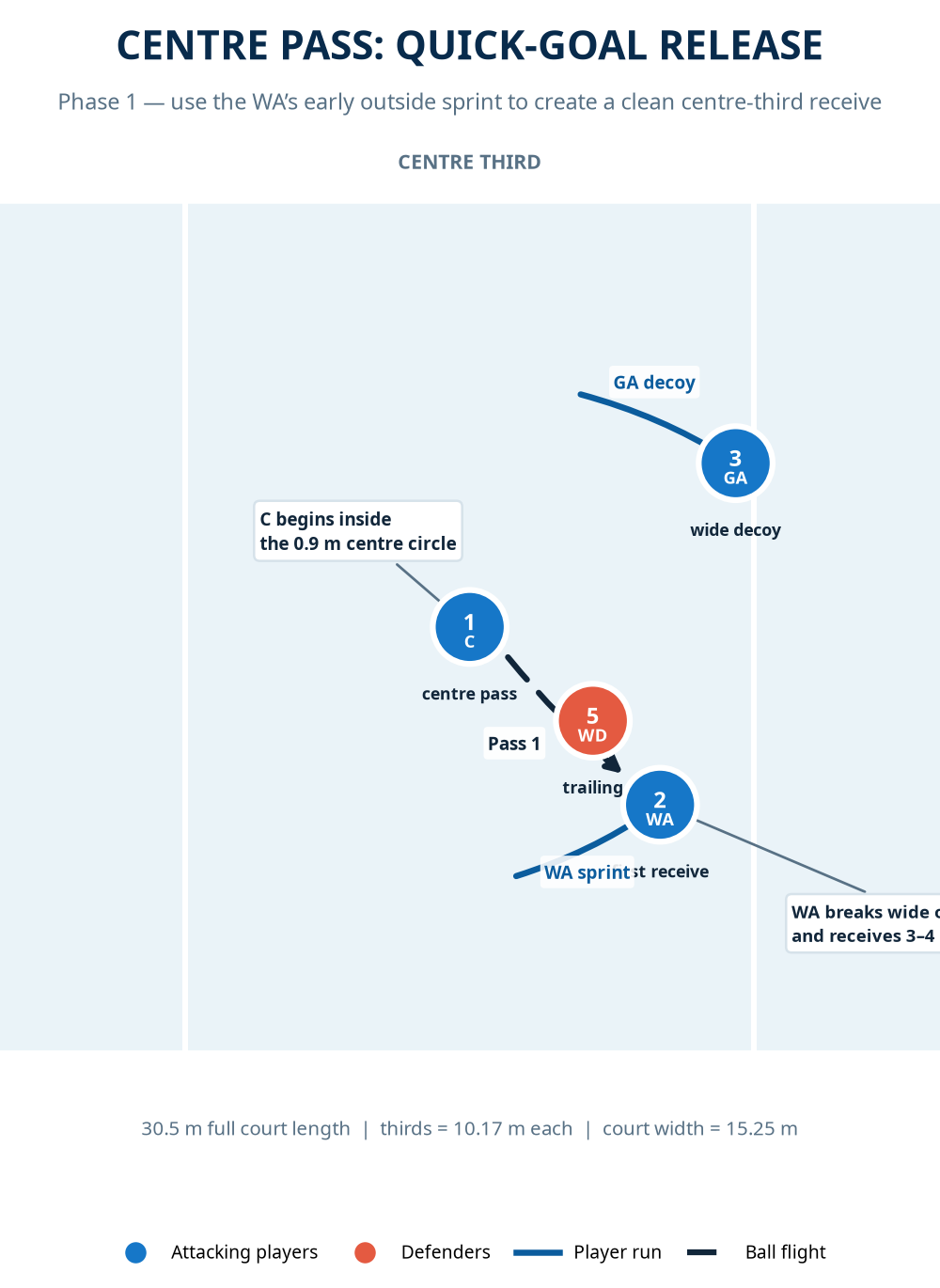
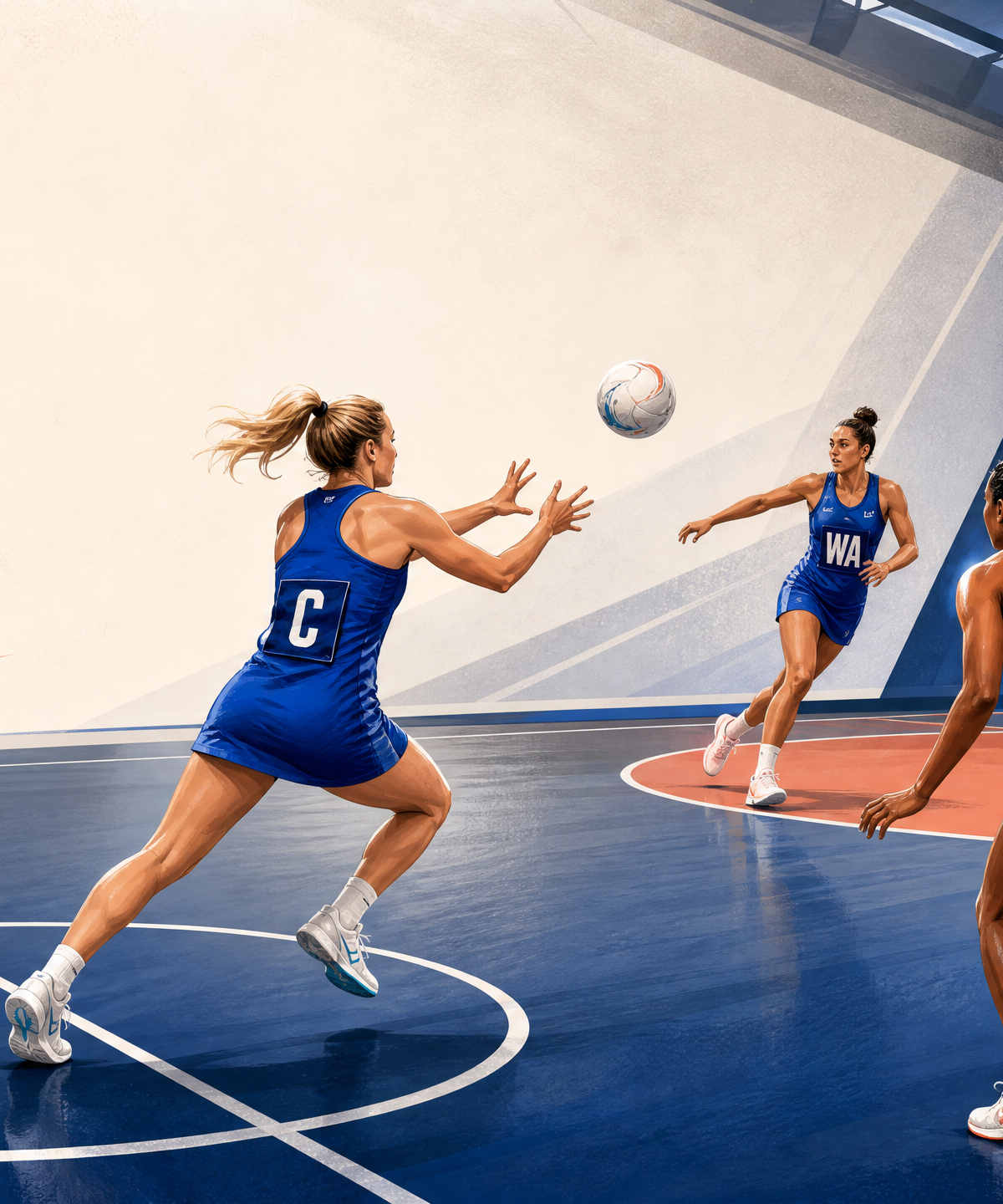
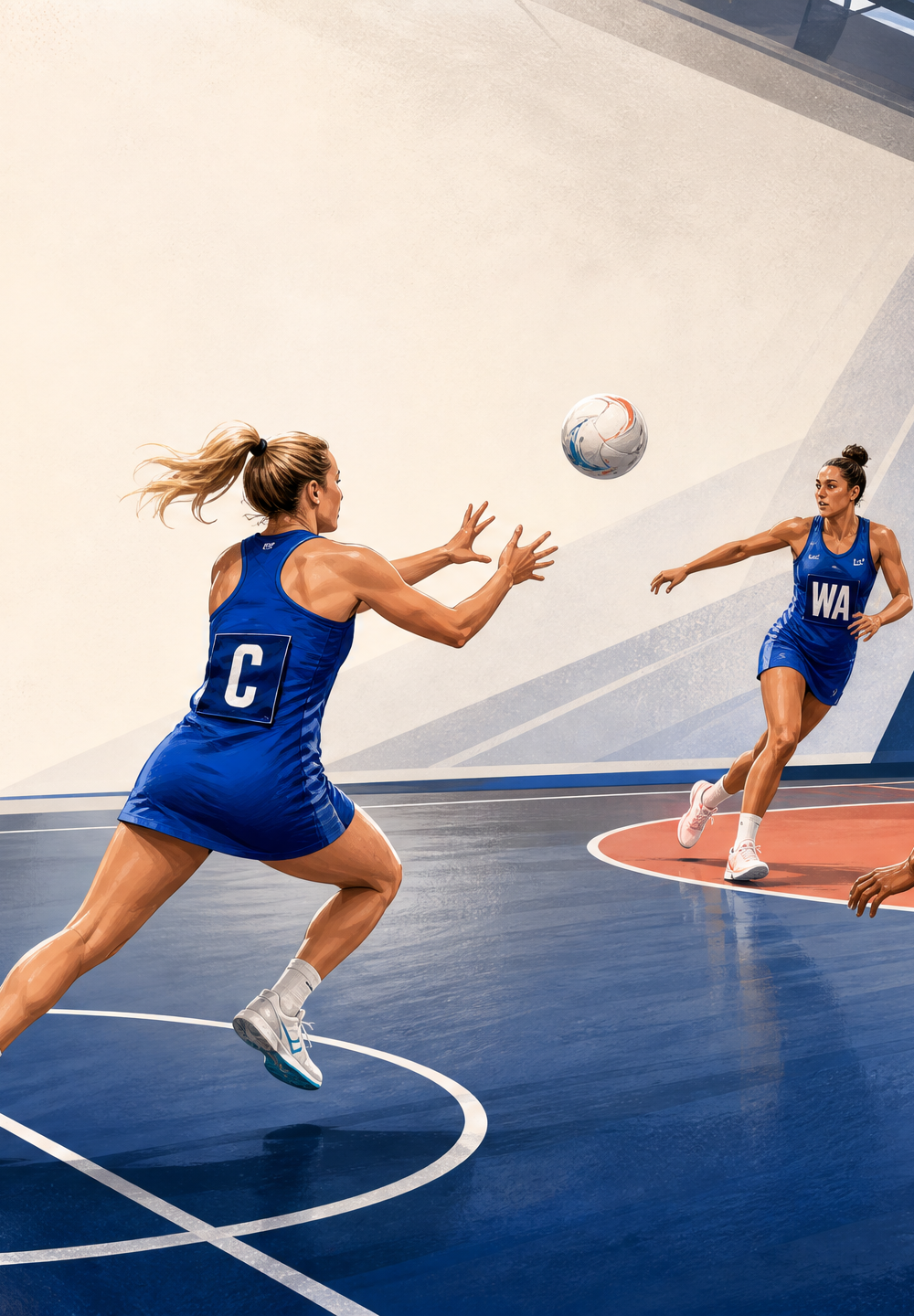
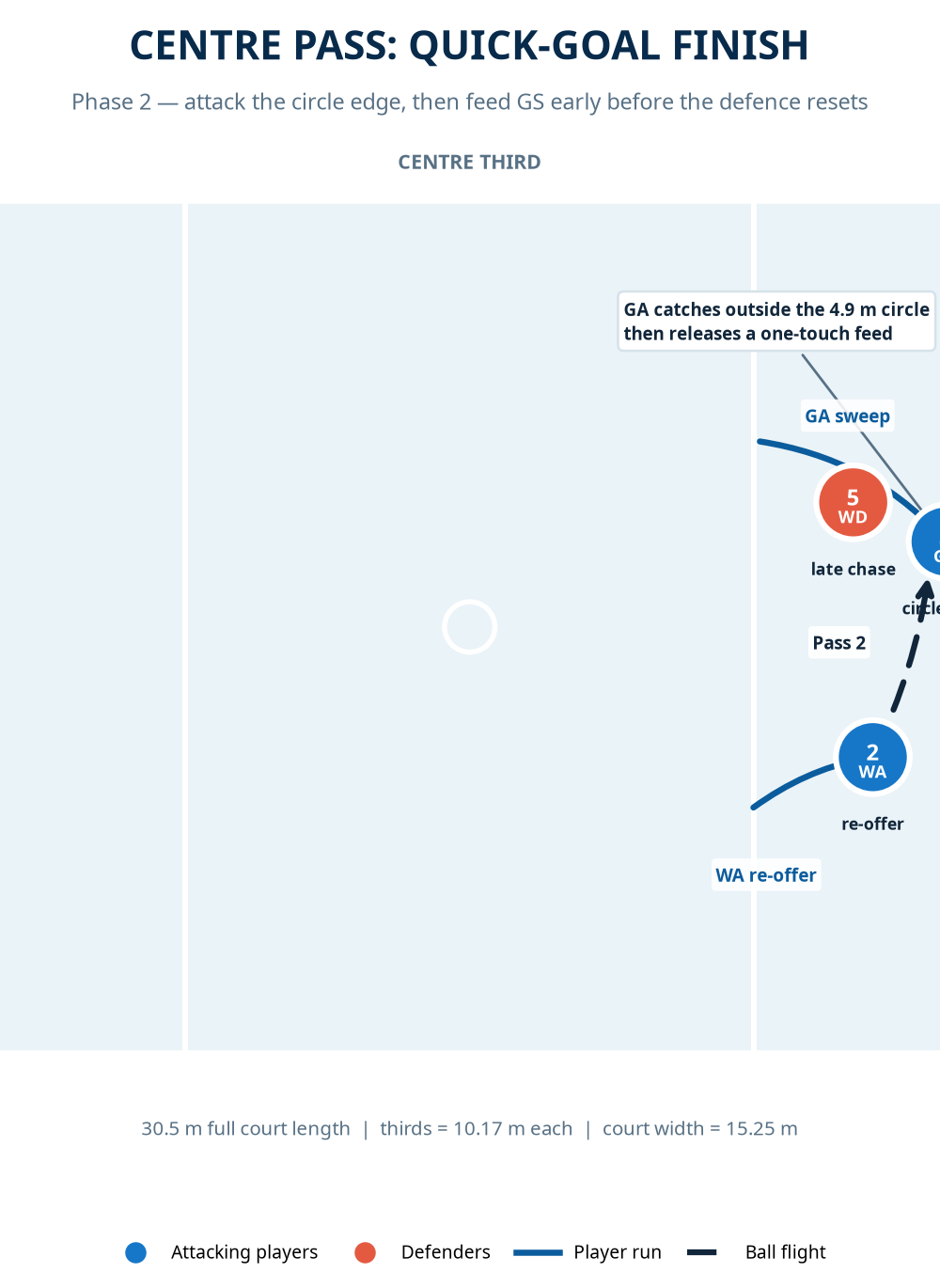
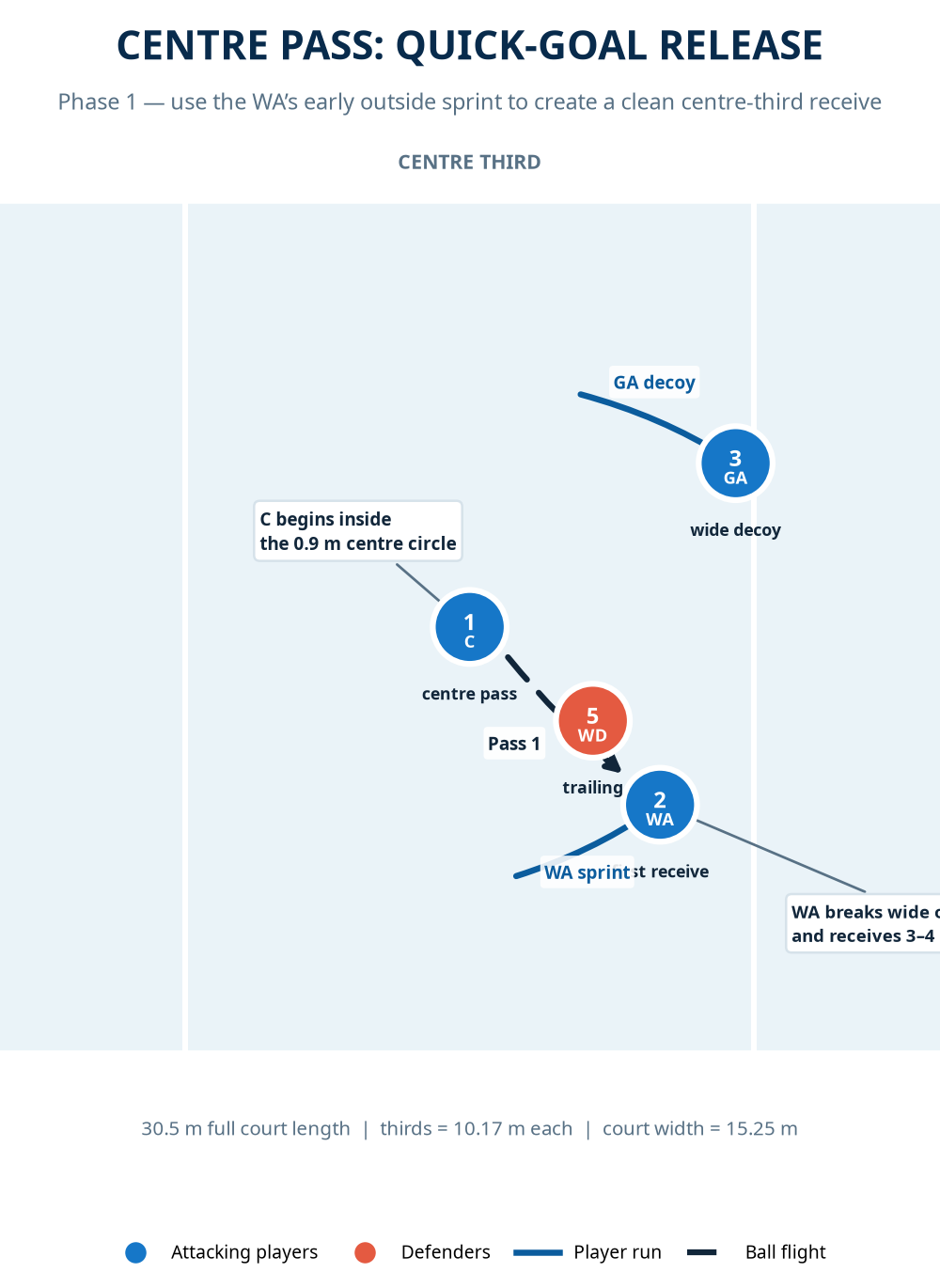
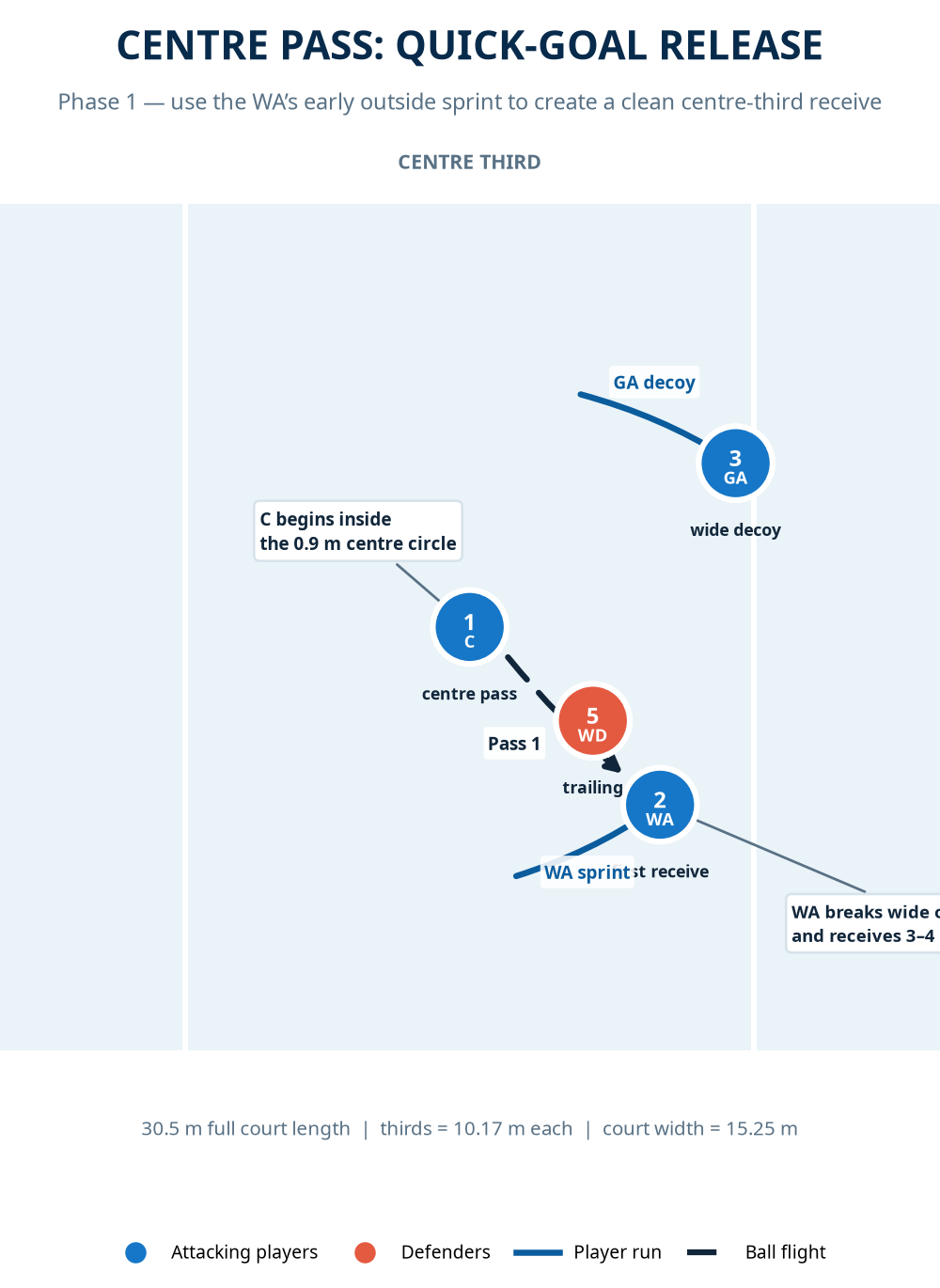
Create the release picture. On the whistle, C stays composed in the centre circle and brings the ball to a strong passing window. WA takes one deceptive step toward the middle, then explodes into the nominated outside lane. The aim is to catch 3–4 m beyond the centre circle and at least 1.5 m clear of WD.
Deliver Pass 1 early. C releases to WA within 1.5 seconds of the signal. The pass should lead WA’s outside shoulder, not arrive behind the runner. Demand a firm chest-height or shoulder-height pass that travels in front of WA so the receiver can land facing the attacking end. C immediately supports through the middle for the reset option, but does not crowd WA’s lane.
Use GA as the delayed second wave. As WA receives, GA holds for roughly half a second, then sweeps diagonally from the opposite channel toward the attacking third. This delay separates GA from WA and moves GD’s eyes from GS. GA’s target is the circle edge, about 1–2 m outside the 4.9 m goal-circle line, with hips already open to the post.
Move the second ball on the catch. WA lands balanced, checks GA’s timing, and sends Pass 2 into GA’s forward space within two seconds. Do not let WA over-carry. If GA is covered, WA uses C as a one-pass safety outlet and immediately re-offers; the shape survives better with a reset than with a forced ball.
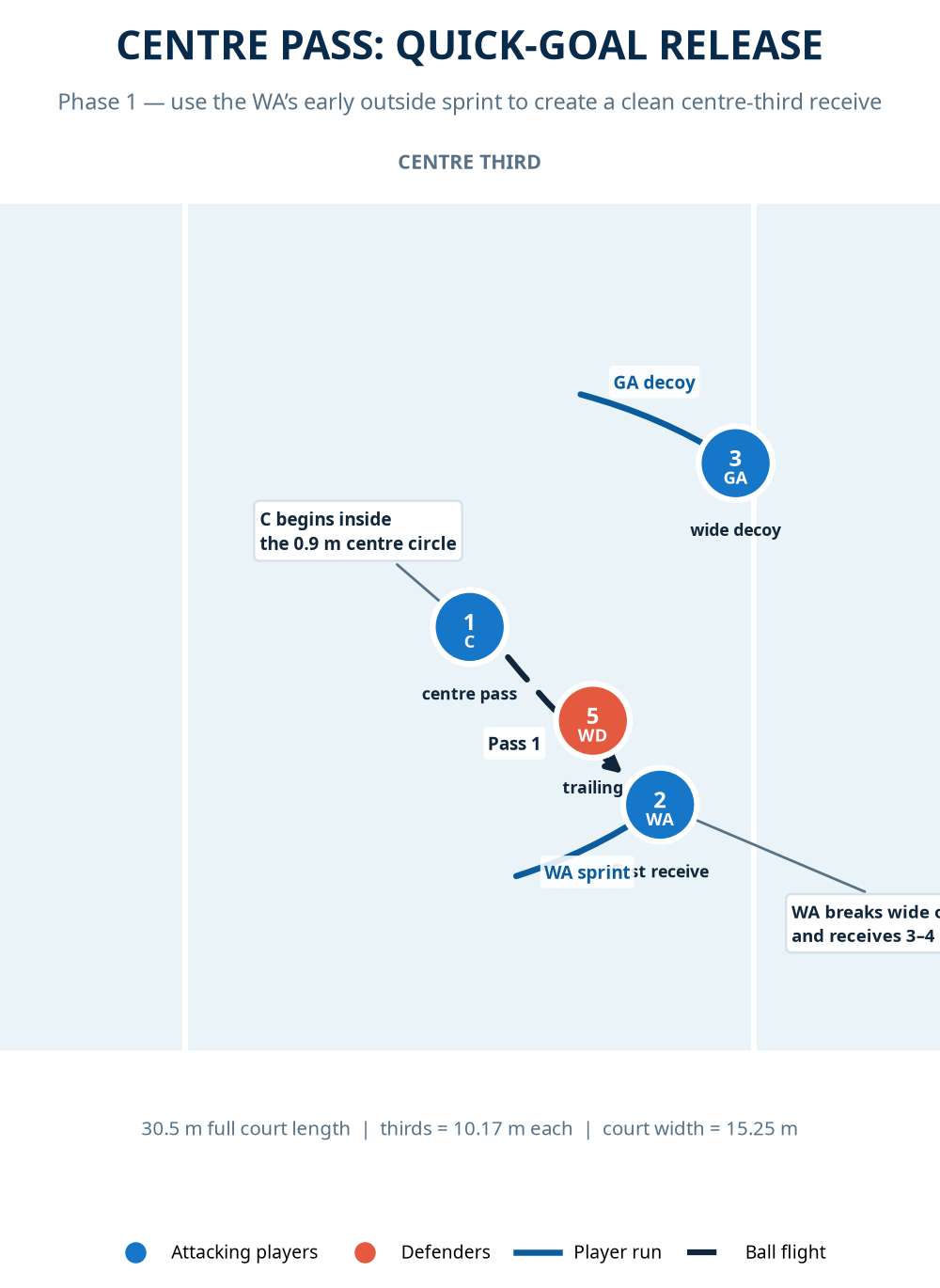
Finish through the front shoulder. GS waits until GA has the ball, then leads sharply across GK’s front shoulder toward the post. GA feeds the space in front of GS, not the defender’s hands. The target is a catch inside the circle, approximately 1.5–2.5 m from the post, with GS landing side-on and shooting in rhythm. Keep the standard: first lead, first feed, first shot.
Rehearse the reset. After every shot, jog the ball back to centre and repeat from the opposite side. Run six unopposed reps—three each side—then add WD, then GD/GK. Finish with a competitive block: one point for a clean shot in three passes, two points if the shot is released before eight seconds.
Key Coaching Points
- Win width before speed. WA’s first two steps must get outside the defender’s line; a fast run straight into traffic does not create a passing window.
- Pass to the space, not the bib. The C and WA should lead runners forward so every catch gains court.
- Delay creates separation. GA’s half-second hold is the trigger that turns a crowded middle into a usable circle-edge channel.
- Land facing the next action. WA faces the attacking end; GA catches with eyes on the GS lead; GS lands balanced for the shot.
- Keep the circle uncluttered. GA holds outside until feeding; GS is the only blue bib attacking the post on the final ball.
- Coach the clock. Call out “one”, “two”, “three” for passes, then “shot” so players learn the speed of the pattern without rushing the decision.
Common Mistakes
| Error to watch | What it causes | Immediate correction |
|---|---|---|
| WA runs before creating a change of direction | WD tracks the straight line and contests Pass 1 | Rehearse one hard inside decoy step, then a 45-degree wide sprint. |
| C throws at a stationary WA | A floating or intercepted first ball | Demand release to the outside shoulder at the moment WA accelerates. |
| GA leaves too early | WA and GA occupy the same channel | Use the cue: “WA catches, GA goes.” |
| GS leads before GA has control | GK can hold position and GD sees the final option | Make GS wait for GA’s catch, then explode across the front. |
| Players force the final feed | Turnover at the top of the circle | Reward the C reset; a fourth pass is better than a speculative third. |
Variations & Progressions
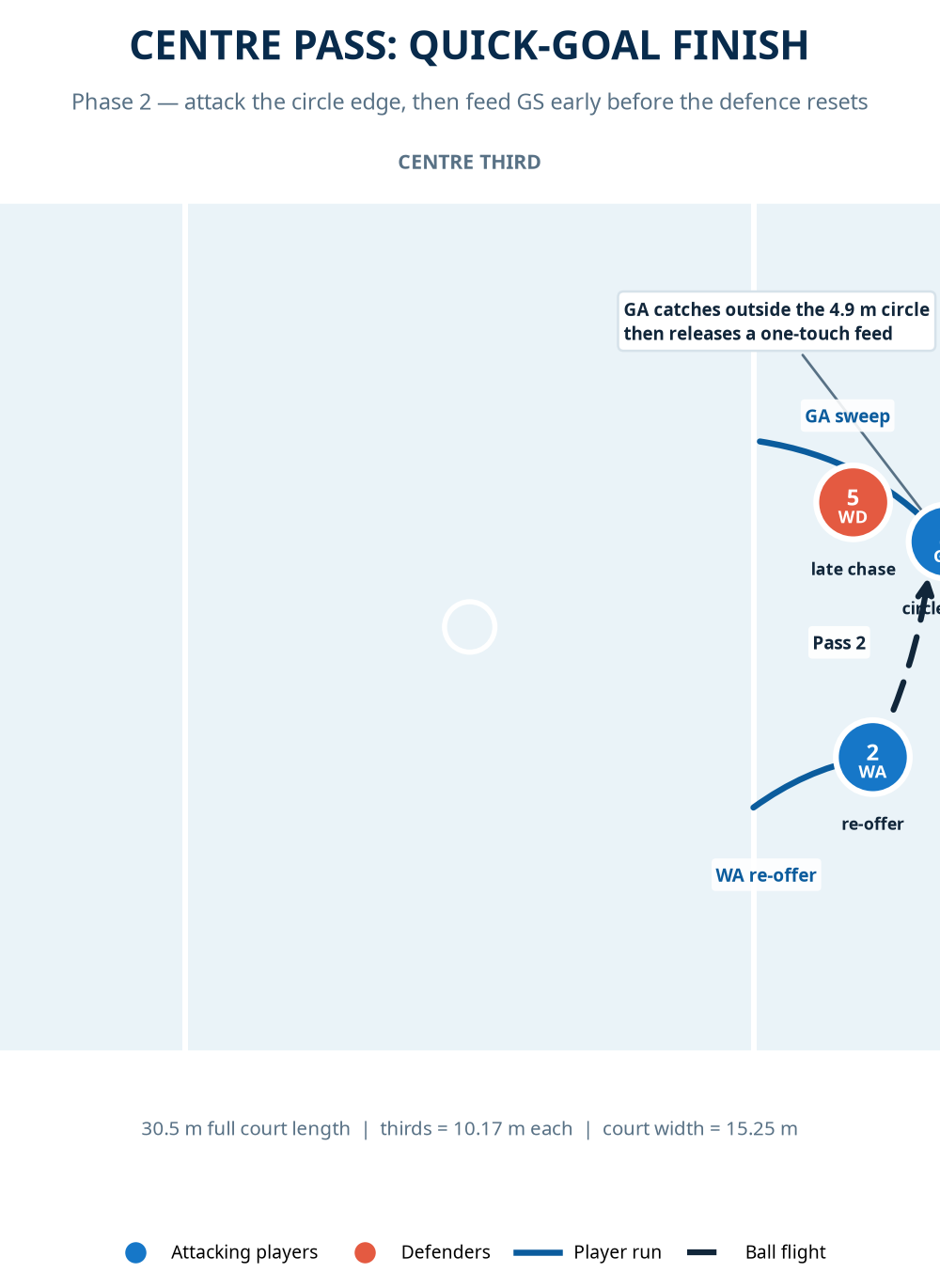
Start with the two-pass scoring variation if your GS is dominant: C hits WA, and WA feeds GS directly after the GS front-cut. This is useful against a late GD but should not become the default if it encourages a hopeful long ball.
For the inside-switch variation, send WA wide as usual but ask GA to check hard toward the centre before sweeping back to the circle edge. Use it when GD jumps the obvious sweep lane. Keep the same GS front-cut; only GA’s first movement changes.
Progress from walkthrough to live pressure. First, use passive defenders who shadow but do not intercept. Next, allow WD to contest only Pass 1. Finally, release all three defenders and give the attack two choices: complete Flash Three or reset safely through C. Track clean first receives, shots inside eight seconds, and turnovers, then coach the weakest metric rather than simply adding more speed.
Age Adaptations
| Age group | Adaptation | Coaching priority |
|---|---|---|
| Under 8 | Use a half-court picture with C, WA and GS; remove defenders. | Wide running and catching in two hands. |
| Under 10 | Keep GA but allow a fourth safety pass and start 2 m closer together. | Spacing and landing balanced. |
| Under 12–14 | Use the complete pattern with a passive WD, then add GD/GK. | Timing the GA delay and GS front-cut. |
| Under 16/Open | Use full live defence, a seven-second target and opponent-specific calls. | Reading the defender, choosing reset versus final feed. |
Finish every session with two video-free questions: “Where did we create the first metre?” and “What told GA or GS it was time to go?” If players can answer both, they understand the pattern rather than merely memorising their route. The 2024 World Netball rules resources should remain your reference for current centre-pass, contact and playing-the-ball interpretations.[2]
References