

Netball
Centre Pass Variations Drill: Three Patterns to Break Any Defence
Master three distinct centre pass patterns — Wing Attack Lead, Goal Attack Baseline Drive, and Double Lead with Centre Drive-Through — to give your team a decisive edge from every restart.
What you need
netball, coloured bibs (two sets), 4 flat cones, whiteboard or coaching clipboard, stopwatch
Overview
The centre pass is the single most repeated set piece in netball. On a standard 30.5m × 15.25m court, your team will execute a centre pass after every goal — which in a competitive match can mean upwards of 40 opportunities per game. Yet many teams rehearse only one pattern, making them entirely predictable to any organised defence. This drill trains your attacking unit to execute three distinct, interchangeable centre pass variations with the same starting shape, so that the defending team cannot read the play until the ball is already in motion.
Use this drill in the middle phase of your training session, after a thorough warm-up and before any full-court conditioned games. It is equally effective as a pre-match activation routine for experienced squads who simply need to sharpen their timing and decision-making. The drill is designed for 8–14 players (one full attacking unit plus a partial defending unit) and runs for approximately 35–40 minutes including debrief.
Setup
Equipment required: 1 netball per group, 6–8 coloured bibs (two colours), 4 flat cones to mark the centre third boundary if training on a non-lined surface, 1 whiteboard or coaching clipboard.
Court area: The drill uses the full centre third (10.17m deep × 15.25m wide) and the top half of the attacking third. All players must respect their positional restrictions as per the Laws of the Game.
Player positions at the start of each repetition:
| Position | Starting Location | Role in Drill |
|---|---|---|
| Centre (C) | On the centre circle | Ball carrier; reads and executes the called variation |
| Wing Attack (WA) | Right side of centre third, ~3m from sideline | Primary lead option (Variation A) or decoy lead (Variation C) |
| Goal Attack (GA) | Centre third, ~2m from the attacking third line | Primary lead option (Variation B) or decoy lead (Variation C) |
| Goal Shooter (GS) | Inside the attacking third, near goal circle edge | Repositions to create space and provide a third option |
| Opp. Centre (C) | Defending side of centre circle | Applies passive-to-active pressure on C |
| Opp. Wing Defence (WD) | Shadowing WA | Applies pressure on WA |
| Opp. Goal Defence (GD) | Shadowing GA | Applies pressure on GA |
Step-by-Step Instructions
Phase 1 — Coaching Introduction (5 minutes)
- Gather all players at the centre circle. Walk through each of the three variations on your whiteboard before any movement begins. Assign a simple call system: "Alpha" for Variation A, "Beta" for Variation B, "Charlie" for Variation C.
- Explain that the starting shape is identical for all three variations. The defence must not be given any positional clue about which pattern is coming.
- Emphasise that the Centre reads the defence after the whistle, not before — the call is made by the coach or captain from the sideline as the whistle blows.
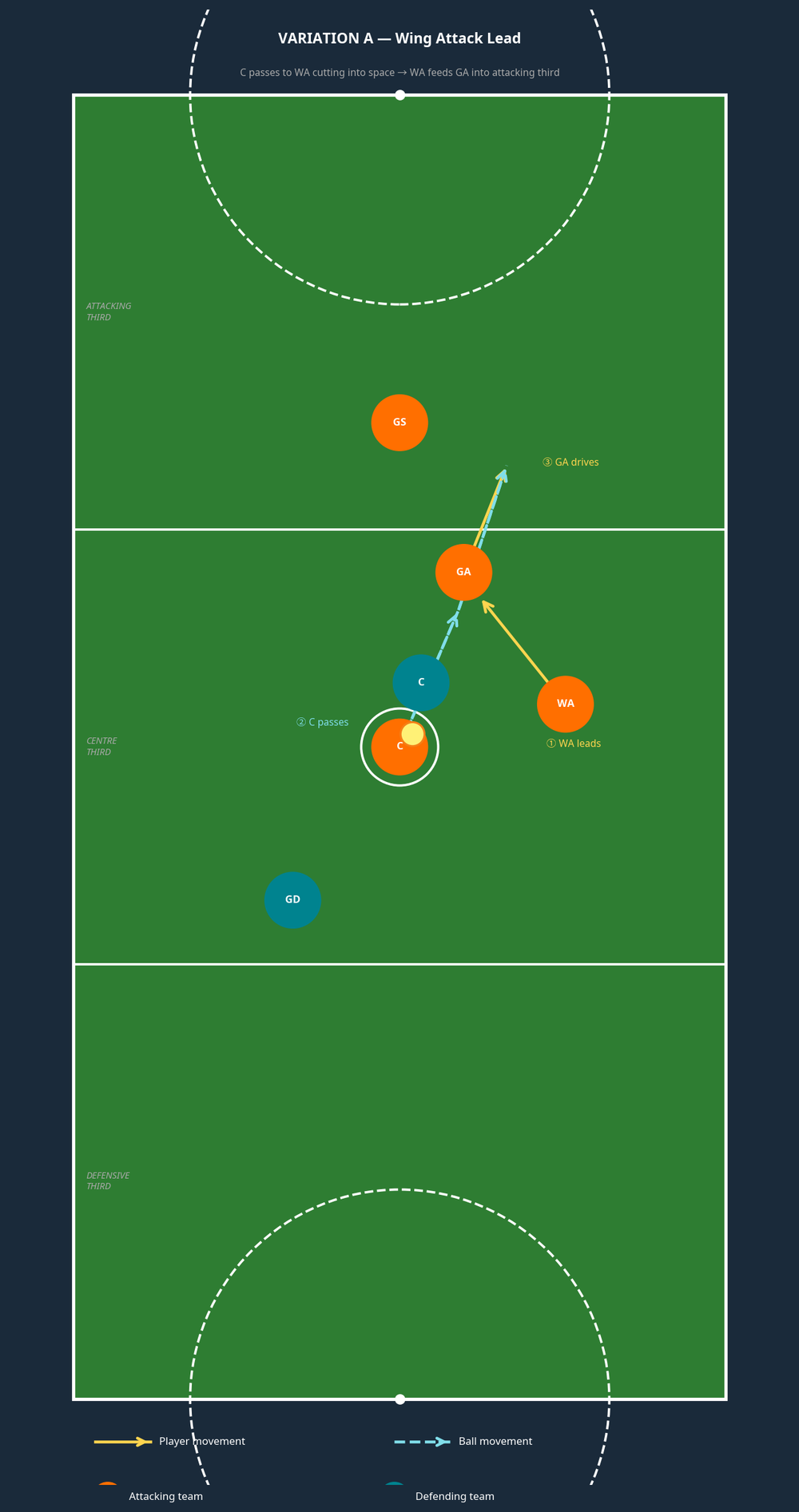
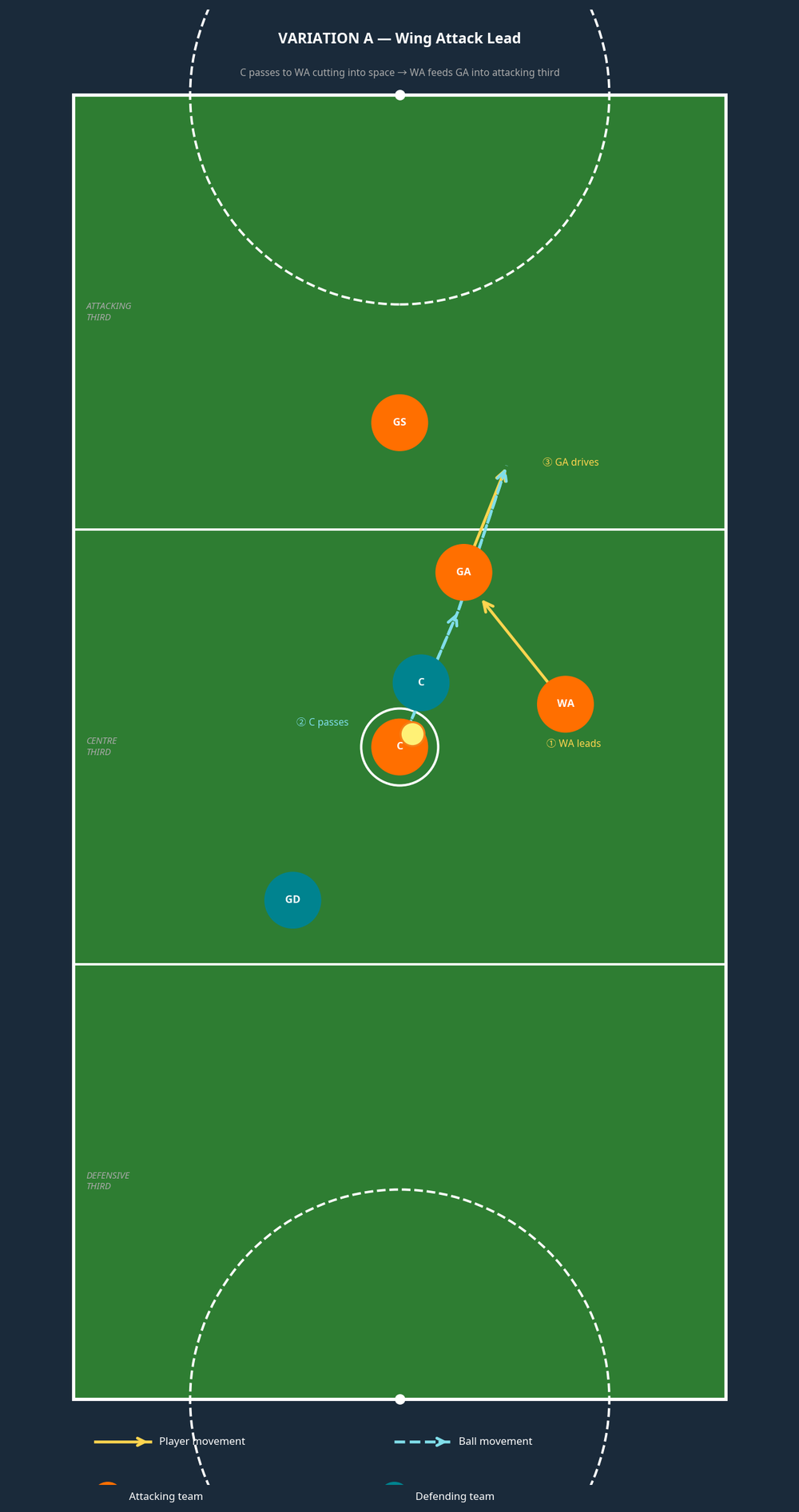
Phase 2 — Variation A: Wing Attack Lead (10 minutes)

Objective: The WA creates a sharp diagonal lead from the right wing into open space ahead of the Centre, receives the ball, and immediately looks to feed the GA driving into the attacking third.
- On the whistle, the WA drives diagonally forward and inward, aiming to receive the ball approximately 4–5m ahead of the centre circle and 3–4m from the right sideline.
- The GA holds her position for a count of one second, then drives hard toward the attacking third line as the WA receives the ball.
- The C delivers a flat, fast chest pass to the WA's leading hand — not to where she started, but to where she is going.
- The WA catches, pivots, and delivers a quick pass to the GA who has now cleared into the attacking third.
- The GS has already repositioned to the far post to create width in the goal circle.
- Repeat 6 times, then rotate the defending unit to apply live pressure.
Coaching cue: "WA — your lead is the trigger. If you don't go, nothing goes."
Phase 3 — Variation B: Goal Attack Baseline Drive (10 minutes)

Objective: The GA drives from the attacking third baseline in a curved run toward the circle edge, receiving a longer pass from C and immediately looking to feed GS.
- On the whistle, the GA begins a curved run from her starting position near the third line, driving forward and inward toward the top of the goal circle (approximately 4.9m radius).
- The WA makes a secondary lead to the right sideline — this is a decoy run designed to pull the WD wide and open the channel for GA.
- The C reads which option is cleaner. If GA's run is clear, she delivers a longer overhead or chest pass into GA's path — leading her into the space, not to her starting position.
- The GA receives at the circle edge and immediately looks to feed the GS, who has repositioned to the far post.
- If GA's run is cut off by GD, C switches to the WA as a secondary option — this decision-making element is critical and should be explicitly coached.
- Repeat 6 times, progressively increasing defensive pressure from passive to active.
Coaching cue: "GA — your run must be curved, not straight. Straight runs are easy to defend. Curve into the space."
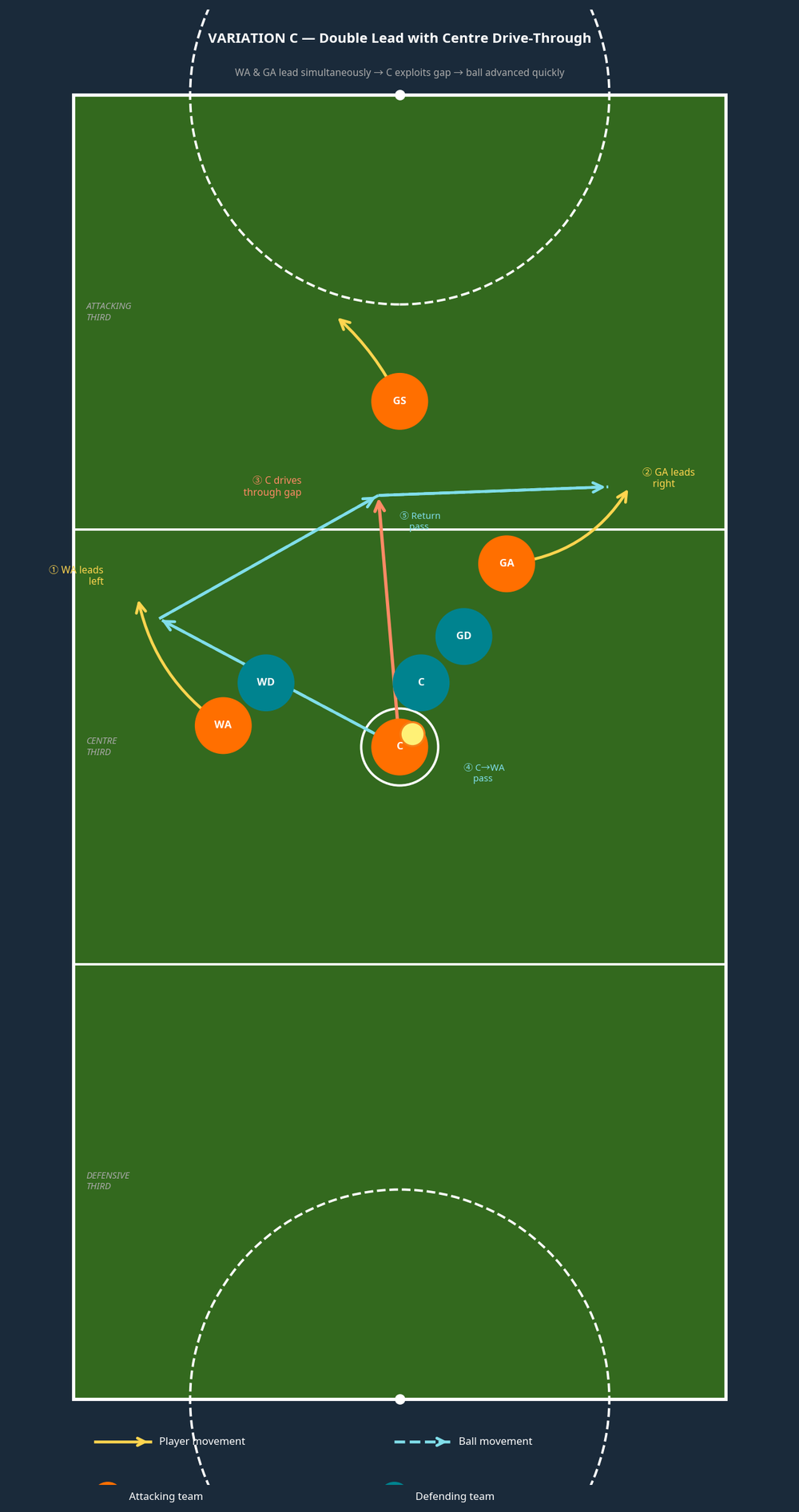
Phase 4 — Variation C: Double Lead with Centre Drive-Through (10 minutes)

Objective: WA and GA lead simultaneously in opposite directions to create confusion, opening a central corridor for the C to drive through and receive a return pass before advancing the ball to GA in space.
- On the whistle, WA drives hard to the left sideline and GA drives hard to the right sideline simultaneously. Both leads must be committed and fast — half-hearted leads will not create the gap.
- The C passes to the WA (the closer option) and immediately drives forward through the central corridor vacated by both leads.
- The WA catches, pivots quickly, and returns the ball to the C who is now 3–4m ahead of the centre circle in open space.
- The C receives on the move, pivots, and delivers a long pass to the GA who has continued her run and is now in open space on the right side of the attacking third.
- The GS has moved to the far post to ensure width in the circle.
- Repeat 6 times. This variation requires the most timing and communication — allow extra repetitions if needed.
Coaching cue: "C — you are not a spectator after you pass. Pass and go. Your drive-through is what makes this variation work."
Phase 5 — Integrated Practice (5 minutes)
- Remove the variation calls. The coach now signals the variation using a hand signal visible only to the Centre before the whistle. The rest of the team must read and respond to the Centre's initial movement.
- Run 8–10 repetitions at match pace with a fully active defending unit.
Key Coaching Points

1. Identical starting shape across all variations. Every player must take the same starting position regardless of which variation has been called. Any positional tell — a WA who stands slightly closer to the sideline before a Variation A, for example — gives the defence a read. Drill this relentlessly.
2. The Centre's first touch must be decisive. The C has 3 seconds from the whistle. She cannot afford to hesitate. The pass must be delivered to the receiver's leading hand, not their body, and must be weighted to allow the receiver to catch on the move without breaking stride.
3. Leads must be timed, not rushed. A lead that begins before the whistle is a footwork violation. A lead that begins too late gives the defender time to recover. Players should begin their lead movement as the whistle sounds — not before, not a second after.
4. The non-primary movers must still move. In every variation, the players not receiving the first pass must still execute their movement. A stationary GA in Variation A is a gift to the defence — she is easy to mark and easy to ignore. Every player on court should be creating space or providing an option at all times.
5. Communication is non-negotiable. Players must call for the ball with a clear verbal cue and a target hand. Silent leads are ineffective leads. Insist on this from the first repetition.
6. The GS's role is spatial, not passive. The Goal Shooter should not simply stand and watch the centre pass unfold. Her job is to reposition to the far post or the circle edge to create maximum width and ensure the ball can be advanced into the circle in two passes from the centre pass.
Common Mistakes

Mistake 1 — The Centre waits for a lead before moving. Many Centres stand on the circle and watch, waiting for a teammate to get free before they commit to a pass. This kills the timing of every variation. The C must be ready to release the ball the instant a lead is created — ideally within 1–1.5 seconds of the whistle.
Correction: Run a timed repetition where C must release the ball within 1.5 seconds of the whistle. If she doesn't, the rep is reset. This creates urgency.
Mistake 2 — Leads that run to a spot rather than through a space. Players who have been coached to "lead to a cone" often run to a fixed point and stop. In a live game, that point will be occupied by a defender. Leads must be dynamic — players should be running through the space, not to it.
Correction: Remove all cones from the drill. Instead, place a defender in the target zone and instruct the attacking player to lead away from the defender, not to a fixed spot.
Mistake 3 — WA and GA leads that are not simultaneous in Variation C. If one player leads a half-second before the other, the defence can track both movements sequentially and the gap never opens. The double lead only works if both players commit at exactly the same moment.
Correction: Use a secondary auditory cue (a hand clap from the coach) as the trigger for the double lead. Both players must move on the clap, not on the whistle.
Mistake 4 — The Centre does not drive through after passing in Variation C. After delivering the pass to WA, many Centres reset to the centre circle rather than driving forward. This eliminates the return pass option and collapses the variation entirely.
Correction: Physically mark a 3m channel on the court with flat cones. The C must drive through this channel after passing. If she doesn't cross the channel boundary before the return pass is made, the rep is repeated.
Mistake 5 — Telegraphing the pass. Experienced defenders read the passer's eyes and shoulders. A Centre who looks directly at her target before passing will be read every time.
Correction: Introduce a "look away" coaching point — C should look to the secondary option for one beat before delivering to the primary option. This keeps defenders honest.
Variations & Progressions
Progression 1 — Introduce a shot clock. Require the team to get the ball into the goal circle within 8 seconds of the centre pass whistle. This replicates match pressure and forces players to execute variations at speed rather than at training pace. Begin with 10 seconds and reduce by one second each week as the team improves.
Progression 2 — Full-court conditioned game with variation calls. Extend the drill to a full-court 7v7 game where the coach calls the variation from the sideline as the whistle blows. Award bonus points (2 goals instead of 1) for any goal scored within two passes of a successfully executed centre pass variation. This rewards clean execution and encourages players to apply the patterns under match conditions.
Variation 1 — Simplified two-player version (beginner/junior). Strip the drill back to just C and WA (Variation A only). The WA leads, C passes, WA returns the ball, and C drives forward to receive. This two-touch pattern teaches the fundamental timing and communication principles without the complexity of multiple movers.
Variation 2 — Blind variation selection. Write each variation on a card. The Centre draws a card in secret before the whistle and executes that variation without any verbal or visual signal to teammates. The rest of the attacking unit must read and react to the C's initial movement. This develops the team's ability to respond instinctively rather than relying on pre-called patterns — a critical skill in matches where the opposition may have scouted your calls.
Age Adaptations

| Age Group | Recommended Adaptation |
|---|---|
| Under 10 | Use Variation A only. Remove the defending unit entirely. Focus purely on the WA lead and the C's pass timing. Allow players to walk through the movement before adding pace. |
| Under 12 | Introduce Variations A and B. Use a passive defending unit (defenders shadow but do not intercept). Emphasise starting shape and lead timing. Allow 4 seconds for C to release the ball. |
| Under 14 | All three variations. Semi-active defence (defenders can intercept but cannot body-check). Introduce the variation call system. Reduce C's release time to 2.5 seconds. |
| Under 16 | All three variations at full pace. Fully active defence. Introduce blind variation selection in the final phase. Add the shot clock (10 seconds to circle entry). |
| Open / Senior | Full drill as described above. Add a fourth "audible" variation where C can change the called variation at the last second based on what she reads from the defence. This requires a high level of communication and trust between the attacking unit. |
