

Netball
Circle Edge Rotation Play: Creating Space in the Goal Third
Master the circle edge rotation to break down tight defensive structures, isolate defenders, and create high-percentage shooting opportunities under the post.

What you need
1 Netball, Positional Bibs (GS, GA, WA, C, GD, GK, WD), Netball Court (Goal Third)
Overview
The Circle Edge Rotation Play is a dynamic attacking strategy designed to dismantle a rigid defensive setup in the goal third. When defenders, particularly the Goal Defence (GD) and Goal Keeper (GK), are holding a strong front position or employing a zone structure around the shooting circle (which has a 4.9m radius), static attacking play often results in held balls or forced passes. This set play utilises synchronized movement between the Goal Attack (GA) and Goal Shooter (GS) to manipulate the defenders' positioning, creating confusion and opening up crucial space on the circle edge for a clean feed into the circle.
By executing a sharp rotation, the attacking duo forces the defenders to make split-second decisions on whether to switch marks or track their original players. This momentary hesitation is the exact window needed for the Centre (C) or Wing Attack (WA) to deliver a precision pass. It is highly effective against a traditional one-on-one defensive style and can be adapted to exploit gaps in a zone defence.
Setup

To effectively run this set play in a training environment, coaches should ensure the court is set up correctly and players understand their starting positions.
- Court Setup: Full court or a half-court setup focusing on the attacking third (from the transverse line to the goal line, 10.16m x 15.25m).
- Equipment: 1 Netball, positional bibs (GS, GA, WA, C, GD, GK, WD).
- Player Positions:
- GS (Goal Shooter): Starting deep in the shooting circle, holding position near the goal post to occupy the GK.
- GA (Goal Attack): Positioned on the left side of the shooting circle, just outside the 4.9m line, drawing the GD away from the central channel.
- C (Centre): Positioned at the top of the goal third, near the centre of the transverse line, acting as the primary playmaker.
- WA (Wing Attack): Positioned wide on the right side of the transverse line, offering a secondary feeding option and stretching the defence.

Step-by-Step Instructions
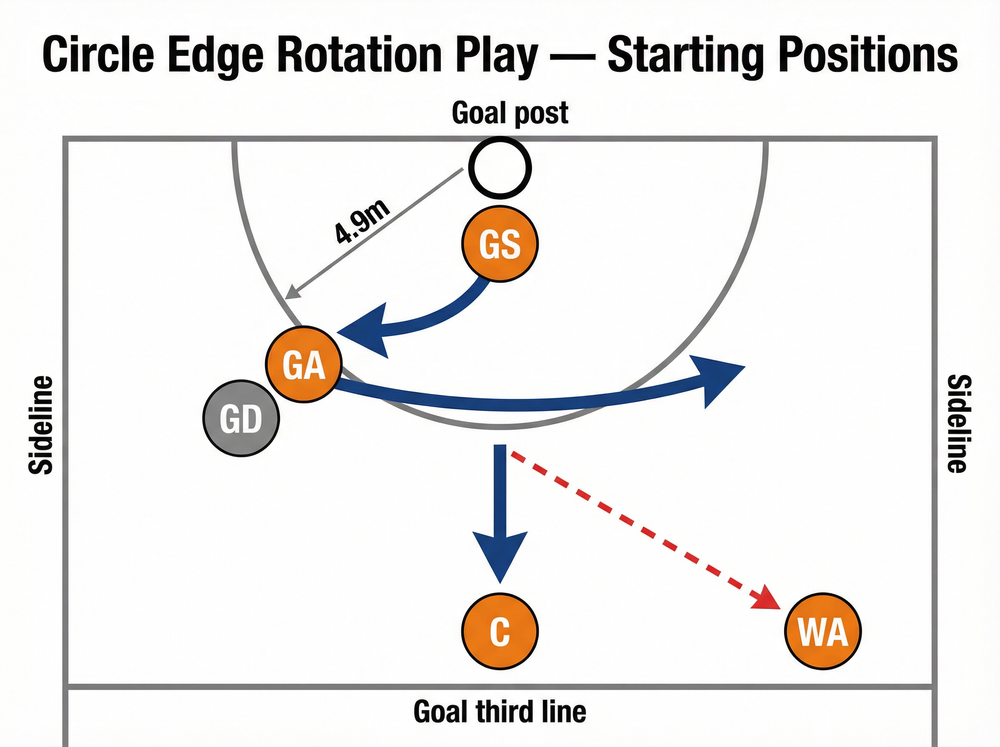
The success of this play relies on timing and decisive movement. Follow these steps to execute the rotation effectively:
- The Trigger: The play is initiated when the Centre (C) receives the ball at the top of the goal third and squares up to the post, signaling readiness to feed.
- The GA Drive: The Goal Attack (GA) initiates the rotation by making a hard, explosive drive across the top of the shooting circle from the left side towards the right side. The aim is to drag the Goal Defence (GD) across the court, clearing the left channel.
- The GS Roll: Simultaneously, as the GA crosses the midline of the circle, the Goal Shooter (GS) rolls off the Goal Keeper (GK) and drives out towards the space vacated by the GA on the left circle edge. This synchronized movement is the core of the rotation.
- The Decision Point: The Centre (C) now reads the defensive reaction. If the GD follows the GA across, the GS should be open on the left edge. If the defenders attempt to switch marks, there will be a momentary gap where either the GA is free on the right edge or the GS is open on the left.
- The Feed: The Centre (C) delivers a sharp, flat pass to the open player on the circle edge.
- The Shot or Reset: Upon receiving the ball on the circle edge, the attacker (GA or GS) immediately turns to face the post. If they are in a balanced position and within range, they take the shot. If the defence recovers quickly, they look to feed their shooting partner who should now be re-positioning under the post.

Key Coaching Points
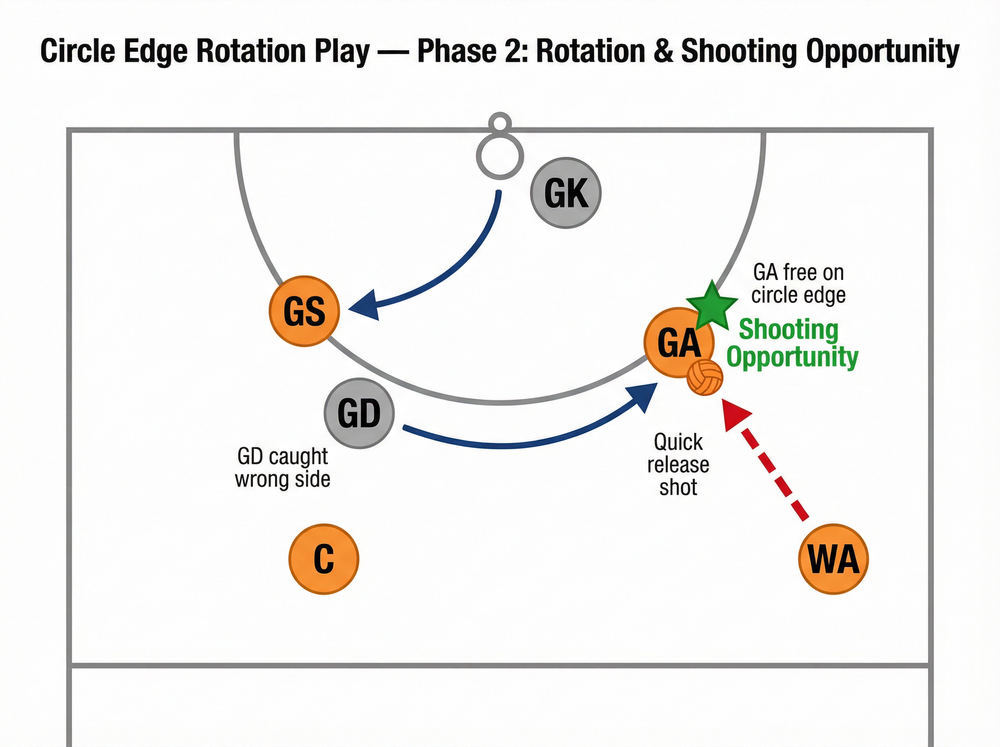
To ensure players execute the Circle Edge Rotation effectively, focus on these critical teaching points during practice:
- Explosive First Step: The GA must initiate the drive with a powerful first step to genuinely commit the GD. A slow or jogging pace will not force the defender to react.
- Timing is Everything: The GS must not roll too early. They need to wait until the GA has drawn the GD across the circle before exploding into the vacated space. If the GS moves too soon, they will simply run into the GD's path.
- Eye Contact: The C, GA, and GS must maintain strong eye contact. The feeders (C and WA) need to read the play as it develops, not pre-determine their pass.
- Strong Holds: When the GS rolls to the circle edge, they must establish a strong physical hold against the recovering defender to secure the space for the pass.
- Square Up: Immediately upon receiving the ball on the circle edge, the attacker must turn and square their shoulders to the goal post, ready to shoot or feed.
Common Mistakes

Watch out for these frequent errors that can cause the play to break down:
- Curving the Run: Attackers (especially the GA) often curve their run around the circle edge instead of making sharp, angular cuts. This allows the defender to easily track their movement and stay in contention for an interception.
- Lack of Communication: If the GA and GS do not communicate their movements (even non-verbally), they risk running into the same space or leaving the feeder with no options.
- Feeder Hesitation: If the Centre (C) hesitates and does not release the ball at the exact moment the attacker breaks free, the defensive window will close, resulting in a held ball or a forced, risky pass.
- Ignoring the WA: Focusing solely on the C as the feeder. The WA on the right wing provides an excellent alternative angle, especially if the GA drives towards them.

Variations & Progressions

Once your team has mastered the basic rotation, introduce these variations to keep the defence guessing:
- The Dummy Run: The GA initiates the drive across the circle edge but abruptly stops and cuts back to their starting position, while the GS holds their ground. This can completely unbalance an over-eager GD.
- The Baseline Drive: Instead of the GS rolling to the circle edge, they drive hard along the baseline (behind the goal post) to receive a lob pass over the top of the GK, while the GA occupies the circle edge.
- WA Feed: Run the exact same rotation, but use the Wing Attack (WA) as the primary feeder from the right wing. This changes the angle of the pass and forces the defenders to adjust their vision.
Age Adaptations

Tailor the complexity of the play based on the age and skill level of your players:
- Under 10s / Beginners: Focus purely on the concept of 'clearing space'. Have one player drive away to create a gap for another player to run into. Do not worry about complex rotations; keep it to simple two-player movements.
- Under 12s – Under 14s: Introduce the full rotation, but focus heavily on the timing of the GS's movement. Practice the play without defenders first to build confidence in the pattern.
- Under 16s / Open: Execute the play at full match speed against a live defence. Introduce the variations (Dummy Run, Baseline Drive) and focus on the feeder's ability to read the defensive switch and make split-second decisions.
