

Netball
Mastering the Defensive Zone: A Netball Intercept Drill
This comprehensive guide breaks down a high-intensity zone intercept drill to teach your players how to shut down attacking space, force errors, and win back possession.

What you need
Netball, Bibs, Cones
\n\n## 1. Overview\n\nThis defensive zone intercept drill is designed to develop a cohesive, intelligent, and proactive defensive unit. The primary objective is to teach defenders how to work together within a zonal system to restrict the attacking team's options, apply immense pressure on the ball carrier, and create opportunities for clean intercepts. It moves beyond simple one-on-one marking and introduces the concepts of spatial awareness, collective responsibility, and reading the game to anticipate the pass. This drill is best used when your team has a solid grasp of individual defensive fundamentals and is ready to progress to more sophisticated team strategies. It is particularly effective for preparing teams to face opponents with fast, fluid attacking styles.\n\n## 2. Setup\n\n### Equipment\n- 1 Netball\n- Bibs for two different teams (e.g., 7 Attackers, 5-7 Defenders)\n- Cones to mark starting positions or zones (optional)\n\n### Court Setup\n- The drill is run in one full third of the court, from the transverse line down to the baseline.\n- The attacking team sets up in the centre and goal thirds, while the defensive team sets up in the defensive third.\n\n### Player Positions\n- Defenders (5-7 players): GK, GD, WD, C are the core. You can add a floating Centre or Wing Attack to create a 7-player defensive unit for progressions.\n- Attackers (minimum 4 players): GA, WA, C, and GS. Additional attackers can be added to increase the challenge.\n\n \n\n## 3. Step-by-Step Instructions\n\n1. Initial Formation: The drill begins with the attacking Centre (C) holding the ball on the centre circle, ready to pass into the defensive third.\n2. Attacking Objective: The attackers' goal is to move the ball through the defensive zone and successfully pass to their Goal Shooter (GS) in a viable shooting position within the goal circle. They should use a variety of passes (flat, bounce, lob) to test the defense.\n3. Defensive Objective: The defenders set up in a 2-2-1 or 1-3-1 zone formation (as shown in the diagrams). Their goal is NOT to mark a specific player but to defend a specific area of the court. They must communicate and shift as a unit to close down passing lanes and force an error or an intercept.\n4. The Trigger: The drill starts on the coach's whistle or the C's first pass. The ball is live.\n5. Reading the Play: As the ball is passed between attackers, the defenders must adjust their positions. The defender closest to the ball applies direct pressure, while the other defenders slide across to cover the newly opened spaces and deny the next pass.\n6. The Intercept: Defenders should be looking for the trigger to attack the ball. This is often a slow pass, a loopy ball, or a moment of hesitation from the attacker. The defender must commit fully, moving into the path of the ball with strong hands to secure the intercept (as shown in Diagram 2).\n7. Rotation and Recovery: If an intercept is made, the drill resets. If the attackers score, the defenders reset and analyze how the zone was breached. The focus is on the collective movement and communication that leads to the turnover.\n\n
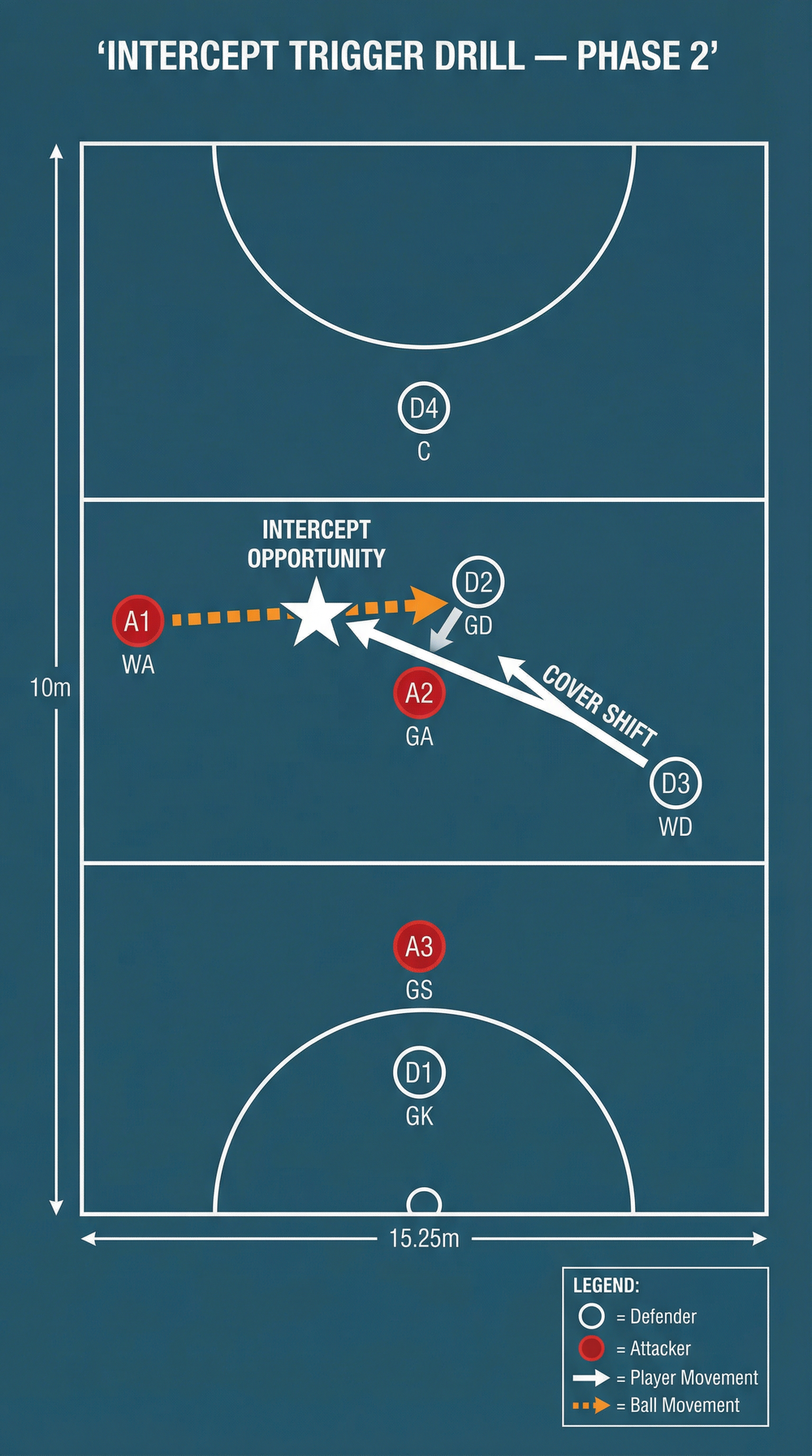 \n\n## 4. Key Coaching Points\n\n- Head Up, Eyes on the Ball: Defenders must constantly track the ball, not just their immediate opponent. This allows them to anticipate the next pass and adjust their position accordingly.\n- Communicate Loudly and Clearly: The zone only works with constant talk. Players should be calling "Ball!", "Cover!", "Shift left!", "Help!". The GK and GD often act as the directors of the defense due to their view of the court.\n- Force the High-Risk Pass: The goal is to make the attackers uncomfortable. By taking away the easy, short options, the zone forces them into making difficult, long-range, or lobbed passes, which are prime intercept opportunities.\n- Attack the Ball at its Highest Point: When going for an intercept, players must be aggressive. Teach them to jump forward into the ball's path and take it cleanly with two hands.\n- Controlled Aggression: While the aim is to be proactive, defenders must not be drawn out of their zone recklessly. They need to learn the discipline of when to hold their position and when to attack the pass.\n- Work as a Unit: Emphasize that one player's movement affects everyone. If one defender is drawn out, another must immediately cover the space left behind. This is a team effort.\n\n## 5. Common Mistakes\n\n- Player-Marking Instead of Zone-Marking: The most common error is defenders reverting to man-on-man defense, following a single attacker and leaving a large gap in the zone for others to exploit.\n- Silent Defense: A quiet defensive unit is an ineffective one. Lack of communication leads to confusion, with two defenders covering the same space or leaving a passing channel wide open.\n- Poor Footwork: Players may be flat-footed and slow to react. Emphasize the need to be on their toes, with a wide base and ready to move explosively in any direction.\n- Getting Drawn to the Ball (Ball-Watching): Defenders can become so focused on the ball that they lose track of the attackers moving into dangerous spaces behind them. They must maintain awareness of both ball and player movement.\n- Not Committing to the Intercept: Hesitation is the enemy. A defender might see the opportunity but fail to attack the ball, allowing the pass to be completed. Encourage them to take the risk.\n\n
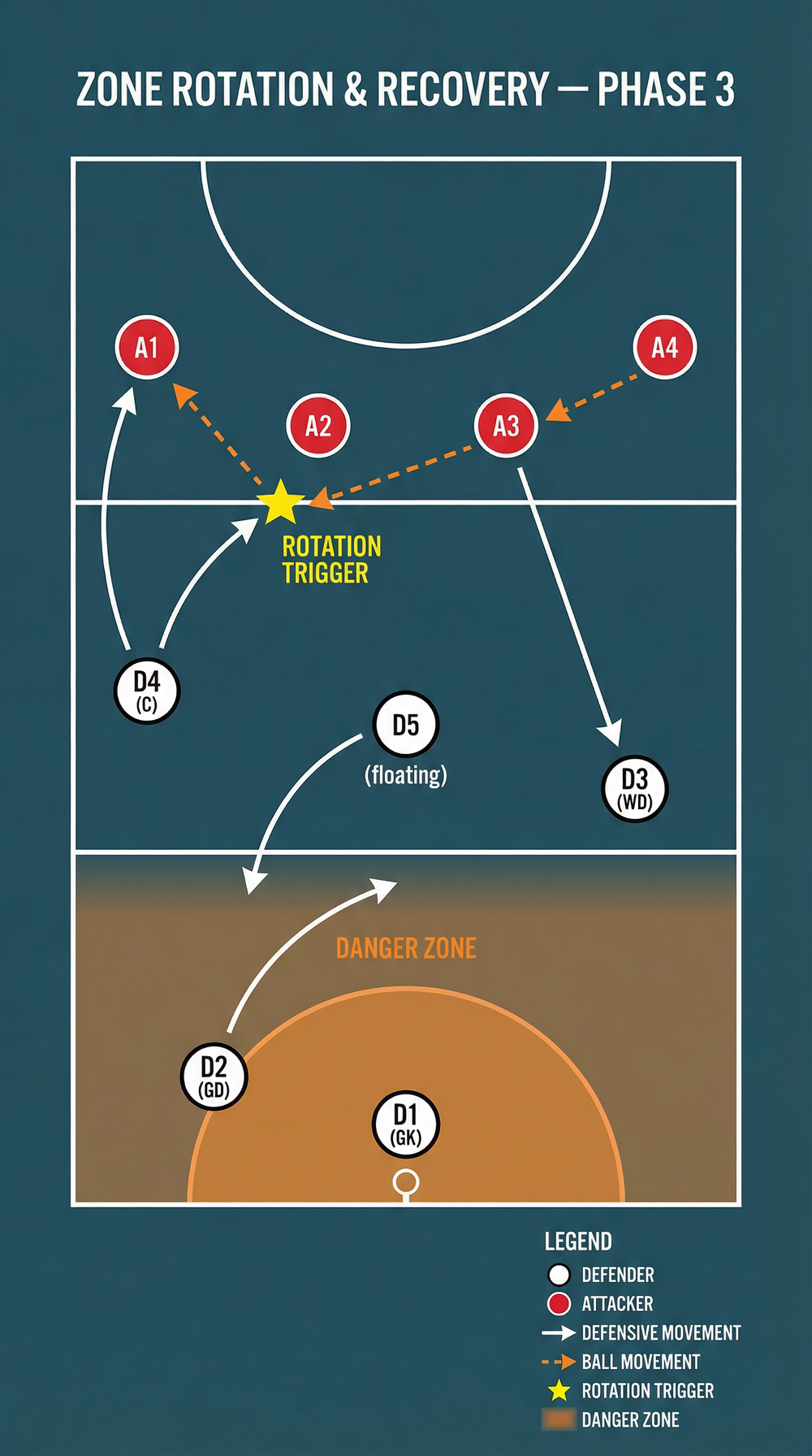 \n\n## 6. Variations & Progressions\n\n### Progressions (Harder)\n1. Add an Attacking Overload: Introduce an extra attacker (e.g., 5 attackers vs. 4 defenders) to force the defensive unit to work harder, communicate more, and make smarter decisions about who to leave open.\n2. Time Constraint: Impose a 5-second rule for the attacking team to get the ball into the goal circle. This increases the pressure and can lead to more rushed, interceptable passes.\n\n### Variations (Simpler)\n1. Walk-Through First: Begin the drill at a walking pace. This allows defenders to understand the required rotations and communication cues without the pressure of live play.\n2. Coach-Led Passing: The coach stands in the C position and makes the passes. This allows the coach to control the pace and type of pass, making it easier to highlight specific teaching points and guarantee success for the defenders early on.\n\n## 7. Age Adaptations\n\n- Under 10/12: Focus on the basic concept of defending a space rather than a player. Use a 3-player zone in the goal circle. Use the "Walk-Through First" variation and have the coach feed the ball to build confidence.\n- Under 14/16: This drill is ideal for this age group. Introduce the full 5-player zone and begin to focus on the triggers for the intercept. Emphasize loud communication and teamwork.\n- Open/Senior: At this level, the drill can be run at maximum intensity. Introduce the "Attacking Overload" and "Time Constraint" progressions. Expect sophisticated communication and for defenders to be able to read the game and self-organize on the court.
