

Netball
Mastering the Dodge and Lead: High-Intensity Attacking Drill
Equip your attacking players with the explosive footwork and timing needed to lose tight defenders and drive into open space.
What you need
1 Netball, 4-6 Marker Cones, Bibs
1. Overview
The ability to break free from tight, one-on-one defensive pressure is a fundamental attacking skill in netball. The 'Dodge and Lead' drill is designed to teach players how to execute a sharp, deceptive dodge followed by an explosive lead into space to receive a pass. This drill focuses on timing, agility, and the crucial connection between the feeder and the worker. It is highly effective for Goal Attacks (GA), Wing Attacks (WA), and Centers (C) who need to penetrate the goal third against a tight defensive unit.
2. Setup
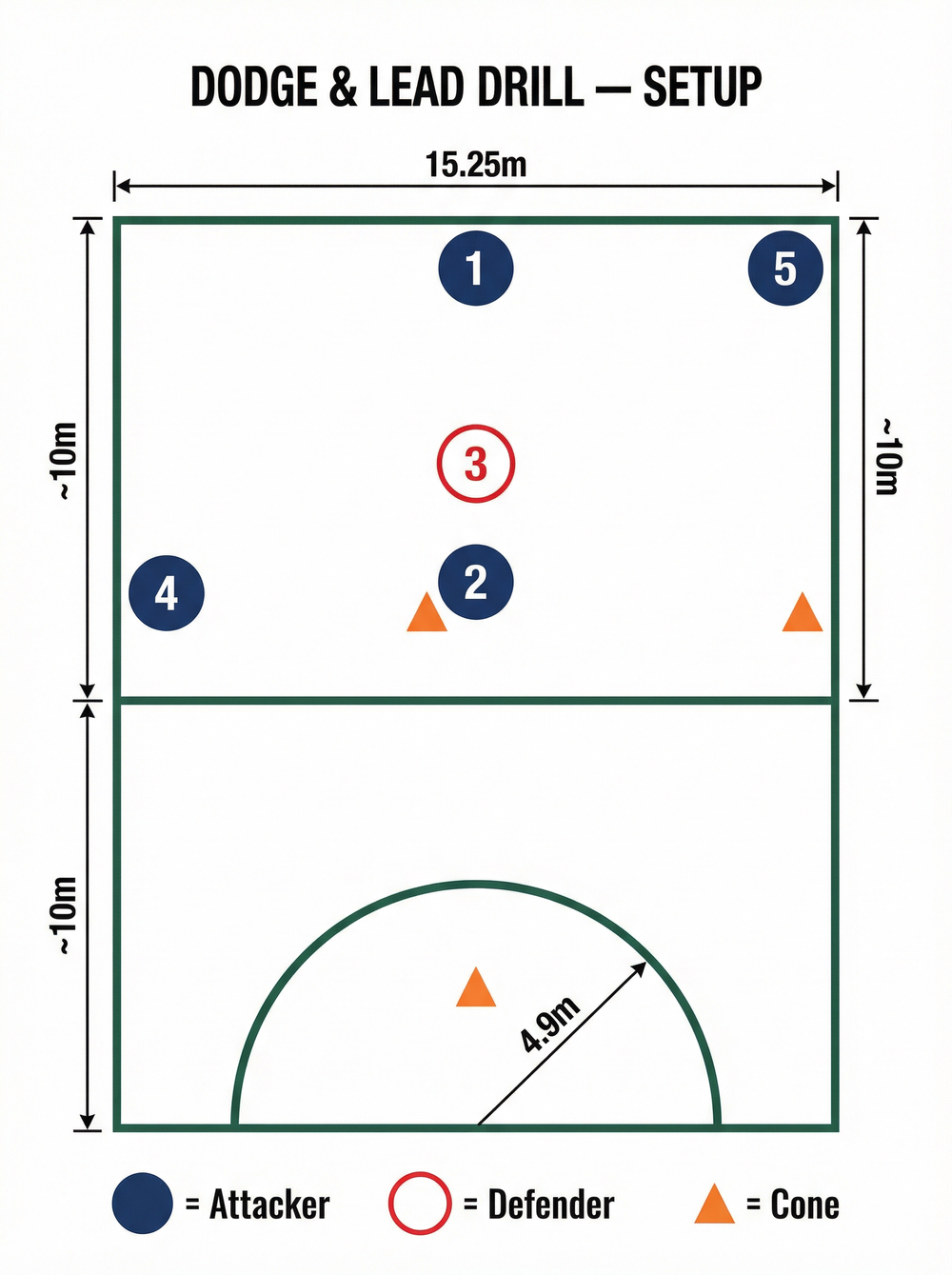
To run this drill effectively, you will need one full attacking third of a standard netball court (15.25m wide by approximately 10m long).
Equipment Needed:
- 1 Netball
- 4-6 Marker Cones
- Bibs (optional, but helpful for differentiating attackers and defenders)
Court Setup and Player Positions:
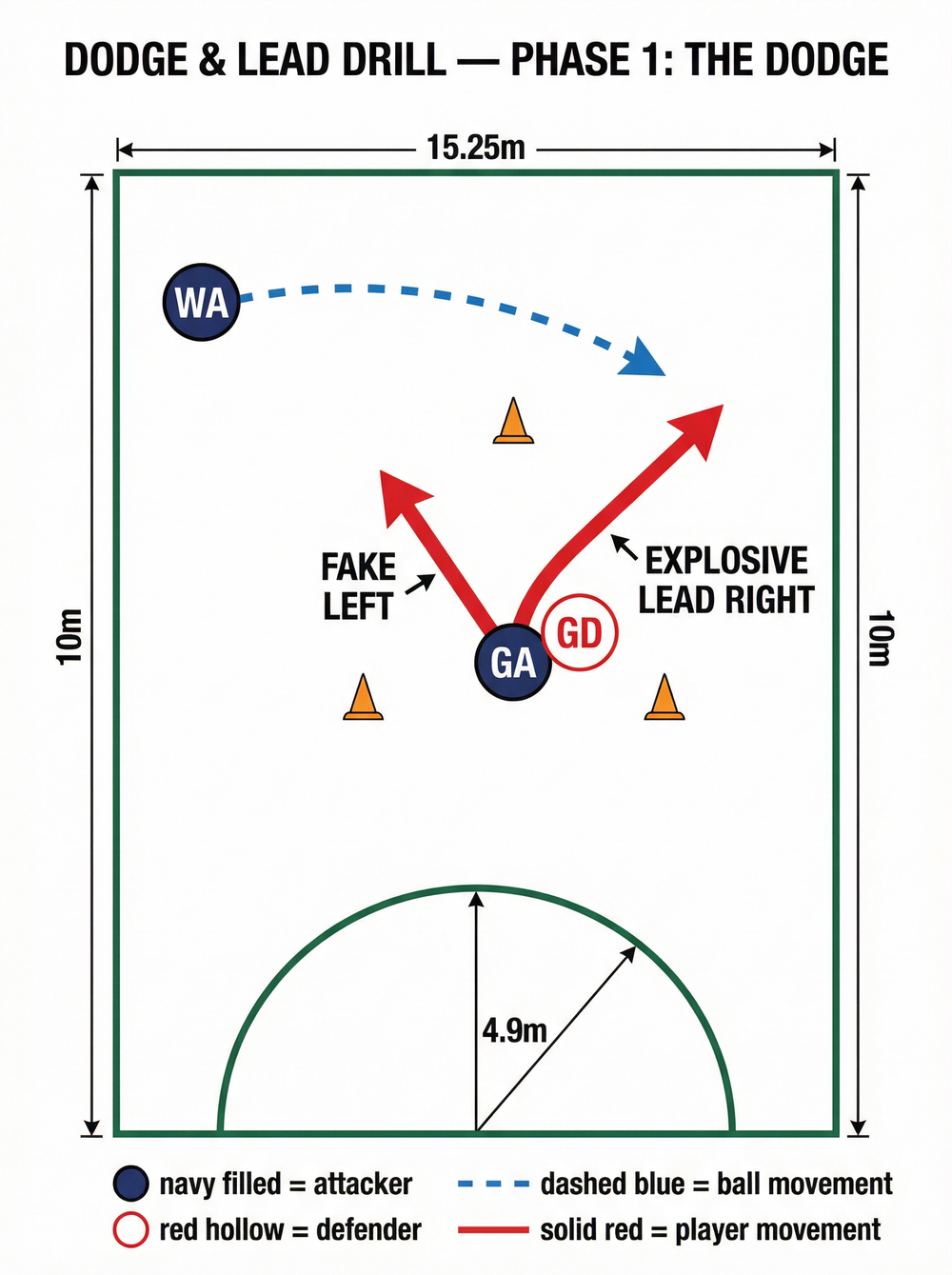
Set up a 3-meter 'dodging channel' using cones near the transverse line.
- Player 1 (Feeder): Starts with the ball at the top center of the transverse line.
- Player 2 (Worker/Attacker - e.g., GA): Starts inside the dodging channel, facing the feeder.
- Player 3 (Defender - e.g., GD): Starts in a tight, one-on-one marking position against Player 2.
- Player 4 & 5 (Support/Next Feeders): Positioned on the wings or near the goal circle edge to receive the next pass and keep the drill flowing.
3. Step-by-Step Instructions
Follow these steps to execute the drill, ensuring players focus on technique before increasing the speed and intensity.
Phase 1: The Dodge
- The Feeder (Player 1) holds the ball high, signaling readiness.
- The Worker (Player 2) initiates the movement by driving hard in one direction (the 'fake' or 'decoy' lead) for 1-2 steps.
- The Worker plants their outside foot firmly, dropping their center of gravity to execute a sharp change of direction.
- The Worker pushes off the planted foot, exploding into a sprint in the opposite direction (the true lead) toward open space.
Phase 2: Receive and Link
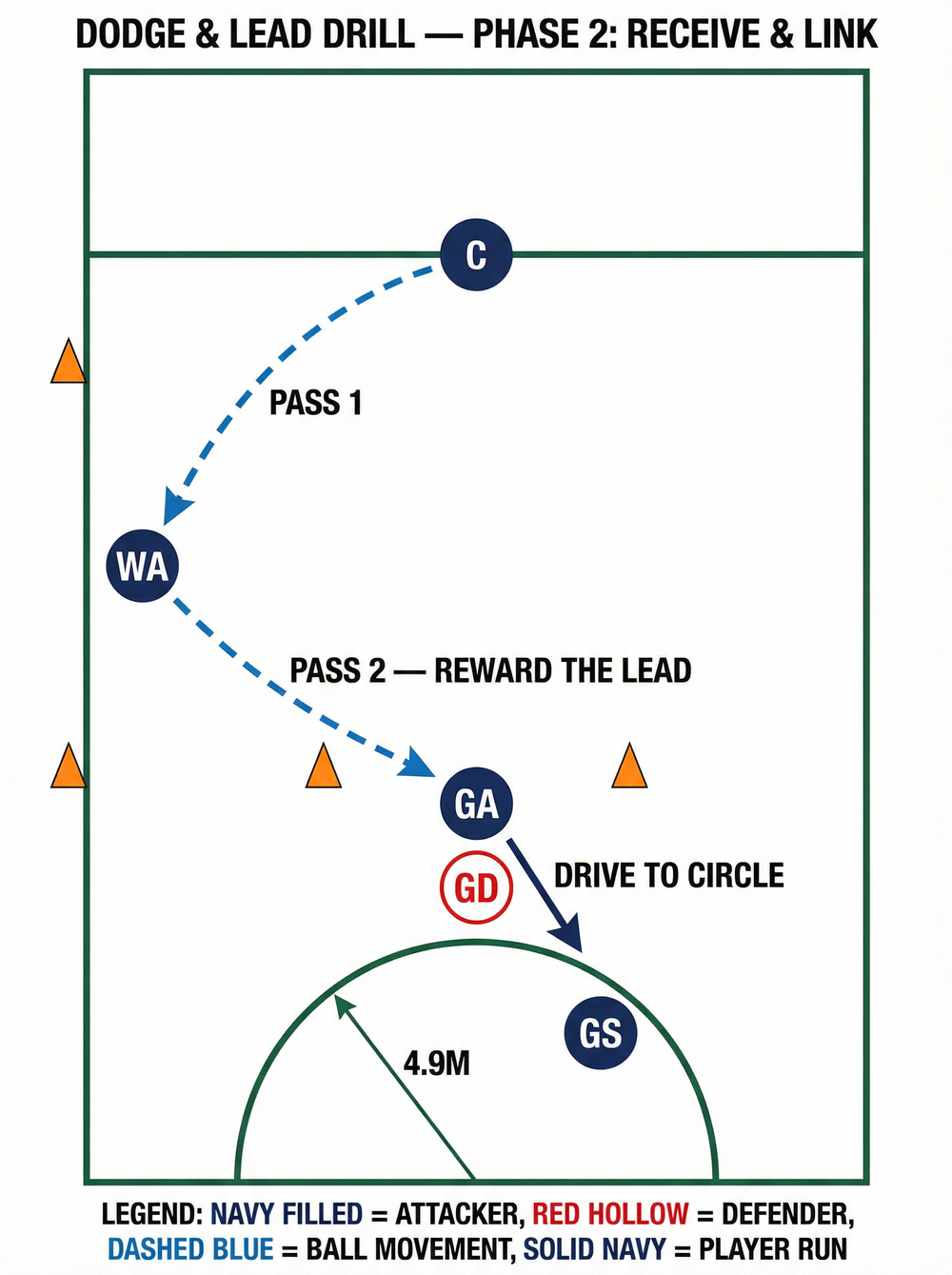
5. The Feeder must read the Worker's movement and deliver a firm, accurate chest pass or bounce pass into the space the Worker is leading into.
6. The Worker attacks the ball, receiving it at full stretch with two hands while in the air, landing in a strong, balanced 1-2 step.
7. Upon landing, the Worker immediately pivots to face down-court and delivers a quick, flat pass to a Support Player (Player 4 or 5) driving toward the goal circle.
8. Players rotate positions: Worker becomes Support, Support becomes Feeder, Feeder joins the back of the line to become the next Worker.
4. Key Coaching Points
To maximize the effectiveness of this drill, coaches should emphasize the following technical aspects:
- Sell the Fake: The initial movement must be convincing. The player needs to turn their shoulders and commit to the fake direction to pull the defender out of position.
- Explosive Push-Off: The change of direction must be sharp and powerful. Players should plant their outside foot hard and drive off it to create immediate separation.
- Eyes on the Prize: The Worker must keep their eyes firmly on the Feeder and the ball throughout the entire dodging movement.
- Attack the Ball: The receiver must not wait for the ball to reach them. They must drive strongly toward the pass, catching it at the earliest possible point to prevent defensive interception.
- Timing is Everything: The Feeder must release the pass just as the Worker completes their change of direction and begins their explosive lead. A late pass allows the defender to recover.
5. Common Mistakes
Watch out for these frequent errors and correct them immediately:
- Rounding the Dodge: Players running in a curved, 'U-shape' path instead of planting and cutting sharply in a 'V-shape'. This makes the movement slow and predictable.
- Leading Too Early: The Worker initiates the dodge before the Feeder is balanced and ready to pass, resulting in a breakdown of timing.
- Fading Away: The Worker leads away from the ball rather than driving strongly toward it, making the pass vulnerable to an interception by a recovering defender.
- Poor Passing Execution: The Feeder throws the ball to where the Worker was, rather than leading them into the open space they are running toward.
6. Variations & Progressions
Adapt the drill to suit the skill level of your players and keep the session challenging.
- Progression 1: Add a Second Dodge (Double Dodge). If the defender recovers quickly, teach the worker to execute a second sharp change of direction before receiving the pass.
- Progression 2: Confined Space. Reduce the size of the dodging channel by moving the cones closer together, forcing the attacker to be more precise and explosive with their footwork.
- Variation 1: The 'Roll' Dodge. Instead of a standard lateral dodge, introduce a reverse pivot (roll) to lose a defender who is over-committing to the fake.
7. Age Adaptations
Tailor the drill's complexity based on the age and experience of your squad.
- Under 8s / Under 10s: Remove the defender initially. Focus purely on the footwork mechanics—planting the foot and pushing off. Use static passing before introducing movement.
- Under 12s / Under 14s: Introduce passive defense (defender shadows but doesn't intercept). Focus heavily on the timing between the feeder and the worker.
- Under 16s / Open: Implement full, active, one-on-one defense. Demand high intensity, game-speed execution, and rapid transition into the next pass after receiving the ball.
