

Netball
Dynamic Dodging and Leading: Creating Space in the Attacking Third
Master the essential netball skills of dodging and leading to break free from tight defense and create dynamic attacking options.

What you need
Netballs, Bibs, Cones or throw-down lines
1. Overview
Creating space against tight, one-on-one defense is a fundamental challenge in netball. The Dynamic Dodging and Leading Drill is designed to teach attackers how to use sharp, explosive footwork to deceive their defender, open up space, and drive strongly to the ball. This drill progresses from basic 1v1 mechanics to a game-realistic 3v2 overload scenario in the attacking third.
Coaches should use this drill to improve their team's attacking flow, reduce held-ball calls, and ensure players are not simply running straight lines into congested areas. By mastering the dodge and lead, players learn to dictate the movement of the defender rather than reacting to them.
2. Setup

Court Area: Full court or two-thirds of a court (30.5m x 15.25m).
Players: 4 to 10 players per group.
Equipment: 1 netball per group, bibs for defenders (optional but recommended), and throw-down lines or cones to mark starting positions if necessary.
Starting Positions
- Feeder (F): Positioned in the centre third with the ball.
- Attacker (A / Worker): Positioned near the transverse line or centre circle.
- Defender (D): Starts in a tight, one-on-one marking position against the Attacker.
3. Step-by-Step Instructions
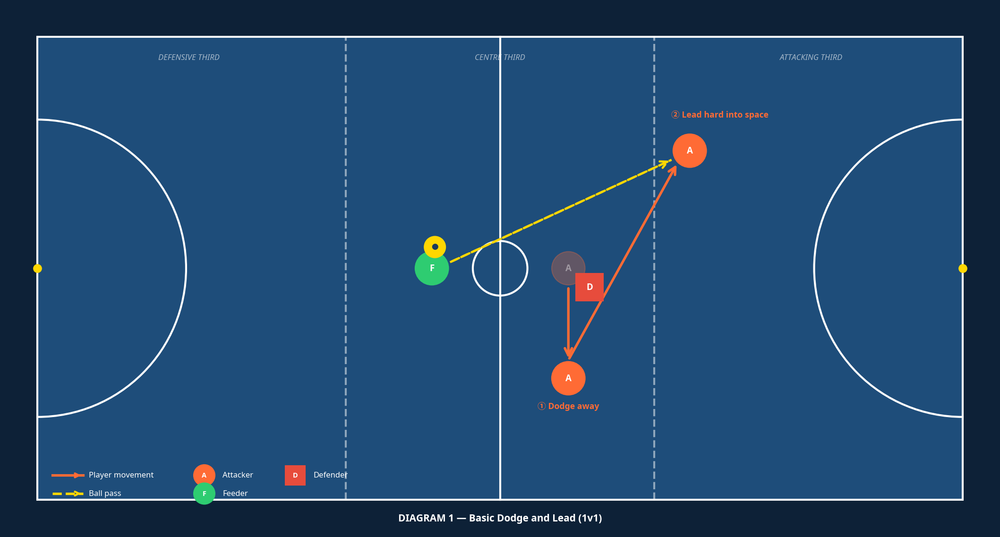
Phase 1: Basic Dodge and Lead (1v1)

- The Feeder (F) starts with the ball in the centre third.
- The Attacker (A) sets up against a Defender (D) near the centre circle.
- The Attacker initiates a sharp dodge away from the intended receiving space (e.g., dodging down towards the defensive third).
- Immediately after the dodge, the Attacker pushes off their outside foot and sprints hard on a diagonal lead into the open space.
- The Feeder delivers a firm, accurate pass out in front of the leading Attacker.
- The Attacker receives the ball, lands balanced, and pivots to face down-court.
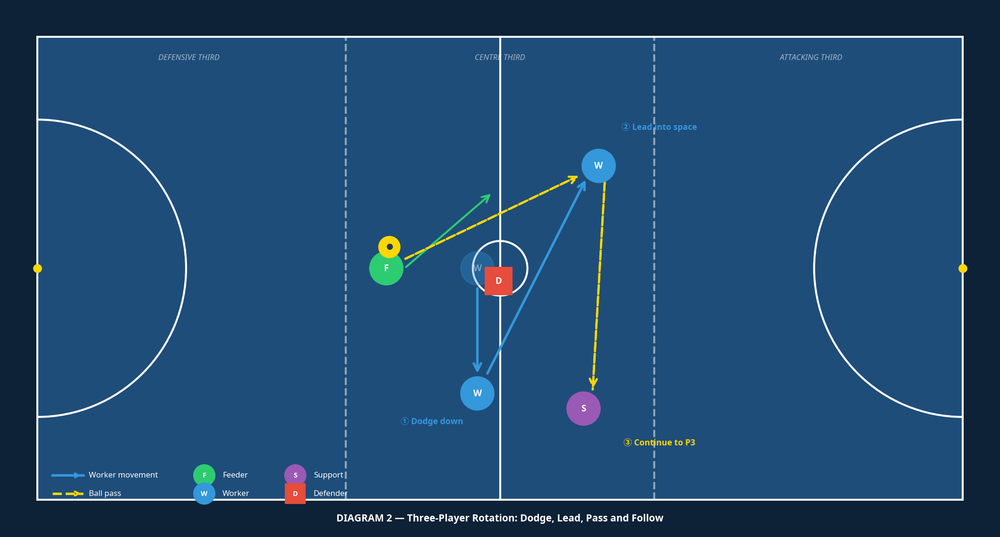
Phase 2: Three-Player Rotation
- Introduce a Support Player (S) wide on the court.
- The Worker (W) executes the dodge and lead to receive the pass from the Feeder (F).
- Upon receiving the ball, the Worker immediately turns and delivers a continuation pass to the Support Player.
- The Feeder follows their pass to become the next Worker, the Worker becomes the Support Player, and the Support Player runs the ball back to the Feeder position. Rotate continuously.
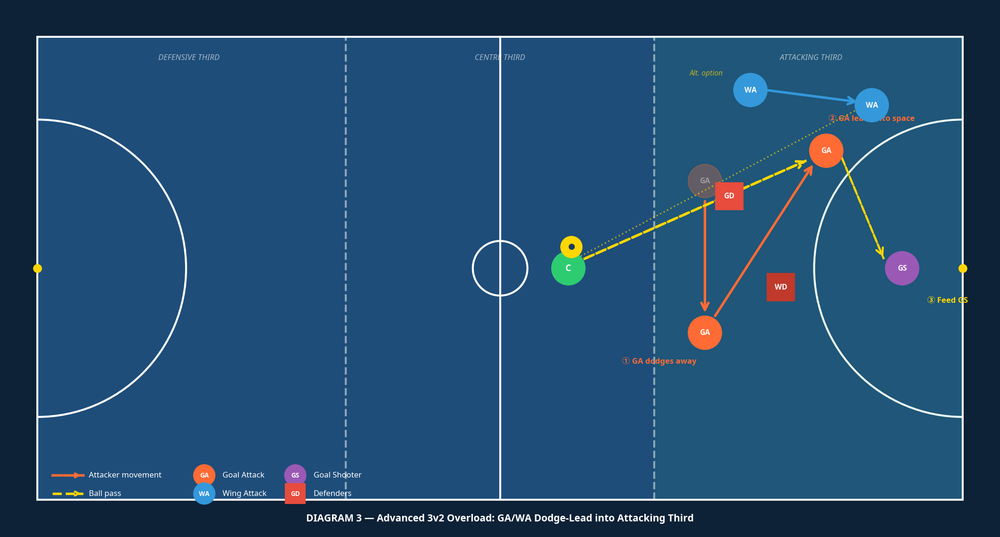
Phase 3: Advanced 3v2 Overload

- Set up a game-like scenario: Centre (C) with the ball, Goal Attack (GA) and Wing Attack (WA) as attackers, against a Goal Defense (GD) and Wing Defense (WD).
- The GA and WA must coordinate their movements. The GA initiates a dodge to draw the GD away, then leads hard into the top of the goal circle or attacking third.
- Simultaneously, the WA leads wide to offer a secondary option.
- The Centre reads the play and hits the primary option (GA) with a pass.
- The GA receives and immediately looks to feed the holding Goal Shooter (GS) inside the circle.
4. Key Coaching Points
- Explosive First Step: The dodge must be convincing. Players need to drop their center of gravity, plant their outside foot firmly, and explode in the opposite direction.
- Change of Pace: The lead must be significantly faster than the dodge. It is the sudden change of speed that loses the defender.
- Angle of the Lead: Attackers should lead at a 45-degree angle to the ball carrier, not straight at them or flat across the court.
- Eye Contact: The attacker must demand the ball by turning their head and locking eyes with the feeder as soon as they break into space.
- Pass Placement: The feeder must pass into the space ahead of the leading player, allowing them to run onto the ball without breaking stride.
5. Common Mistakes
- Curving the Run: Players often run in a 'banana' curve instead of making a sharp, V-cut dodge. This allows the defender to easily track their movement.
- Dodging Too Early: If the attacker dodges before the feeder is ready to pass, the space will close up before the ball is released.
- Passing Behind the Player: Feeders throwing the ball directly at the attacker rather than into the space ahead, causing the attacker to slow down and allowing the defender to intercept.
- Lack of Intensity: A half-hearted dodge will not move a good defender. The dodge must look like a genuine attempt to receive the ball.
6. Variations & Progressions

- Double Dodge: For advanced players, introduce a double dodge (e.g., left, right, then lead left) to further confuse tight marking.
- Confined Space: Restrict the area the attacker can lead into (e.g., they must receive the ball within a specific channel) to increase difficulty.
- Add a Defender on the Feeder: Place hands-over pressure on the feeder to make the timing and execution of the pass more challenging.
7. Age Adaptations

- Under 8 / Under 10: Focus purely on the footwork of the dodge without a defender. Use cones to teach the sharp change of direction. Ensure the pass is a simple chest pass.
- Under 12 / Under 14: Introduce passive defense (defender shadows but doesn't intercept) to help attackers get used to the physical presence. Focus strongly on the timing between the feeder and the attacker.
- Under 16 / Open: Full active defense. Emphasize the speed of the transition from receiving the ball to making the next pass. Introduce the 3v2 overload scenarios to develop decision-making under pressure.
