Netball Dodging & Leading Drill: Clear, Front-Cut, and Drive
A game-realistic attacking drill that teaches C, WA, and GA to create separation, time the feed, and link a circle-edge entry under pressure.

Equipment Needed
Overview
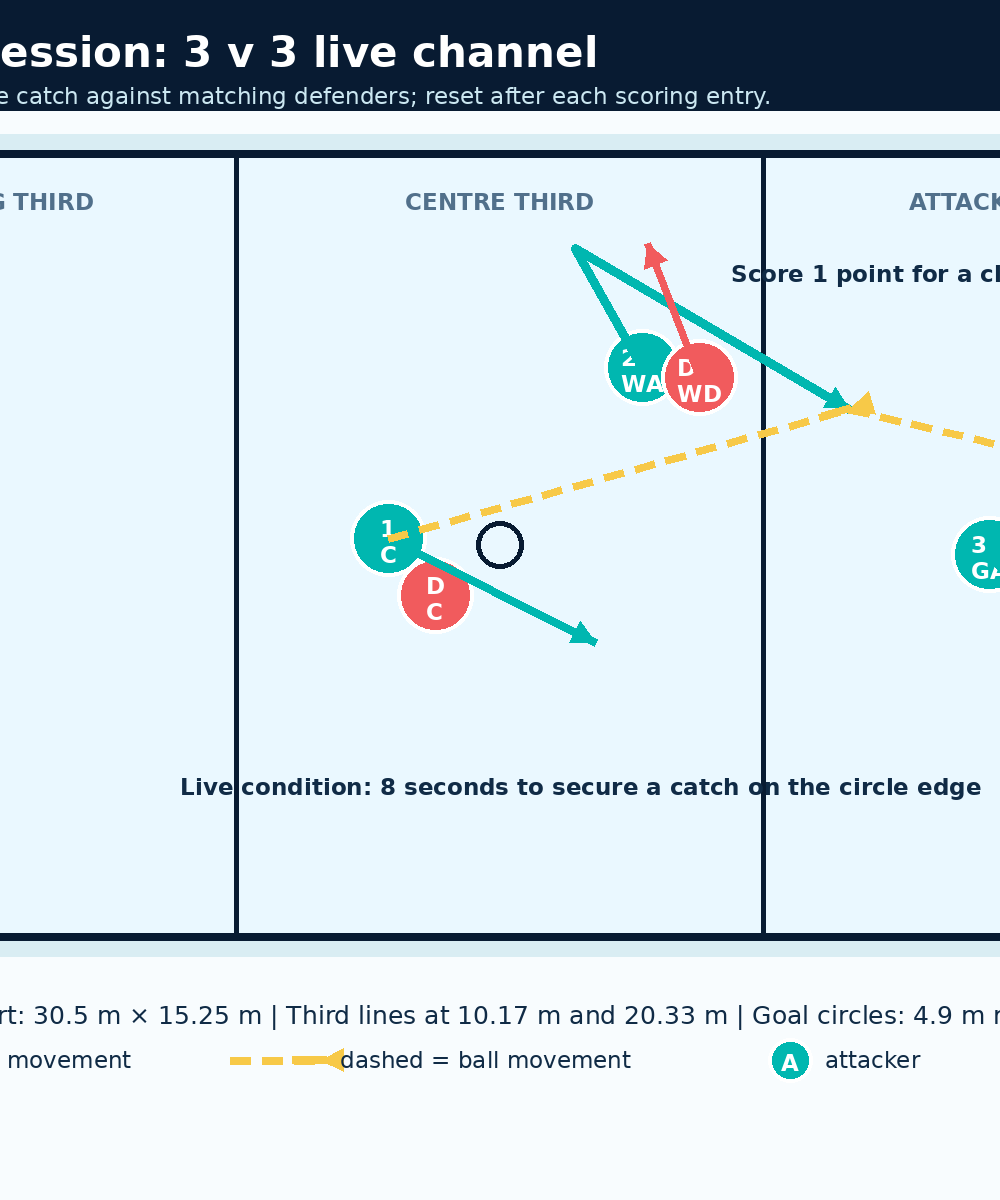
This Dodging and Leading Drill trains attackers to create a passing window before the ball arrives. C (1) holds and times the feed, WA (2) clears wide then front-cuts, and GA (3) re-offers for a circle-edge entry. Use it for 15–18 minutes after the warm-up or before centre-pass work.
The pattern uses the full 30.5 m × 15.25 m court and its three equal thirds, so players feel the true distance required to turn a centre-third catch into an attacking-third entry.1 It is designed for Under-12 and Under-14 players, with a live progression for older squads.
| Coaching outcome | What good looks like | Coach measurement |
|---|---|---|
| Create separation | WA clears away from WD before changing direction. | A clear 1.5–2 m passing lane at the catch. |
| Time the pass | C releases as WA’s second attacking step commits the defender. | Ball arrives in front of WA, not behind her shoulder. |
| Link the next phase | GA clears first, then drives to the next space. | Second pass reaches the circle edge inside the coach’s 8-second condition. |
Setup
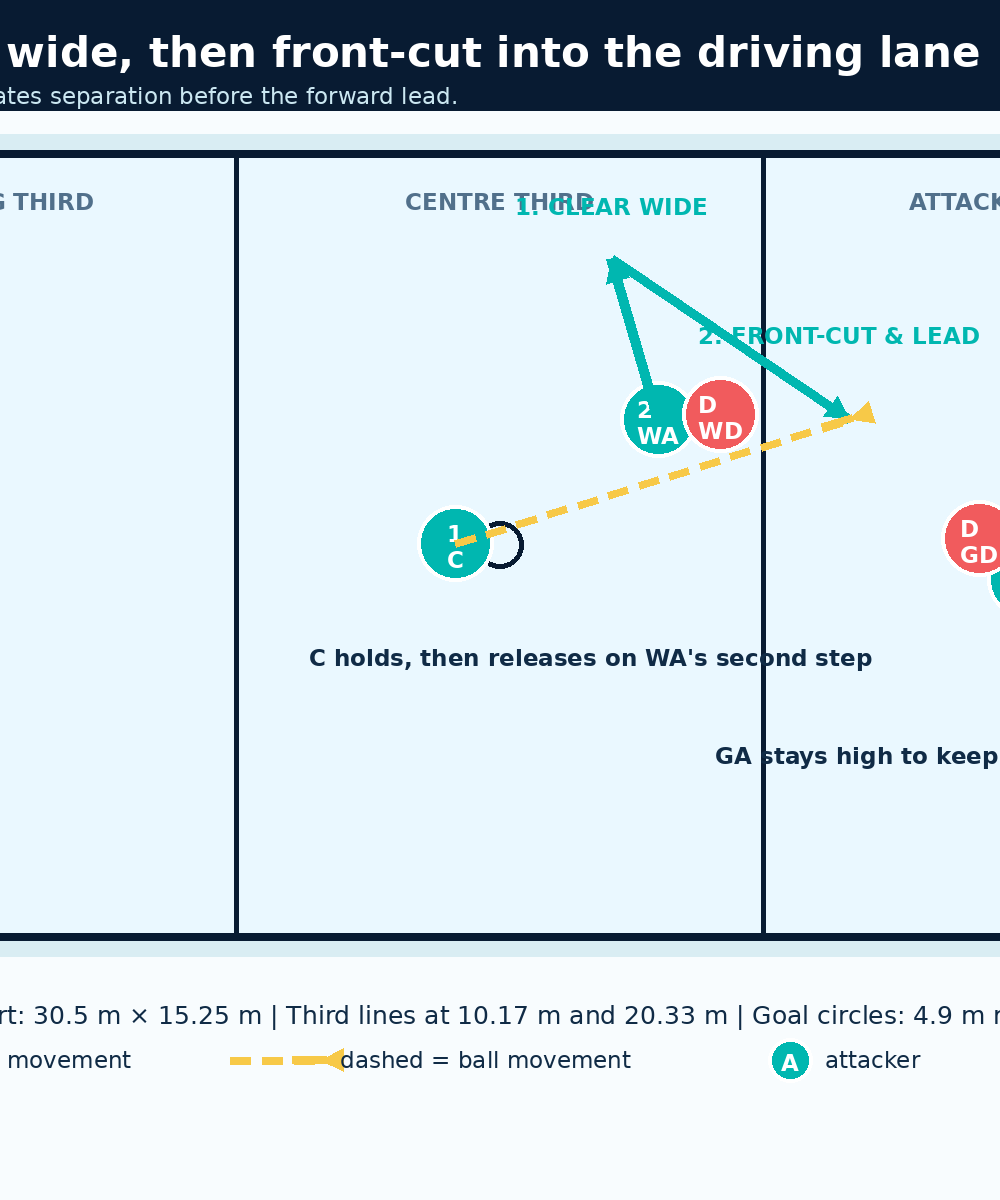
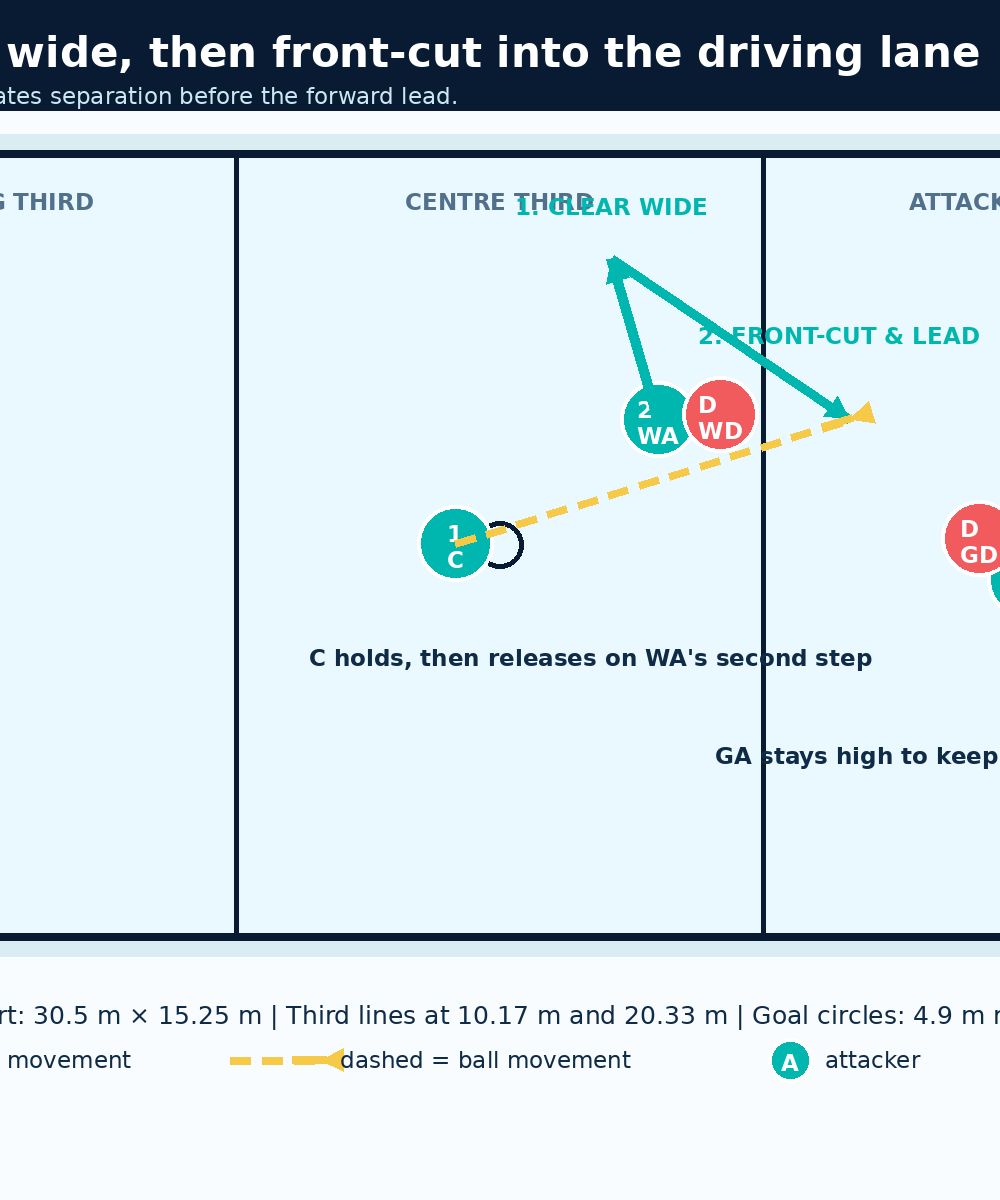
Use the centre and attacking thirds of a regulation court. Put a 4 m × 4 m WA receiving box across the attacking transverse line, with a two-cone clearing lane 3 m wide beside it. Place a second gate 2 m outside the 4.9 m goal circle as GA’s target.1
Start C (1) 3 m inside the centre third, WA (2) 2 m beside the box with WD touch-tight but passive, and GA (3) 4–5 m outside the circle with passive GD. With eight players, use three attackers, three defenders, and two rotating servers.
| Equipment | Quantity | Coaching use |
|---|---|---|
| Flat cones | 10 | Receiving box, wide clearing lane, and GA target gate. |
| Netballs | 4 | One live ball and three ready replacements to preserve tempo. |
| Bibs | 8 | Teal attackers and coral defenders; clearly label C, WA, GA, WD, and GD. |
| Whistle and stopwatch | 1 each | Start 45-second work blocks and apply the 8-second live condition. |
Step-by-Step Instructions
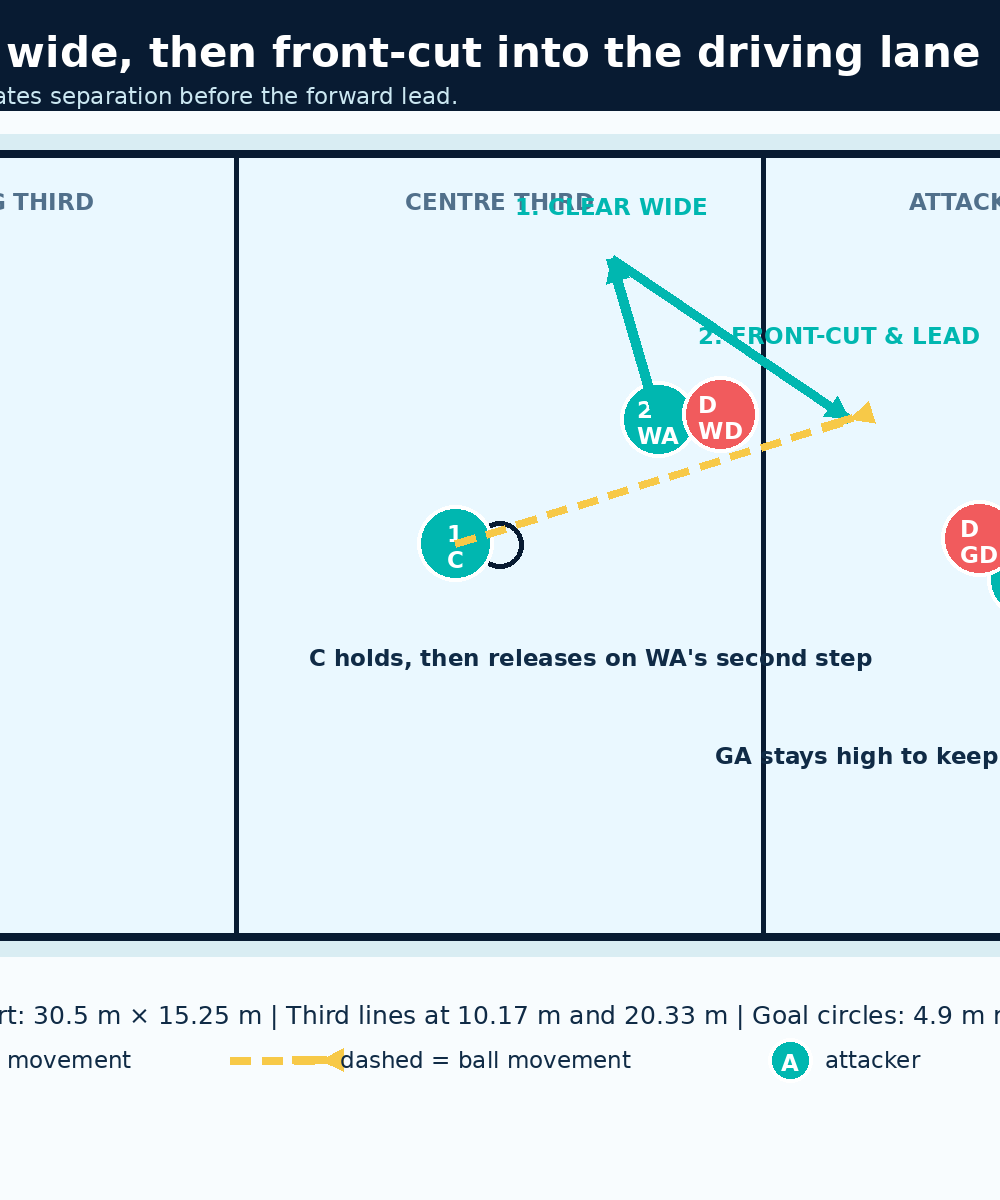
Walk the movement first. Use the cue: “clear, plant, front-cut, drive.” WA takes two sharp steps away from the intended lane, plants the outside foot, then drives diagonally into the box. C waits for the second attacking step rather than passing to WA’s starting position.
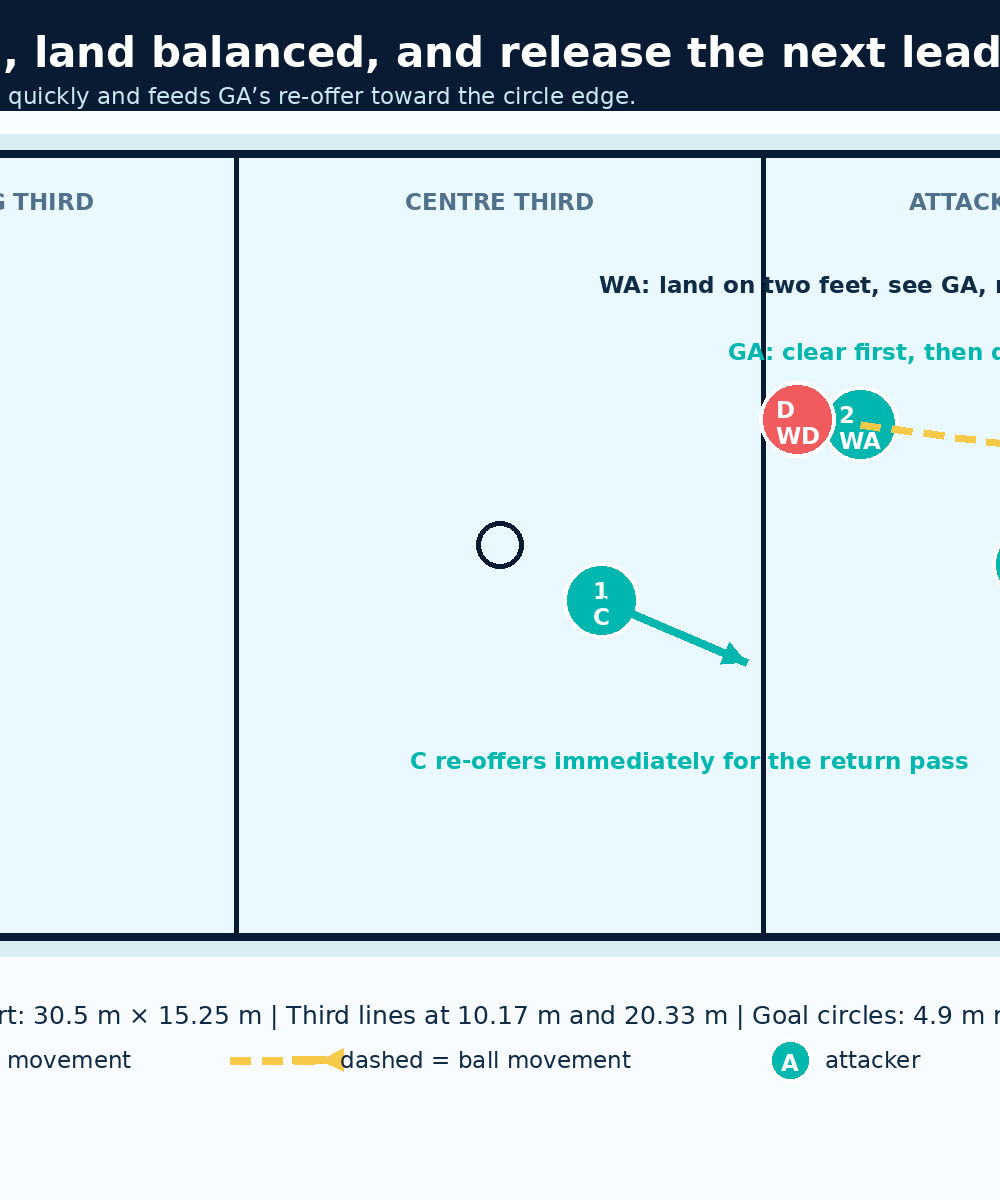
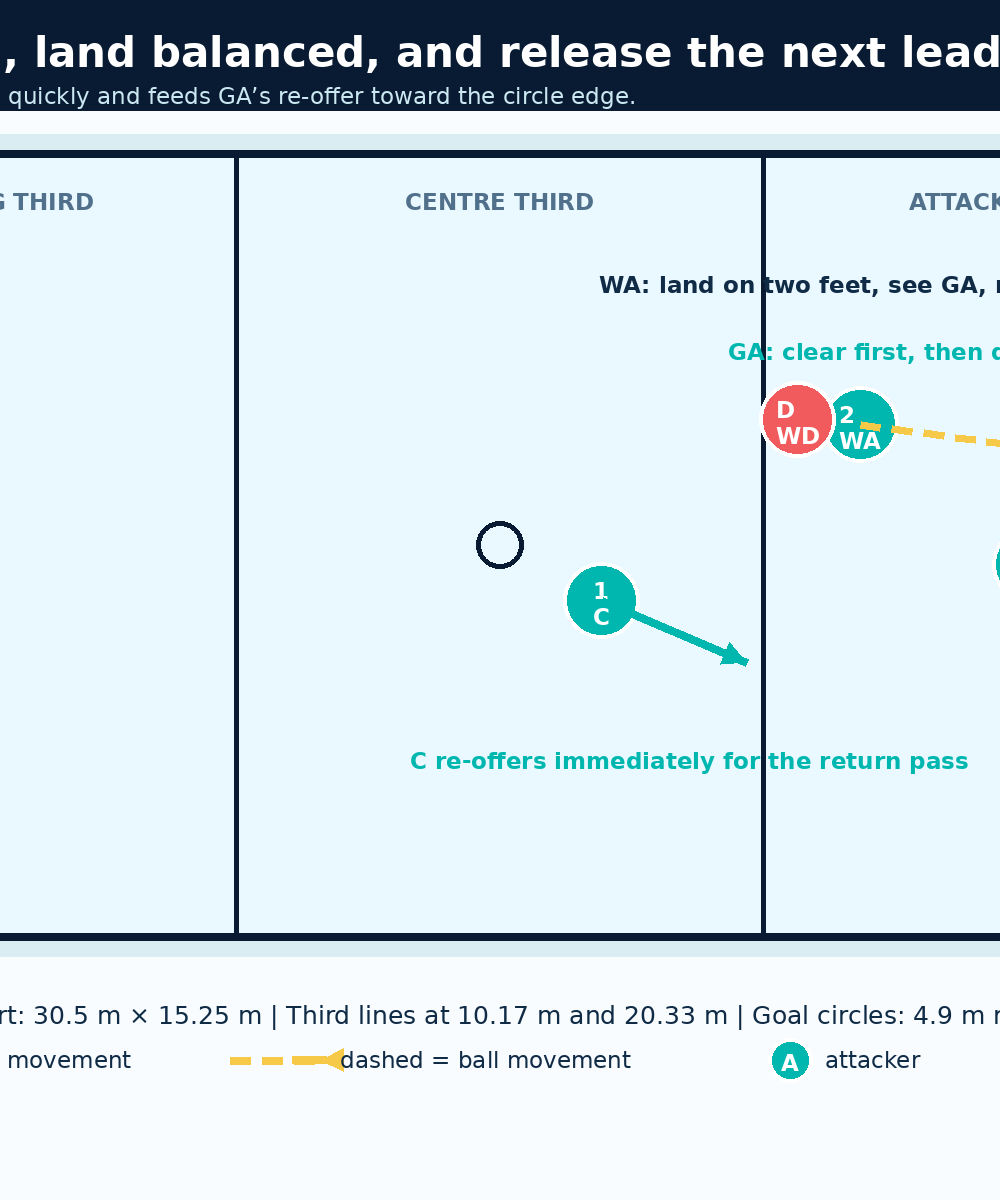
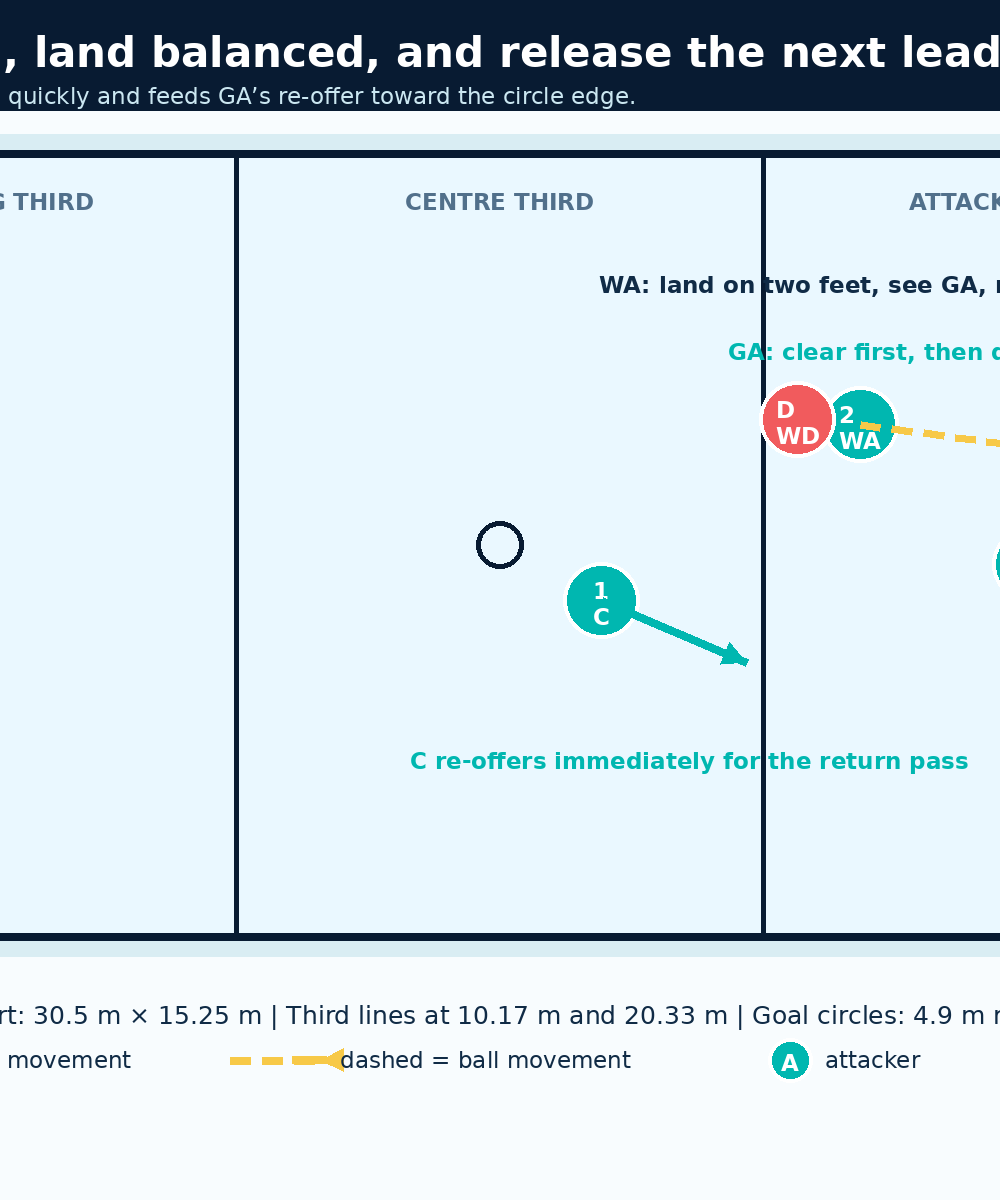
Run the unopposed feed. On the coach’s whistle, C feeds a chest pass into WA’s forward space. WA receives on two feet where possible, lands balanced, and pivots to see GA. GA has already cleared away from GD, then drives toward the target gate at the circle edge. Give each trio four repetitions before rotating C to WA, WA to GA, and GA to the back of the C line.
- Add the catch-and-release. WA catches, scans, and releases to GA inside a calm three-second count. C immediately re-offers down and across as the safety outlet. WA’s first look is forward to GA; the second is back to C.
Introduce shadow defence. WD and GD track the first two metres at 50–60% intensity but do not intercept. Attackers protect their line, show an outside arm, and adjust without losing timing.
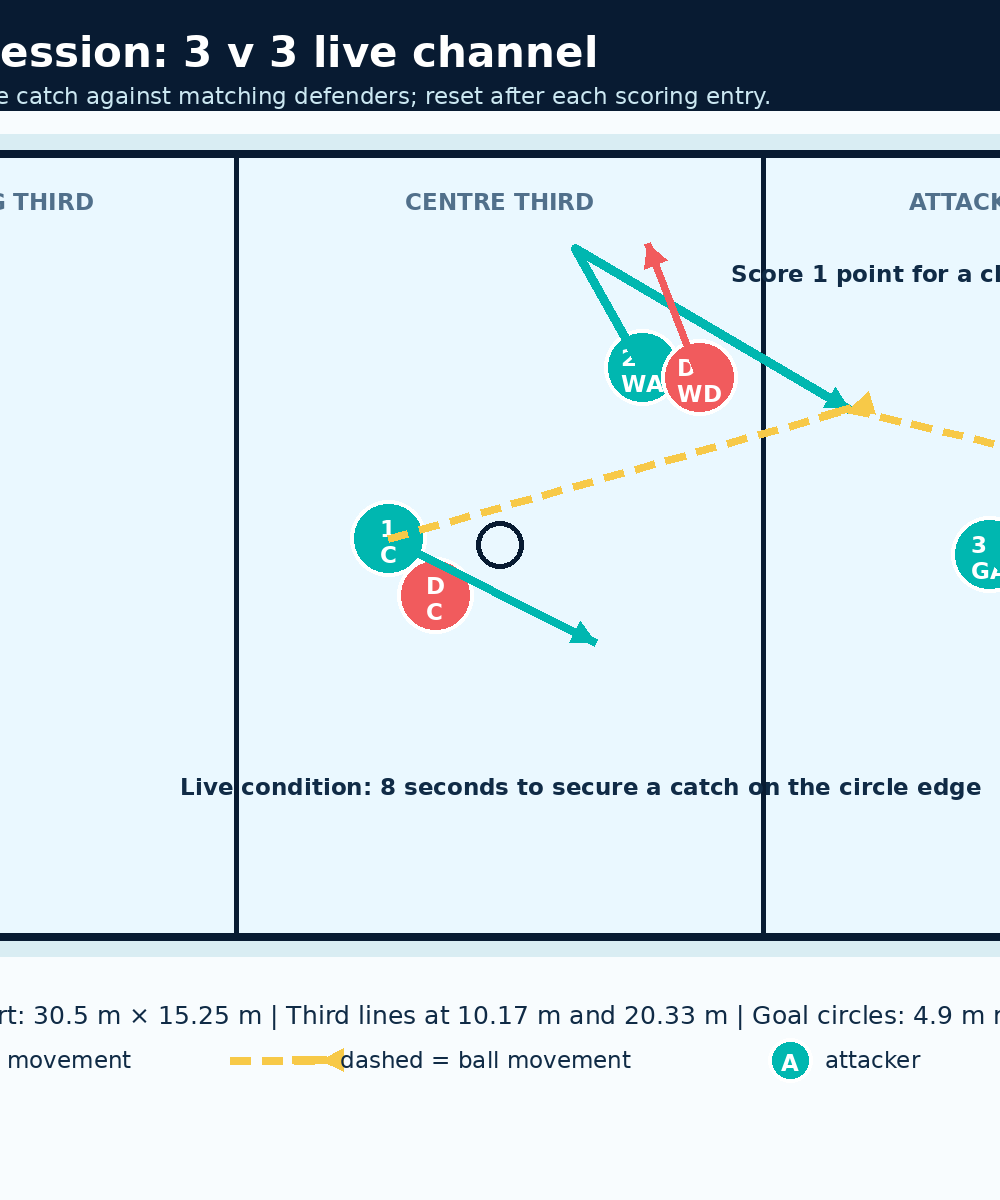
Progress to live 3 v 3. Allow WD, GD, and the opposing C to contest fully. Start the ball with attacking C and give the unit 8 seconds to secure a controlled catch on the circle edge. Award one point for that catch, an extra point if GA or WA has clearly changed direction before receiving, and no point if an attacker runs into a teammate’s lane. Run three 45-second bouts with 20 seconds coaching/reset between bouts.
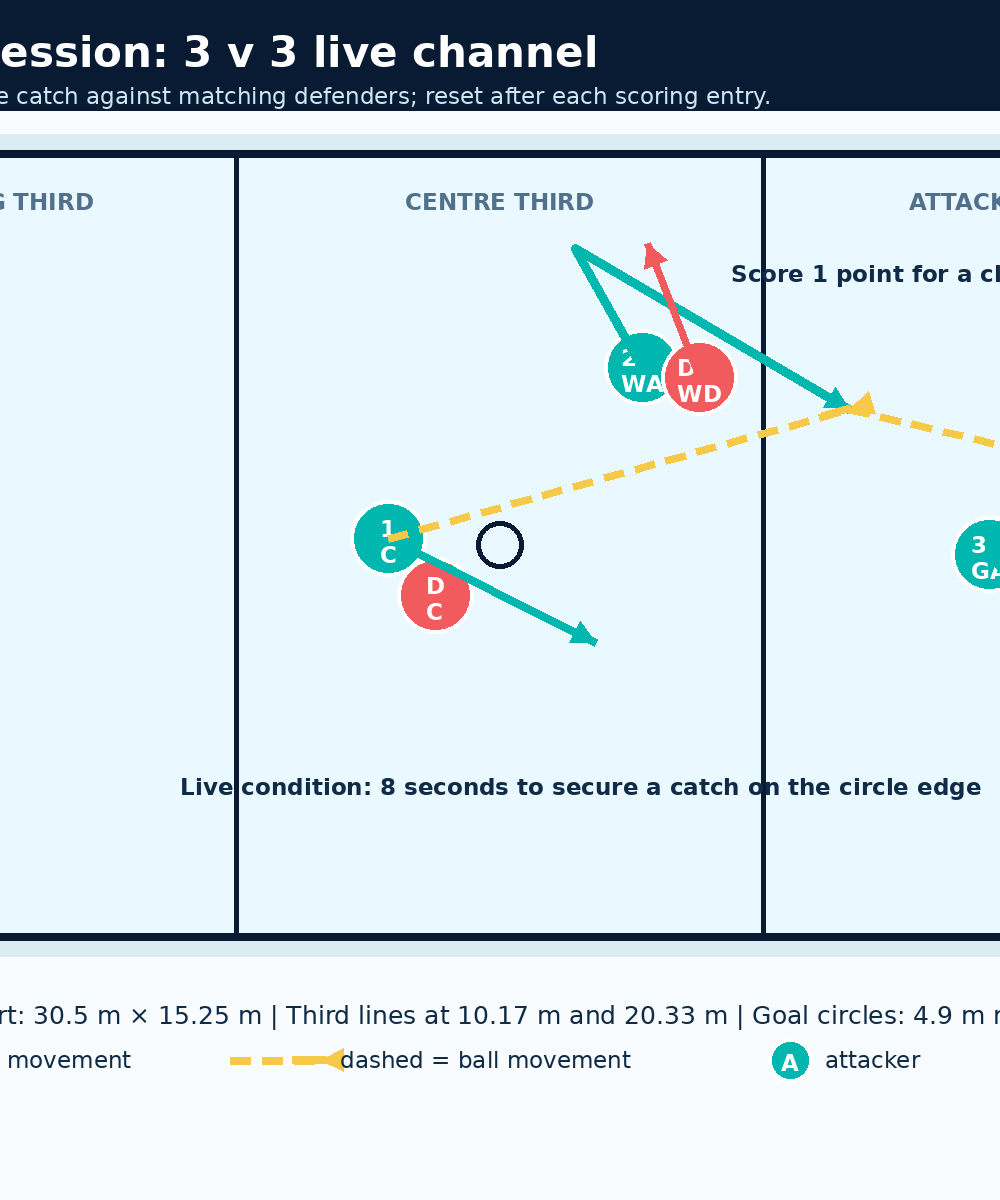
- Finish with a transfer challenge. Each group needs five consecutive circle-edge entries. Reset the count for a drop, interception, held ball, or catch outside the lane.
Key Coaching Points
| Coaching focus | Head-coach cue | What to correct immediately |
|---|---|---|
| Sell the clear | “Take the defender somewhere first.” | WA cannot simply drift sideways; the first move must create a defender reaction. |
| Plant to change direction | “Low hips, outside foot, then go.” | A high, rounded turn slows the front-cut and leaves the pass behind the runner. |
| Pass to space | “Feed the next step, not the bib.” | C should release into WA’s path at chest height, not throw to the original position. |
| Present strong hands | “Show a target early.” | WA and GA need outside hand visible, eyes on the ball, and fingers ready before the catch. |
| Maintain depth | “One high, one driving.” | GA should not collapse into WA’s lane; clear first to preserve two passing options. |
| Re-offer after passing | “Pass and move again.” | C must create the safe return line, not admire the first pass. |
Coach’s standard: the best lead is not the fastest run; it is the run that arrives in front of the defender at the exact moment the feeder is balanced to pass.
Common Mistakes
| Error coaches will see | Why it happens | Quick correction |
|---|---|---|
| WA leads before C is set. | Players chase speed rather than connection. | Freeze the picture and require eye contact plus a clear ball presentation before the lead. |
| C passes as WA is clearing wide. | The feeder reads the first movement as the target. | Call “second step” aloud for two repetitions, then remove the cue. |
| GA stands inside WA’s driving lane. | Both attackers want the ball in the same moment. | Use the two-cone GA gate and require GA to clear away before the re-offer. |
| Attackers catch upright or on one unstable foot. | The ball arrives late or runners do not decelerate. | Reduce the pass distance by 2 m, rehearse the landing, then rebuild speed. |
| Defenders become passive spectators. | They do not have a defined job in the early stages. | Give WD the task of denying the first lead and GD the task of protecting the circle gate. |
Variations & Progressions
To simplify, remove defenders and use C–WA only: WA clears a cone, front-cuts through a 3 m gate, catches, and returns to C. Reverse the wide side each block so players lead and feed from both sides.
To progress, add a floating defender who can hunt the first pass. Then keep 3 v 3 live and give defenders a point for a forced backward pass; attackers must value width, depth, and the immediate re-offer.
Age Adaptations
| Group | Adaptation | Coaching emphasis |
|---|---|---|
| Under 8 | Use a 10 m × 8 m rectangle, no defenders, and a walking-to-jogging pace. | Big change of direction, two hands ready, and calling the receiver’s name. |
| Under 10 | Use a half-court, 3 m gates, and shadow defenders who cannot intercept. | Clear before leading; stop under control before passing. |
| Under 12 | Use the full third-to-third pattern shown, then introduce the 8-second condition. | Timing the second step and passing into forward space. |
| Under 14 and above | Use live 3 v 3, a floating interceptor, and score consequences for backward passes. | Reading defender body position, disguise, and re-offer speed. |
Finish by asking players to name the sequence—clear, front-cut, drive—and the best second option. Use World Netball’s standard C, WA, GA, WD, and GD initials consistently in bibs, diagrams, and feedback.1