

Netball
Goal Circle Shooting Accuracy & Movement Drill
A dynamic shooting drill designed to improve shooting accuracy under fatigue while developing strong attacking movements within the goal circle.
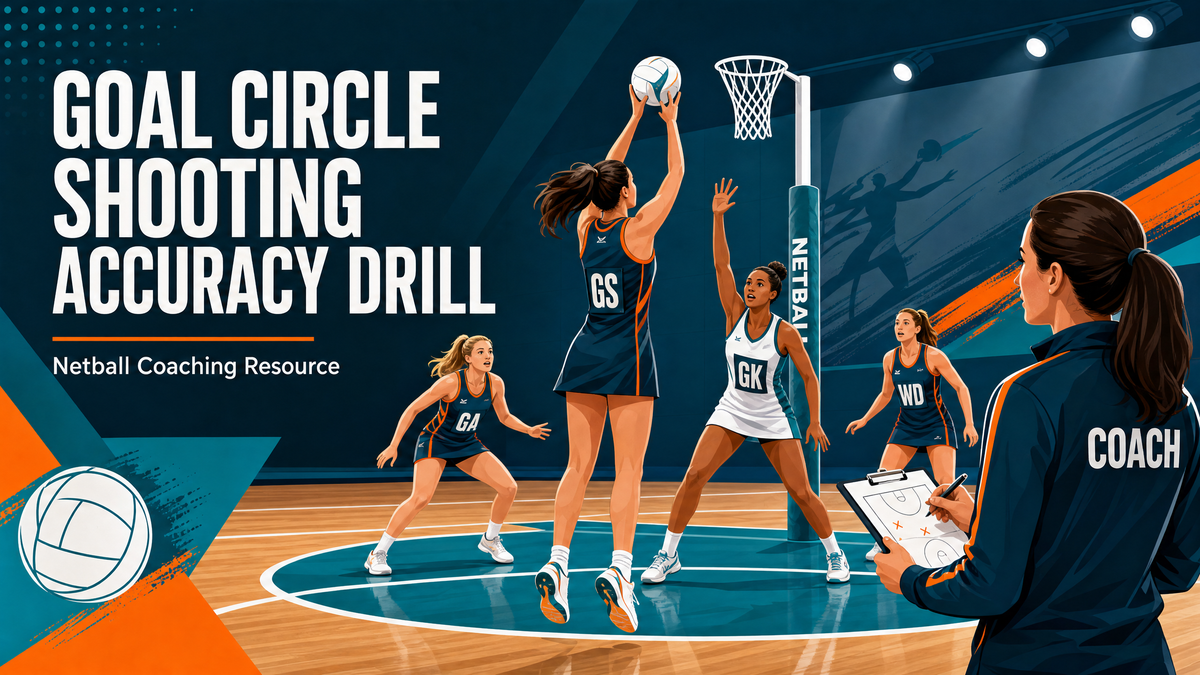
What you need
1 Netball post, 2-3 Netballs, 5 Marker cones, Bibs for defenders
Overview
This drill is designed to bridge the gap between static shooting practice and match-play scenarios. It focuses on developing shooting accuracy under fatigue, while also reinforcing strong, decisive movements within the 4.9m goal circle. By incorporating dynamic drives, V-cuts, and precise feeding, this drill ensures that your Goal Shooters (GS) and Goal Attacks (GA) are practicing game-realistic scenarios. Use this drill during the main body of your session after a thorough warm-up, particularly when focusing on attacking circle entry and shooting execution.
Setup
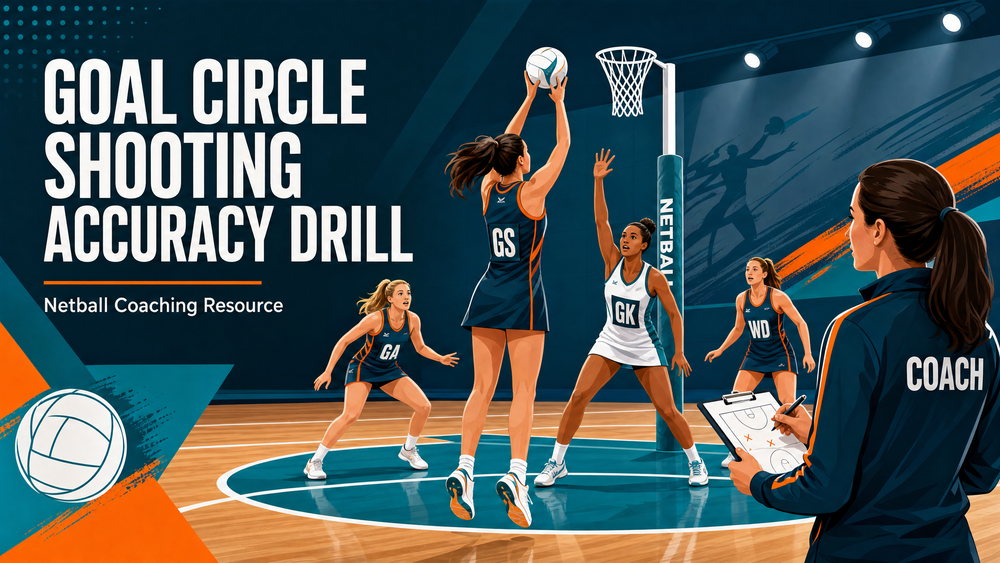
Equipment Needed:
- 1 Netball post
- 2-3 Netballs
- 5 Marker cones (optional, to mark shooting spots)
- Bibs for defenders (if using progressions)
Court Setup:
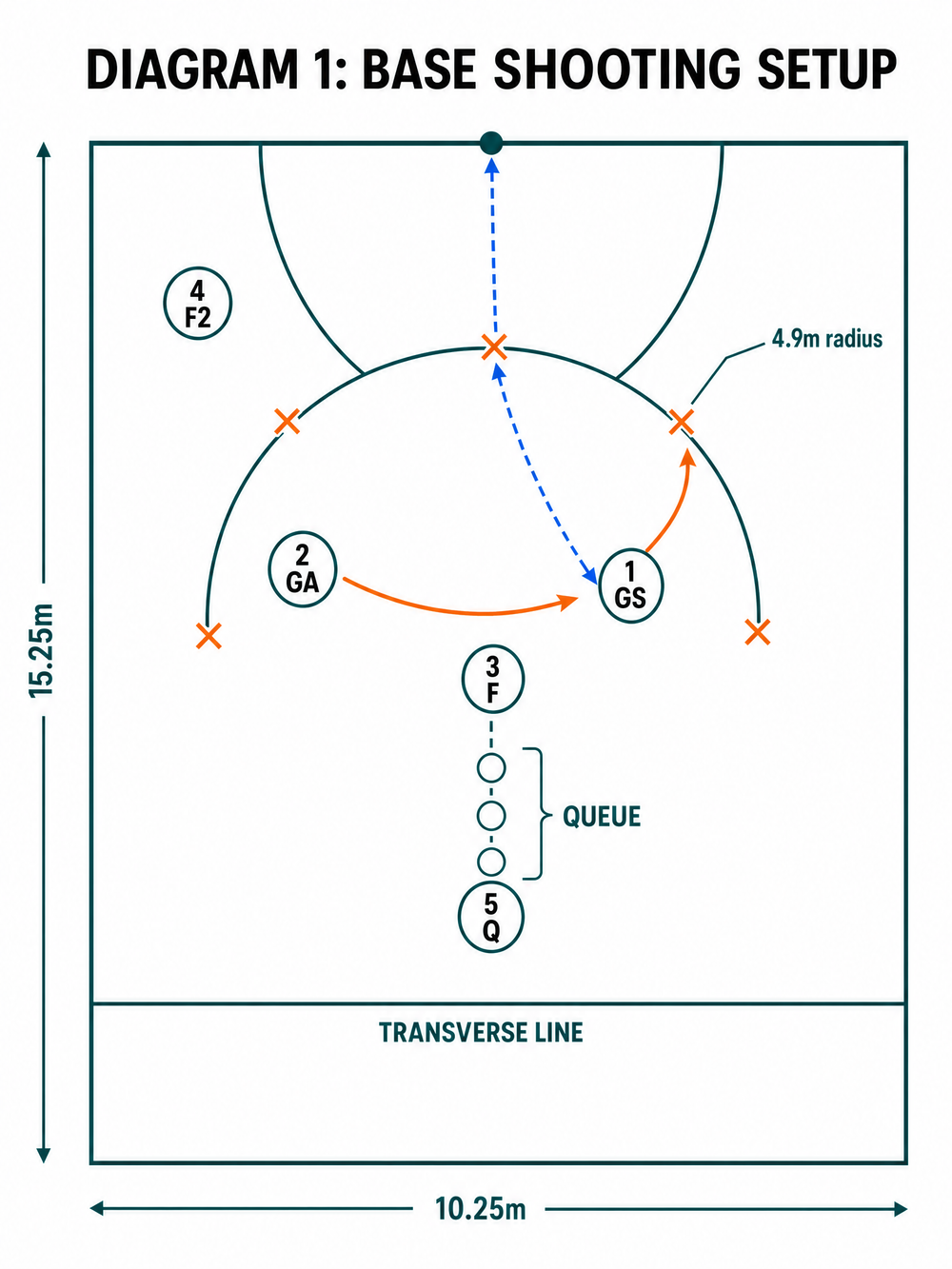
- Use the attacking third of the court (10.25m x 15.25m).
- Place marker cones at 5 distinct spots around the edge of the goal circle: 45 degrees left, 45 degrees right, straight in front, and two diagonal positions.
Player Positions:
- GS (Goal Shooter): Starts inside the goal circle near the post.
- GA (Goal Attack): Starts inside the goal circle on the opposite side.
- F (Feeder): Starts just outside the top of the goal circle.
- Queue: Remaining players line up behind the Feeder.
Step-by-Step Instructions
Phase 1: Base Setup (Uncontested)
- Starting Position: The GS starts on the baseline near the post. The GA is positioned on the edge of the circle. The Feeder holds the ball at the top of the circle.
- The Drive: The GS makes a strong, decisive drive from the post out towards one of the marked spots on the edge of the circle.
- The Feed: The Feeder delivers a sharp, accurate pass to the GS as they hit the edge of the circle.
- The Shot: The GS receives the ball, balances quickly, and takes a shot.
- The Rebound: The GA cuts across the circle to position themselves for a potential rebound.
- Rotation: After the shot, the GS moves to the queue, the GA becomes the new GS, the Feeder becomes the GA, and the first person in the queue becomes the new Feeder.
Phase 2: Progression - Defender & Multi-Feed
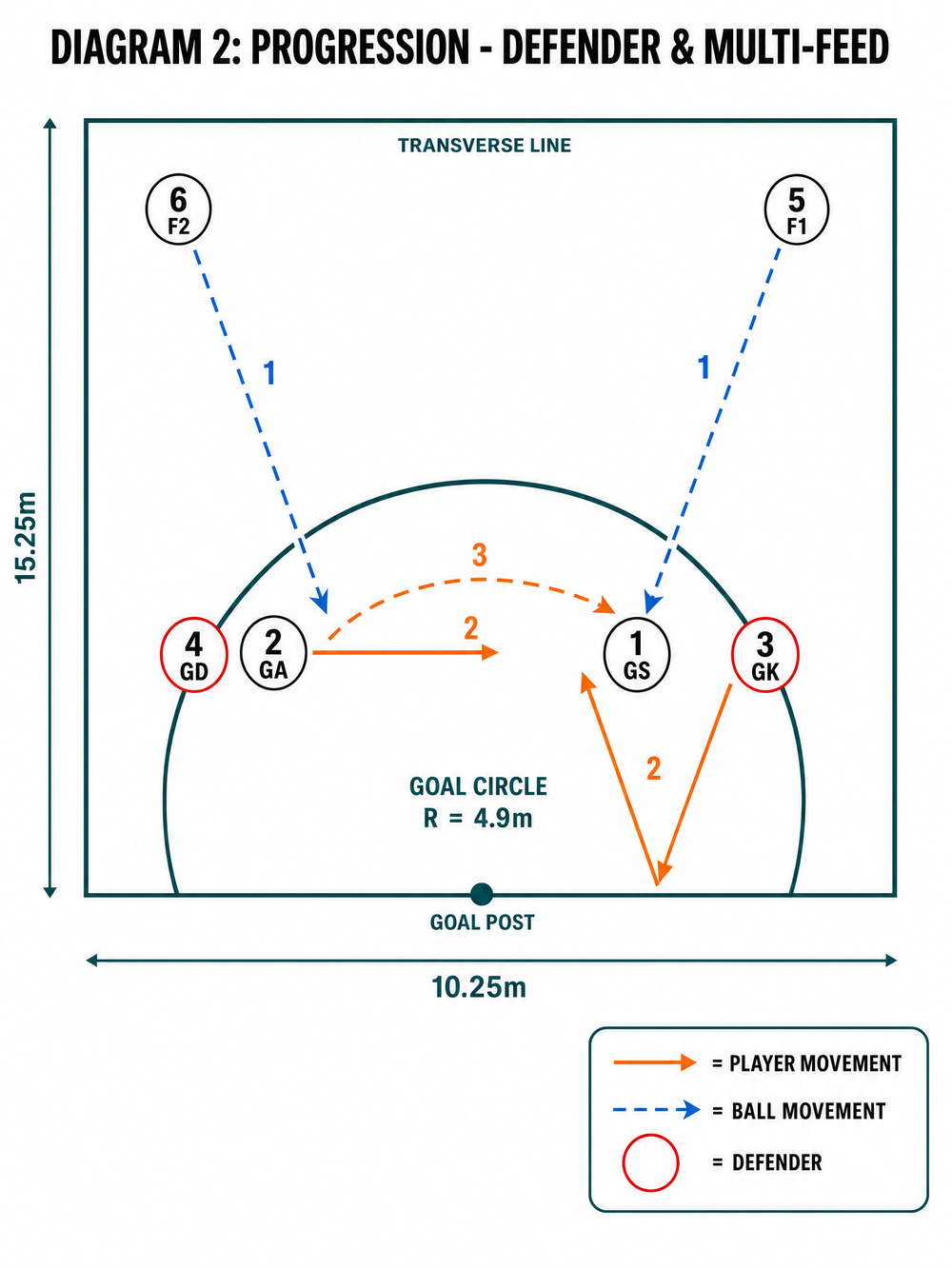
- Adding Defense: Introduce a Goal Keeper (GK) to defend the GS, and a Goal Defence (GD) to defend the GA.
- Multi-Feed Setup: Position two Feeders (F1 and F2) outside the circle.
- Dynamic Movement: The GS must now use a sharp V-cut or roll to lose the GK and drive to the circle edge.
- Options: F1 can feed the GS, or F2 can feed the GA.
- Circle Play: If the GA receives the ball, they look to pass to the GS closer to the post (second-phase pass), or take the shot themselves if in a good position.
Key Coaching Points
- Decisive Movement: Emphasize strong, sharp movements. Players should sprint to the edge of the circle, not jog.
- Balance Before Shooting: Shooters must establish a solid, balanced base before attempting the shot. Rushed shots lead to inaccuracy.
- High Release: Encourage shooters to release the ball high above their head with a smooth follow-through.
- Accurate Feeding: Feeders must pass to the space in front of the driving shooter, allowing them to take the ball on the move.
- Rebound Positioning: The non-shooting attacker must anticipate the shot and aggressively position themselves for the rebound.
Common Mistakes
- Drifting on the Shot: Shooters failing to set their feet and drifting sideways while shooting.
- Weak Drives: Attackers making half-hearted runs, making it easy for defenders to intercept.
- Poor Feed Timing: Feeders passing too early or too late, forcing the shooter to break their stride.
- Ignoring the Rebound: Attackers assuming the shot will go in and failing to contest the rebound.
Variations & Progressions
- Time Pressure: Set a target for the number of successful shots within a 2-minute window to simulate match pressure.
- Conditioned Defense: Start with passive defense (hands down) and progress to fully contested defense.
- Distance Challenge: Require shooters to take a step back from their preferred shooting spot to extend their range.
Age Adaptations
- Under 8 / Under 10: Focus purely on the base setup without defenders. Lower the goal post if necessary. Emphasize basic shooting technique and having fun.
- Under 12 / Under 14: Introduce passive defense. Focus on the timing of the drive and the accuracy of the feed.
- Under 16 / Open: Run the full progression with active, intense defense. Incorporate physical conditioning elements (e.g., a sprint to the transverse line before entering the circle).
