

Netball
The 'Lightning Strike' Centre Pass Set Play
A fast-paced, high-percentage centre pass set play designed to bypass the midcourt defence and deliver the ball to the Goal Shooter in three quick passes.
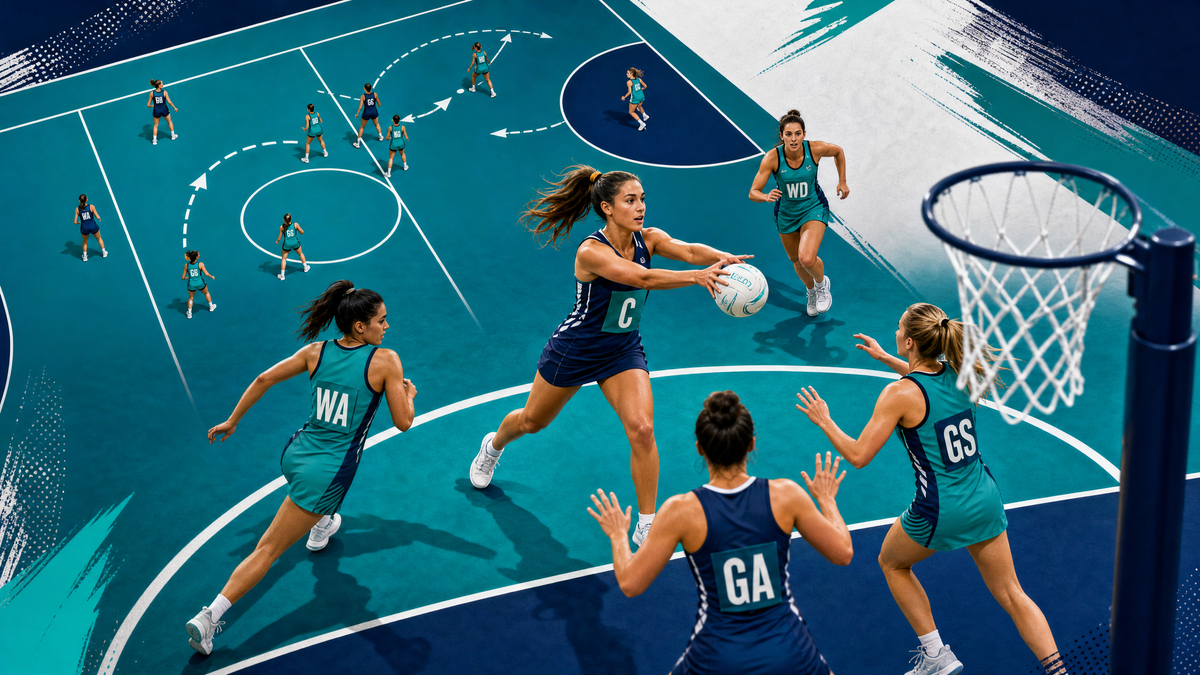
What you need
1 Netball, Netball Court (30.5m x 15.25m), Team Bibs
Overview
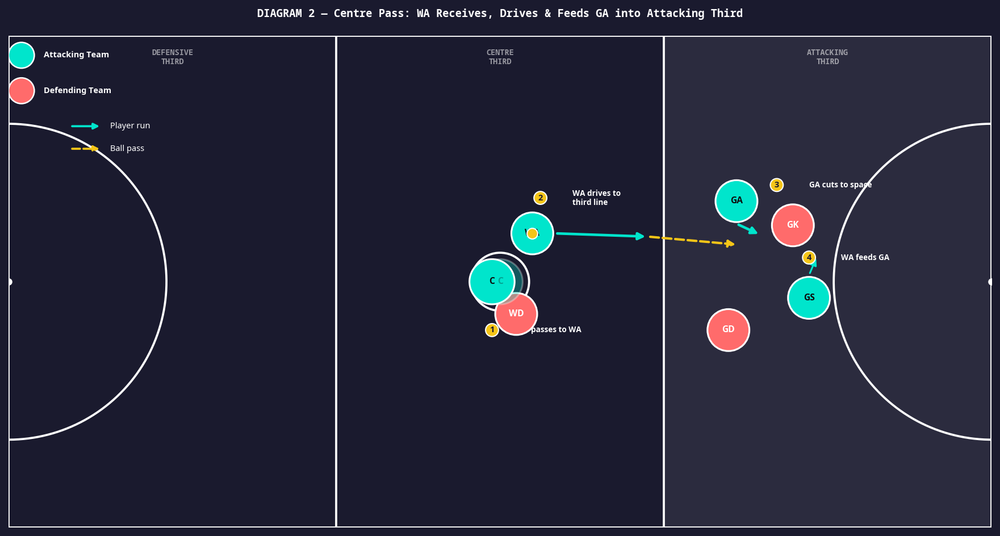
The 'Lightning Strike' is a rapid, three-pass centre pass set play designed to catch the opposition off guard and deliver the ball straight to the Goal Shooter (GS) holding prime position under the post. This play relies on decisive preliminary movements, sharp changes of direction, and precise timing. It is highly effective against a heavily structured zone defence or when your team needs a quick goal to shift momentum.
By drawing the defending Goal Defence (GD) out of the circle with a sharp cut from the Goal Attack (GA), and using the Wing Attack (WA) as the crucial link player, the 'Lightning Strike' isolates the GS one-on-one against the Goal Keeper (GK), creating a high-percentage scoring opportunity.
Setup
Equipment Needed:
- 1 Netball
- Full standard netball court (30.5m x 15.25m)
- Bibs for two teams (7 vs 7)
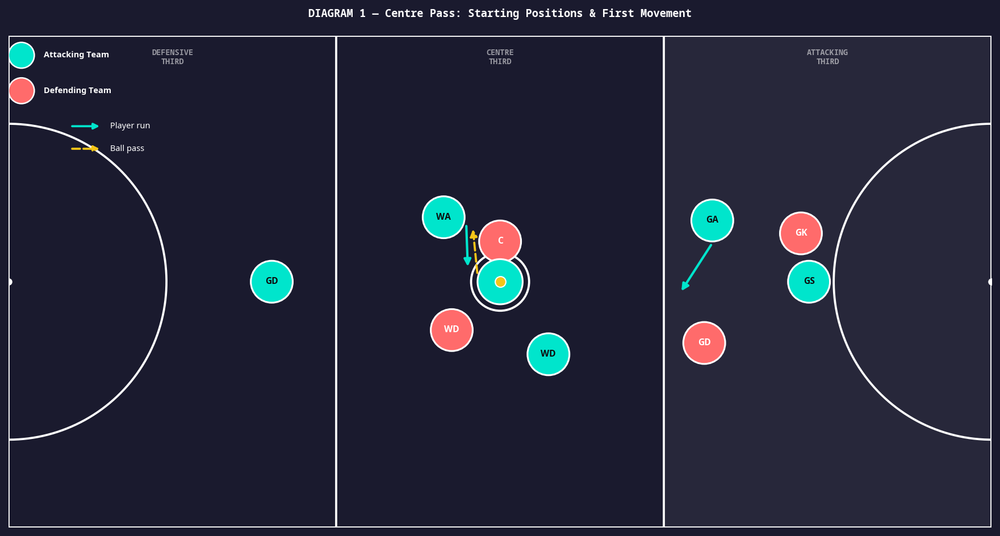
Player Starting Positions:
- Centre (C): Inside the centre circle, holding the ball, ready for the whistle.
- Wing Attack (WA): Positioned in the centre third, near the left sideline, setting up a strong drive toward the centre circle.
- Goal Attack (GA): Positioned in the attacking third, preparing to cut sharply from the wing toward the transverse line.
- Goal Shooter (GS): Holding space deep in the goal circle, engaging the GK.
- Wing Defence (WD) & Goal Defence (GD): Positioned defensively to cover any immediate transition if the play breaks down.
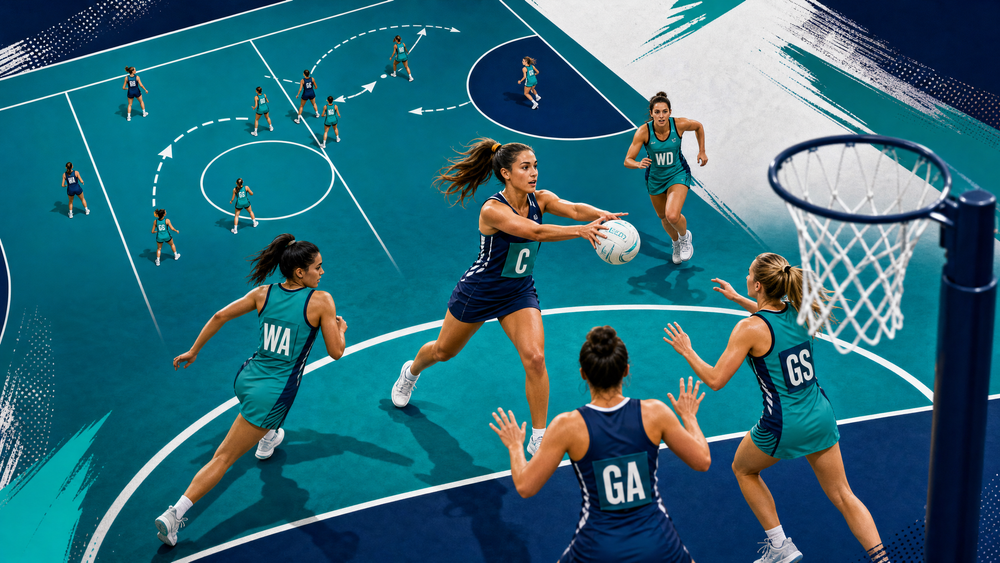
Step-by-Step Instructions
Phase 1: The Initial Drive
- The Whistle: On the umpire's whistle, the WA makes a hard, decisive sprint from the sideline toward the centre circle to receive the first pass.
- The Delivery: The C executes a crisp, flat chest pass to the WA exactly as they hit the top of the centre circle.
- The Decoy: Simultaneously, the GA pushes wide toward the sideline to draw the defending GD away from the middle corridor.
Phase 2: The Midcourt Link
- The Drive: Upon receiving the ball, the WA immediately turns and drives aggressively toward the attacking transverse line.
- The Cut: The GA plants their outside foot and cuts sharply back into the middle corridor, driving into the space created at the top of the attacking third.
- The Feed: The WA delivers a perfectly timed, leading pass into the path of the cutting GA.
Phase 3: The Final Strike
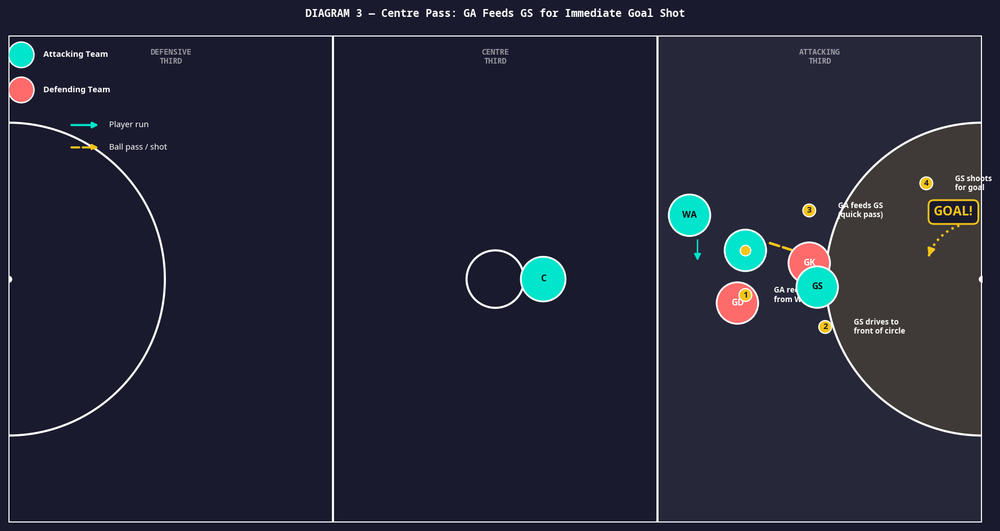
- The Hold: As the ball travels to the GA, the GS uses strong body positioning to hold the defending GK behind them, stepping slightly out to create a clear passing lane.
- The Final Feed: The GA catches the ball, lands in a balanced position on the circle edge, and immediately feeds a quick, direct pass (often a bounce pass or lob, depending on the GK's position) to the holding GS.
- The Shot: The GS receives the ball close to the post, turns, and executes a high-percentage shot.
Key Coaching Points
- Timing is Everything: The WA must hit the top of the centre circle exactly as the ball is released by the C. If they are too early, they will be covered; if too late, the play slows down.
- Strong Preliminary Moves: The GA must sell the initial wide movement. The harder they push wide, the more space they create for their inward cut.
- Vision and Awareness: The WA must have their eyes up before they catch the ball. They need to anticipate the GA's cut and release the pass without hesitation.
- Strong Holding: The GS must be physically strong and hold their ground against the GK. A weak hold will result in an interception or a heavily contested pass.
- Flat, Hard Passes: To beat the defence, passes must be flat, fast, and placed out in front of the receiver.
Common Mistakes
- Hesitation on the Pass: The C or WA taking an extra second to look for options, allowing the defence to recover and set their zone.
- Weak Cuts: The GA running in a curved line rather than making a sharp, angled cut off the outside foot, making it easy for the GD to stay with them.
- Crowding the Space: The GS leading out too far or too early, bringing the GK into the space where the GA is trying to operate.
Variations & Progressions
- The Fake and Go: If the defending WD anticipates the WA's drive, the WA can fake the drive to the centre circle, spin, and drive deep down the sideline to receive a longer pass from the C.
- The GA First Option: If the WA is heavily heavily tagged, the GA can make the primary drive to the transverse line to receive the centre pass directly, with the WA cutting into the attacking third as the secondary option.
- Add Defensive Pressure: During practice, start with passive defenders and gradually increase the intensity to full, match-level pressure to test the timing and execution.
Age Adaptations
- Under 10s / Under 12s: Focus purely on the C to WA pass and the WA to GA pass. Simplify the movements and allow for lob passes. Emphasise the concept of moving into empty space.
- Under 14s / Under 16s: Introduce the sharp cuts and changes of direction. Emphasise flat, hard chest passes and the importance of the GS holding strong position.
- Open / Advanced: Execute at full match speed. Incorporate the variations and focus on the split-second decision-making required by the WA and GA.
