Penalty Pass Advantage: Two-Phase Circle Entry Set Play
Teach your attackers to turn a penalty pass in the attacking third into a disciplined first-window feed, a fast reset, and a high–low shooting finish.

Equipment Needed
Overview
A penalty pass is an attacking moment when your side uses the whistle to organise, not stand still. This play is for an attacking-third penalty, roughly 10–13 m outside the circle. It creates a first-window feed to Goal Attack (GA); if Goal Defence (GD) wins that contest, Centre (C) resets quickly to Wing Attack (WA) and the shooters attack before the defence re-forms. The finish is deliberately high–low: one shooter holds depth while the other becomes the active ball option.
Use it after contact or obstruction, once the umpire has established the mark. A penalty pass permits a shot, and the offending player must stand by the player in possession until the ball is played.2 Coach the first decision as: correct mark, eyes up, then execute.
World Netball’s court is 30.5 m long by 15.25 m wide, divided into equal thirds, with a 4.9 m-radius goal circle at each end.1 Marking those lines accurately matters: it teaches WA to stay outside the circle, keeps C in a legal area, and gives GA and GS a realistic finishing picture.
Setup
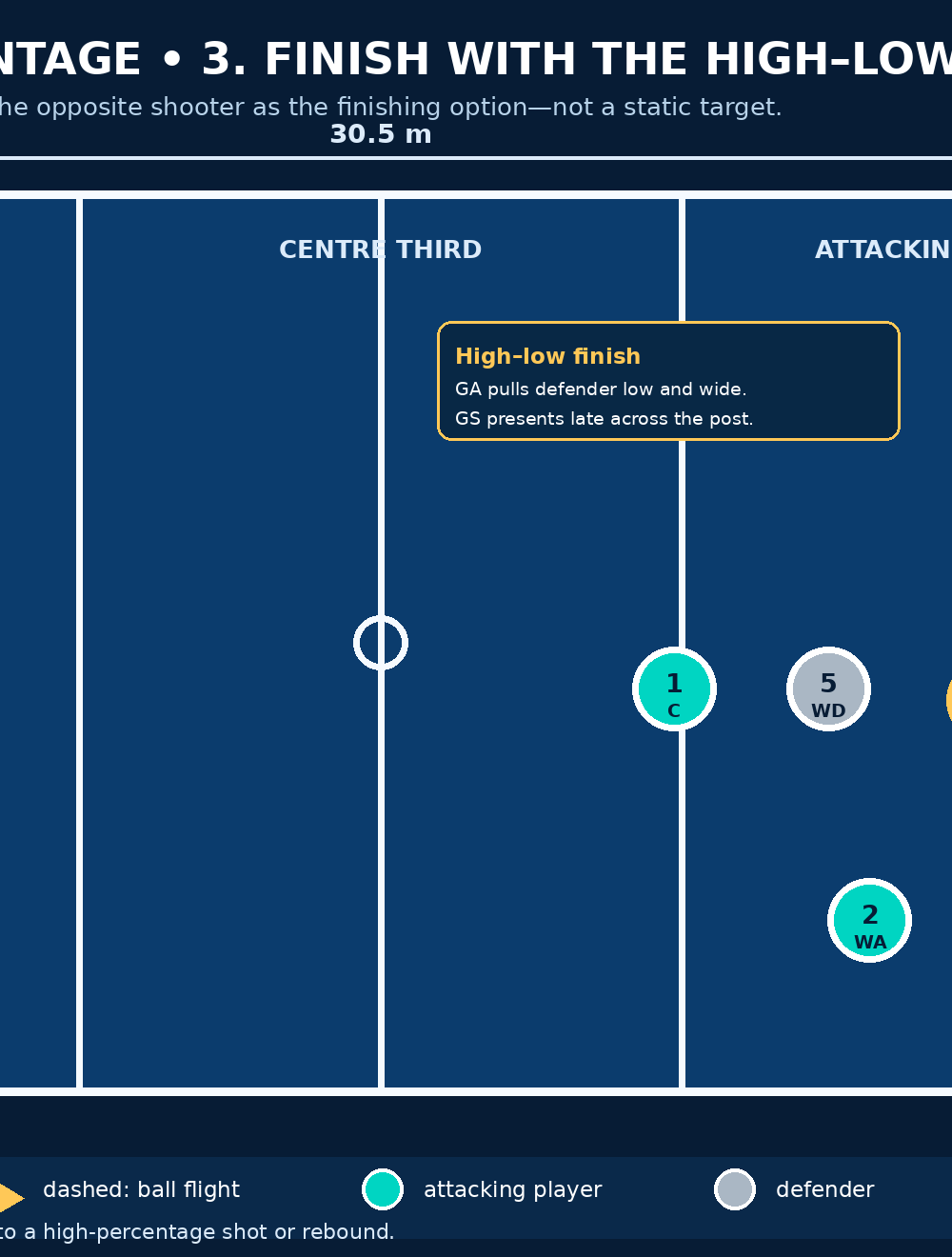
Set on a full court or the attacking third plus 5 m of centre third. Put the penalty cone 2 m inside the attacking transverse line and 1.5–2 m from the sideline. The ball starts with 1 C. Set 2 WA 3–4 m wider and lower, 3 GA 2–3 m outside the circle, and 4 GS on the post-side. Defenders are 5 WD on C’s next action, 6 GD on GA, and 7 GK on GS.
| Number | Position | Starting responsibility | Coaching cue |
|---|---|---|---|
| 1 | C | Take the penalty pass and scan | “Set, see, release.” |
| 2 | WA | Provide the safe reset outside the circle | “Wide hands, hips to goal.” |
| 3 | GA | Make the first front cut, then re-offer | “Sell the lead, change the picture.” |
| 4 | GS | Hold depth and separate from GA | “Own the post-side space.” |
| 5 | WD | Apply legal recovery pressure after release | “Delay the second ball.” |
| 6 | GD | Decide whether to take GA’s first cut | “Win front space or protect circle.” |
| 7 | GK | Protect the post and read the second shooter | “Stay tall, see ball and player.” |
Use 10 players for continuous practice, or seven without live defenders. Use two balls, bibs, 8–12 flat cones, a whistle and a visible three-second count. Place two GA landing cones: one 1.5 m outside the circle and the other 2 m nearer the baseline.
Step-by-Step Instructions
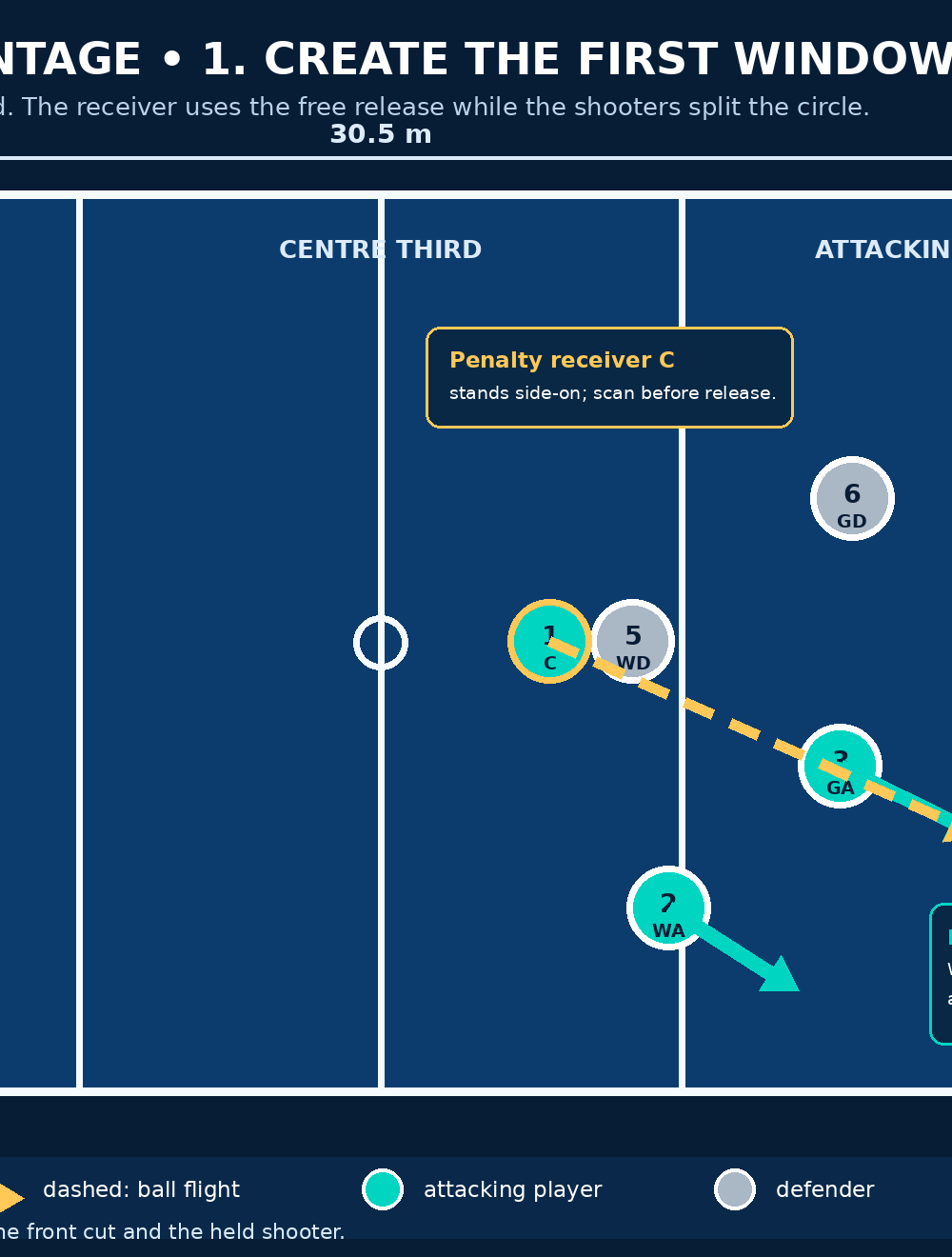

Phase 1 — Create the first window
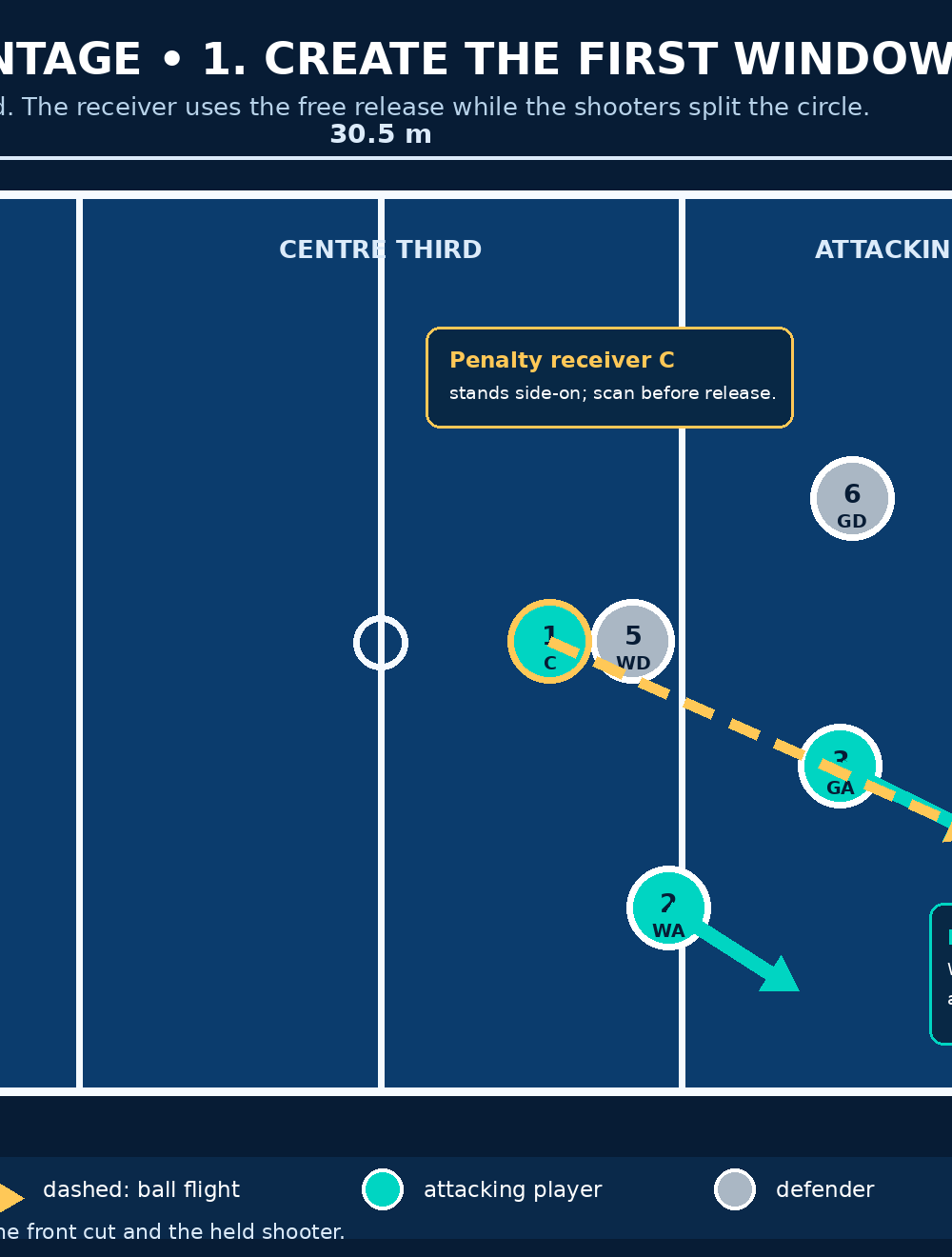
Whistle and establish the mark. C arrives side-on, feet balanced and chest open to GA. The coach holds 5 out of the immediate contest. C scans GA first, GS second and WA third; she does not pre-call the pass.
Clear three lanes. On C’s eye contact, WA drives wide and down-court. GA cuts hard to the lower cone, finishing about 1.5 m outside the circle. GS holds high enough to threaten the post but far enough away that GK cannot cover both shooters. Demand separation, not merely speed.
Use the free release. C feeds GA only when GA wins front shoulder and can receive side-on. Pass crisply to GA’s outside hand. The legal window is three seconds; target a decision and release inside 1.5 seconds. If GD owns front space, C calls “reset.”
GA lands, turns and decides. GA looks first for high GS, then for a short WA drop. GA puts body between GD and ball, stabilises the landing foot and lifts eyes. Do not reward an off-balance, low-percentage shot.
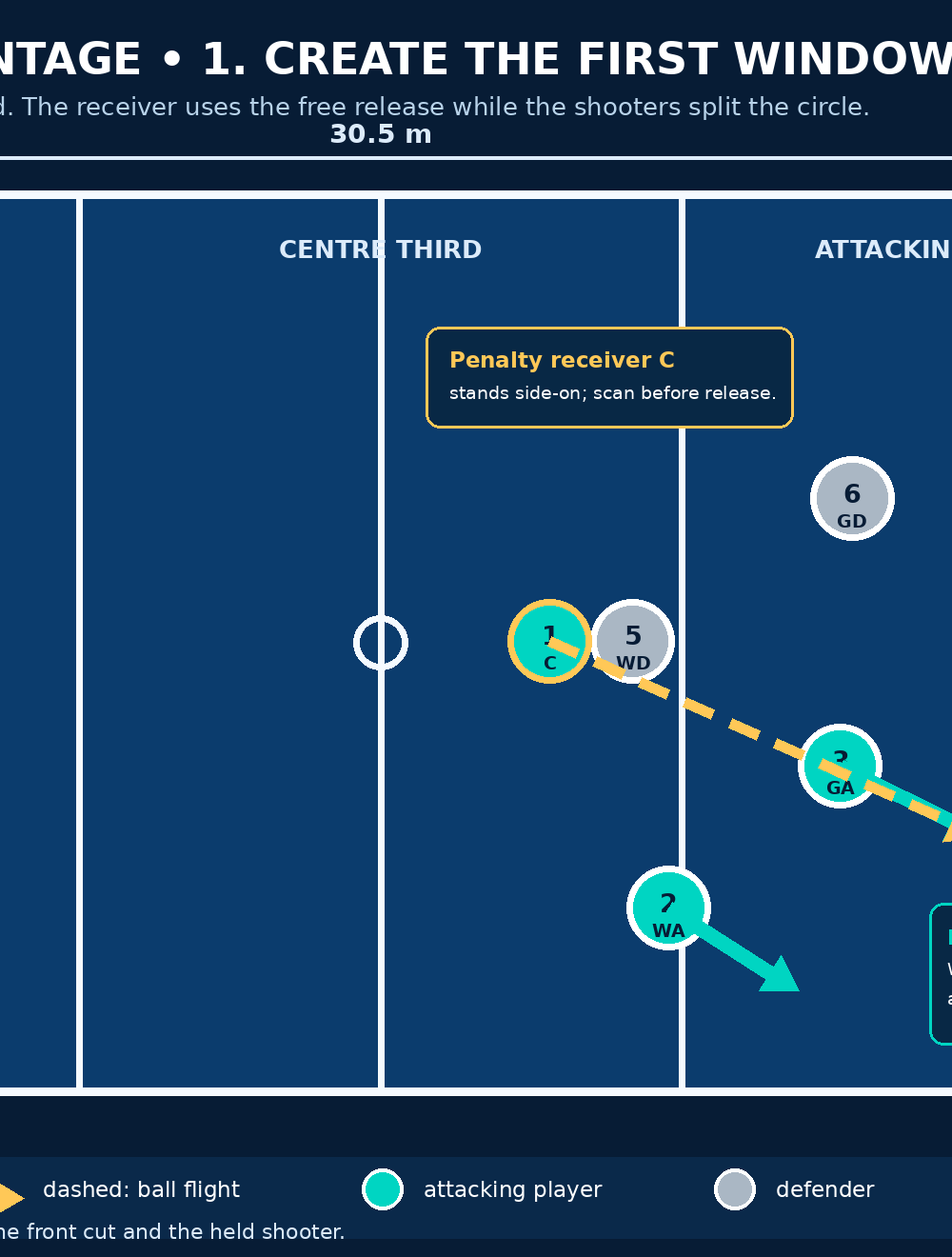
Phase 2 — Punish the recovery
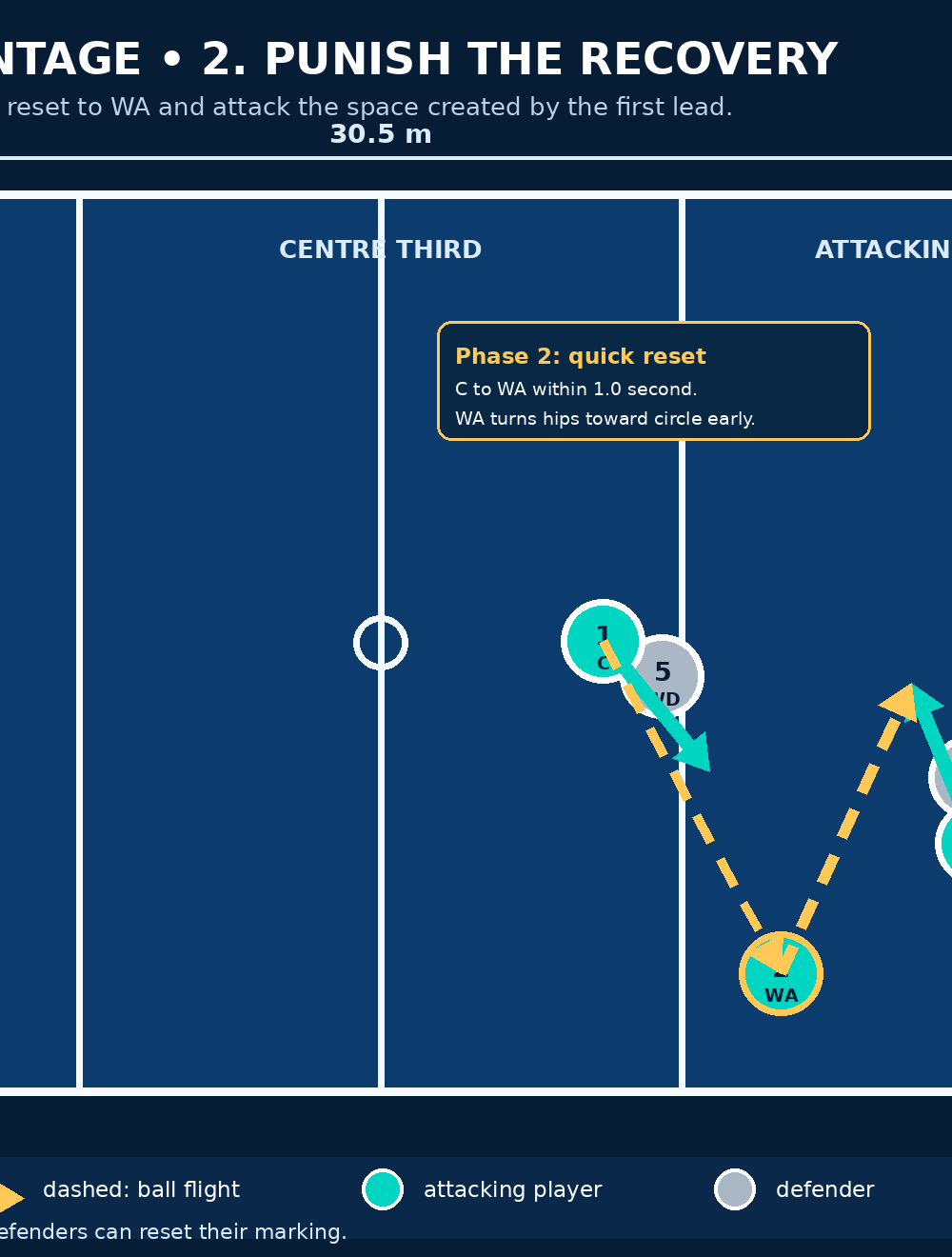
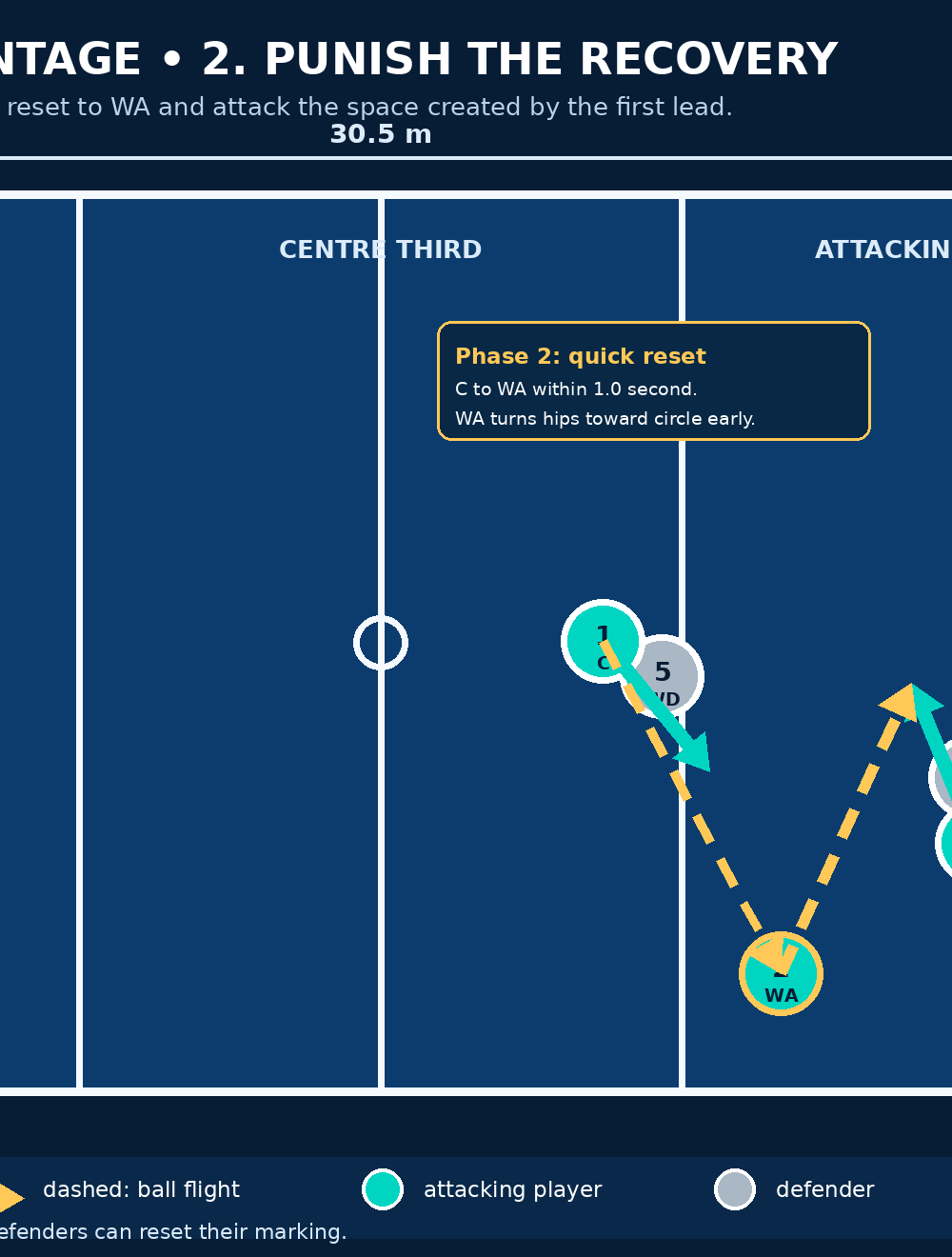
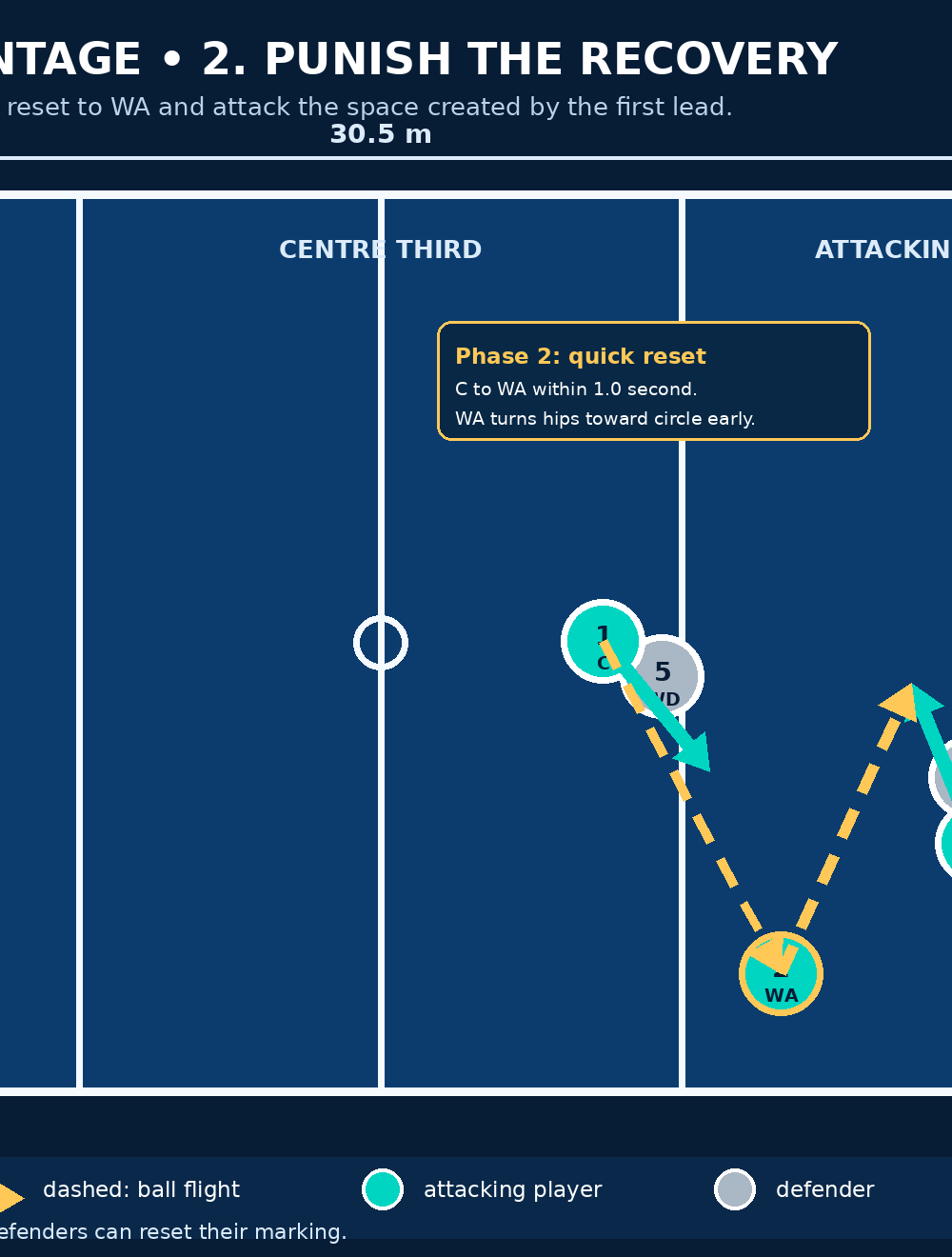
Reset at pace when the first pass is denied. C uses WA as the outlet. The C–WA reset travels in under one second; WA receives outside the circle and already turned toward goal. C follows by 2–3 m to occupy WD and offer a return.
Run the second GA lead. As C passes to WA, GA drives away for one step, plants, then re-offers in front of GD. GS slides across the post-side line, not toward GA. WA feeds GA’s front hand or GS late; a floated ball invites an intercept.
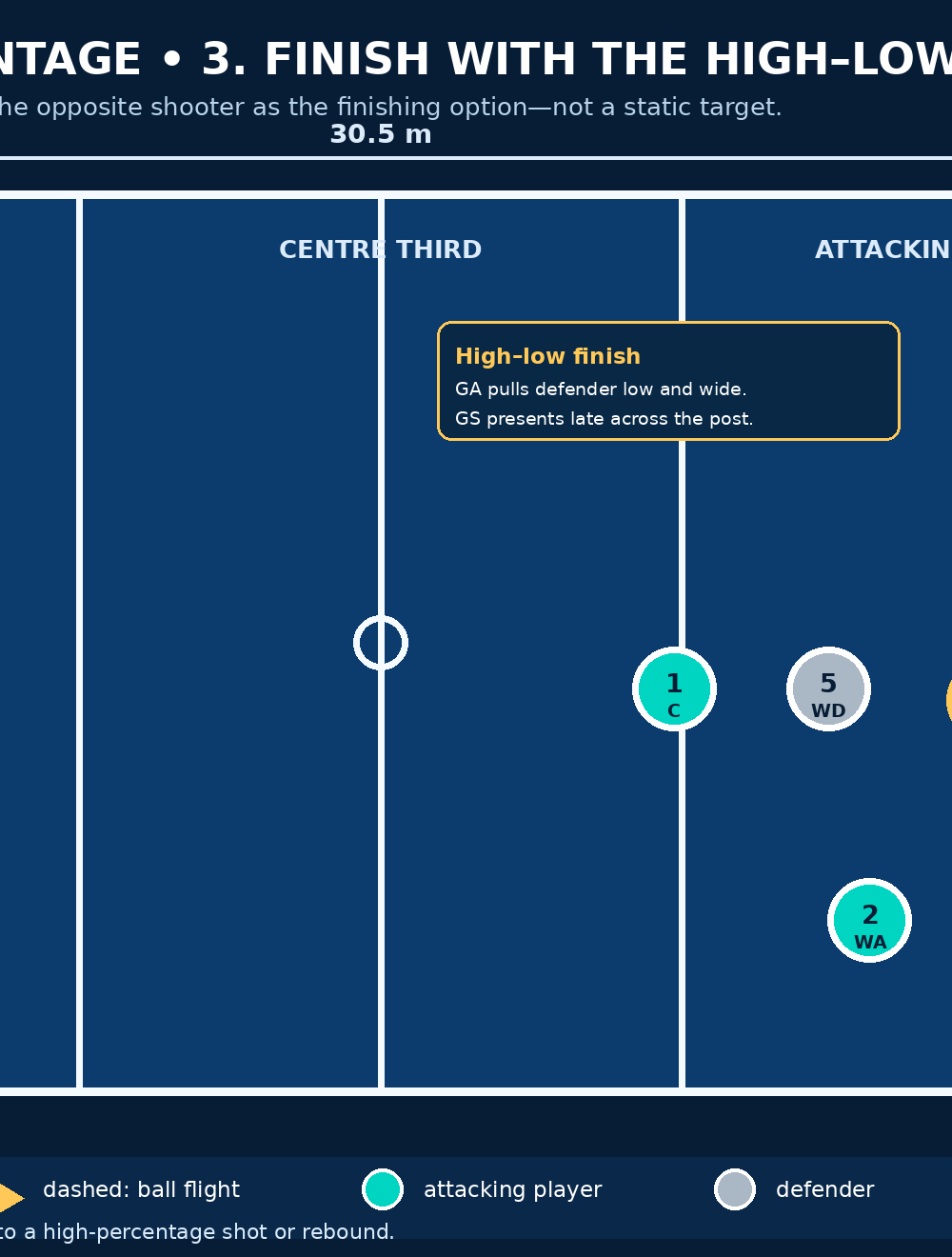
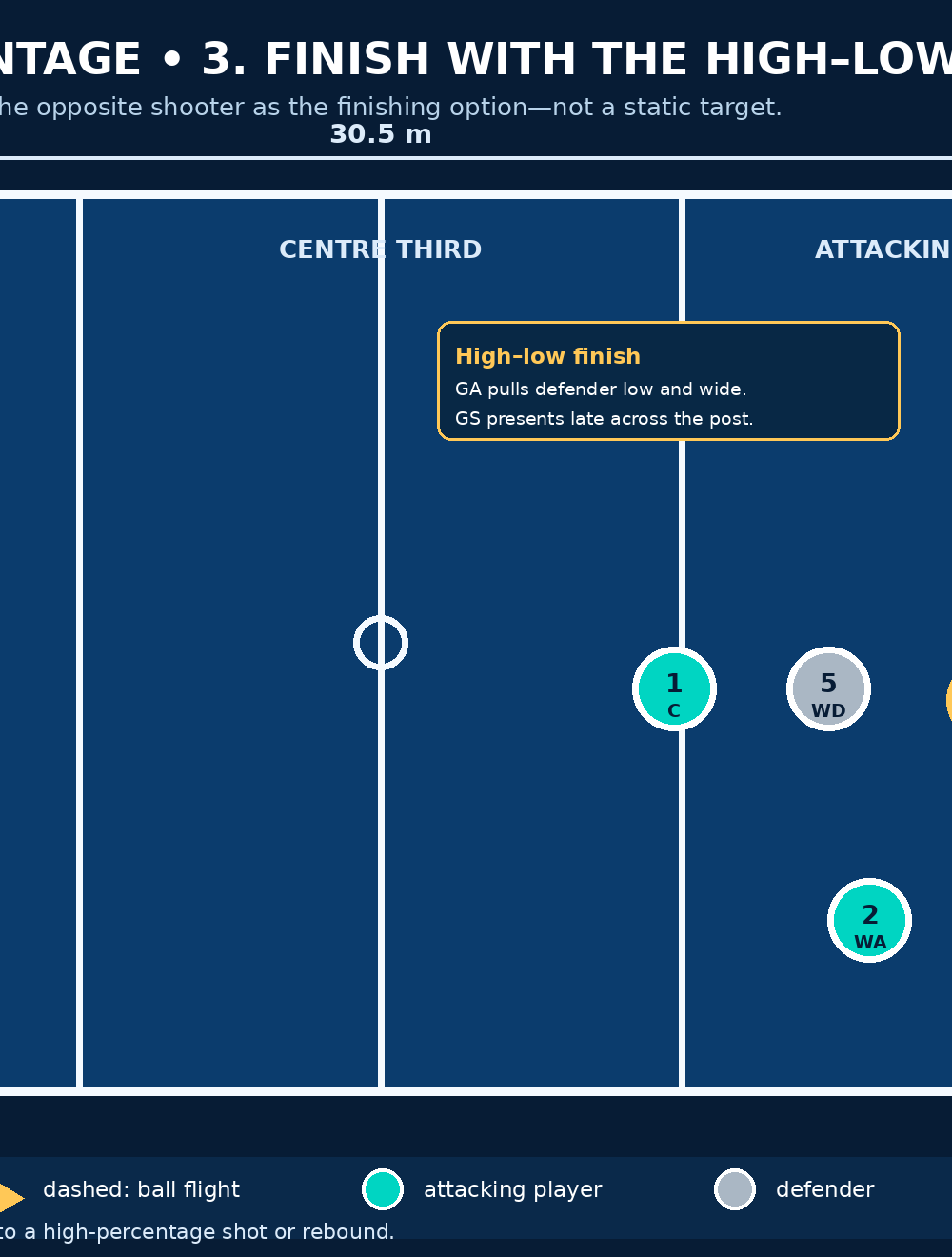
Finish with high–low discipline. GA drags GD low and wide while GS presents late across the post. If GS receives, GA stays active for rebound or return. A controlled recycle is successful when defenders have closed the shot.
Key Coaching Points
| Priority | What to coach | Why it changes the play |
|---|---|---|
| Penalty discipline | C waits for the correct mark and sets feet before playing. | It protects possession and keeps the practice legal. |
| Timing | GA leaves on C’s eye contact, not on the whistle. | It stops the first lead being predictable. |
| Width | WA stays 3–4 m outside the ball line and never enters the circle. | It preserves an outlet and a legal delivery lane. |
| Separation | GS holds a different depth and side of the circle from GA. | One defender cannot screen both shooters. |
| Ball quality | Feed to the outside/front hand with pace, not loft. | It reduces GD’s intercept window. |
| Decision-making | “First window, reset, finish” is a sequence, not a compulsory pass. | Players learn to exploit the defence actually in front of them. |
Common Mistakes
The common error is C forcing GA after GD has won front position. Freeze the rep and ask C for the second option. WA may drift too close to the circle or square behind C; use a wide outlet cone and require target hands. GA and GS can finish in one channel, allowing GD and GK to cover both; rehearse separated starting landmarks. Finally, players can confuse urgency with panic. Use a loud three-second count, but praise the reset as strongly as direct circle entry.
Variations & Progressions
Begin with a guided progression: remove defenders 5–7, pre-call the first option and allow C four seconds to scan. This is ideal when installing the pattern. Next, add GD and GK only; C must choose GA or the reset, while WA and GS learn how their positioning changes the defenders’ picture. Finally, run a live decision progression with all three defenders, an umpire/coach setting a realistic penalty mark, and a point system: two points for a shot within two passes after the penalty, one point for a secure reset and subsequent shot, and zero for a forced turnover.
For a tactical variation, move the penalty mark toward the sideline. WA then becomes the immediate release while C sweeps underneath for the second ball. For an advanced variation, tell WD to front C’s follow-up run after the reset; C must then use a delayed drag rather than running directly at the ball.
Age Adaptations
For Under 8 and Under 10, use half an attacking third, no live defenders at first, larger visual landing zones and one clear success criterion: C finds GA or WA without breaking footwork. Do not overload them with the high–low finish on day one. For Under 12, use a full attacking third, introduce GD and GK, and insist on correct court restrictions; GA may enter the circle, while WA cannot.3 For Under 14 and Under 16, add live WD pressure, genuine decision-making and a three-second release clock. At Open level, vary the penalty location and defender starting stance each rep, then review whether the attackers created a shot, a rebound chance or simply a safe reorganisation.
Head-coach check: finish each block by asking the attacking four, “Which defender did we move, which lane did that open, and why was our chosen pass the best one?” If players can answer that, the set play is becoming a transferable attacking principle rather than a memorised route.
References