

Netball
Penalty Pass Advantage: Quick Three to the Circle
Turn an attacking-third penalty pass into a fast, coachable three-pass sequence that creates a high-percentage front-position shot.
What you need
4–6 Netballs, 7 position bibs (C, WA, GA, GS, WD, GD, GK), 8–12 flat discs or cones, Whistle, Stopwatch or visible 6-second timer
Overview
Penalty Pass Advantage: Quick Three to the Circle is a compact attacking set play for the moment a penalty is awarded just inside the attacking third. It turns the temporary defensive disruption into a high-percentage shooting feed rather than treating the penalty as merely a safe restart. The core picture is simple: C (1) takes quickly to WA (2), WA moves the defence with an early release to GA (3), and GA feeds GS (4) in front position at the circle edge.
Use it when the penalty mark sits in the first 2–4 m of the attacking third, particularly on the sideline half of the court, and your goal attack and goal shooter have already established a workable circle picture. It is most effective against a defence that wants time to reset its WD (5), GD (6) and GK (7) around the goal circle. The aim is not to force a spectacular pass. The aim is to make three clean decisions in under six seconds and finish with a balanced shot.
Setup
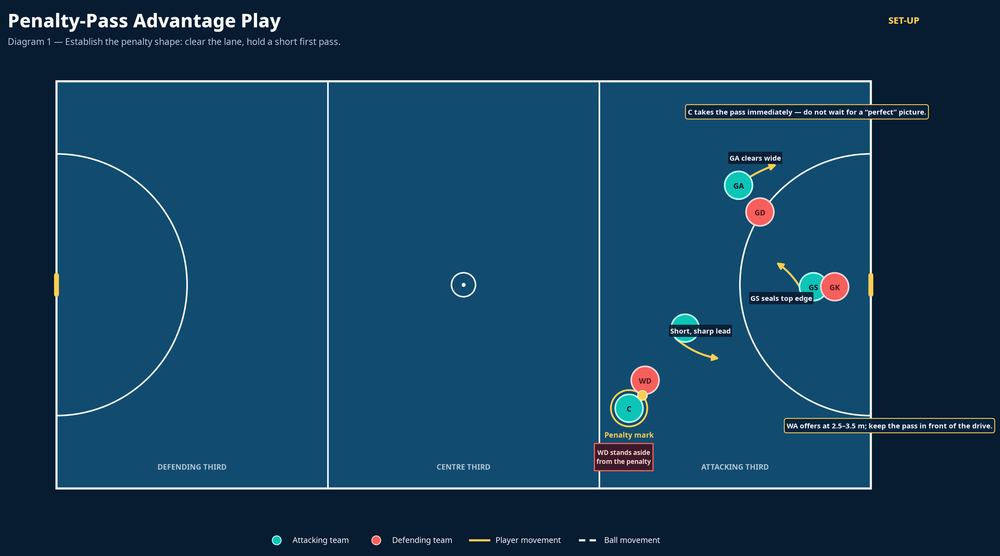
Use the full 30.5 m × 15.25 m Netball court. Mark a penalty spot 1.2 m inside the attacking-third transverse line and 3.0 m in from the sideline. Set the attack toward the goal at the far end. Work initially with four attackers and three defenders, then add the remaining players to create game realism. Use bibs marked 1 C, 2 WA, 3 GA, 4 GS, 5 WD, 6 GD and 7 GK; the numbering is for this resource’s coaching calls.
| Role | Starting position | Coaching job |
|---|---|---|
| 1 C | On the penalty mark with ball | Restart immediately and re-offer safely. |
| 2 WA | 2.5–3.5 m forward and inside of C | Attack the first pass on the move, land balanced. |
| 3 GA | 5–6 m high and wide of the circle | Pull GD away, then cut down into the channel. |
| 4 GS | On the top edge of the circle | Hold, seal space, then slip to front position. |
| 5 WD | Near C/WA lane | Recover after the whistle and contest the second action. |
| 6 GD | With GA | Decide whether to follow GA or protect the circle. |
| 7 GK | Goal-side of GS | Protect the post and contest the final feed. |
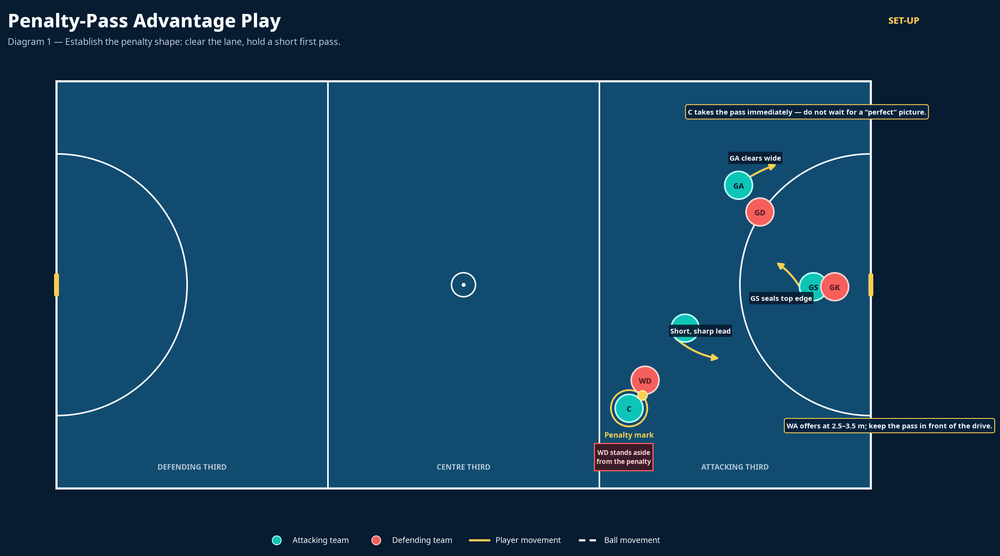
Place two flat discs to show WA’s lead lane and two more to show GA’s high-wide clearing lane. Keep a supply of balls with the coach at the penalty mark. The first learning block is 7 attackers/defenders rotating every three repetitions; a 25-minute block allows demonstration, isolated timing work, opposed rehearsal and a conditioned finish.
Step-by-Step Instructions
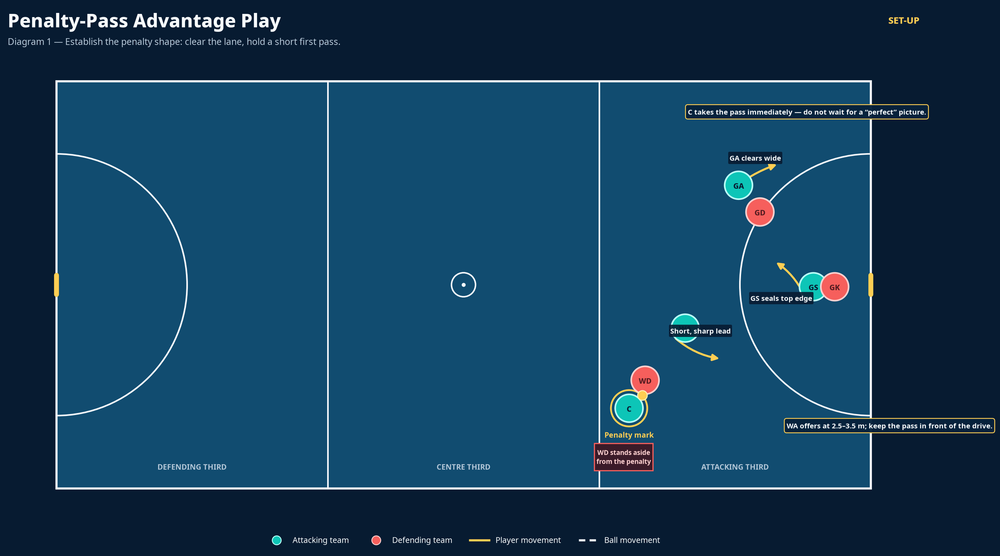
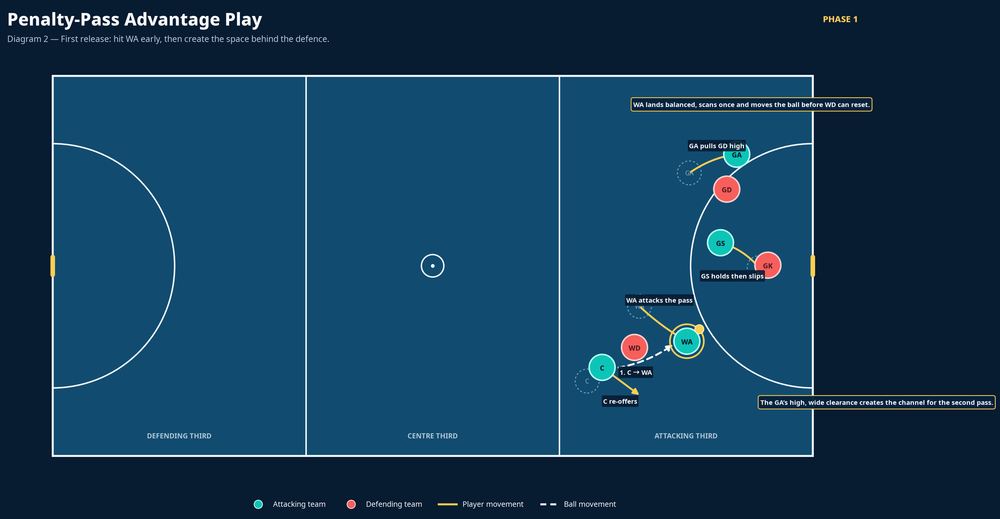
Freeze the penalty picture. On the whistle, place C on the mark. WA starts 2.5–3.5 m ahead and slightly inside; do not stand square on the sideline. GA begins high and wide, approximately 5–6 m from the goal-circle edge. GS starts at the top of the circle, body between GK and the preferred receiving space. The coach names the trigger: “Quick three.”
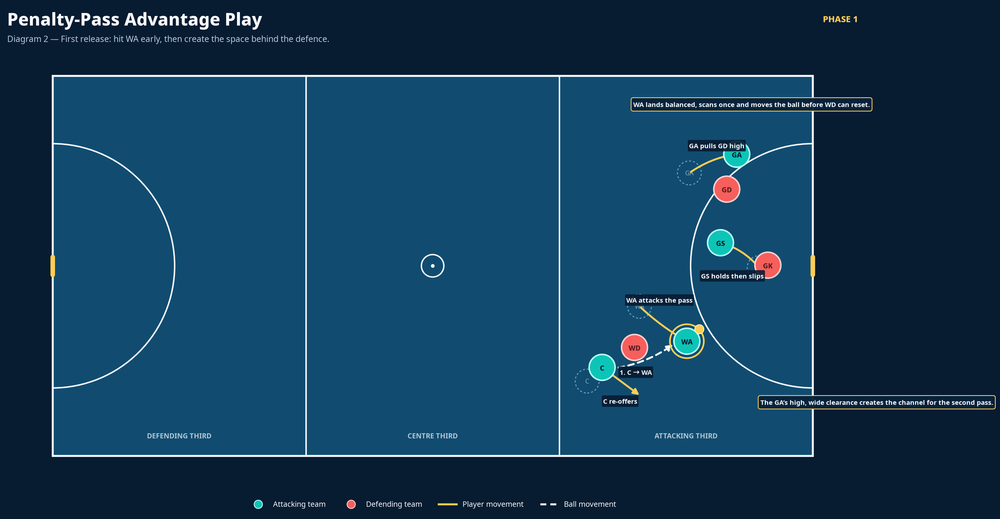
Take the first pass on the whistle. C sets a stable landing foot, sees WA’s front shoulder and releases within one second. The pass is chest-height into WA’s path, not behind her. C then makes a short re-offer 1.5–2 m back toward the transverse line; that re-offer keeps WD honest and preserves a safe outlet.
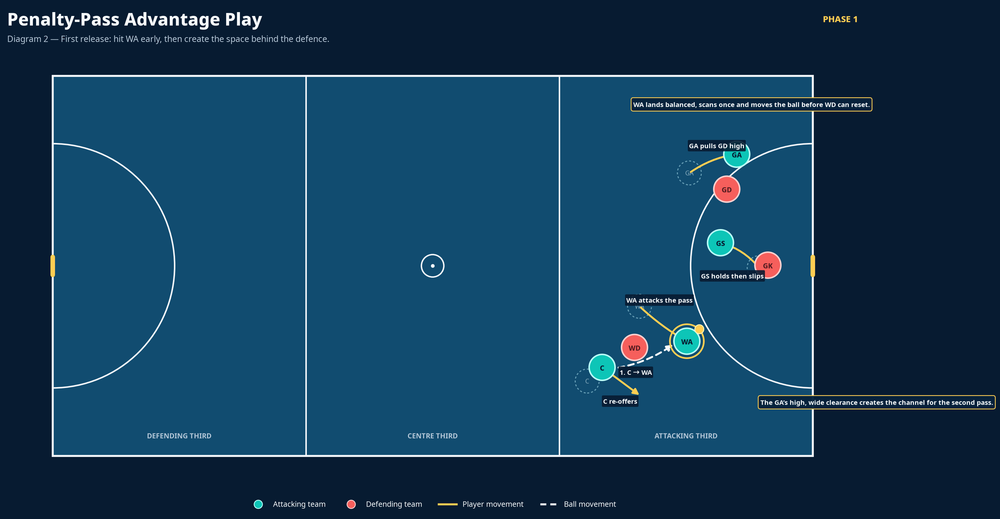
Create the lane while the ball travels. WA drives onto the pass and lands facing the goal. At the same moment, GA clears high and wide to draw GD upward and away from the circle edge. GS initially holds the top-circle space for one beat. This hold prevents GK and GD from simply collapsing into the lane before the second pass.
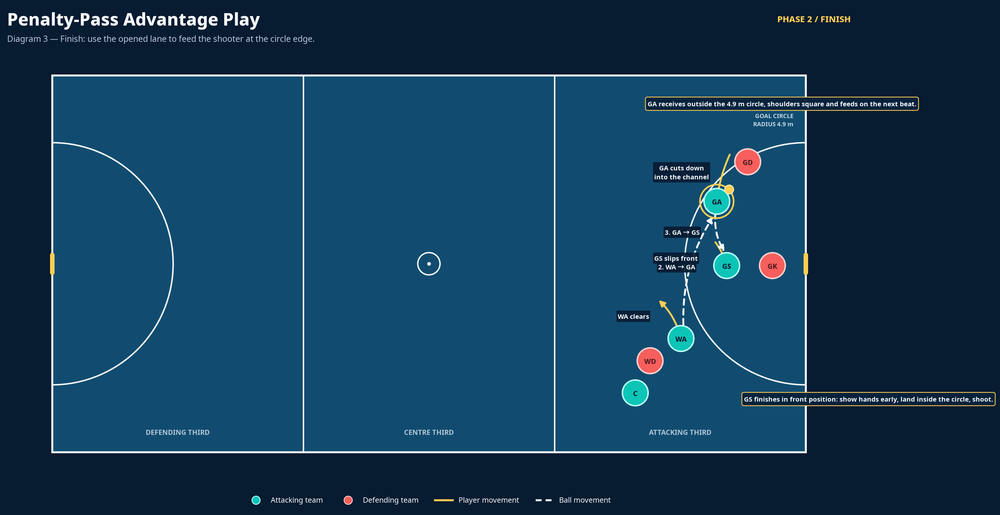
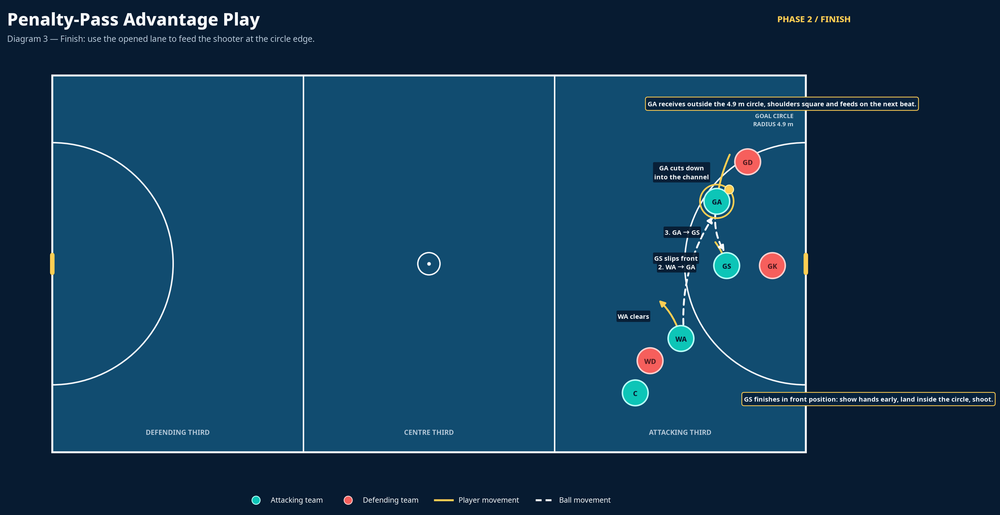
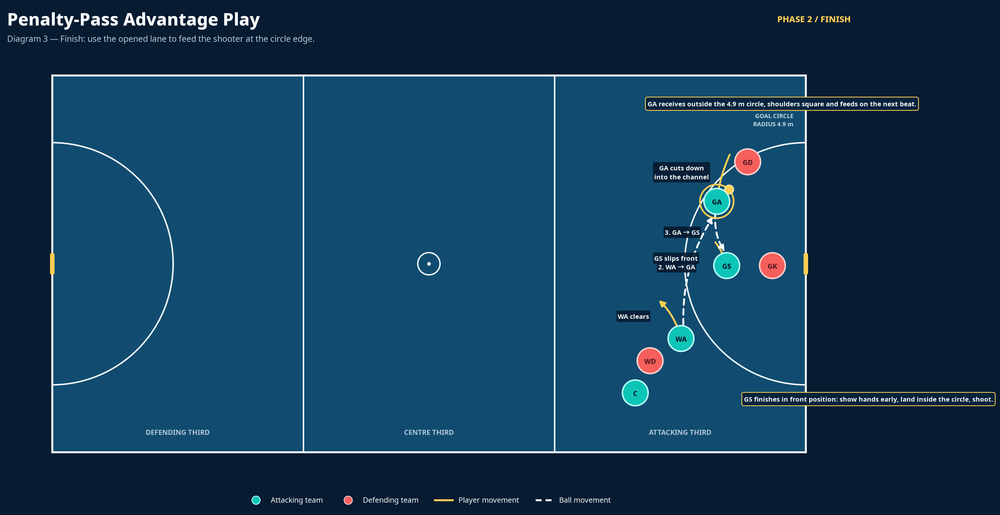
Play the second action, not the first opportunity. WA scans once. If GA has separated from GD, WA releases to GA’s outside hand as GA cuts down toward the edge of the 4.9 m goal circle. The release should arrive early enough that GA receives outside the circle with shoulders already square to the post. If WD has closed the WA–GA lane, WA uses C’s re-offer and immediately rebuilds the same picture; do not force a flat ball through traffic.
Finish in front. As GA receives, GS slips from the top edge to front position inside the circle, showing both hands early. GA delivers a soft, catchable feed to the outside shoulder away from GK. GS lands under control, settles the feet, and shoots. Call the tempo as: “Whistle—WA—GA—GS.” The target is three passes and a shot in 5–6 seconds.
- Reset with purpose. After each shot, ask one question only: “Where did the defence reset?” If it reset on WA, make GA’s clearance wider. If it reset on GA, make GS’s hold one beat longer. Change just one variable on the next repetition so players learn the cause-and-effect of their movement.
Key Coaching Points
The play succeeds on timing before speed. C must take the penalty promptly but not rush a poor first pass; the cue is “quick feet, calm eyes.” WA’s job is to attack the ball rather than wait for it, landing on a stable base with the next pass visible. GA must genuinely stretch GD high and wide before cutting down, because a token clearance leaves the circle crowded. GS must hold the defender for one beat, then slip into front position only as GA receives. Finally, teach every player that the ball moves faster than the defence: pass early into space and make the next decision before the defender resets.
Coach’s cue: “Use the penalty to move the defence, then use the space it leaves.”
Common Mistakes
| Mistake to identify | Immediate correction |
|---|---|
| C waits for every attacker to be stationary | Run a one-second restart count: “whistle, one, pass.” |
| WA stands flat or receives with back to goal | Move her start disc 0.5 m more inside and require a forward lead. |
| GA cuts toward the ball before clearing GD | Demand a high-wide clearance first; no cut until WA has secured the ball. |
| GS moves too soon and brings GK into the lane | Coach a visible one-beat hold at the top-circle edge. |
| WA forces the second pass through WD | Reward the C re-offer; reset the play rather than gifting an intercept. |
Variations & Progressions
For the beginner variation, remove WD and let WA practise the first pass, landing and GA release against GD/GK only. This gives the attacking unit a clear success picture. For a side-switch variation, mirror the starting mark from the opposite sideline and reverse the clearing lane; players must use both hands and read the goaler’s preferred feed side. For a double-option variation, allow GA to receive or to continue high while C becomes the second receiver; WA calls “go” for GA or “back” for C before the ball leaves her hands.
Progress from passive defenders to live defenders who may contest as soon as the pass is taken. Then impose a six-second shot clock from the whistle. Finally, use a 7v7 conditioned game: every attacking-third penalty earns two points only when the team creates a shot within six seconds, and one point for any other retained possession. This makes the set play an instinctive match solution rather than a rehearsed pattern.
Age Adaptations
| Group | Adaptation | Coaching focus |
|---|---|---|
| Under 10 | Use 1 C, 1 WA and 1 GS with a passive defender; shorten the lead to 2 m. | Catching, landing and seeing the next pass. |
| Under 12 | Add GA and one live defender; allow 8 seconds for the shot. | Clear lead lanes and simple two-pass decisions. |
| Under 14 | Run the full 4v3 picture with passive-to-live defence. | Timing GA’s clear-and-cut and GS front position. |
| Under 16/Open | Use 7v7, video the first two passes and add score/time consequence. | Reading defender recovery and selecting the safest finish. |
Finish by returning to normal match play and calling the set only when the exact penalty picture appears. That is the standard: players recognise the advantage, use it decisively, and are still free to abort to a safe possession when the defence wins the first reaction.
