Netball Zone Defence Set-up Play: 2–3–2 Canopy and Sideline Funnel
Coach a connected 2–3–2 zone that funnels the first wide pass, steals the next option, and turns the intercept into a composed counterattack.
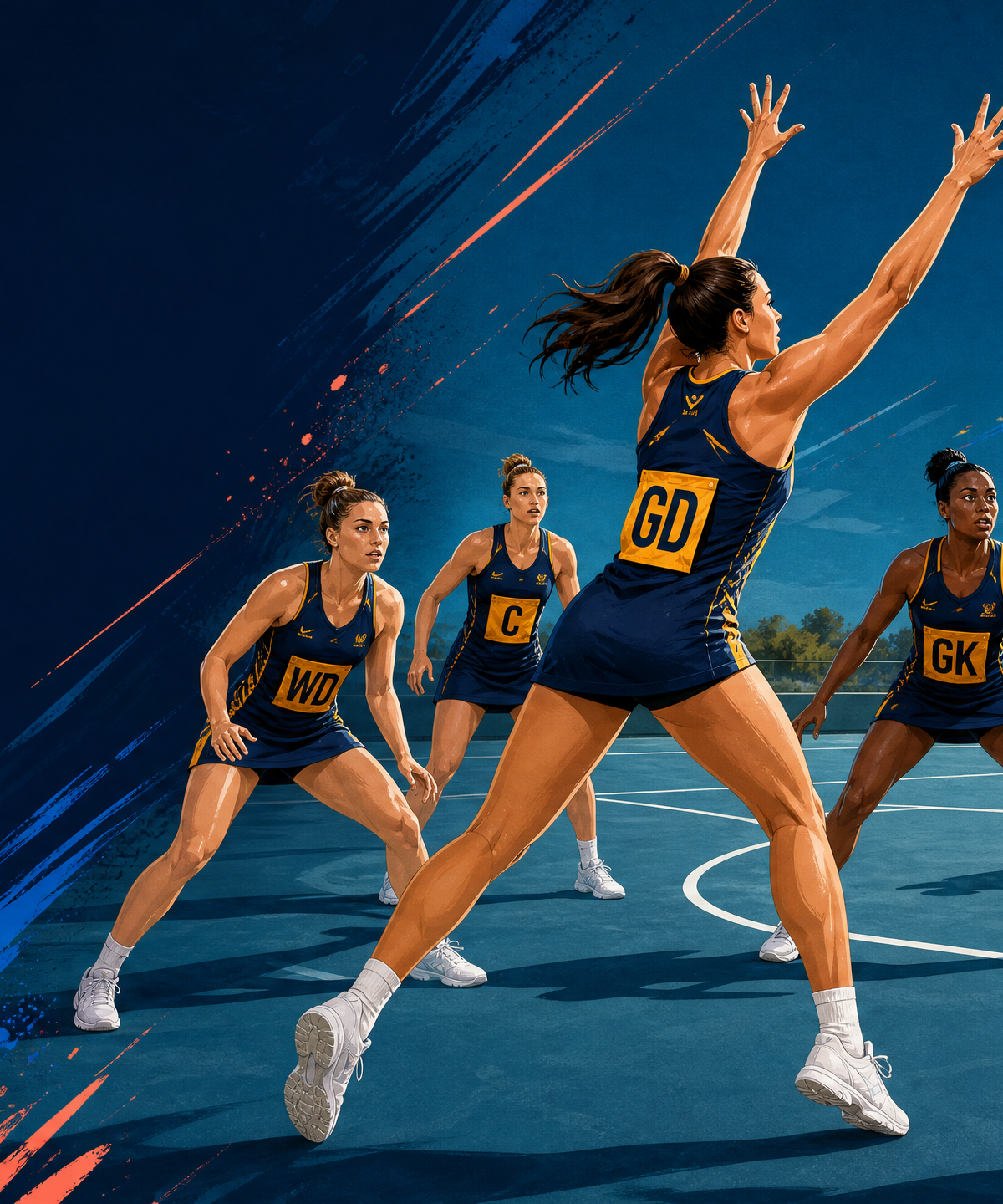
Equipment Needed
Overview
Zone Defence Set-up Play: 2–3–2 Canopy, Sideline Funnel and Safe Exit gives a coach a repeatable answer to an opposition centre pass or controlled restart. It is an active, not passive, zone: show a tempting lateral option, remove the return, and own the next passing lane. The outcome is a pressured float pass, held-ball call, tip, or clean intercept followed by two calm release passes.
Use it when the opposition has easy centre-third flow or a Wing Attack is receiving freely near the sideline. The court is 30.5 m × 15.25 m, with a 0.9 m centre circle and 4.9 m goal-circle radius; use the third lines to set the screen and intercept lanes.1
Coach’s intent: Make the opposition feel they have a wide pass, then make the next pass disappear.
Setup
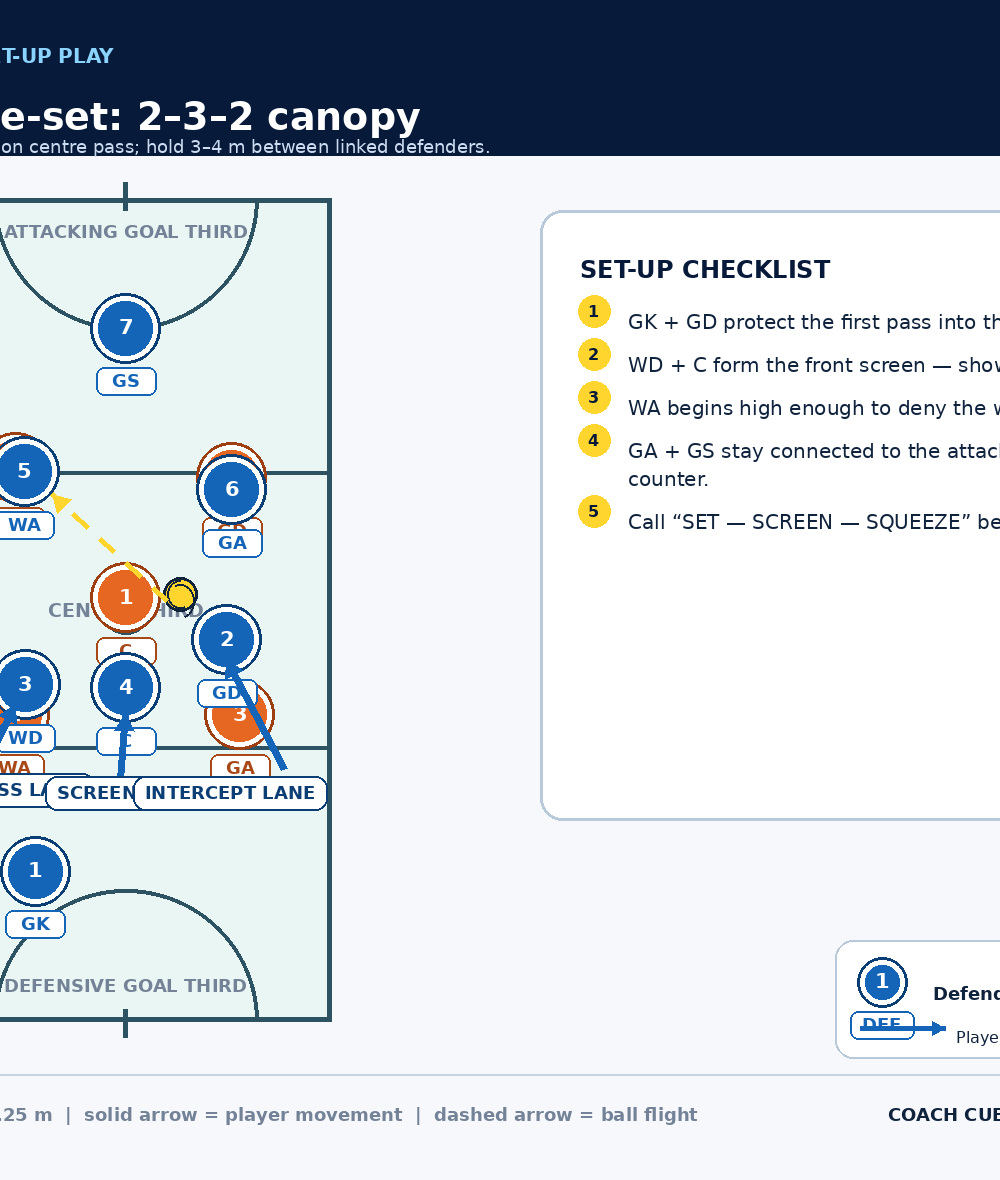
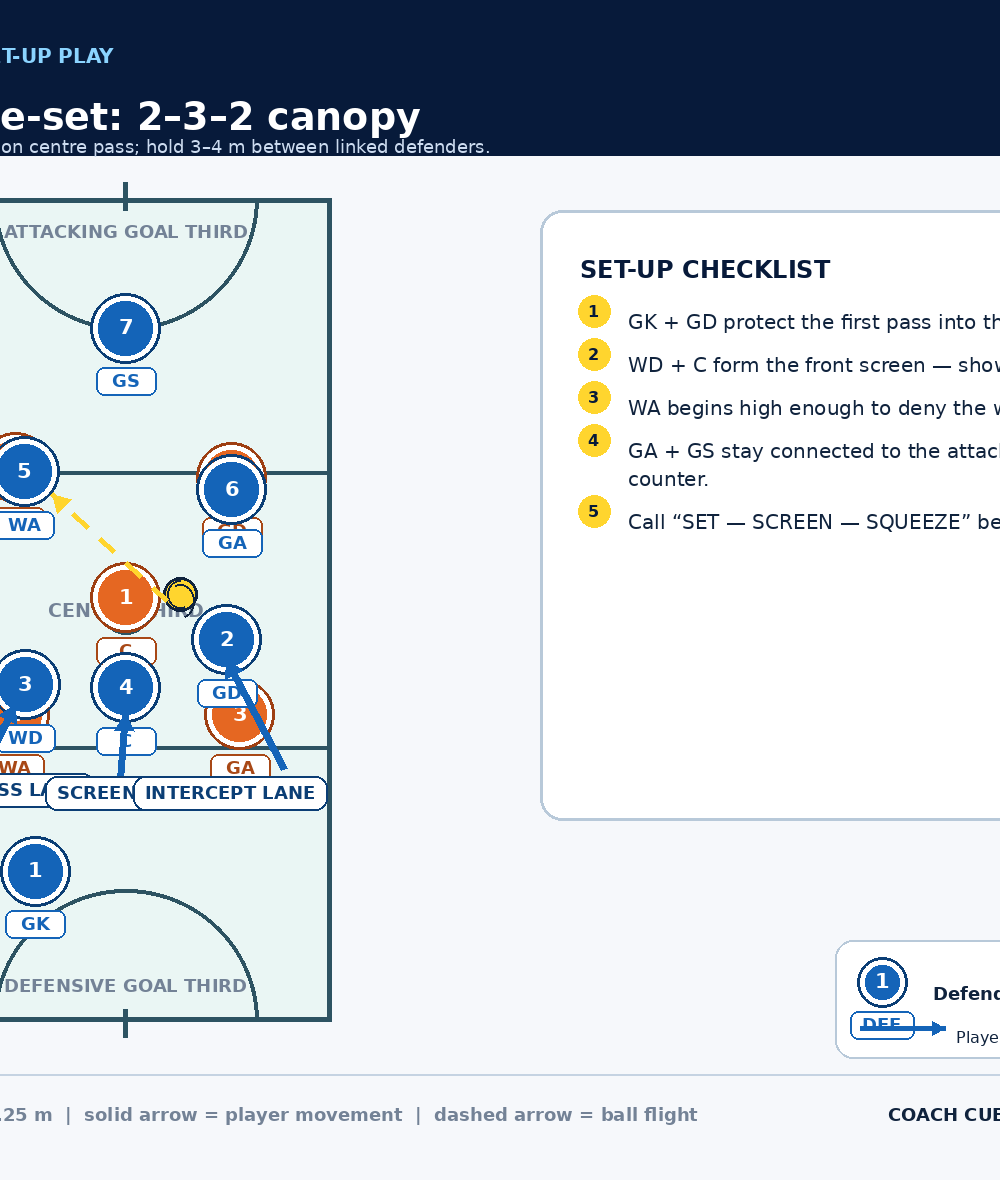
Set up on a full court with two squads of seven. Put six flat cones 3 m inside each sideline through the centre third as visual “fence posts,” then add three cones for the press, screen, and intercept lanes. Each third is approximately 10.17 m long; keep the funnel work in the centre third before allowing the attack into the defensive goal third.
| Position | Starting responsibility in the play | Starting reference |
|---|---|---|
| GK (1) | Protect the circle edge, rebound and tip ball. | 1–2 m outside the top of the defensive goal circle. |
| GD (2) | Read the second pass and attack the high intercept window. | Ball-side edge of the defensive goal third, 3–4 m from GK. |
| WD (3) | Start the funnel by taking the front shoulder of the first wide receiver. | Ball-side centre-third lane. |
| C (4) | Shut the return gate and organise the screen. | Centre circle edge, one pass inside WD. |
| WA (5) | Deny the high release, then become the first wide counter option. | Off-ball high centre-third lane. |
| GA (6) | Hold a legal attacking-half outlet and time the front cut after turnover. | Attacking goal-third edge. |
| GS (7) | Stay circle-ready and stretch the last defender. | Attacking goal circle edge. |
Use one match ball, 12–15 cones, two bib colours, a whistle and a stopwatch. Allocate 28 minutes: four minutes to brief and walk through, eight minutes to rehearse the shape without attackers, ten minutes of constrained live play, and six minutes of fully live transfer.
Step-by-Step Instructions
1. Build the canopy before the whistle
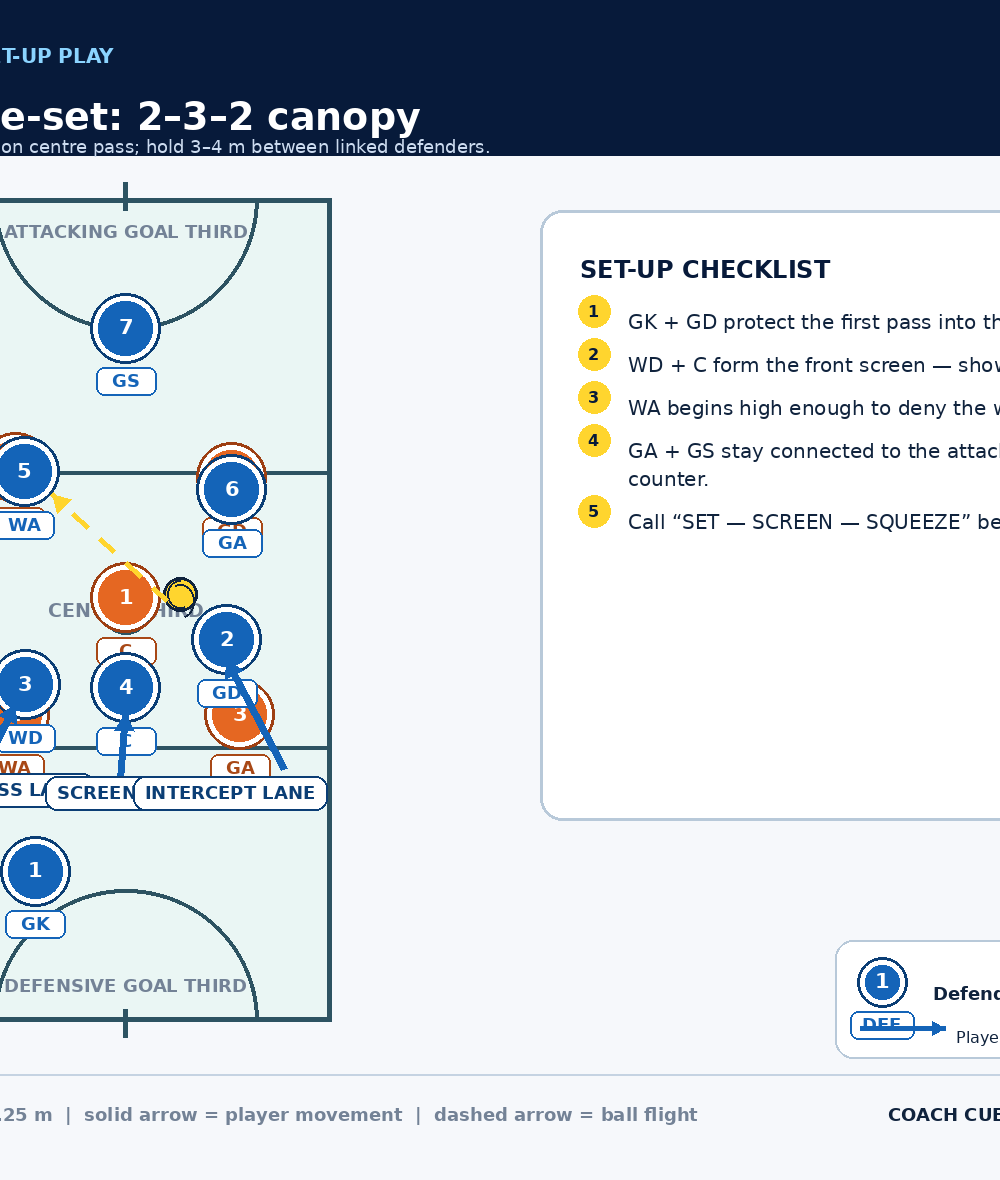
On the call “Set,” GK and GD establish the back security line. They must be connected by a visible 3–4 m gap—close enough to cover the same feed, not so close that one pass eliminates both. WD and C form the first screen in the centre third. WD faces the likely wide receiver; C positions one pass inside, shoulders square to the ball, able to close either the return or the central drive. WA holds high to discourage the easy outlet, while GA and GS remain disciplined in their legal attacking areas and prepare the counterattack. Do not pull GA or GS into a defensive role they cannot legally perform.
The defending captain calls “Set—screen—squeeze.” Give the attacking C the first centre pass. The defence protects its shape and waits for the sideline trigger rather than chasing the first ball.
2. Activate the sideline funnel
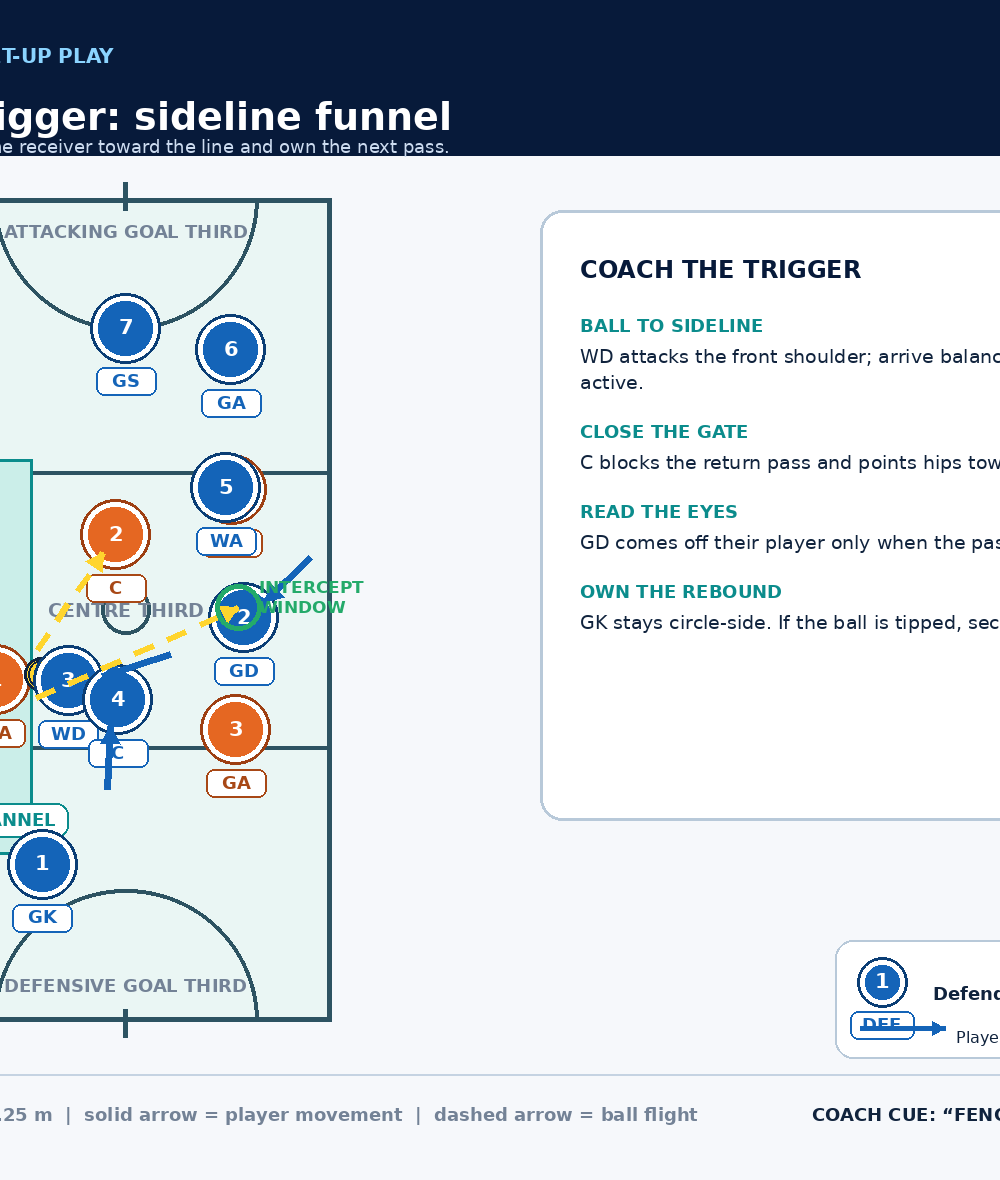
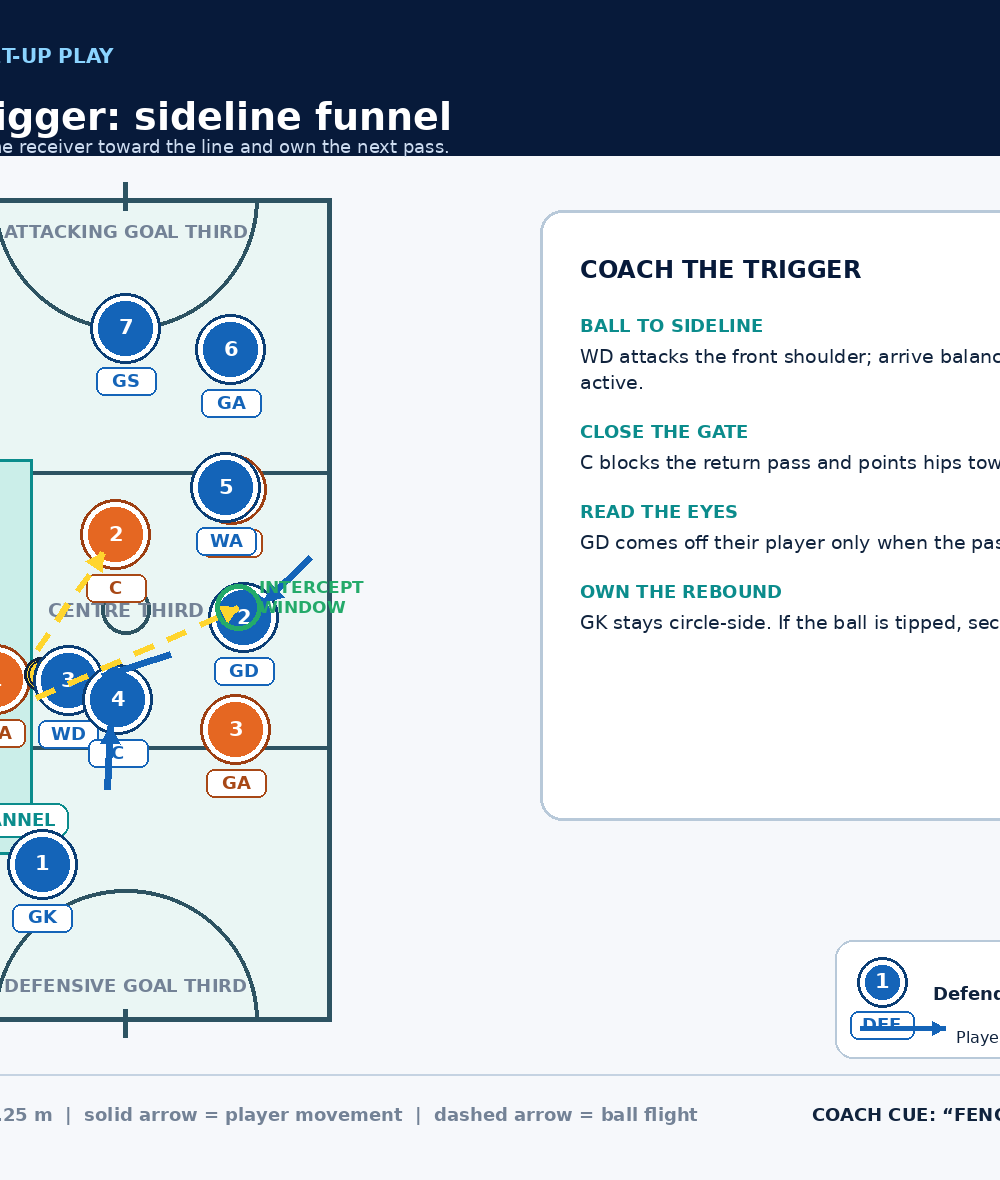
The trigger is an attacking receiver catching within roughly 1.5 m of a sideline in the centre third. Call “Fence.” WD closes the receiver’s front shoulder and arrives balanced at the legal obstruction distance—0.9 m from the landing foot when actively defending the ball.2 The job is not to steal immediately. WD angles the body so the receiver sees the sideline and a risky pass back inside.
C steps into the return lane and calls “Gate,” with hips facing the sideline. GD slides toward the intercept lane but commits only when the passer’s chest and eyes open. GK stays circle-side to secure any tip.
Give the receiver a three-second pass count. Award the defence one point for a forced backward pass, two for a deflection, and three for an intercept. Reset immediately so players learn the trigger.
3. Squeeze on the second ball
When the ball leaves the sideline receiver, call “Squeeze.” WD recovers along the pass line, C fills the central screen, and GD attacks the expected flight path with hands first. If the ball beats the first line, GK and GD retreat together toward the circle edge.
Time it: 0–2 seconds hold spacing; 2–4 seconds close the return gate; 4–6 seconds own the next aerial ball. The group must arrive on the same count.
4. Exit with control after the intercept
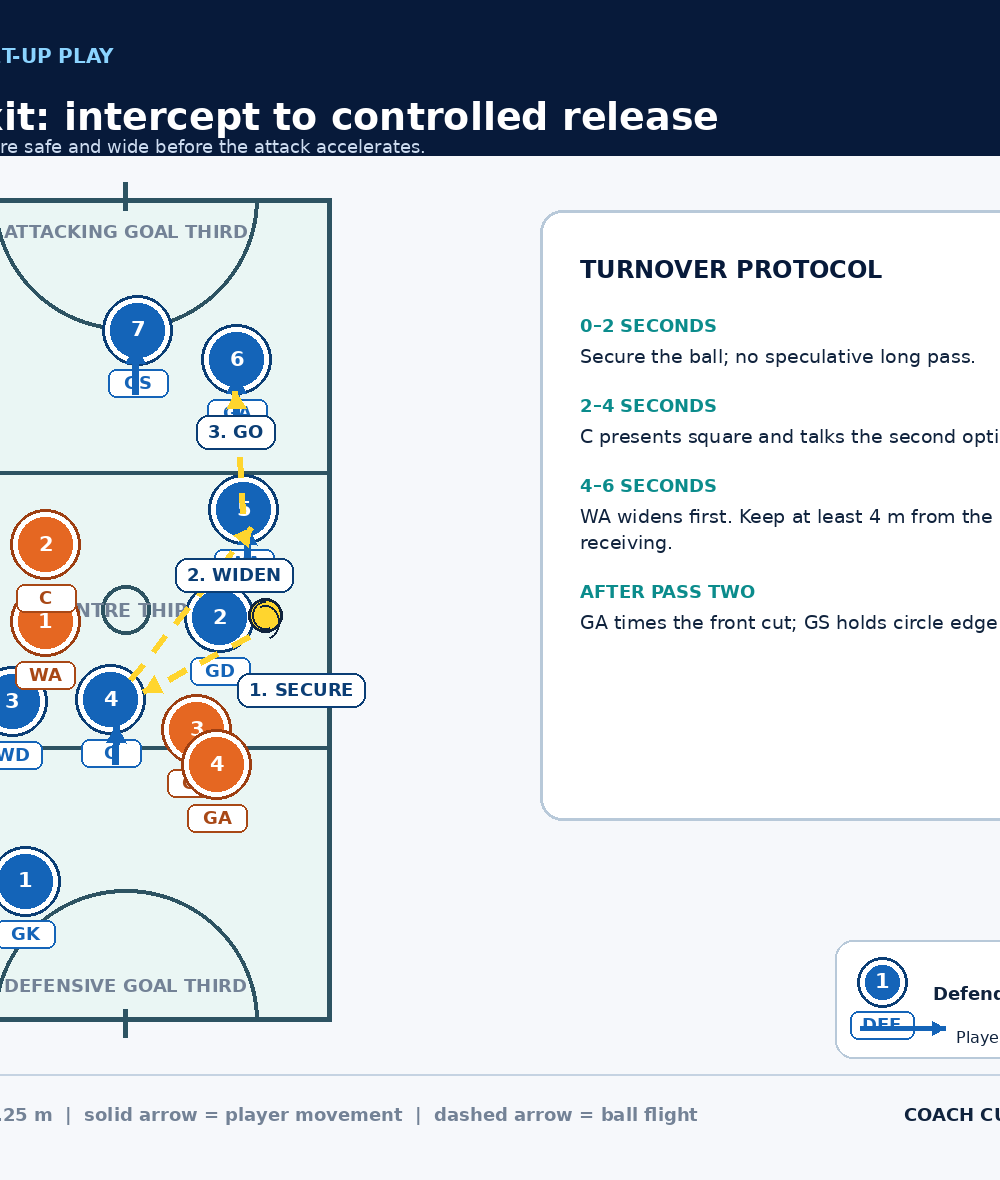
The turnover call is “Win—wide—work.” In 0–2 seconds, secure the ball and reject the hero pass. In 2–4 seconds, C presents square as the stabiliser. In 4–6 seconds, WA widens into the next legal lane, at least 4 m inside the sideline. After two secure passes, GA runs the front cut and GS holds circle edge.
Measure success as turnovers retained, not merely balls touched.
Key Coaching Points
| Coaching focus | What to see and say |
|---|---|
| Collective spacing | “Three to four metres: connected, not crowded.” One pass must not beat two defenders. |
| Body angle | “Show the fence.” The ball-side defender’s chest and lead foot guide play toward the sideline. |
| Ball-to-player communication | C names the ball; the next defender names the lane; GK owns the rebound call. |
| Legal pressure | “Arrive, balance, then hands up.” Do not land inside 0.9 m while contesting the ball.2 |
| Patience | “First pass is information; second pass is opportunity.” Do not over-commit before the trigger. |
| Turnover discipline | “Win it, widen it, work it.” Two safe passes earn the right to attack. |
Common Mistakes and Corrections
The first error is WD chasing square behind the receiver. Put a cone on the front shoulder: WD closes that space and leaves the sideline as the poor option. The second is C ball-watching; freeze play and show C the return gate.
The third is GD gambling early. GD waits for the shoulder turn or lifted passing arm. Fourth, GK drifting high exposes the circle edge; keep GK as protector. Finally, reject the hero pass after an intercept. If two exit passes are not secure, reduce the release distance to 5–7 m.
Variations & Progressions
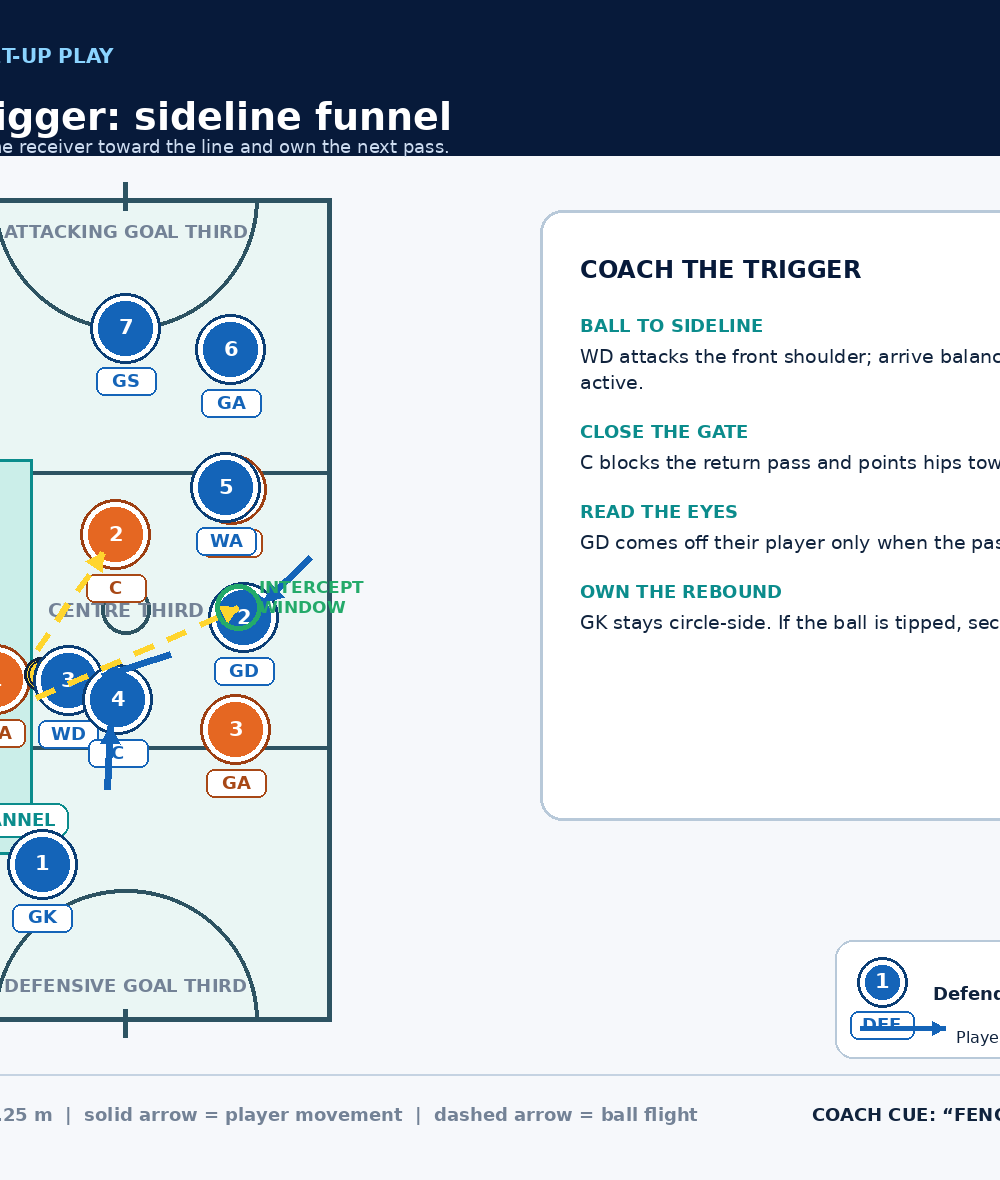
Start with guided 5 v 5: remove GA and GS, freeze after the sideline catch, then replay at speed. Progress to a constraint game: the attack earns a bonus for breaking through centre; the defence earns three for an intercept and one for a forced backward pass. Advanced groups add a decoy drive through the screen lane.
Age Adaptations
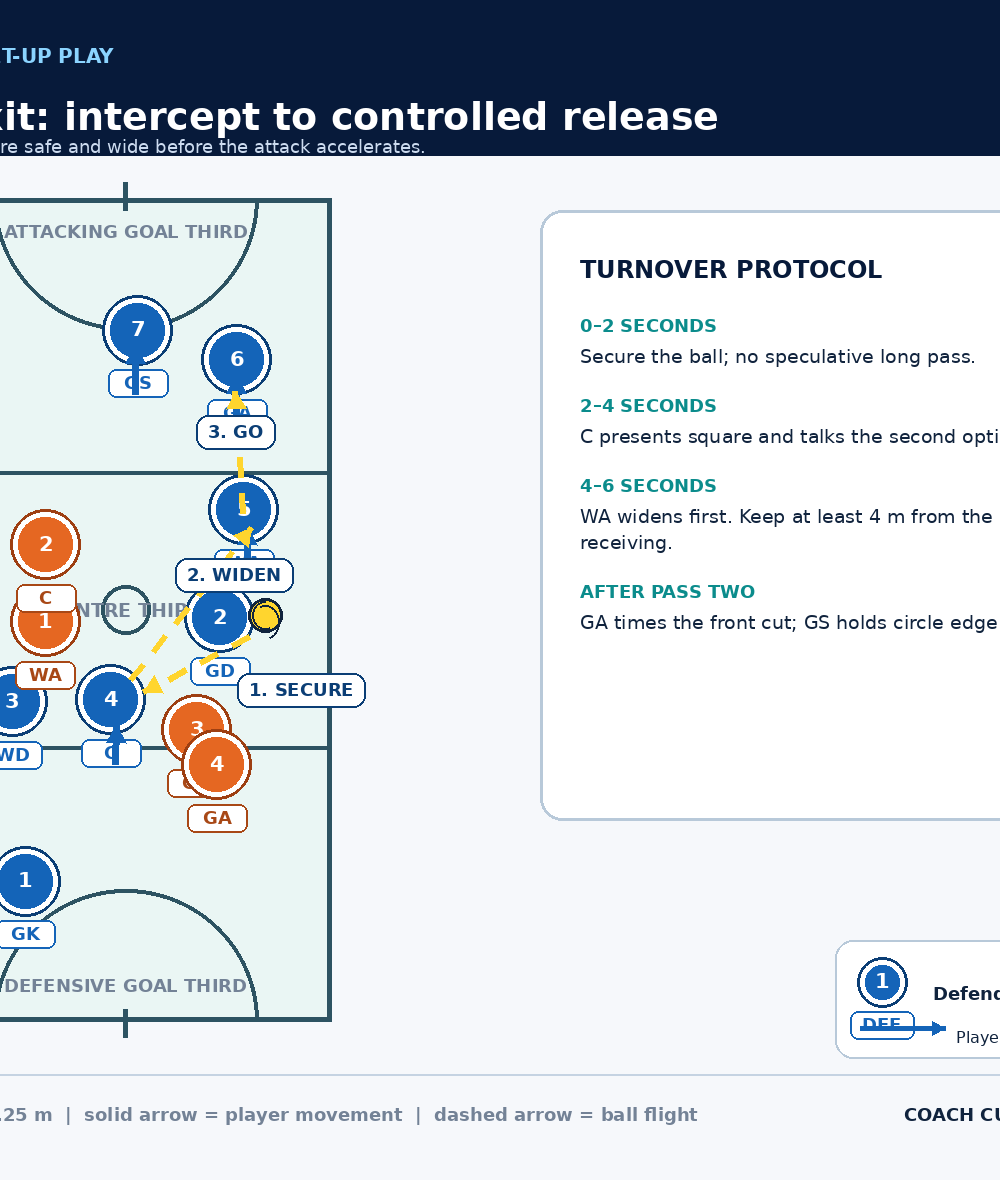
For Under 8, use a half-third area, four players, walking speed, and the calls “set,” “fence,” and “wide.” For Under 10, use 5 v 5 over two thirds and let the coach call the trigger. For Under 12, introduce 7 v 7 with a five-second hold after the trigger. For Under 14 and older, remove the pause, add the decoy, and track retained turnovers over six minutes.
Session Standard
Finish with three live centre-pass sequences each. A successful rep has four features: the team calls the trigger, the sideline receiver is funneled, the return is screened, and any turnover is retained through two passes. If one element is absent, replay the same starting picture rather than changing the drill. Repetition with a clear trigger is what turns a diagram into a dependable defensive habit.