

Netball
Netball Zone Defence Set-Up Play: Blue Lock Funnel
Teach your back four to set an organised zone, deny the middle pass and funnel possession into a planned sideline intercept trap.
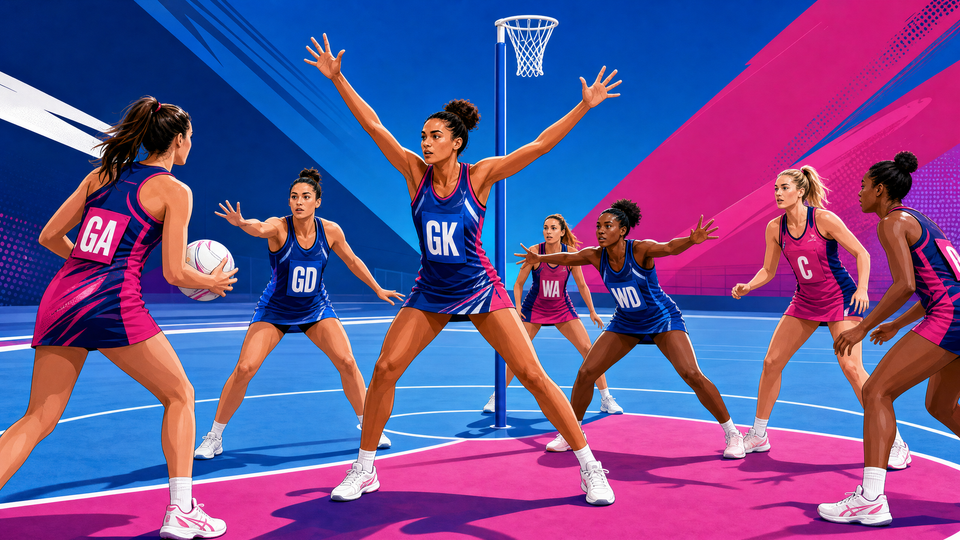
What you need
1 regulation netball, 14 positional bibs, 8–10 flat cones, whistle, stopwatch
Overview
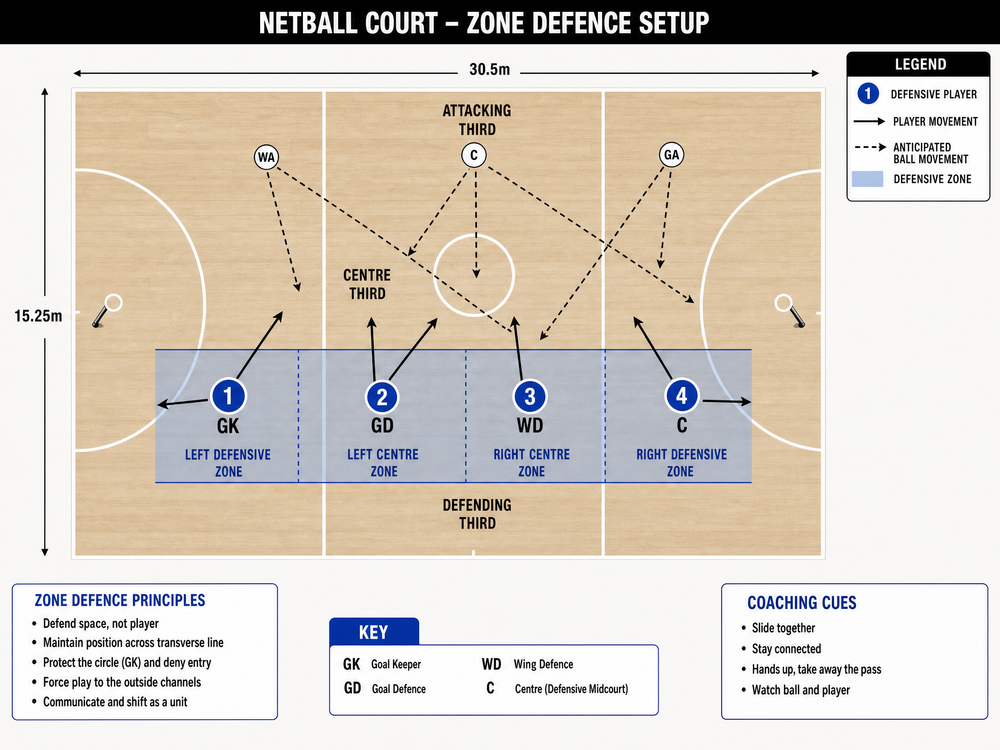
Blue Lock Funnel is a four-player defensive set play that gives your GK, GD, WD and C a shared picture as the opposition builds through their goal third. Rather than chasing one-on-one, the back four protect connected spaces: GK owns the circle, GD protects the high-circle channel, WD owns the wide outlet, and C patrols the central release. The objective is not to steal the first pass at all costs. It is to deny the direct middle option, show the ball carrier toward one sideline and arrive together on the second or third pass for a tip, intercept or forced error.
Use it after a centre pass, defensive throw-in or settled possession. It is especially effective against a confident C or a direct middle ball. World Netball specifies a 30.5 m by 15.25 m court divided into three equal thirds; use that geometry as a reference point.1
Coach’s intention: make the opposition choose the sideline, then make that choice feel crowded.
Setup
Set out the full court. Place four flat cones across the defensive half of the centre third: one 1.5 m inside each sideline and two central-lane markers. Add two cones 2 m either side of the circle top. The goal circle has a 4.9 m radius and the centre circle a 0.9 m diameter.1
| Unit | Start landmark | Primary responsibility | First movement cue |
|---|---|---|---|
| 1 – GK | 1 m inside the goal circle, on the ball-side post line | Protect the circle and the split to GS | Slide with the ball, never chase beyond the circle picture |
| 2 – GD | 2 m above the circle edge, ball-side shoulder of GA | Seal the high-circle channel and contest the feed | Close the central lane when the ball leaves the carrier’s hands |
| 3 – WD | 1.5 m inside the ball-side sideline, level with the transverse line | Invite the wide pass, then deny the return | Set a side-on stance and squeeze upfield on the release |
| 4 – C | Central lane, 3 m defensive-side of the centre circle | Take away the first central release and cover the second pass | Read the passer’s hips and shift before the ball travels |
Start 4 v 4 (GK, GD, WD, C versus GS, GA, WA, C), then progress to 7 v 7 when players hold their permitted areas. Standard position initials are visible in match play, and every position has designated court areas.1
Use one ball, 14 bibs, 8–10 flat cones, a whistle and a stopwatch. Allocate 25 minutes: five for walk-through, eight unopposed, eight conditioned and four competitive.
Tactical Diagram 1 — Initial Shape
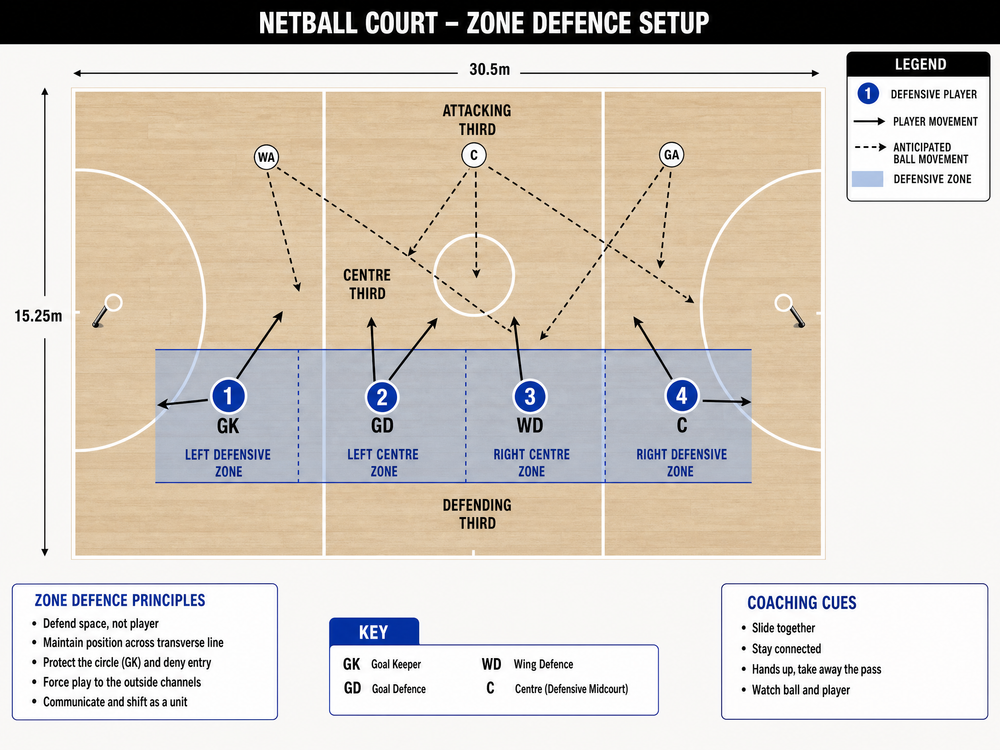
In Diagram 1, numbered blue circles identify the core unit. Solid arrows show defensive movement; dashed arrows show expected attacking passes. The lanes are coaching references, not legal court lines.
Step-by-Step Instructions
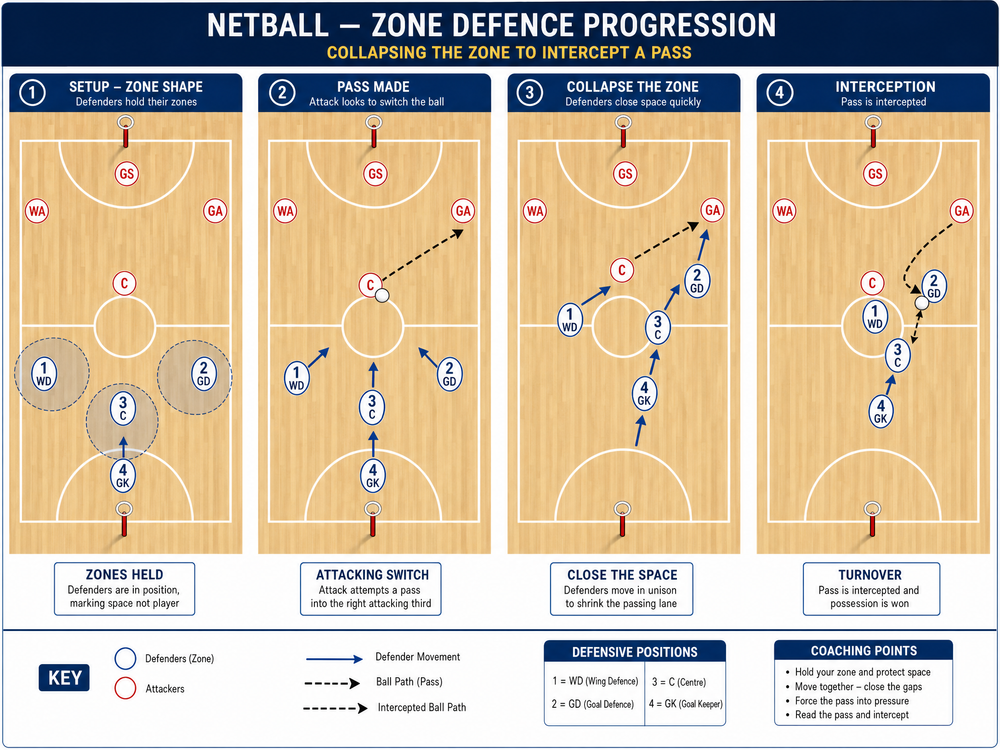
Call the set early. Before the first pass, C calls “Blue Lock” and everyone identifies ball side. The non-ball side stays connected for the reversal.
Build the screen. GK stays in the circle, GD 2 m above its edge, WD near the ball-side sideline and C 3 m defensive-side of the centre circle. Keep 2–3 m between defenders.
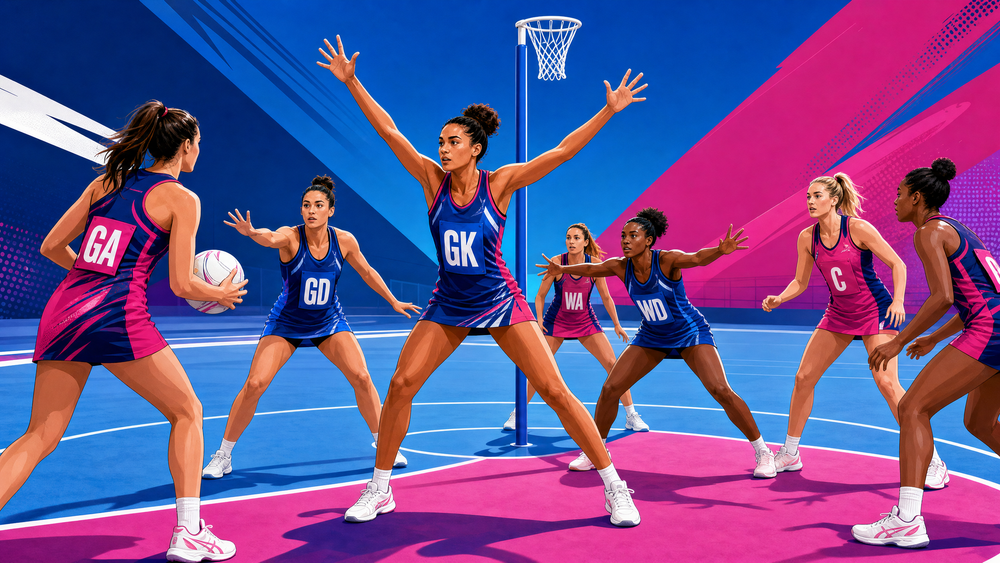
Show the sideline, not the middle. The ball-side defender takes away the inside shoulder first. WD’s feet are staggered, outside foot slightly forward, and hands are alive in the passing lane. C stays square to the centre channel. The visual message is simple: the wide pass looks available; the pass into the middle does not.
Shift on the release. As the ball leaves hands, every defender shuffles one or two steps to the next catch. GK slides across the circle, GD closes high, WD moves up the channel and C fills behind. Cue: “Ball travels, block travels.”
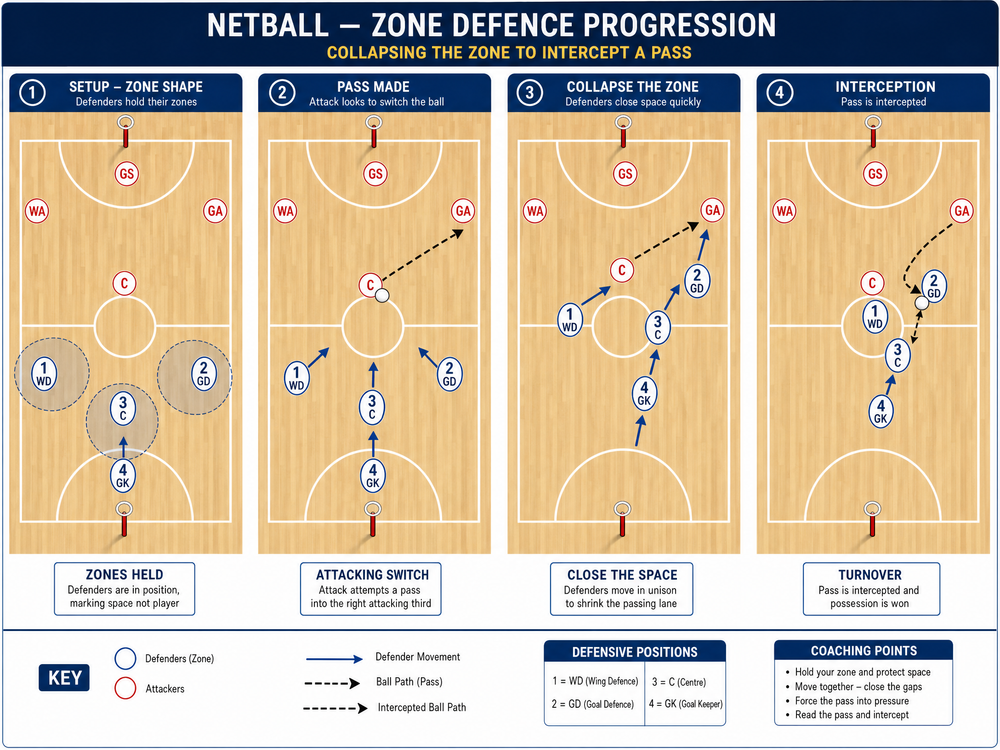
Spring the trap. On the wide catch, WD applies legal 0.9 m pressure and angles the receiver away from the transverse line. GD or C attacks the inside return; the other is safety. GK stays the last line.
Convert and reset. On a turnover, make the safe first pass to C or WD; GA, WA and GS present in their permitted areas. If the middle is breached, call “reset”, rebuild the four lanes and identify whether chasing, late shifting or a missing safety caused it.
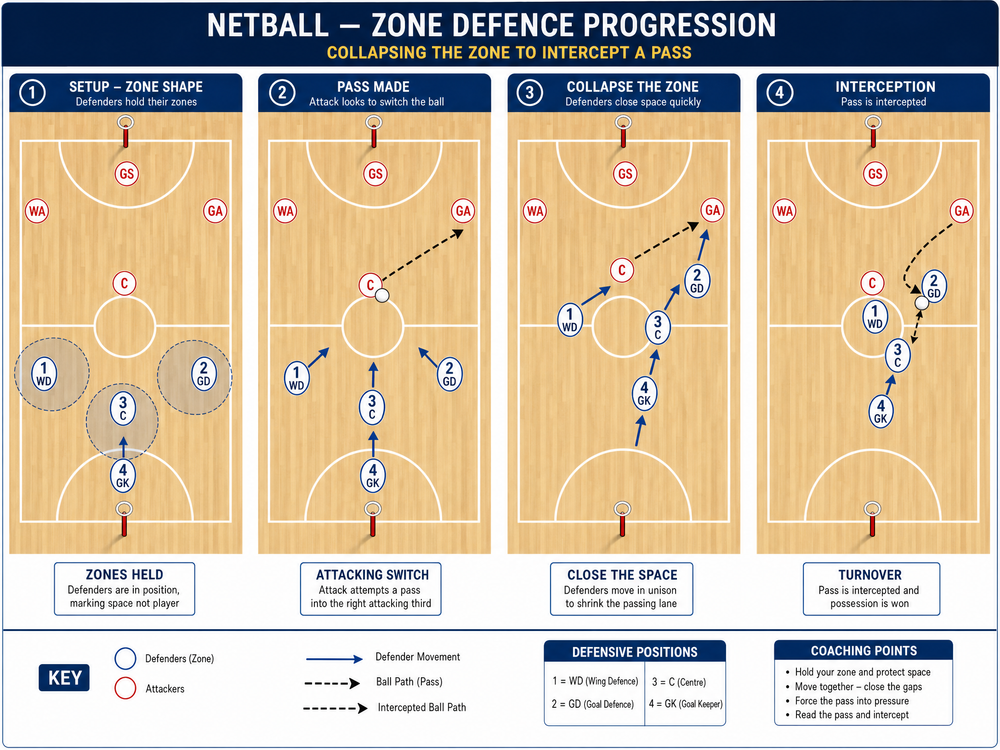
Tactical Diagram 2 — Collapse and Intercept
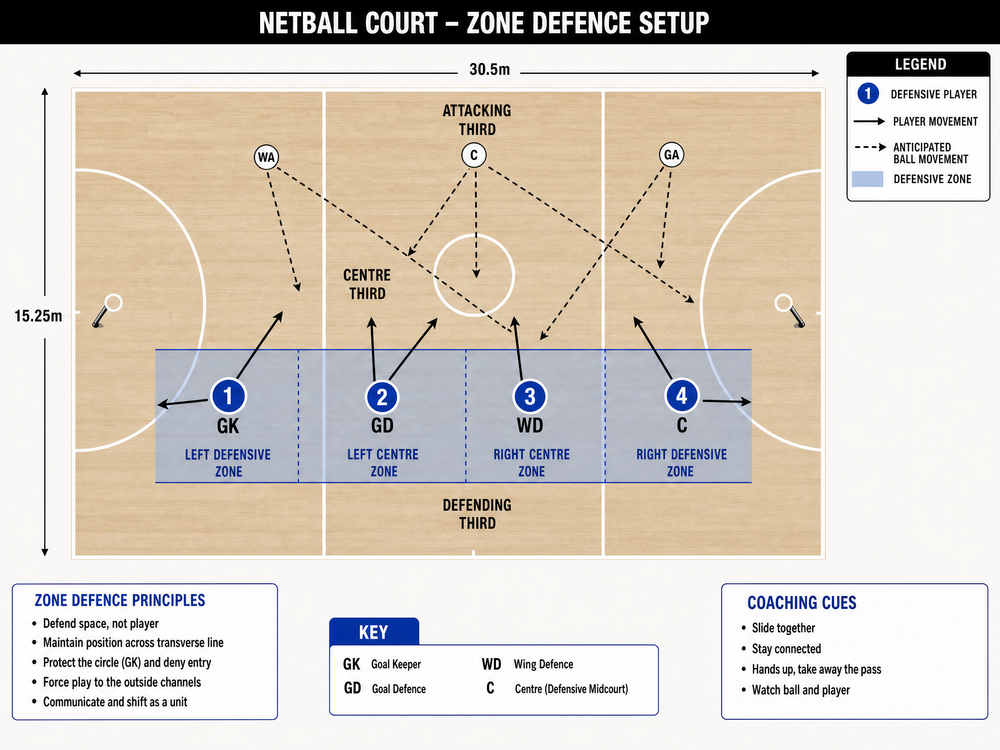
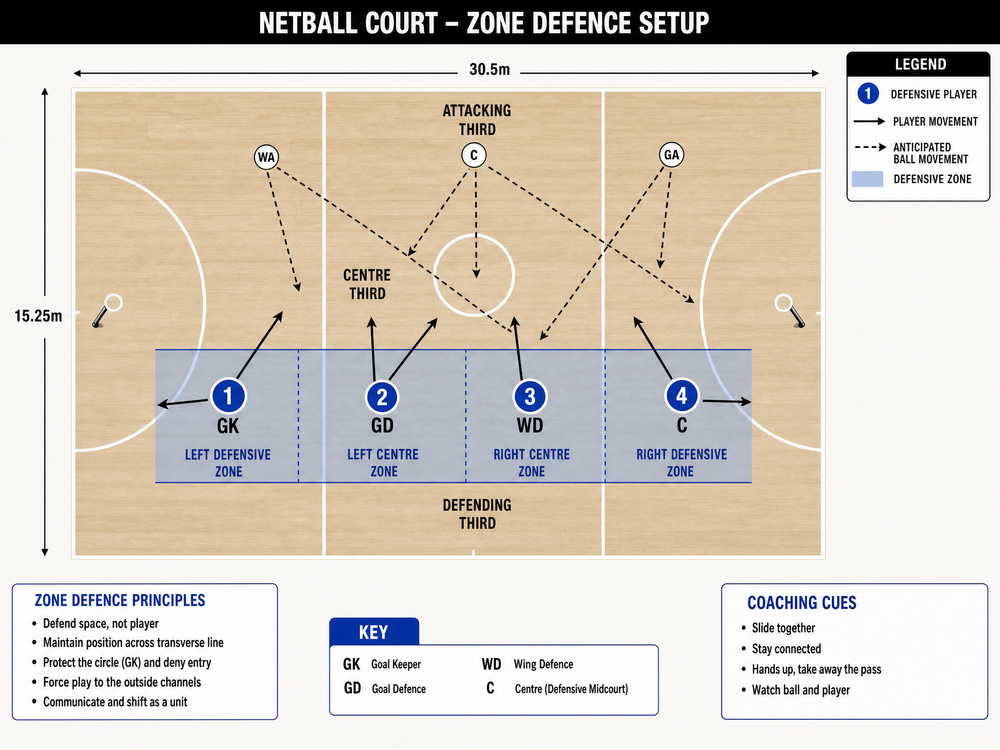
Diagram 2 shows the trap: the ball is funnelled wide, the middle return closes and a defender attacks the predictable pass. Solid arrows are player movement; dashed arrows are the anticipated ball path.
Key Coaching Points
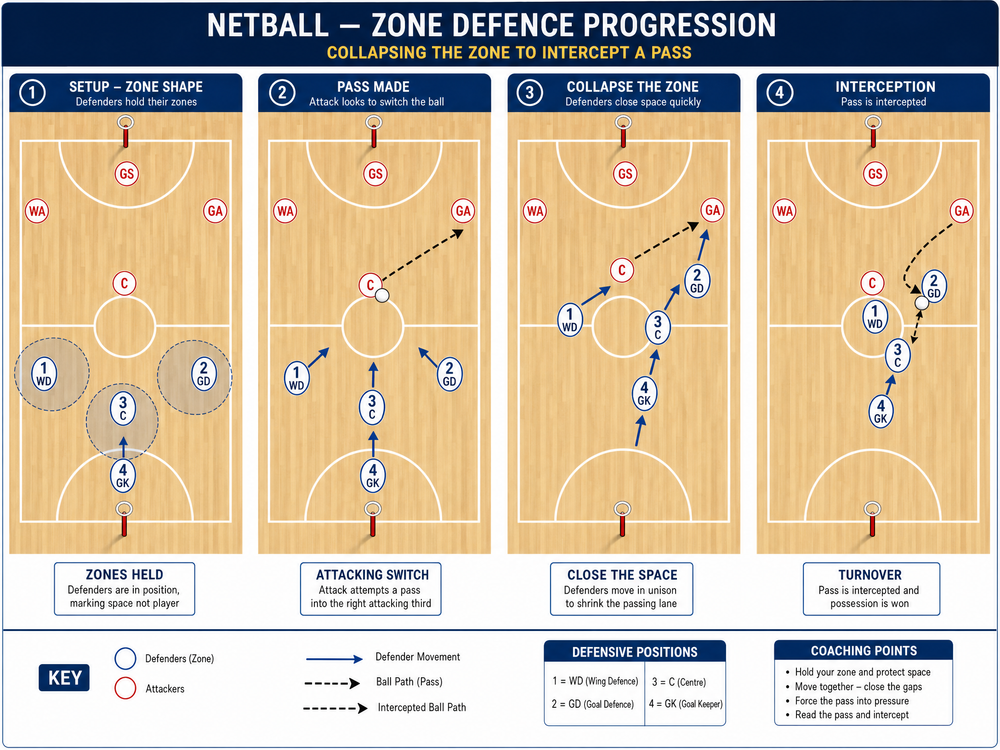
- Defend space first, then win the ball. A disciplined player who holds a lane is often more valuable than a player who chases an unlikely intercept.
- Move together on the pass. Demand a two-step shuffle from every defender as the ball travels. A delayed shift opens a seam.
- Make the ball-side defender the director. WD or GD calls “wide”, “hold” or “trap”; clear communication stops two defenders jumping the same player.
- Keep eyes through the ball carrier. Read the carrier’s hips, shoulder and pivot foot to predict the next pass, while still seeing the most dangerous receiver.
- Protect the circle at all times. GK holds the final line and communicates the GS/GA picture to GD.
- Win it cleanly, then value it. After the turnover, demand one secure pass before trying the long attacking ball.
Common Mistakes
| Error | What it causes | Immediate correction |
|---|---|---|
| Everyone chases the first wide pass | A central lane opens behind the contest | Freeze the play; return C to the central safety cone and rehearse the two-step shift |
| WD stands square or too close to the sideline | The attacker drives inside or gains the line too easily | Start 1.5 m inside the sideline; present an angled, side-on stance |
| GD leaves the top of circle too early | GA receives a direct high-circle feed | Give GD the cue, “circle first, intercept second” |
| GK follows the ball outside the circle picture | GS receives an uncontested feed | Reset GK 1 m inside the circle and rehearse ball-side sliding only |
| The intercept player jumps without a safety | One missed tip becomes a breakaway | Name the safety before every repetition: “C behind” or “GD behind” |
Variations & Progressions
Use guided passing first: attack uses two passes before centre third and the coach calls ball side. Then let attack choose either sideline; score one point for a forced backward pass and three for an intercept. Finish with live 7 v 7 and a 12-second centre-third crossing countdown.
For an advanced variation, rotate GA high into the WD–C pocket. Coach “pass, talk, transfer”: pressure, call the handover and exchange responsibility.
Age Adaptations
| Age group | Adaptation | Coaching focus |
|---|---|---|
| Under 8–Under 10 | Half-court 3 v 3; walking passes | Naming space and safe stopping |
| Under 12 | Core 4 v 4 with a two-pass rule | Ball-side awareness and shifting |
| Under 14–Under 16 | Add live sideline traps and points | Connection, legal pressure, safe turnover |
| Open | Full 7 v 7 with timed possessions | Reading patterns and transition |
Finish every block with one question: “Which pass did we want them to throw, and who was waiting for it?” If players can answer that clearly, the set play is becoming a shared defensive system rather than a collection of individual efforts.
