

Cricket
Rapid Reaction: The Ultimate Wicket-Keeping Agility Drill
Develop explosive lateral movement and razor-sharp reflexes in your wicket-keepers with this high-intensity agility drill.
What you need
6-8 cricket balls, one set of stumps and bails, two cones or flat markers, deflection ramp or Katchet board (optional), wicket-keeping pads, gloves and helmet
1. Overview
The Rapid Reaction agility drill develops the explosive lateral movement, footwork, hand-eye coordination and recovery speed that wicket-keepers need when the ball deviates, is edged or arrives wide of the stumps. Rather than simply catching repeated feeds, the keeper must react to an unpredictable call, move efficiently, secure the ball with soft hands and reset under time pressure. Use it in the skill-development portion of a practice, particularly before a session focused on standing back to pace bowlers, taking edges or managing variable bounce.
2. Setup
Equipment Needed
- 6-8 cricket balls; use Incrediballs or other soft training balls for younger players.
- One complete set of stumps and bails.
- Two cones or flat markers.
- One deflection ramp or Katchet board for the advanced progression.
- Wicket-keeping pads, gloves and a helmet when the keeper is standing up to the stumps.
Pitch and Field Setup
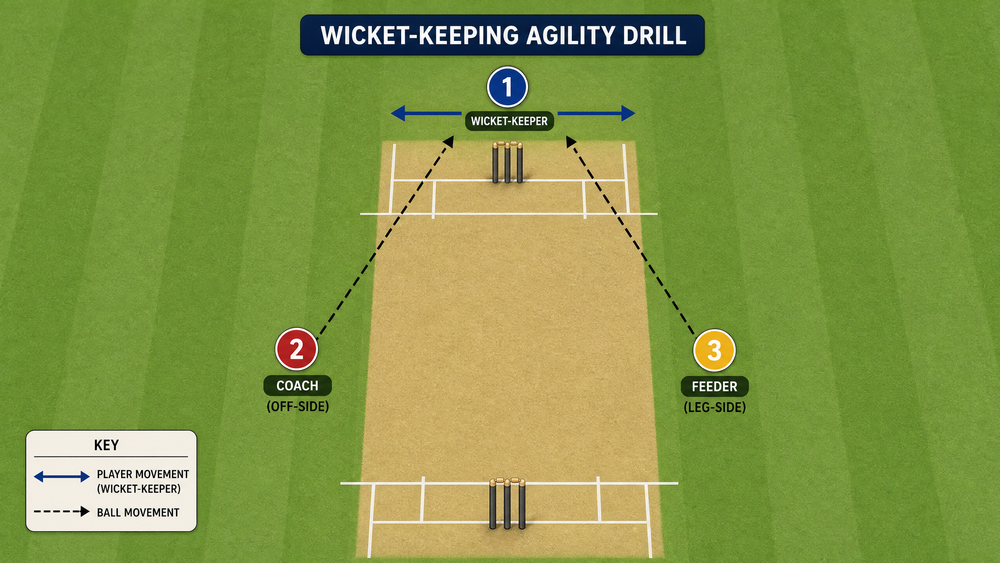
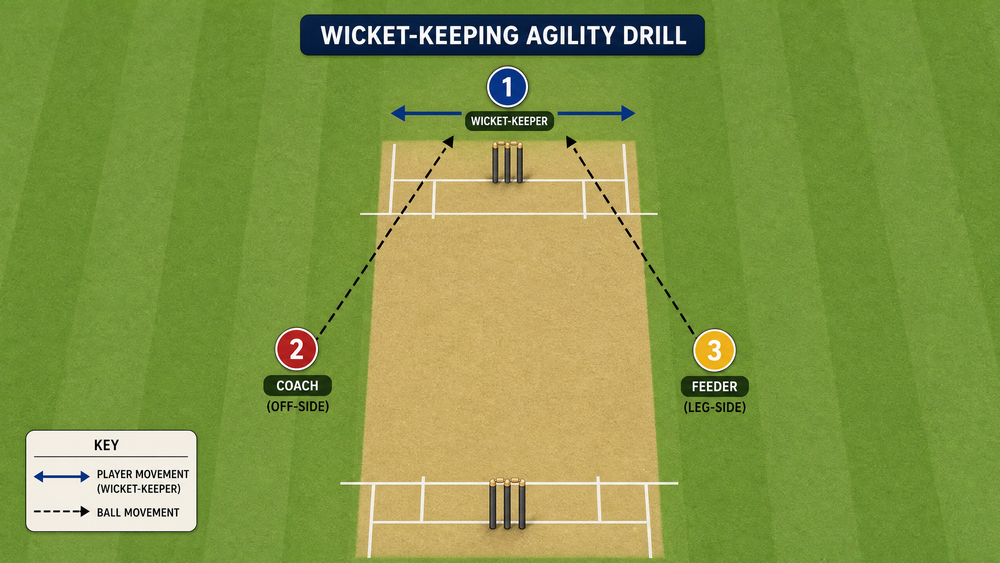
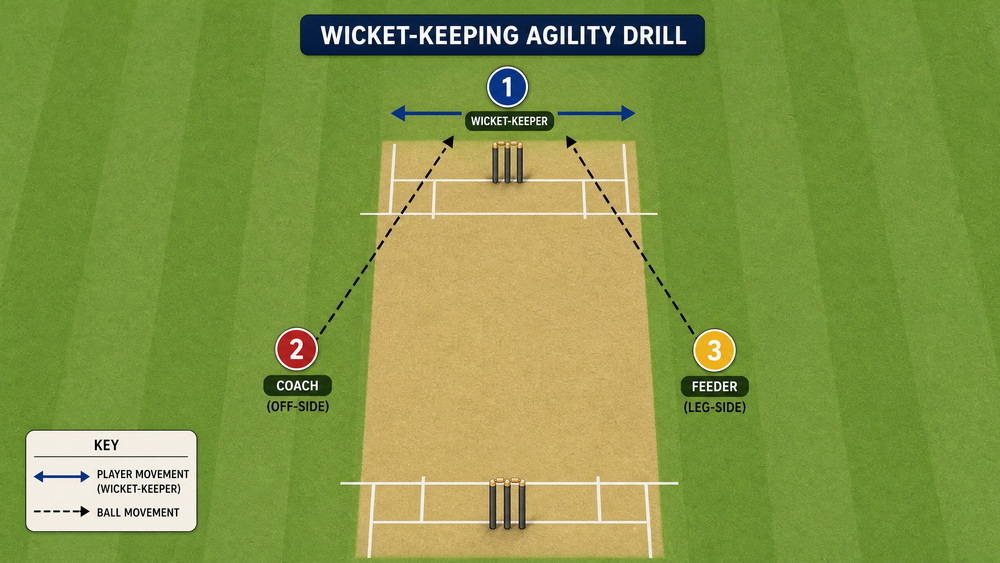
Work on a standard 22-yard cricket pitch or in a safe net lane. Set the wicket in its normal position. Player 1 — Wicket-Keeper starts directly behind the stumps in their match stance. Player 2 — Coach/Off-side Feeder stands 10-12 yards away on the off-side, around a first-slip or gully line. Player 3 — Leg-side Feeder stands 10-12 yards away on the leg-side. Mark two lateral target zones with cones, each 3 yards from the middle stump: one off-side and one leg-side. Make the zone wide enough for the keeper to set a balanced catching base rather than merely reaching with their gloves.
3. Step-by-Step Instructions
- Set the stance. Player 1 begins in a balanced crouch behind the stumps, with weight on the balls of the feet, hands presented in front of the body and eyes fixed on Player 2.
- Give a late cue. Player 2 calls "Left" or "Right", or points at the relevant cone, only when the keeper is settled. Alternate calls unpredictably so the keeper cannot pre-load towards one side.
- Drive laterally. On the cue, the keeper pushes powerfully from the outside leg, remains low and moves with quick side-steps to the named cone. For example, to move right, drive from the left leg first.
- Feed to the new line. As Player 1 reaches the target zone, Player 2 or Player 3 underarms or throws a firm catchable ball into the keeper’s new line. Begin at chest-to-knee height; introduce low or wider feeds only when the base movement is sound.
- Take the ball cleanly. The keeper gets their head towards the line of the ball, watches it all the way into the gloves and lets the hands give slightly on impact. Demand a completed catch, not just a touch.
- Recover through centre. After the catch, Player 1 returns the ball safely, side-steps rapidly back through the central starting point and resets in wicket-keeping posture before the next call. The recovery is a scored part of the repetition.
- Dose the work. Run 6-8 deliveries over 20-25 seconds, with 30-40 seconds of recovery between sets. Complete three high-quality sets per keeper, then rotate Player 1, Player 2 and Player 3. Stop a set early if posture, footwork or catching quality deteriorates.
4. Key Coaching Points
- Keep the hips low. A low centre of gravity lets the keeper push laterally without first rising up. Coaches should cue "stay in the rails" rather than allowing a tall running action.
- Push, do not reach. The first movement comes from the outside leg and travels through the hips. Reaching across the body with the gloves creates late, unstable catches.
- Lead with the head. The head should move into the ball’s line, eyes level and chin stable. Hands follow the head; they should not chase ahead of it.
- Receive with soft hands. Encourage the keeper to absorb the ball by giving fractionally with the gloves. Hard hands turn a catchable ball into a rebound.
- Reset as a keeper. Every recovery must finish behind the stumps in a ready stance. Coaches should not allow players to admire a catch or jog back upright.
5. Common Mistakes
- Crossing the feet. Crossing over instead of side-stepping compromises balance and prevents a second change of direction. Correct it by slowing the feed and rehearsing short, parallel steps.
- Popping up before the catch. Keepers often rise out of the crouch as the ball arrives, which makes low takes difficult. Re-state the expectation that the hips stay below the shoulders through contact.
- Snatching with hard hands. Players may jab at the ball rather than letting it arrive. Reduce pace, ask for a quiet catch and listen for clean glove contact.
- Anticipating the call. If the keeper moves early, withhold the feed and reset. The drill trains reaction, not guessing.
6. Variations & Progressions
Progression 1: Deflection Ramps
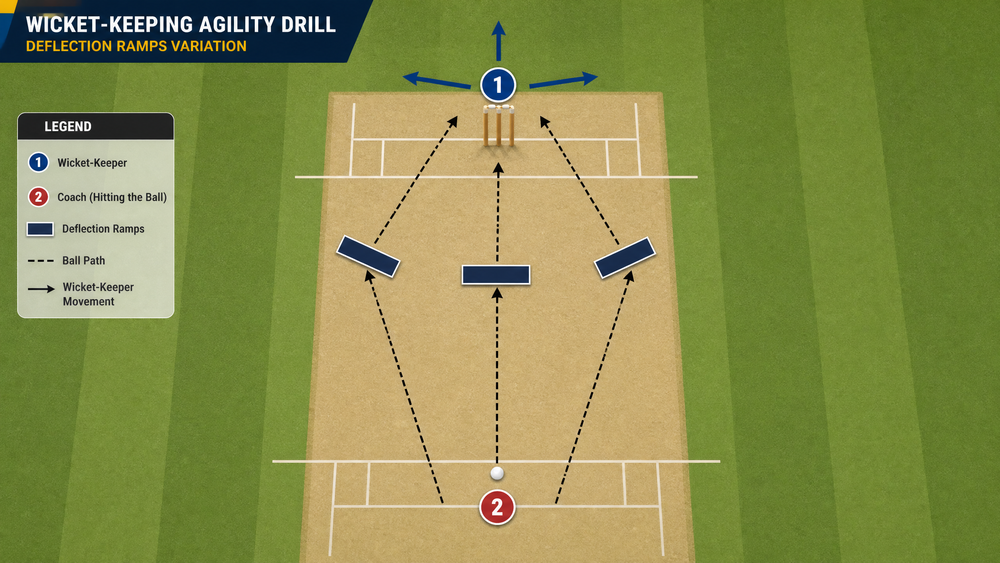
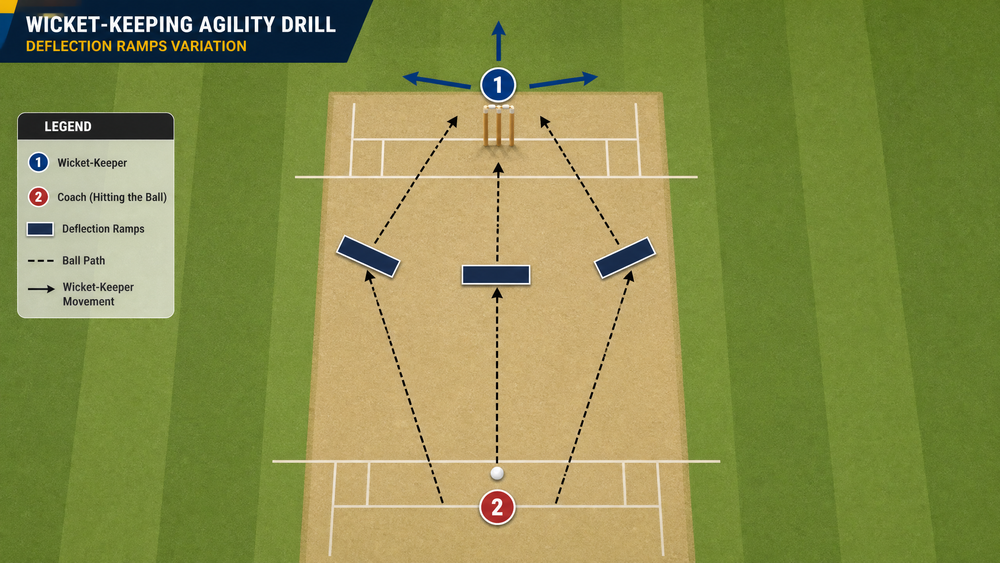
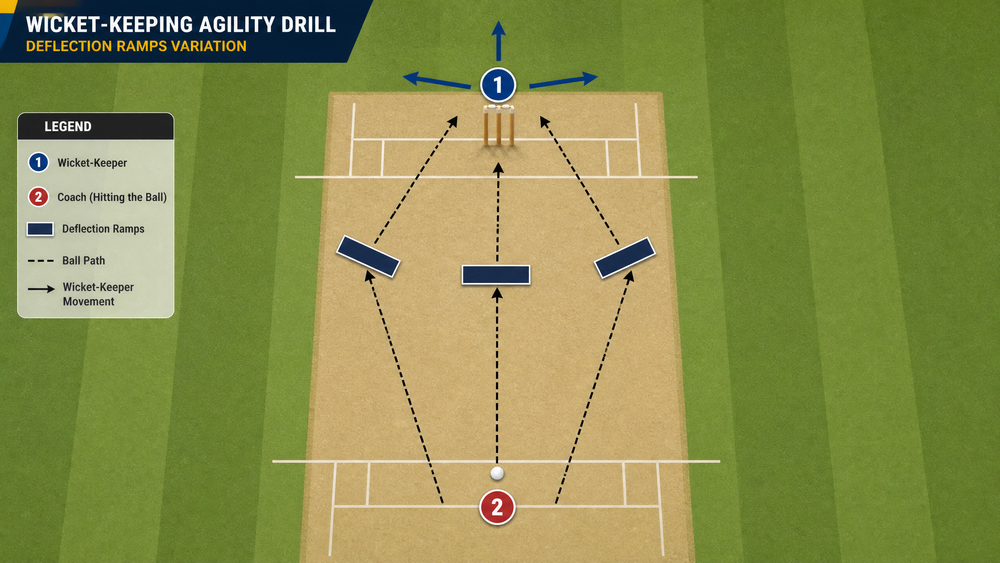
Place a Katchet board or deflection ramp 5-7 yards in front of the stumps. Player 2 fires the ball into the ramp, creating variable bounce and deviation. Player 1 reads the altered ball path and moves to take it; use a controlled pace at first and retain a clear safety corridor around the board. This is an effective bridge towards edged catches and uneven bounce.
Progression 2: Blind Reaction
Player 1 begins facing the stumps with their back to the feeders. On Player 2’s call of "Turn", the keeper spins, establishes a low base and reacts immediately to a ball sent to either lateral cone. Limit this to 4-6 repetitions per set because the turn adds a substantial reaction and orientation demand.
Variation 1: Double Feed
After the keeper completes an off-side catch, Player 3 immediately feeds a second ball towards the leg-side stump line. Player 1 must return the first ball to a safe zone, recover across the stumps and take the second feed. Begin with two hand-thrown balls; for advanced groups, have Player 2 strike controlled deflections with a bat.
7. Age Adaptations
- Under 8 and Under 10: Use soft balls and reduce the lateral distance to 1.5-2 yards. Feed underarm at a gentle pace, use two-handed catches and coach one action at a time: low stance, side-step, then catch. Two sets of five balls are sufficient.
- Under 12 and Under 14: Use standard cricket balls where appropriate, set the cones 2.5-3 yards out and increase feed pace only after consistent technique. Introduce simple late cues and the blind-reaction version, but keep the first feeds above knee height.
- Under 16 and Open: Use full 3-yard movement zones, faster feeds, deflection ramps and the double-feed variation. Once the keeper’s movement is reliable, controlled bat-generated edges can replicate varied pace and line. Insist on recovery speed, clean hands and decision-making under realistic pressure.
