

Rugby
7v6 Defensive Drift Pattern and Edge Containment Drill
A live 7v6 practice that teaches defenders to press together, drift with connection, and close the outside gate without surrendering the cutback.

What you need
2 Rugby balls, 12–16 field cones, Two sets of training bibs, Whistle, 2 contact shields or tackle bags
Overview
This is a coach-led 7v6 defensive drift pattern drill for the phase in which a backline must absorb a wide numerical threat without losing its shape. The attack has six backs; the defence has a six-player front line plus a sweeping Fullback. That extra defender does not make the drill easy: the line still has to launch on one call, protect the cutback, and close the touchline before the ball reaches the edge.
Run it after a tackle-technique or line-speed block, when players are ready to make decisions at match pace. The outcome is not simply an early tackle. The outcome is a connected line that removes outside space, forces the attack toward touch or back inside into traffic, and reloads quickly for the next phase.
Session snapshot
| Item | Coach specification |
|---|---|
| Players | 13 minimum: 6 attackers and 7 defenders |
| Area | 40 m × 25 m grid within a 100 m × 70 m Rugby field |
| Work-to-rest | 20–25 seconds live, then 40 seconds to coach and reset |
| Dose | Two blocks of six reps; reverse the attacking direction after three reps |
| Contact | Start with wrap-and-hold or touch; progress to controlled tackle only when technique is secure |
Setup
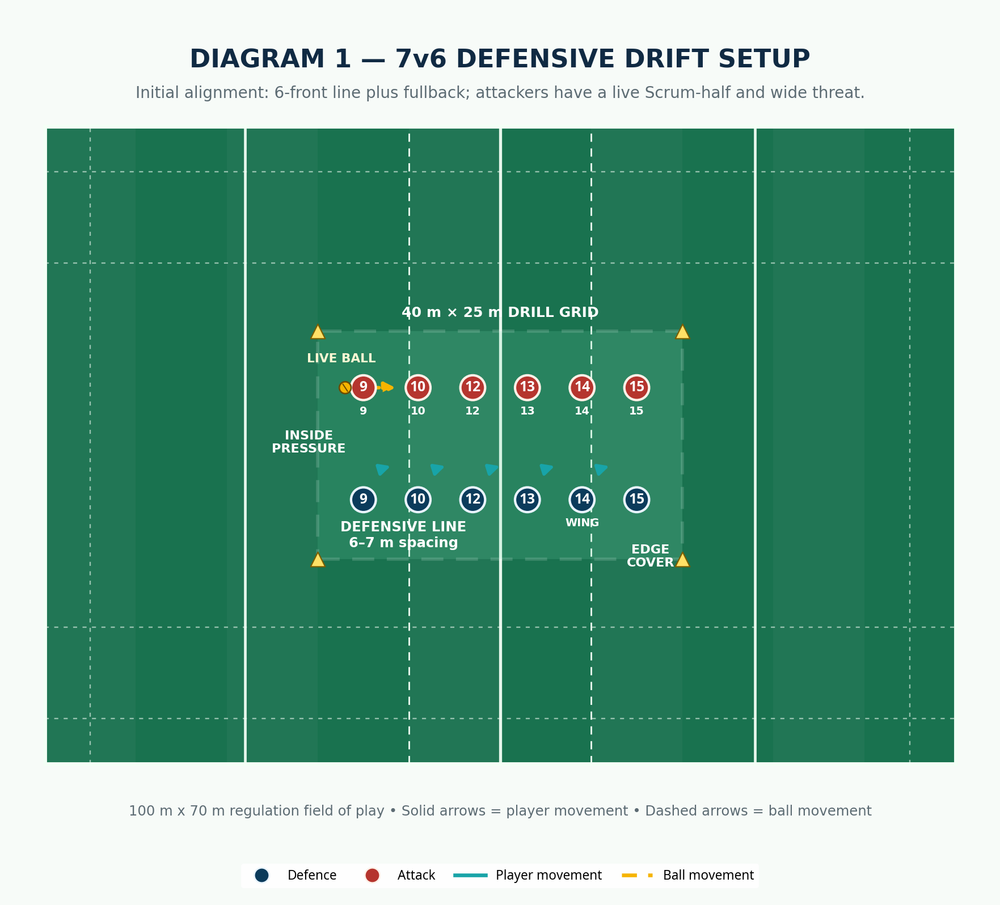
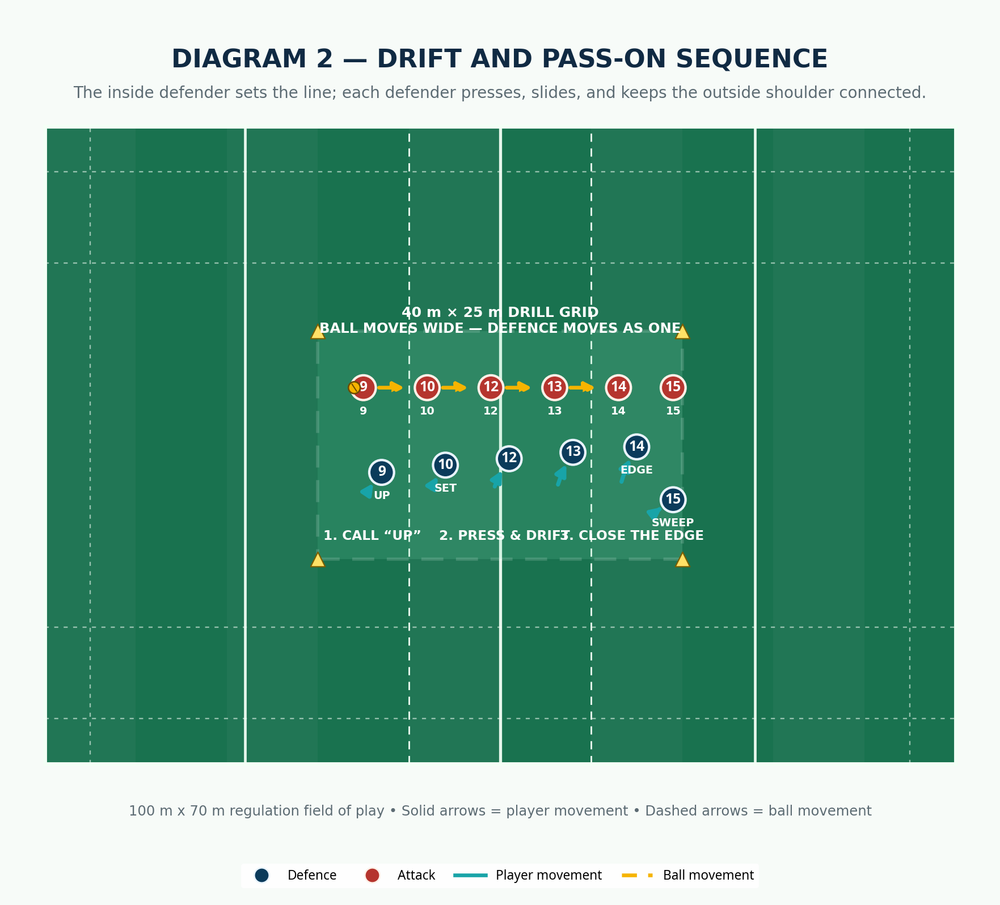
Mark a 40 m × 25 m grid in the middle third of a regulation 100 m × 70 m Rugby pitch.1 Set four corner cones and add a Fullback reference cone 5 m behind the outside half of the defensive line. If the venue allows, leave a 5 m safety channel beyond the grid so players can finish a break or kick safely. You need two Rugby balls, 12–16 cones, two bib colours, a whistle, and two contact shields or tackle bags.
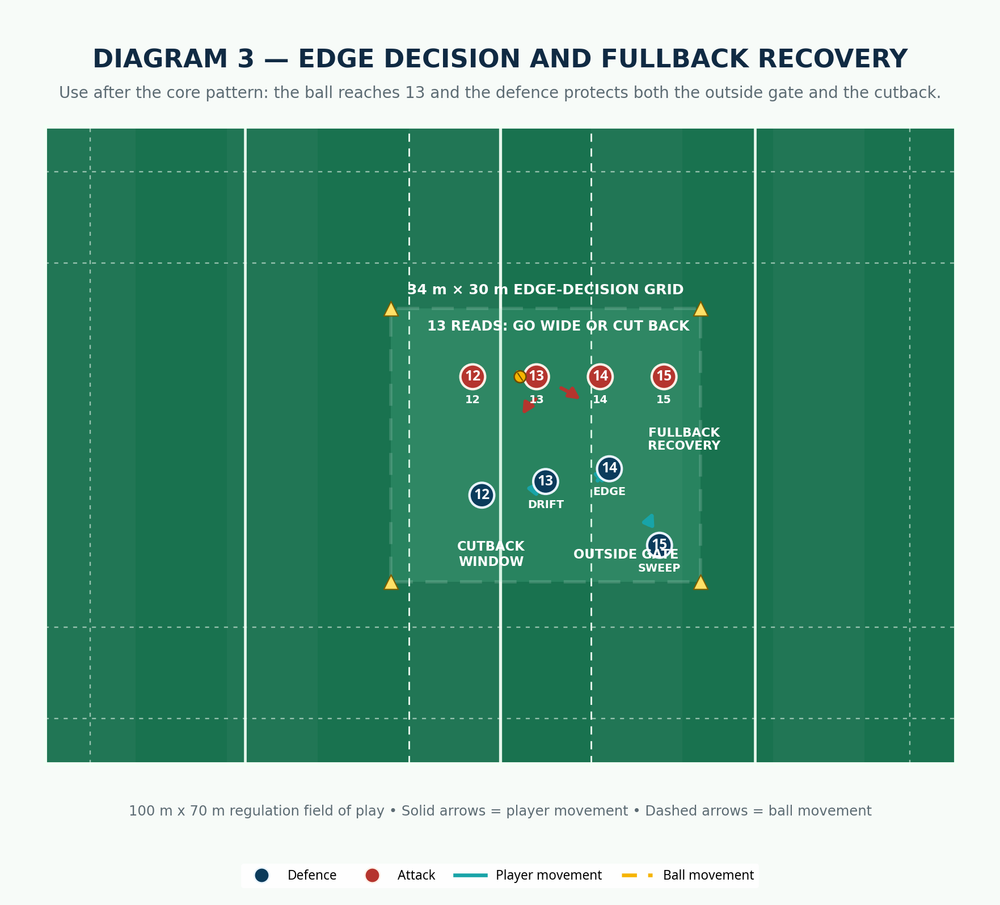
The attack starts in a conventional shape: Scrum-half 9, Fly-half 10, Inside Centre 12, Outside Centre 13, Wing 14, and Fullback 15. Give them about 6 m lateral spacing. The defence mirrors the front line with defensive 9, 10, 12, 13, and 14, plus defensive 15 sweeping 5–7 m behind the outer line. An extra player can feed the ball or rotate as a ruck defender.

Coach briefing
Rehearse the language before the first live rep. Defensive 9 owns the launch call: UP. Defensive 10 confirms the set. From 12 outward, use mine, yours, and edge to pass attackers across. Defensive 15 owns the cover call: sweep, kick, or line. Keep calls short; long instructions arrive after the attacking decision.
Step-by-Step Instructions
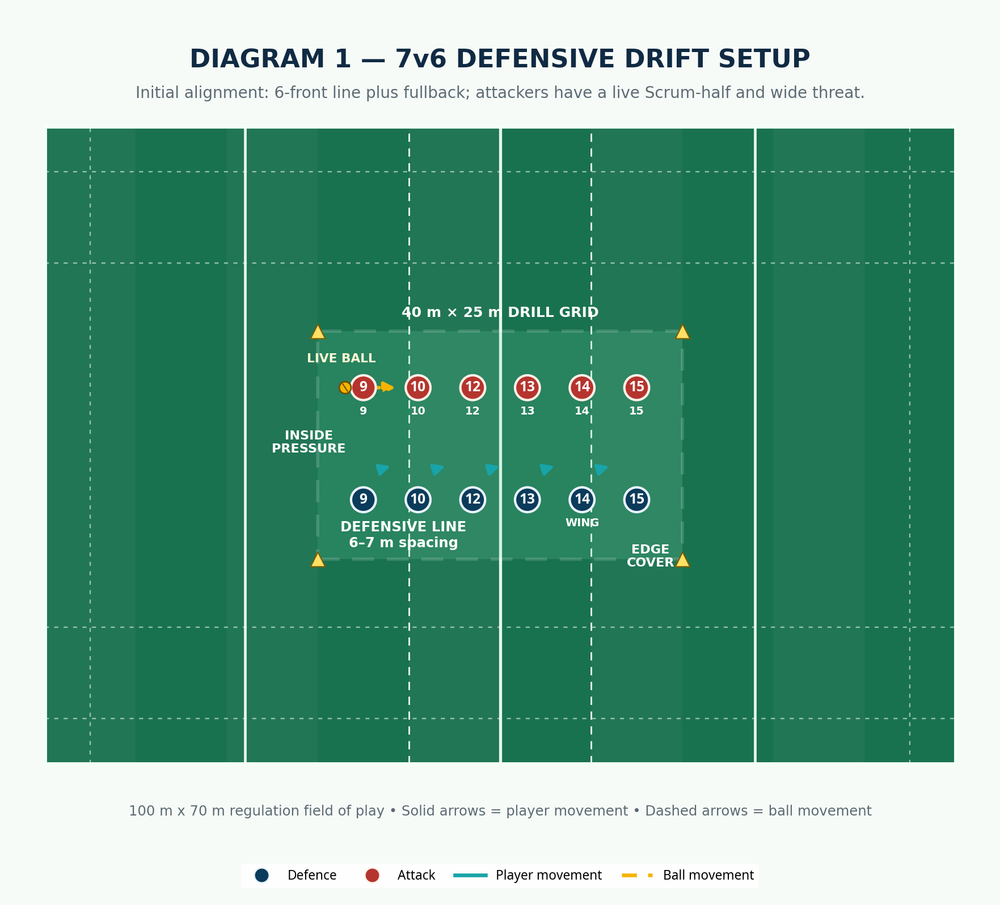
Set the picture. Put the attack 8–10 m in front of the defensive line. On the first two reps, require the ball to travel at least two passes wide. This lets the defence learn the pattern before it must solve carries, kicks, and late runners.
Launch together. On the whistle, attacking 9 passes to 10. Defensive 9 calls UP and the front line advances together for 3–4 m. The inside defender sets a pace the whole line can reproduce; stop the rep if the first two defenders get more than 1 m ahead of the outside line.
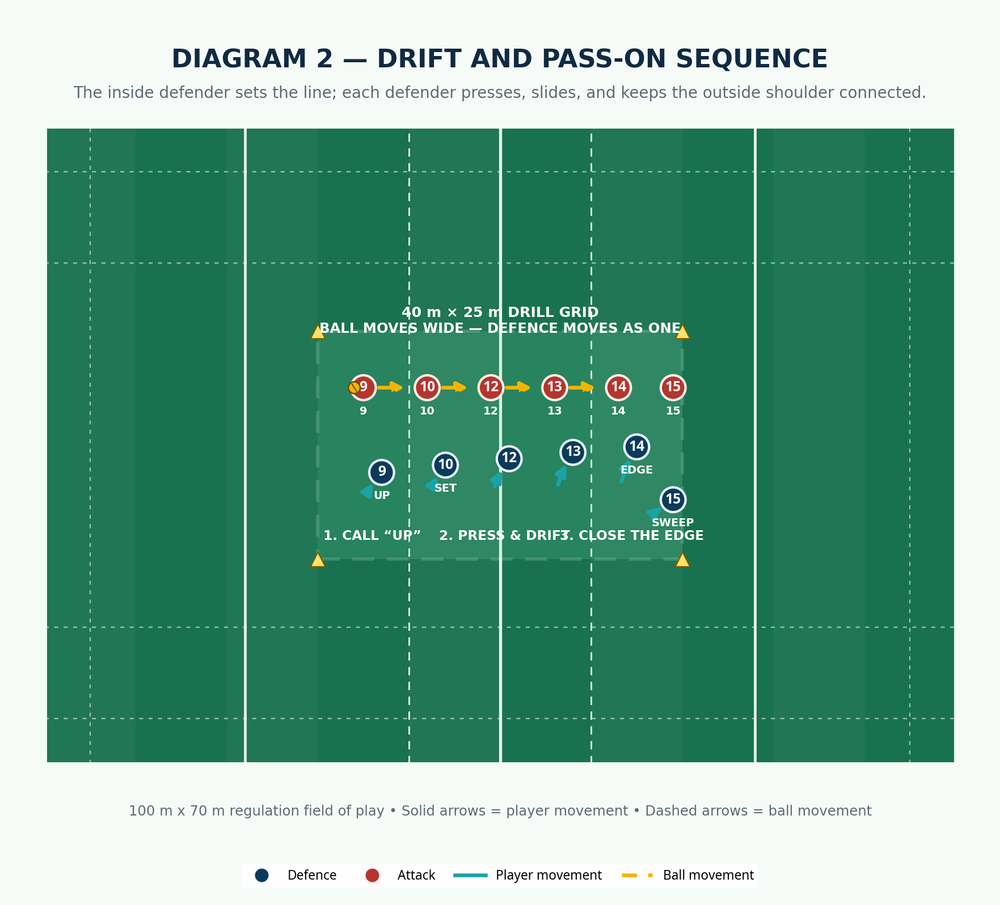
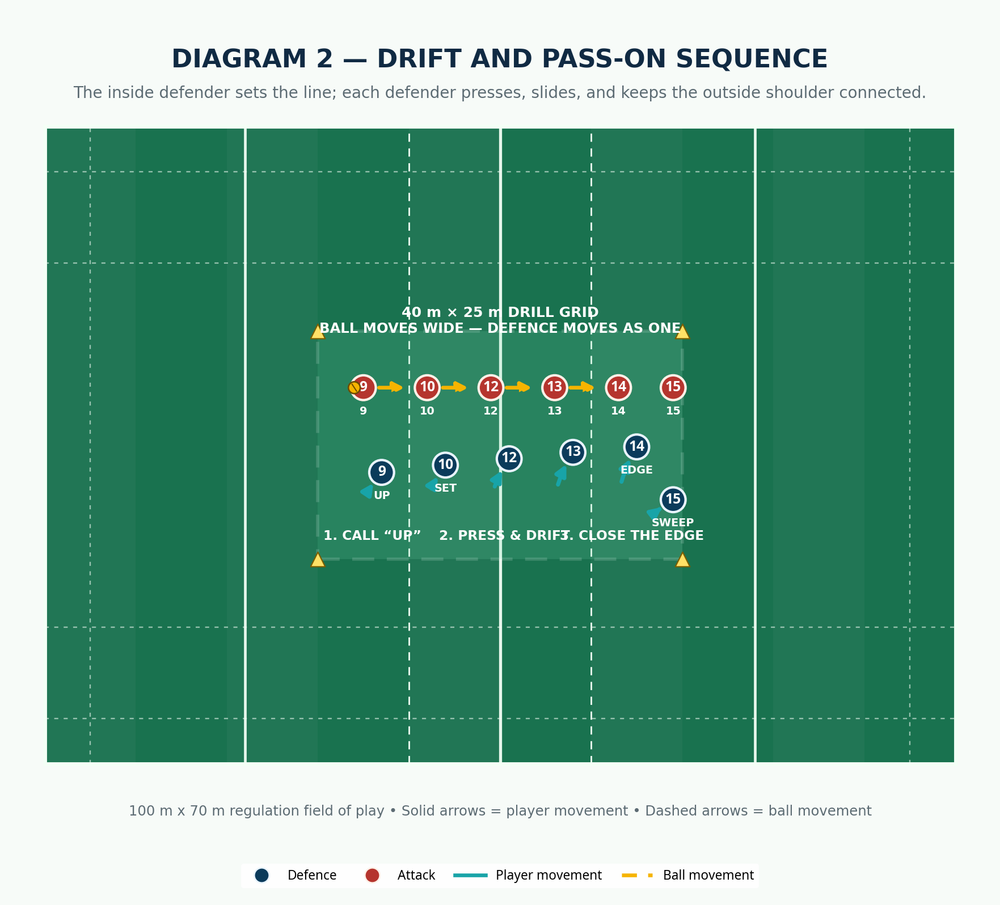
Press square, then drift. As 10 receives and shows the pass, 9 and 10 close forward space while 12, 13, and 14 begin to drift. Players push from the inside foot, keep hips and shoulders mostly square, and use peripheral vision to remain connected to the defender inside. Keep 4–6 m of usable spacing rather than bunching around the ball.
Pass on, do not chase. When the ball moves through 12 and 13, each defender identifies the next attacker before the ball reaches them. Use mine to take the ball carrier and yours to release the attacker to the next defender. Look from the ball to the near shoulder of the opposite player; turning inward to chase a decoy opens the outside gate.
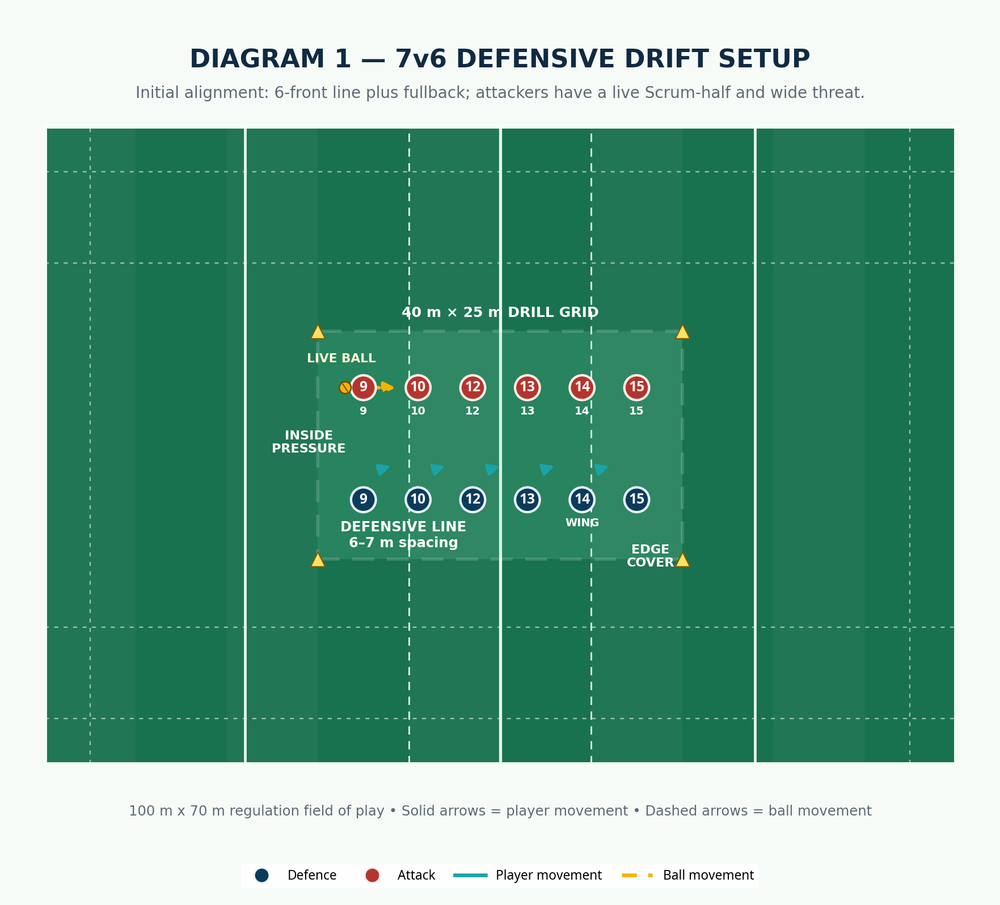
Close the edge. Once the ball reaches attacking 13 or 14, defensive 14 works from outside-in and uses the touchline as an extra defender. Defensive 13 stays connected on the inside shoulder; they must not overrun the carrier and expose the cutback.
Sweep and finish. Defensive 15 tracks 5–7 m behind the edge, reading the attacking Fullback, grubber, and clean break. End the rep when the attack is held, turned inside, kicked through, scores, or holds possession for eight seconds. Reset within 40 seconds and deliver one correction before the next rep.
Key Coaching Points
Set the speed from the inside. Defensive 9 and 10 create the launch tempo. If they race ahead, they create a dogleg; if they hesitate, the attack plays on the gain line. Demand one audible trigger and an advance everyone can match.
Drift is not passive sliding. Defenders should gain a little forward ground while moving laterally. Coach short steps, an inside-foot push, chest up, and eyes level so the player can still tackle if the carrier straightens.
Keep the outside shoulder connected. Each player owns the space outside their opposite number until it is clearly passed on. Connection is more valuable than an isolated highlight tackle: a connected line turns an overlap into a pressured pass.
Make the edge predictable. Defensive 14 calls edge early; defensive 15 confirms the cover picture. When both communicate before the ball reaches 13, the Wing can close hard and the Fullback can protect the kick or late pass instead of guessing.
Reload after the finish. Once the tackle or wrap is made, defenders work inside-out and regain 6–7 m spacing. A good first drift matters only if the next defensive line is organised.
Common Mistakes
| Error | What the coach sees | Immediate correction |
|---|---|---|
| Dogleg | One defender shoots 2–3 m ahead | Reset; make the inside caller run at the line's slowest sustainable speed |
| Touchline-facing shoulders | A slider cannot tackle a straightening carrier | Cue: square chest, inside-foot push; rehearse three steps |
| Ball watching | Spacing vanishes after the pass | Ask: Who is yours if the ball is not yours? |
| Edge panic | The Wing bites in and exposes the wide channel | Freeze; re-place 14 outside-in and 15 5–7 m deeper |
Variations & Progressions
Easier: narrow the problem. Reduce the grid to 30 m × 25 m, start with a static pass from 9 to 10, and limit the attack to passing and carrying. This gives developing players a clear picture of line speed, spacing, and the first pass-on decision.
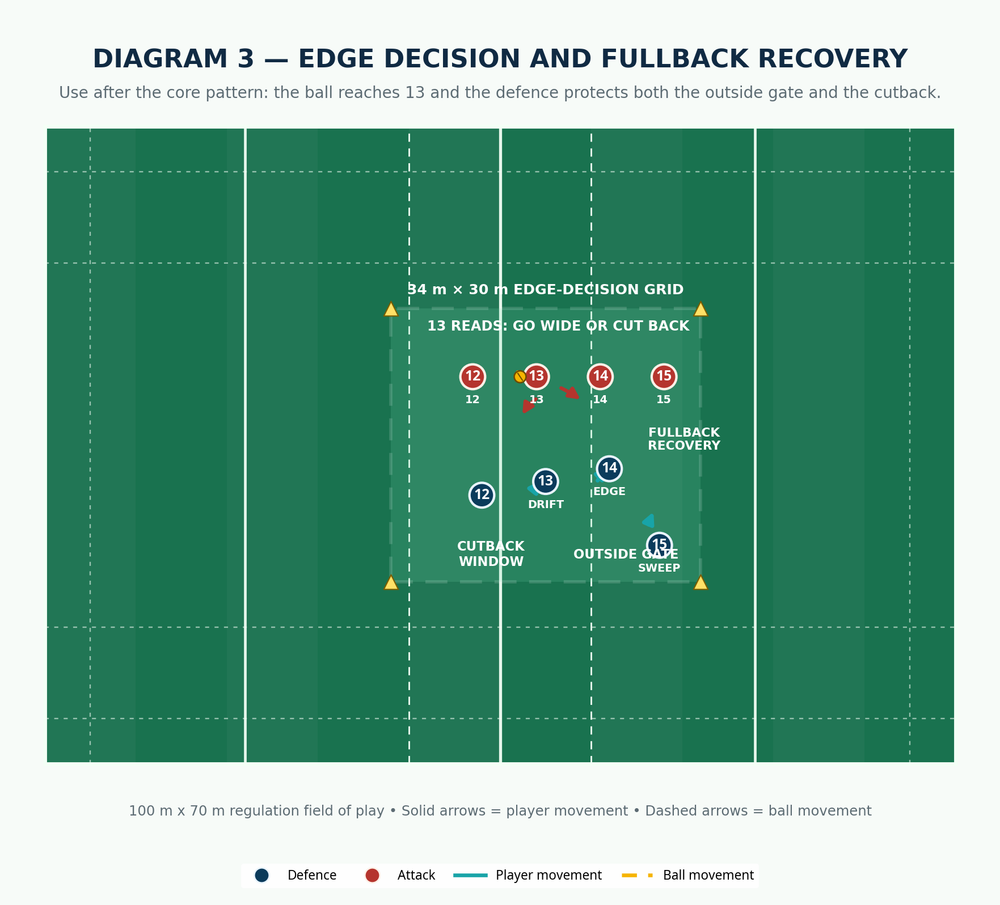
Progression 1: late-arriving threat. Let attacking 15 enter late from depth on a loop or unders line after 13 receives. Defensive 12 and 13 must communicate the cutback while 14 protects the edge. Award the attack two points for a clean line break and the defence two points for forcing the carrier to touch or back inside.
Progression 2: kick-or-carry decision. Allow attacking 13, 14, or 15 to kick behind the line. Defensive 15 coordinates with 14 to cover the kick while defensive 13 protects the inside gate. The Wing closes the live carrier, the Fullback owns the space behind, and the nearest inside defender guards the short return.
Progression 3: live breakdown reload. After the first tackle, place the ball quickly and play a second phase. The defence scores only if it reforms within 5 seconds, which makes recovery part of the drill rather than an afterthought.
Age Adaptations
| Age group | Adaptation | Coaching emphasis |
|---|---|---|
| Under-8 | 4v3 touch in a 20 m × 15 m grid; no kicking | Staying in a line and tracking safely |
| Under-10 | 5v4 tag or wrap-and-hold from a static pass | Calling up together and visible spacing |
| Under-12 | 6v5 with pass-and-carry only initially | Square shoulders, inside-foot push, and pass-on calls |
| Under-14 | Full 7v6 shape; add a late runner after core reps | Communication between 13, 14, and 15 |
| Under-16 and Open | Full pace with kicking, late entries, controlled tackle, and second phase | Numerical reads, decision speed, and rapid reload |
Finish by asking the defensive leaders: Did we force the attack where we wanted it to go while keeping the next line connected? If the answer is yes, the drill has moved beyond line speed into a functioning defensive system.
