Rugby Defensive Line Speed & Alignment: The Launch–Connect–Reload Drill
Build a faster, connected defensive wall by coaching the launch, the inside-out alignment, and the three-second reload after contact.

Equipment Needed
Overview
The Launch–Connect–Reload Drill teaches a defensive line to move as one unit rather than as five individual chasers. It develops the three things that decide whether pressure is useful: a shared launch cue, consistent inside-out alignment, and a rapid rebuild after the first contact. Run it early in a defensive block, after a handling warm-up, or as the bridge between tackle-technique work and opposed phase play.
Use a regulation-style rugby canvas: a field of play may be 100 m long and 70 m wide, with halfway, 22 m, 10 m and touchline markings visible for reference.1 The work happens in a 30 m wide × 28 m deep grid that repeatedly exposes line speed, ball tracking and the outside channel.
The core unit is five defenders: 6 blindside flanker, 7 openside flanker, 12 inside centre, 13 outside centre and 14 wing. The attacking pod is 9 scrum-half, 10 fly-half, 12 inside centre and 13 outside centre. Rename roles to suit your system, but retain the inside-to-outside responsibility.
Setup
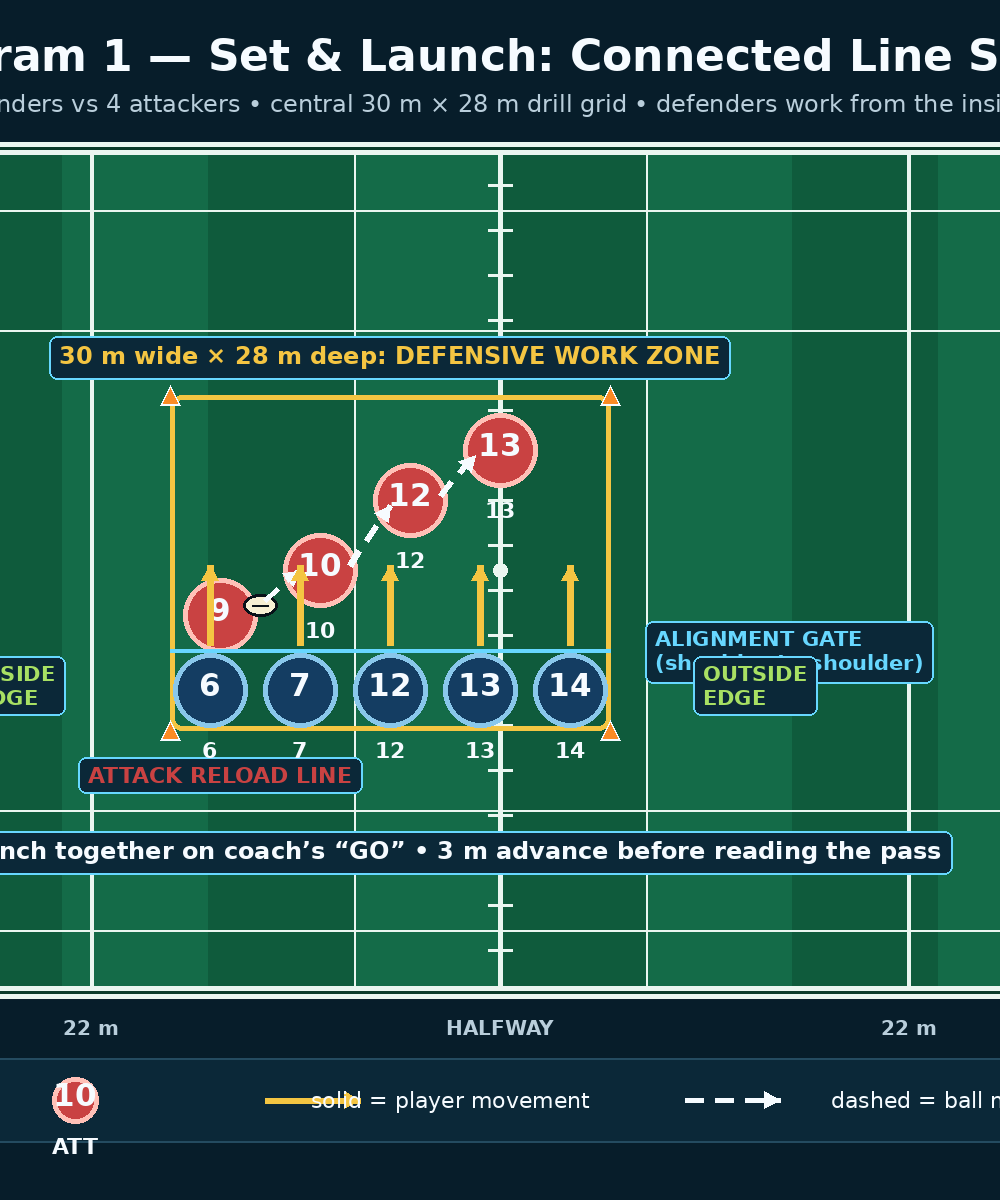
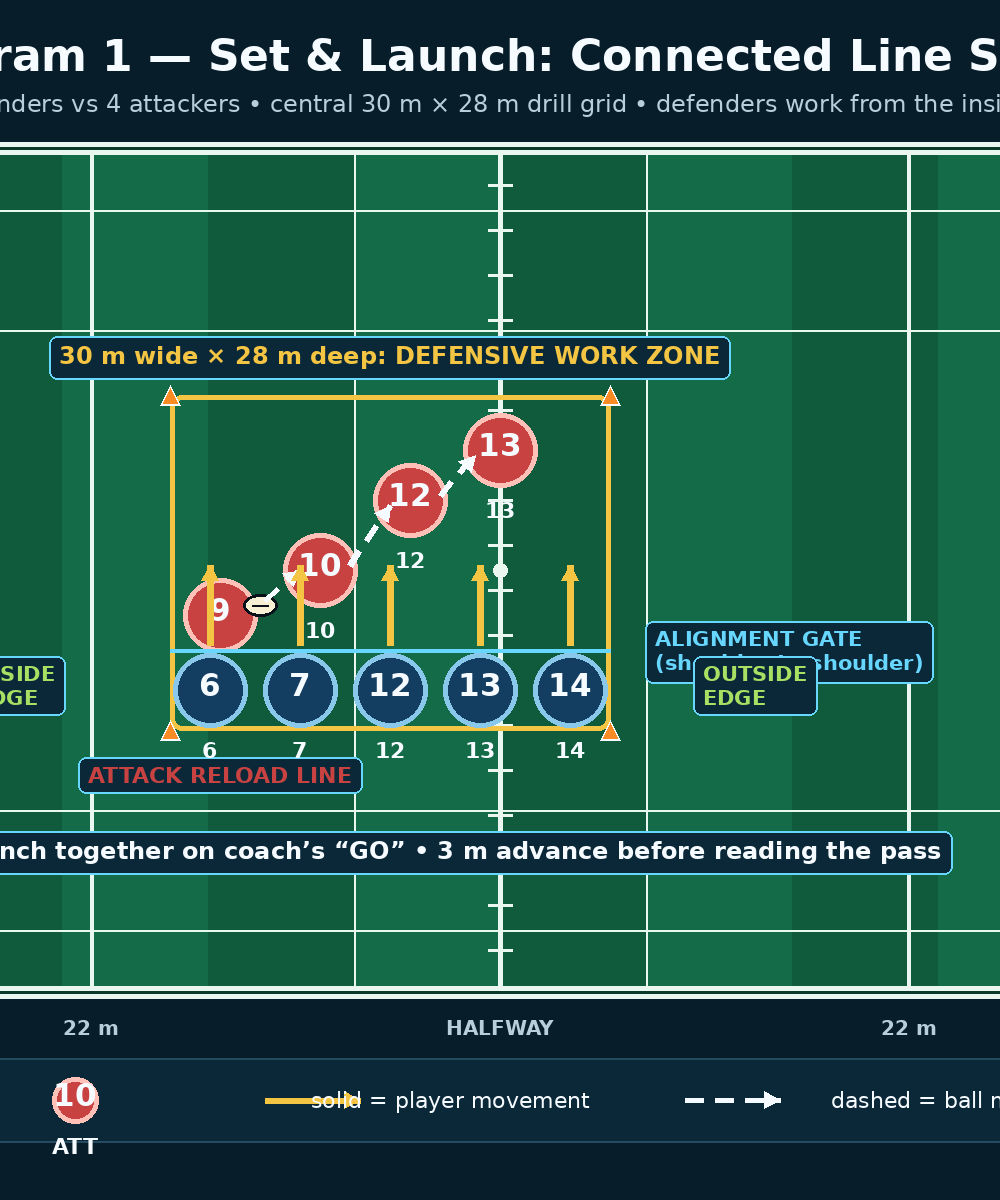
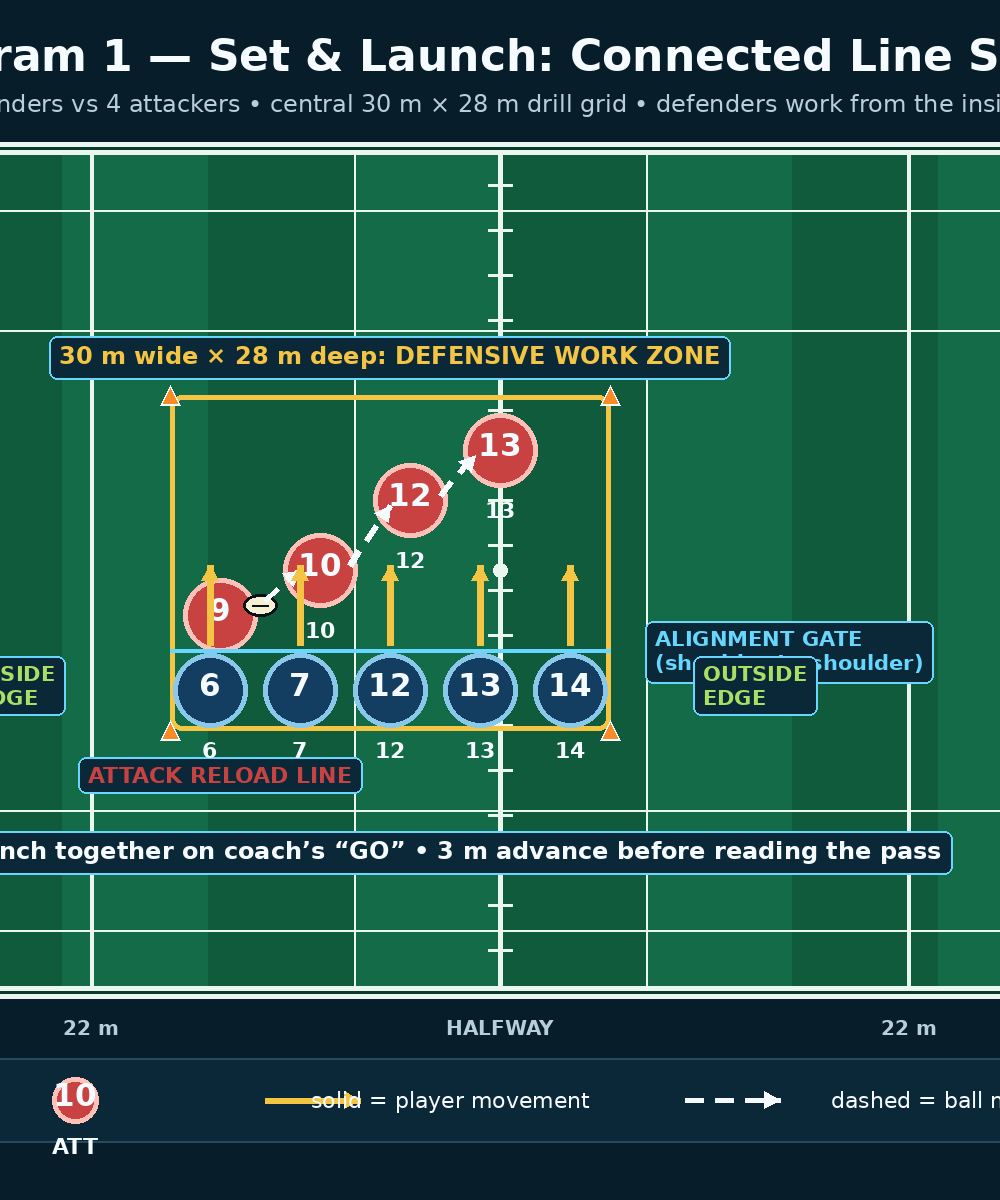
Mark a 30 m × 28 m rectangle across the central third of the pitch. On a 100 m × 70 m field, place the grid roughly between the 10 m lines, with the long side running across the pitch. Put four orange cones at the corners, a blue flat-cone “alignment gate” 8 m in from the defensive end, and an advantage-line marker 12 m ahead of the defenders. The defensive unit begins 3 m behind the gate; the attack begins 10–12 m ahead of it. This spacing exposes the first three-metre launch before the pass.
| Item | Quantity | Coaching use |
|---|---|---|
| Cones or flat markers | 20 | Grid, alignment gate, advantage line and reload line |
| Rugby balls | 2–3 | Fast re-starts and a spare ball with the coach |
| Coloured bibs | 10–12 | Clear attack/defence identity |
| Tackle shields | 2 | Contact version or safe technical finish |
| Whistle and stopwatch | 1 each | Launch timing and 3-second reload standard |
Number 6 is the inside edge and gives the first “up” call. 7 owns the next shoulder. 12 is the line’s organiser and repeats the call if the picture changes. 13 manages the outside shoulder and communicates with 14, who protects the outside gate without drifting early. The scrum-half starts each repetition with a visible ball lift or pass; the coach can also call “GO” on early reps.

Step-by-Step Instructions
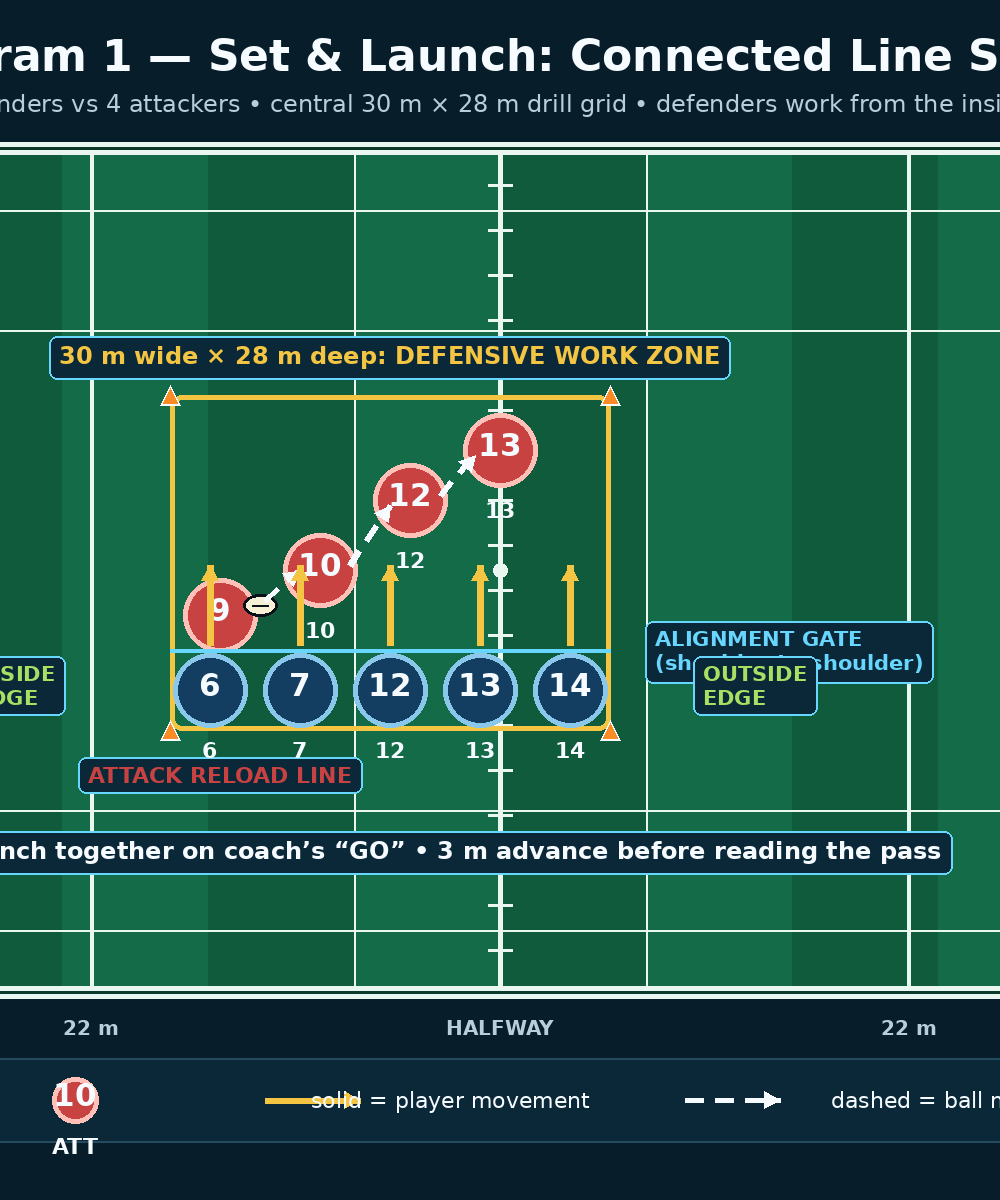
Set the picture. Place the five defenders on the reload line, one metre apart shoulder-to-shoulder, with knees soft and weight on the balls of the feet. Attackers stand in depth with 9 at the base and 10, 12 and 13 staggered outside. Give the defence five seconds to call numbers, confirm the inside edge and agree the launch word: “Up.”
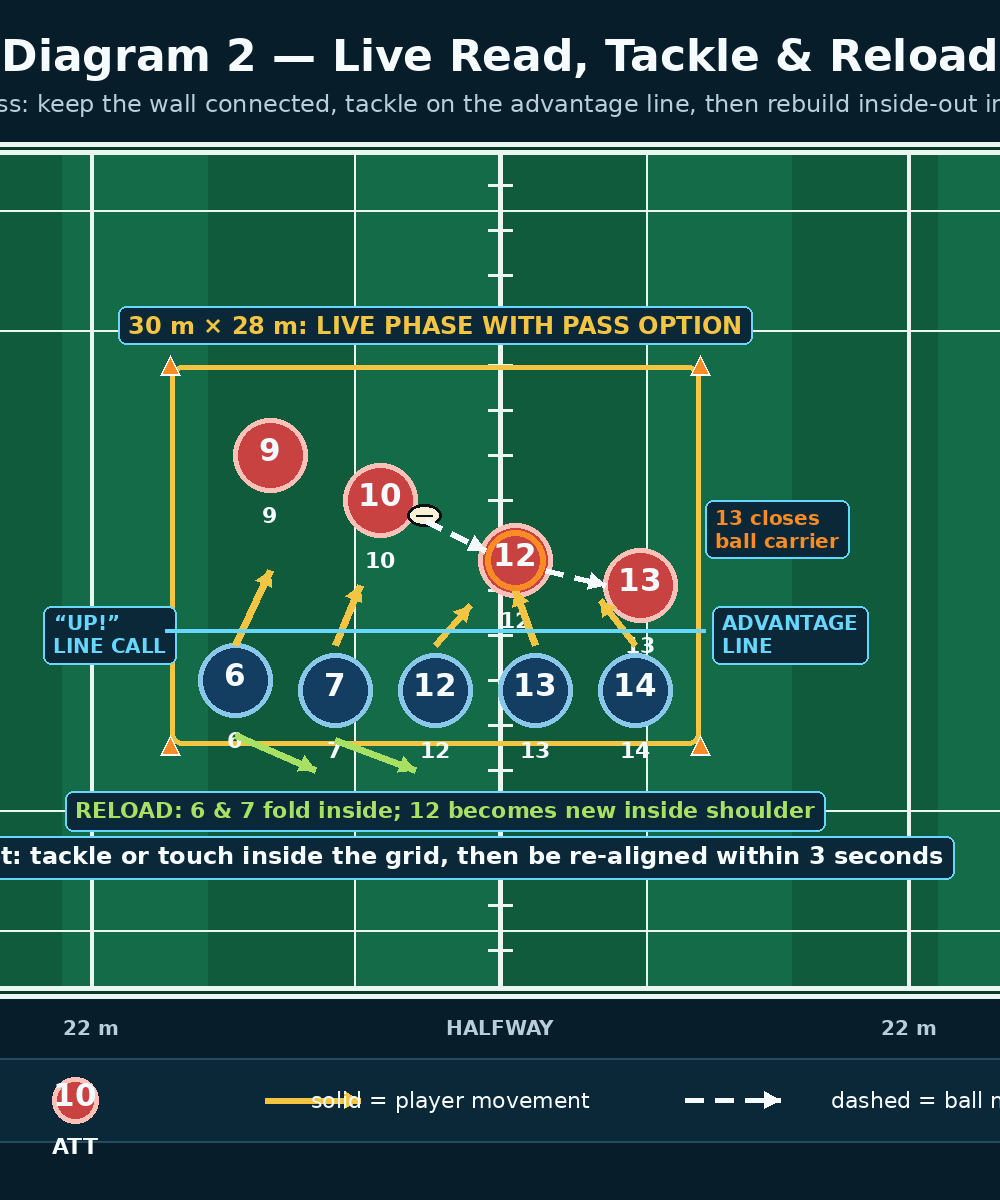
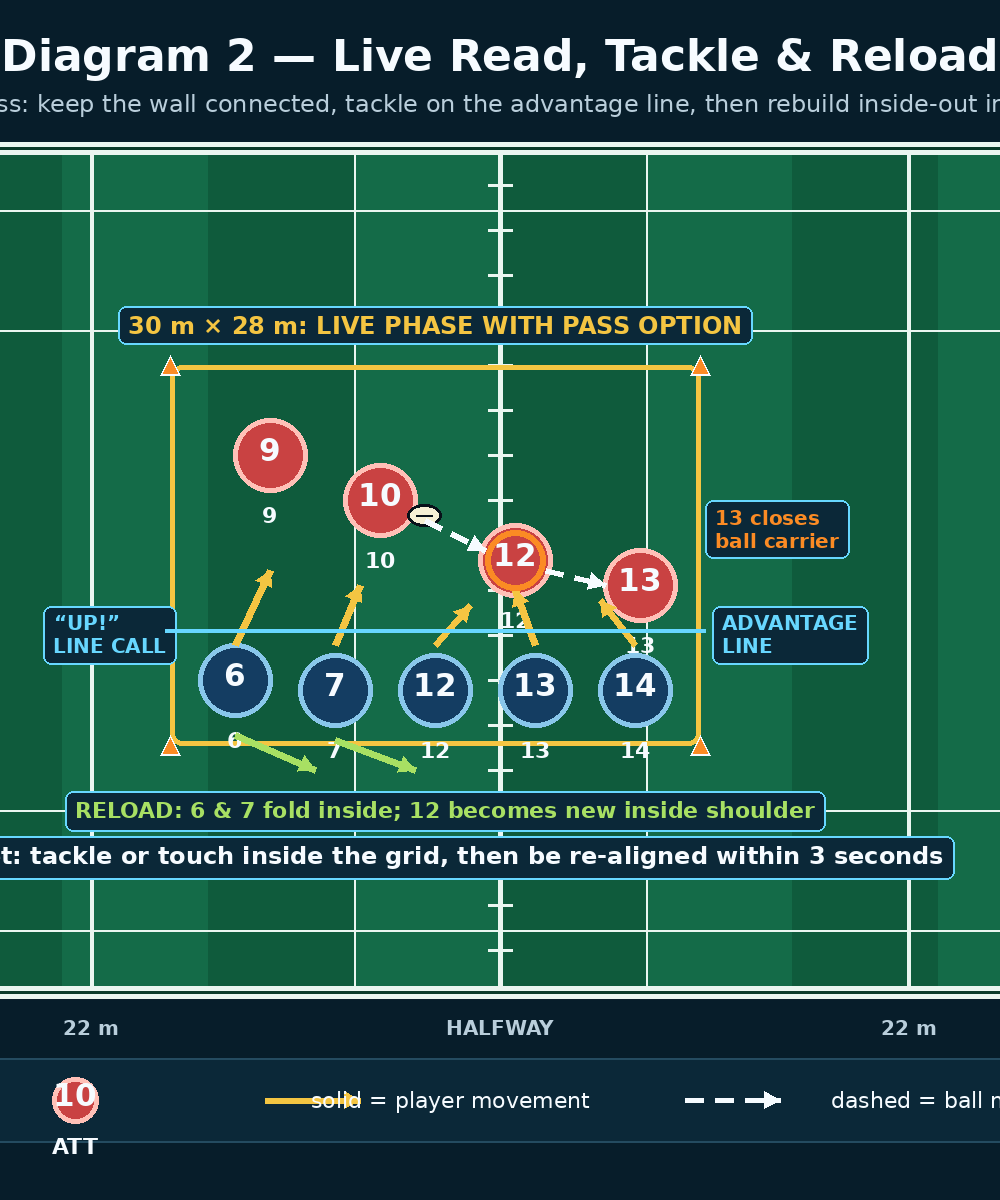
Launch as a wall. On 9’s first movement or the coach’s “GO,” every defender takes a sharp two-step acceleration forward. The first target is a 3 m advance in one second while keeping the same relative spacing. Do not allow 6 or 7 to win the race alone; the wall must cross the alignment gate together.
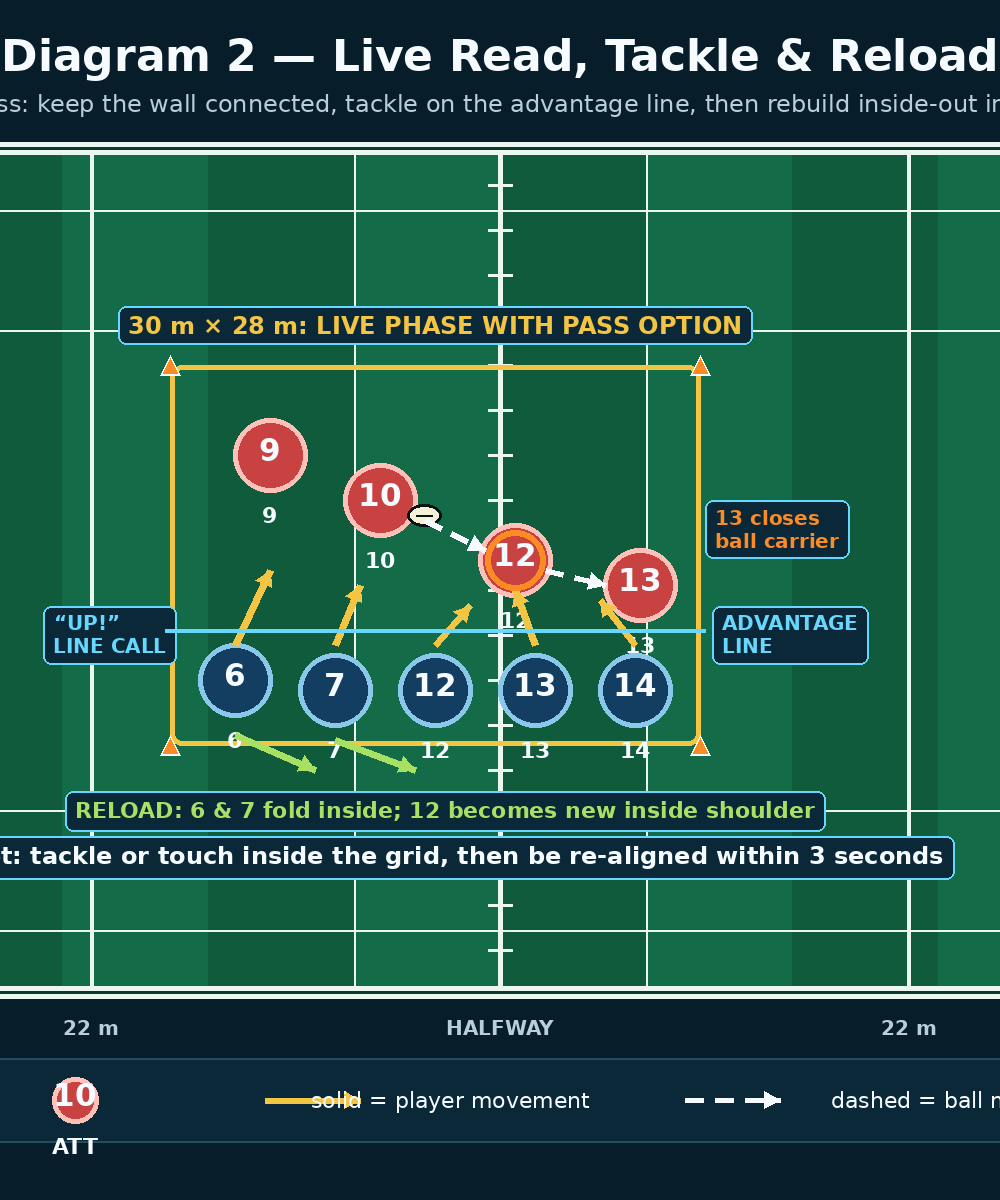
Square and read. Once across the gate, defenders shorten their steps, stay square through the hips and keep eyes on the player inside the ball. Attackers make one pass from 9 to 10 and may either carry or shift once more. The defence calls “ball,” “up,” and “outside” as the ball moves. Hold attackers to a controlled 70–80% running speed for the first two rounds.
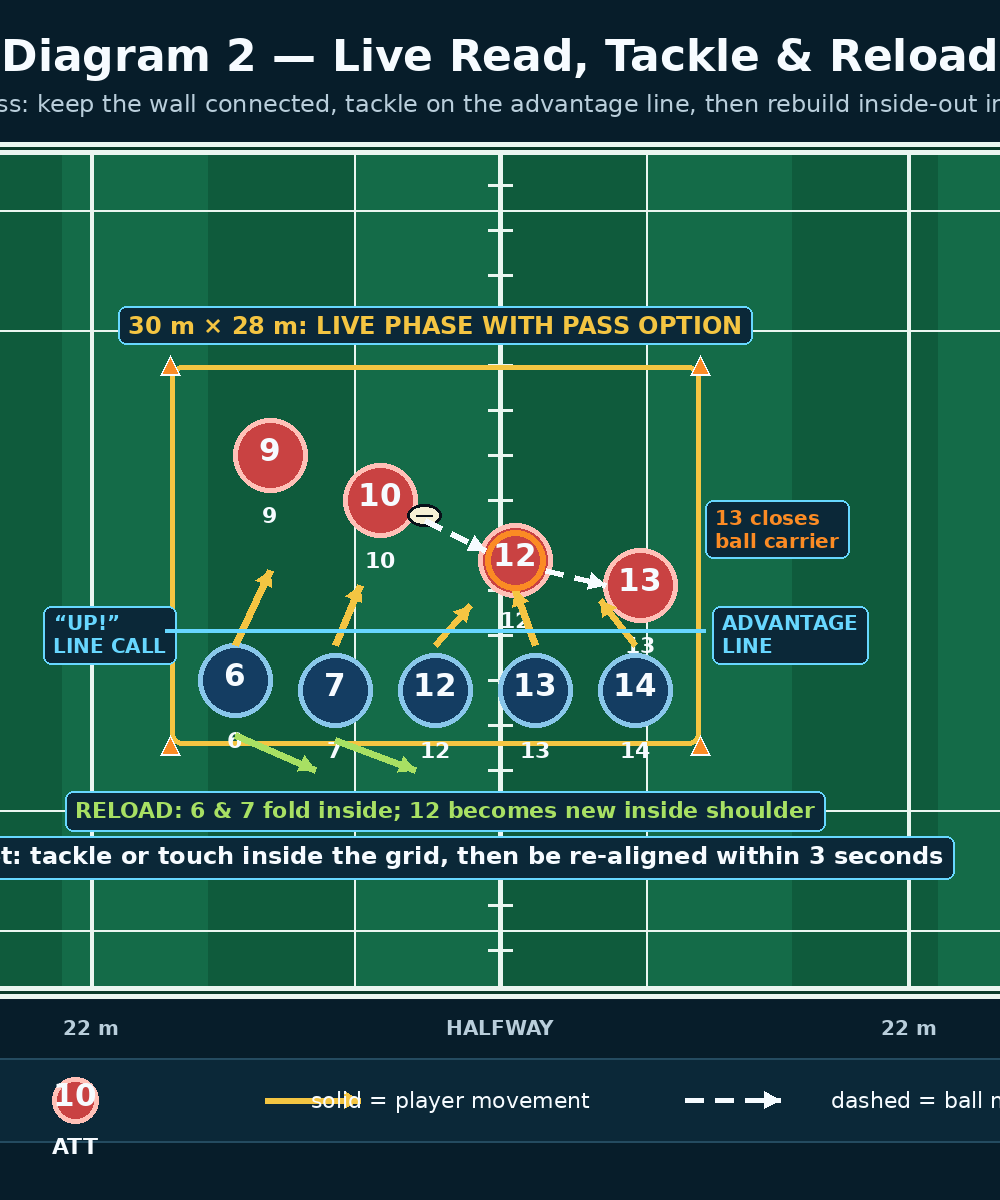
Finish the phase. The ball carrier is stopped by a safe touch, wrap-and-hold, or shield tackle—choose one before the session. The nearest defender makes the finish; the next two defenders close the space on either side, while the remaining players preserve width. Blow the whistle once the carrier is controlled or crosses the grid boundary.
Reload under a clock. Start a visible three-second count on the whistle. The original tackler and nearest support players fold inside; 12 becomes the reference shoulder if required; 13 and 14 reset the outside gate. The line must be connected and facing the next attack before the count reaches three. Any gap wider than one metre is a failed reload.
Rotate and repeat. Run six repetitions, then swap attack and defence. Coach behind the line for two reps, then outside 14 for two more to judge drift. Use three four-minute blocks: launch mechanics, live pass, then tackle-and-reload. Keep work-to-rest close to 1:1 by giving a 20–30 second reset after every two reps.
Key Coaching Points
- Win the first three metres together. Line speed only counts if the whole unit moves. Praise the slowest player who stays connected over the fastest player who shoots alone.
- Build from the inside edge. Number 6 must name the inside threat; everyone else aligns off that shoulder. If the inside is secure, 14 can press with confidence rather than backpedalling.
- Square hips, short feet, active voice. A fast line with turned shoulders creates a soft inside seam. Cue “square, scan, speak” during the approach.
- Track the ball, not the decoy. Eyes should move from the player inside the ball to the ball carrier. Encourage players to communicate a late pass rather than chase a tempting decoy line.
- Protect the space between shoulders. Aim for no more than one metre between adjacent defenders at the advantage line. Hands can be out, but bodies must remain ready to tackle.
- Reload is part of the rep. Do not let players admire the tackle. The standard is a connected defensive picture within three seconds, not merely a completed contact.
Common Mistakes
| Error | What the coach sees | Immediate correction |
|---|---|---|
| Shooter breaks the line | 6 or 7 is 2–3 m ahead of teammates | Re-run from the gate; demand the first two steps land together |
| Outside drift | 14 keeps moving sideways before the pass | Freeze the picture; make 13 call “hold” until the ball has travelled |
| Turned shoulders | Defenders chase the passer rather than face up | Reduce attacker speed and rehearse square two-step closes |
| Silent line | Late or conflicting calls | Assign 6 as inside caller and 12 as echo; stop play on silence |
| Slow post-contact picture | Players stand near the tackle | Add the three-second count and award points only for a connected reload |
Variations & Progressions
Make it easier: remove the second pass, use touch only, and give the defence a fixed “GO” call. This lets younger or new units rehearse body height, spacing and the first three metres without an overload of decisions.
Add a decision: allow 10 to run, tip to 12, or pass to 13. Start 14 two metres deeper only for this progression, then bring them back into the line once 13 and 14 communicate effectively. Reward the defence with one point for stopping the ball inside the advantage line and one extra point for reloading inside three seconds.
Make it match-real: play a two-phase sequence. After the first contact, 9 immediately feeds a second ball from the ruck area. Defenders must fold, nominate a new inside edge, and launch again. Progress to live tackles only when players show safe technique and the coach can consistently identify a connected five-player line.
Age Adaptations
For Under 8–Under 10, use four defenders in a 20 m × 15 m grid, tag or touch only, and one coach-led launch cue. Avoid formal position numbers; use “inside, middle, outside” roles and celebrate straight running and communication.
For Under 12, use five defenders in a 25 m × 20 m grid, introduce 6, 7, 12, 13 and 14 labels, and permit a single controlled pass. Keep the reload target at five seconds and use shields rather than live tackles if contact competency is still developing.
For Under 14–Under 16, use the full 30 m × 28 m grid, two-pass options and a three-second reload target. Add a tackle only after the defence has earned the right through body-height and alignment quality. At open age, add a genuine ruck picture, a scanning 9, and system-specific edge rules; measure whether the line prevents gain-line breaks rather than merely producing a loud hit.
Coach’s scoring challenge
Run a five-rep competition. Award 1 point for a connected launch through the gate, 1 point for a stop inside the advantage line, and 1 point for a reload inside three seconds. A defender who shoots out of the line cancels the launch point, even if they make the tackle. The scoring makes the behavioural priority unmistakable: connection first, pressure second, finish third.
References