

Rugby
Dynamic Kick-Off Reception & Wide Channel Counter-Attack
Turn defensive restarts into lethal attacking opportunities with this structured reception and rapid counter-attack set play.

What you need
1-5 Rugby balls, 10-15 Training cones, Full pitch or 50m x 70m area, Bibs (two colors)
Kick-off Reception and Counter-Attack Play
1. Overview
The kick-off reception and counter-attack is a critical transition moment in Rugby. Rather than simply securing the ball and kicking it back or setting up a slow, predictable ruck, this set play aims to immediately exploit the disorganized chase line of the opposition. By using a structured reception pod, rapid recycling, and aggressive running lines, teams can turn a defensive restart into a potent attacking opportunity, putting the kicking team on the back foot from the first whistle.
2. Setup
Equipment Needed:
- 1 Rugby ball (minimum, 3-5 recommended for continuous reps)
- 10-15 Cones (to mark zones and starting positions)
- Full pitch or minimum 50m x 70m playing area
Pitch Setup:
- Mark the halfway line as the kick-off line.
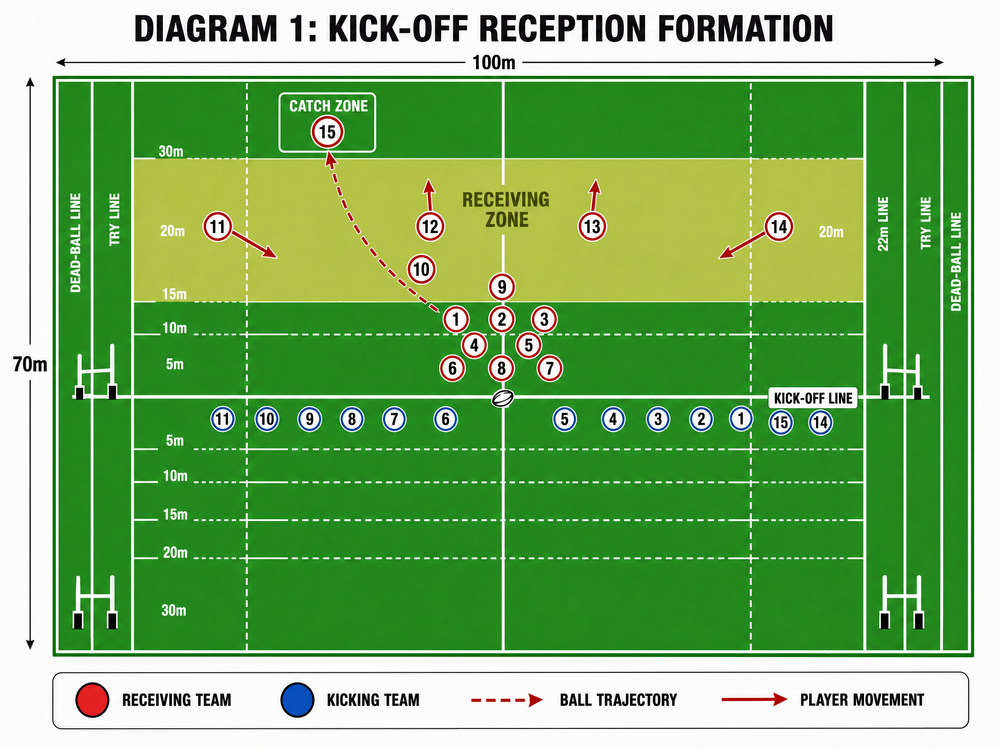
- Use cones to designate the 'Catch Zone' deep in the 22m area.
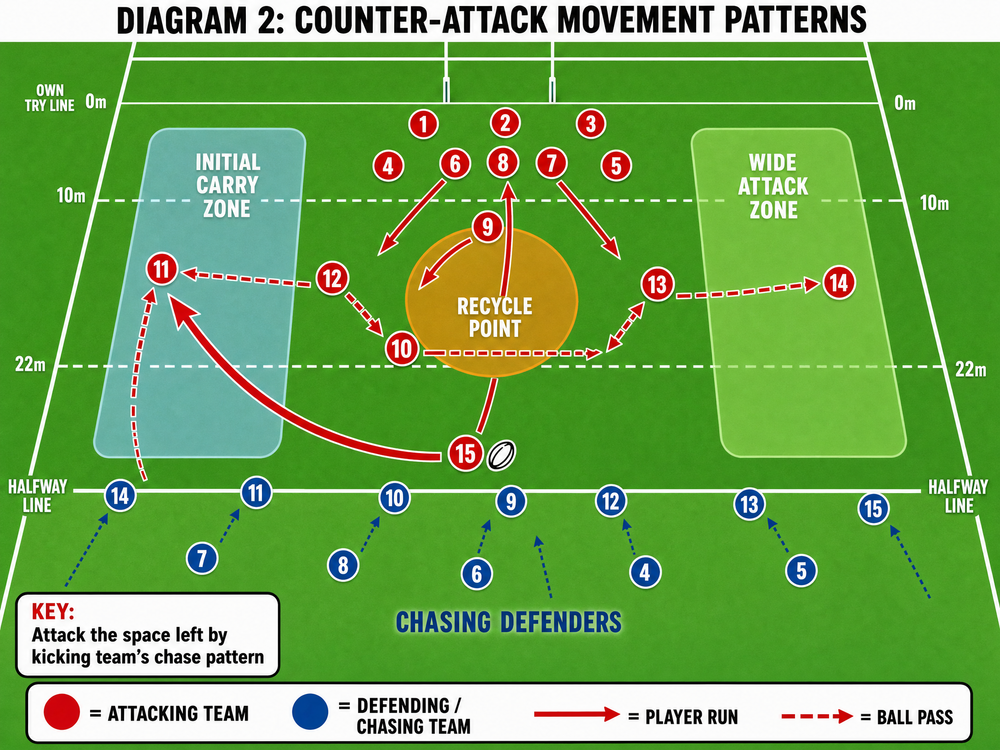
- Set up a 'Recycle Point' target area near the 15m line.
Player Positions:
- Receiving Team (Red): Full 15-man structure. Key players are the Fullback (15) deep, Wings (11, 14) covering wide, and a forward pod (1-8) clustered centrally around the 10m line.
- Kicking Team (Blue): Standard kick-off formation spread across the halfway line.
3. Step-by-Step Instructions
Phase 1: The Reception
- The Kick: The opposition fly-half kicks the ball deep toward the left-back zone.
- The Catch: The Fullback (15) tracks the ball, calls "Mine!" early and loudly, and jumps to catch the ball at its highest point, protecting it with their body.
- The Escort: The Left Wing (11) and Inside Centre (12) move to block the direct chasing lines of the opposition, providing a safe landing zone for the catcher.
Phase 2: The Initial Carry and Recycle
4. The Carry: Upon landing, the Fullback (15) immediately accelerates forward and slightly infield, aiming for the 'Initial Carry Zone'.
5. The Support: The forward pod (specifically 6, 7, and 8) aggressively tracks back to support the ball carrier.
6. The Ruck: As the Fullback is tackled, they present the ball cleanly. The supporting forwards secure the ruck instantly at the 'Recycle Point', ensuring lightning-fast ball availability.
Phase 3: The Counter-Attack
7. The Distribution: The Scrum-half (9) arrives at the ruck and fires a fast, flat pass to the Fly-half (10).
8. The Decoy: The Inside Centre (12) runs a hard, flat decoy line to freeze the interior defense.
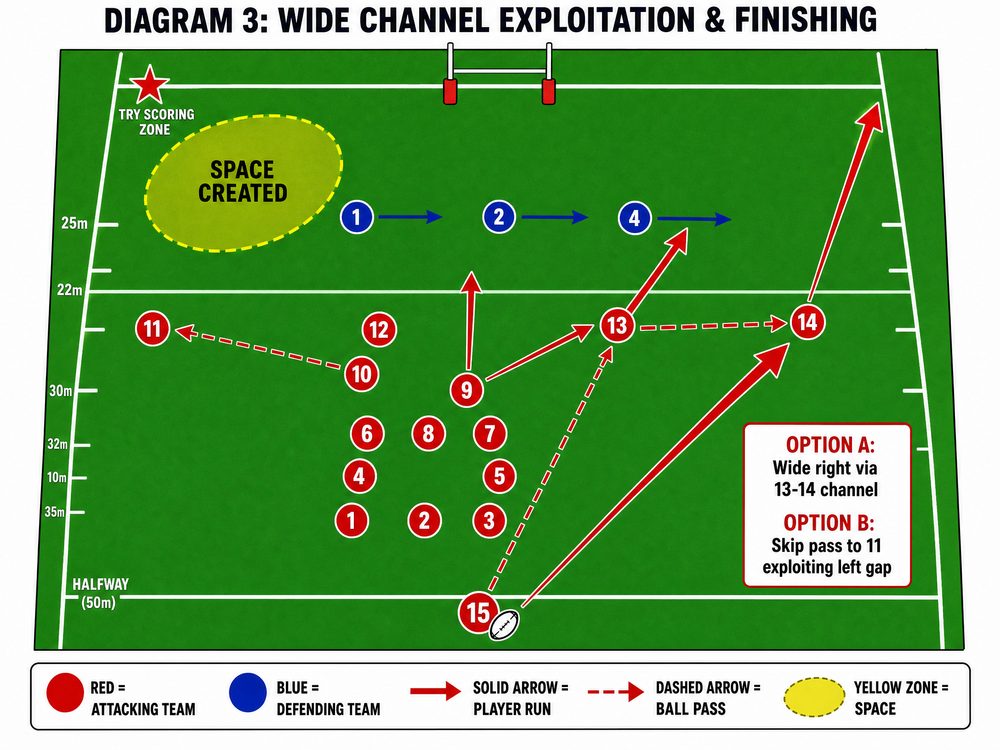
9. The Strike: The Fly-half (10) passes behind the decoy to the Outside Centre (13), who attacks the outside shoulder of their defender.
10. The Finish: The Outside Centre (13) draws the final defender and passes to the Right Wing (14) screaming down the wide channel, or the Fly-half (10) executes a skip pass to the Left Wing (11) if the defense over-commits to the right.
4. Key Coaching Points
- Communication is Non-Negotiable: The catcher must call for the ball early and decisively. Silence leads to collisions and dropped balls.
- Catch on the Move: The catcher should aim to catch the ball while moving forward, instantly generating momentum rather than starting from a static position.
- Ruthless Ruck Speed: The counter-attack relies entirely on quick ball. The first three supporting players must secure the ruck within 2 seconds of the tackle.
- Depth on the Attack: The backline (10, 12, 13) must hold their depth to give themselves time to read the disjointed defensive line and execute the play.
- Decoy Commitment: The decoy runners (like the 12) must run their lines with 100% conviction to genuinely hold the defenders.
5. Common Mistakes
- Static Catching: Waiting for the ball to come down rather than attacking it in the air, allowing the chasing team to make a dominant tackle.
- Over-committing to the Ruck: Sending too many players into the first ruck, leaving the backline starved of attacking options for the counter-attack phase.
- Lateral Running: The initial ball carrier running sideways to avoid contact, which slows down the play and allows the defense to organize.
- Flat Attack Lines: The backline standing too flat, resulting in rushed passes and easily intercepted balls.
6. Variations & Progressions
- Progression 1: Add Live Defenders. Start with passive defenders (touch only), then progress to full contact with a live, aggressive chase line to simulate match pressure.
- Progression 2: Unpredictable Kicks. Have the kicker vary the kick-off (short, deep, left, right) to force the receiving team to adapt their structure dynamically.
- Variation 1: Forward Pod Carry. Instead of the Fullback running, the ball is caught by a lock (4 or 5) who drives straight up the middle with the entire forward pack latched on.
- Variation 2: Immediate Kick Return. If the chase is too aggressive, the Fullback catches and immediately executes a long spiraling punt into the opposition 22m area, turning the defense around.
7. Age Adaptations
- Under 10s: Focus entirely on the safe catching technique (making a basket with the arms) and immediate forward running. Remove the complex backline moves.
- Under 12s: Introduce the concept of the escort runners and securing the first ruck quickly. Keep the counter-attack to a simple pass to the fastest player.
- Under 14s/16s: Implement the full structure, emphasizing communication, depth, and the specific roles of the decoy runners. Focus on decision-making by the Fly-half (10).
