

Rugby
Mastering the Offload in Contact: A Progressive Drill Series
Equip your players with the technical skills and decision-making ability to keep the ball alive through contact and break defensive lines.
What you need
10-15 Cones, 3-4 Rugby Balls, Tackle Shields (Optional), Bibs (Two Colors)
1. Overview
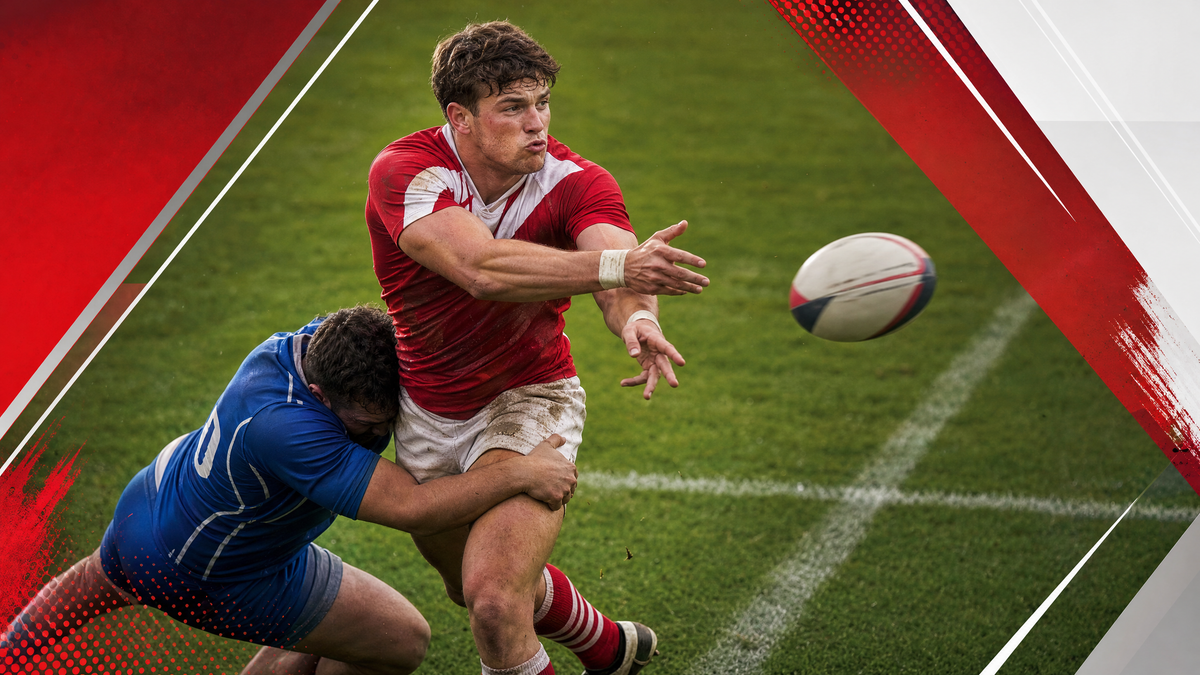
The ability to offload the ball in contact is one of the most potent attacking weapons in modern rugby. A successful offload bypasses the tackler, maintains forward momentum, and forces the defense to scramble, often leading to line breaks and scoring opportunities. This comprehensive drill series is designed to develop the fundamental mechanics of the offload—specifically the "fending" offload and the "pop" offload—while simultaneously training support players to anticipate the pass and run effective lines.
By progressing from a static, controlled environment to a dynamic, multi-phase attacking wave, coaches can ensure players not only learn how to offload but when it is appropriate to do so. This session will elevate your team's attacking fluidity and continuity.
2. Setup
- Pitch Area: A marked grid of 30m x 20m (can be adjusted based on age and skill level).
- Equipment: 10-15 cones to mark the grid and starting positions, 3-4 rugby balls, and tackle shields (optional for the initial phases).
- Players Required: Minimum of 6 players per group (4 Attackers, 2 Defenders) to ensure continuous rotation, though it can scale up to 12+ players per grid.
- Player Positions: Use standard backline numbering for clarity (e.g., 12 Inside Centre, 13 Outside Centre, 14 Wing), but this drill is essential for forwards as well (e.g., 6 Blindside Flanker, 8 Number Eight).
3. Step-by-Step Instructions
Phase 1: The Basic Offload Pattern
This initial phase focuses on the mechanics of the ball carrier freeing their arms in the tackle and the support runner timing their line.
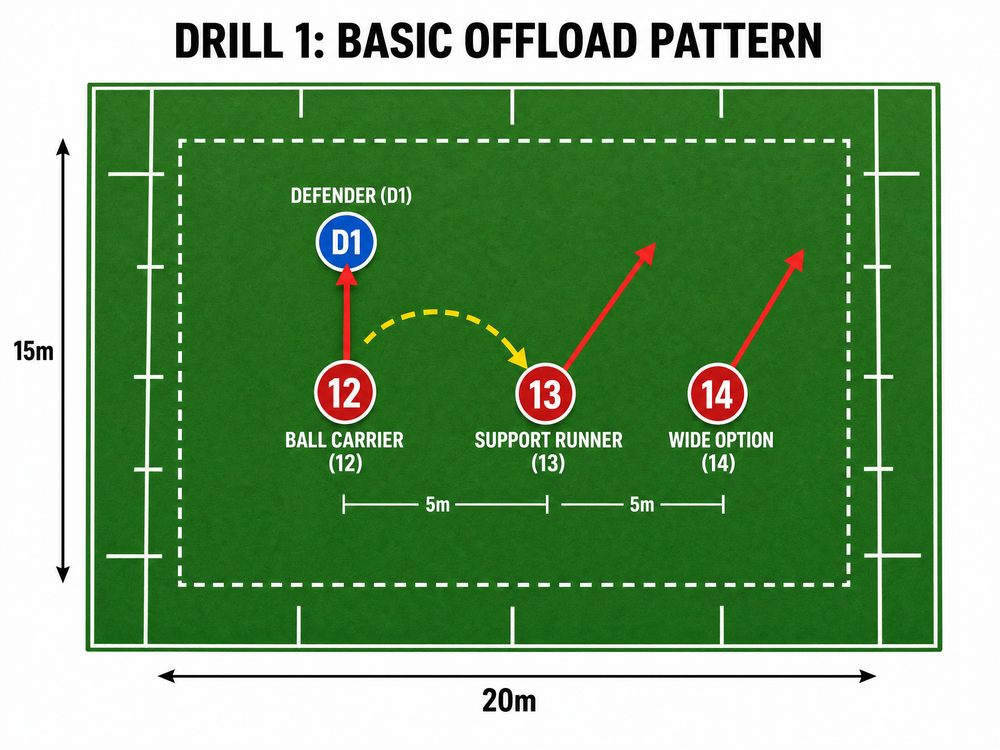
- Set up a 20m x 15m grid. Position an attacking line of three players (e.g., 12, 13, 14) spaced 5 metres apart.
- Place one defender (D1) 5 metres in front of the primary ball carrier (12). D1 should start with a tackle shield or at 50% resistance.
- On the coach's whistle, the Ball Carrier (12) drives forward, aiming to step slightly to the side of D1 to engage the defender on one shoulder.
- As contact is made, 12 must fight to keep the ball free (carrying in two hands initially, then transferring away from the contact point).
- The Support Runner (13) must read the contact, hold their depth, and accelerate onto the ball just as 12 pops the pass.
- The Wide Option (14) maintains width to hold any drift defense and provides a secondary passing option.
- Rotate positions after every 3 repetitions.
Phase 2: Chained Offload Progression
Once the basic mechanic is mastered, introduce a second defender to force decision-making and continuous support play.
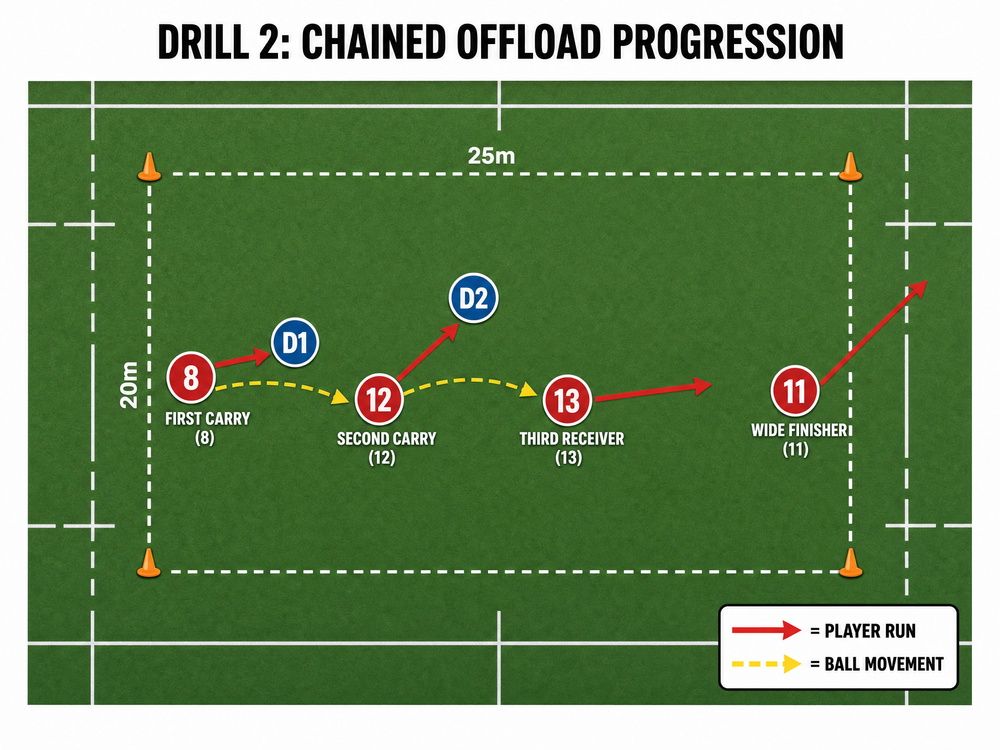
- Expand the grid to 25m x 20m. Set up four attackers (e.g., 8, 12, 13, 11) and two staggered defenders (D1, D2).
- The First Carry (8) drives into D1. As D1 commits to the tackle, 8 executes an offload to the Second Carry (12).
- Player 12 must catch the ball at pace and immediately attack the space around D2.
- D2 must react to the first offload and attempt to tackle 12.
- Player 12 then executes a second offload to the Third Receiver (13), who runs a hard line into the created space.
- The Wide Finisher (11) stays wide to stretch the defense.
- Crucial: Support runners must communicate early ("Pop!", "With you!") to give the ball carrier confidence.
Phase 3: Wave Attack — Creating & Exploiting Space
The final progression simulates a game scenario, emphasizing exploiting the space created by successful offloads.
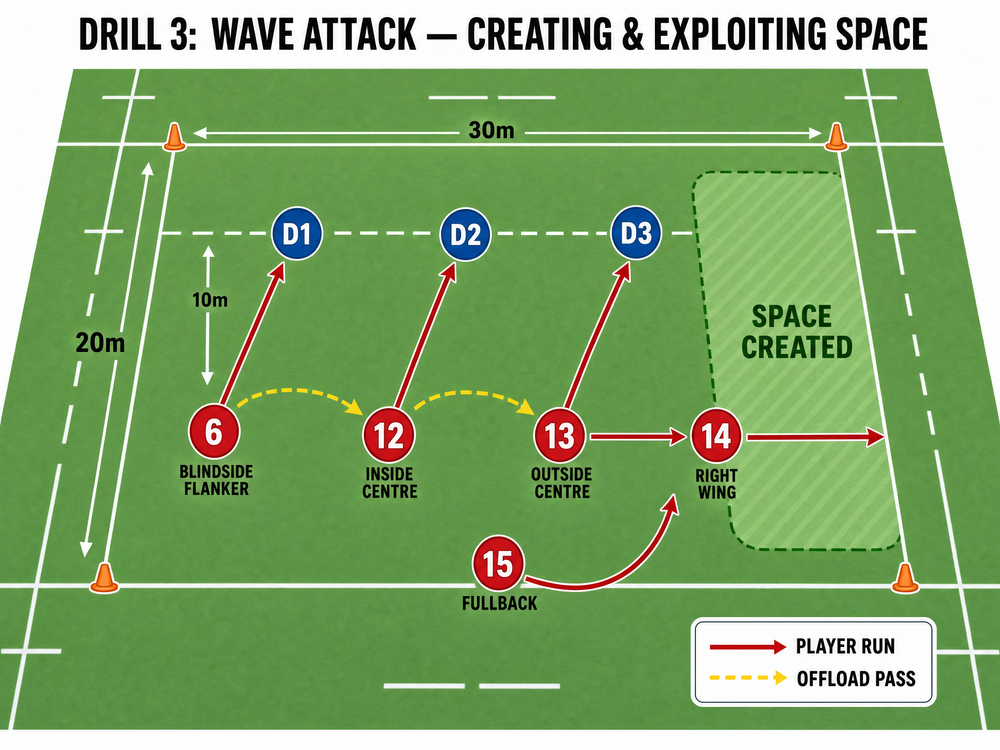
- Use a 30m x 20m grid. Align five attackers (6, 12, 13, 14, and 15 looping from deep) against a flat defensive line of three (D1, D2, D3).
- Player 6 initiates the attack, driving hard at D1 and offloading to 12.
- Player 12 attacks D2, offloading to 13.
- By the time the ball reaches 13, the defense should be compressed. Player 13 now has the option to pass to the Right Wing (14) in the newly created space.
- The Fullback (15) runs a sweeping support line behind the play to offer a cut-back option or secure the breakdown if an offload is not possible.
- Defenders should increase intensity to 80-100%, forcing the attackers to make realistic decisions: "Is the offload on, or should I go to ground and present?"
4. Key Coaching Points
- Pre-Contact Footwork: The ball carrier must not run straight into the defender's chest. Step late to attack the "soft shoulder" and force an arm tackle, making it easier to keep the ball free.
- Ball Security First: Carry the ball in two hands into contact. Only transfer to one hand (away from the defender) once the tackle is engaged and the arms are free.
- Support Depth and Timing: Support runners must not overrun the ball carrier. Stay deep, read the body language of the carrier, and accelerate onto the pass.
- Communication: Loud, early, and clear calls from the support players are non-negotiable. The ball carrier needs to know exactly where their support is without looking.
- The "No-Offload" Decision: Teach players that going to ground and presenting the ball perfectly is better than forcing a bad offload that leads to a turnover.
5. Common Mistakes
- Forcing the Pass: Attempting to offload when completely wrapped up by the defender, resulting in a dropped ball or interception.
- Flat Support Lines: Support players standing too flat, meaning they have to stop to catch the offload, killing all forward momentum.
- "Looking" for the Pass Before the Hit: The ball carrier focusing so much on the offload that they forget to win the collision first, getting driven backward.
- Throwing Blind: Tossing the ball backward over the shoulder without knowing if a support player is there.
6. Variations & Progressions
- The "Off-the-Deck" Offload: Have the ball carrier go to ground, but if the defender doesn't wrap the arms immediately, the carrier pops the ball up from the floor to a trailing runner.
- Conditioned Game: Play a game of touch or grab rugby where the only way to score is if the final pass is an offload in contact. This forces teams to actively seek offloading opportunities.
- Uneven Numbers: Run the Phase 3 drill with 5 Attackers vs 4 Defenders to increase the difficulty of finding the space.
7. Age Adaptations
- Under 8s - Under 10s: Focus entirely on the "pop" pass before contact. Use tackle bags instead of live defenders. Emphasize running straight and passing to a friend.
- Under 12s - Under 14s: Introduce the fend and the one-handed offload. Use 50% resistance "wrap and hold" tackles to build confidence in keeping the arms free.
- Under 16s - Open Grade: Full contact. Focus on high-speed execution, decision-making under pressure, and complex support lines (e.g., switch lines off the ball carrier).
