

Rugby
Penalty Corner Attack Play: The 10-12-13 Pod Strike
A structured and dynamic set play designed to manipulate the defensive line off a penalty or free-kick, creating a high-percentage scoring opportunity on the edges.
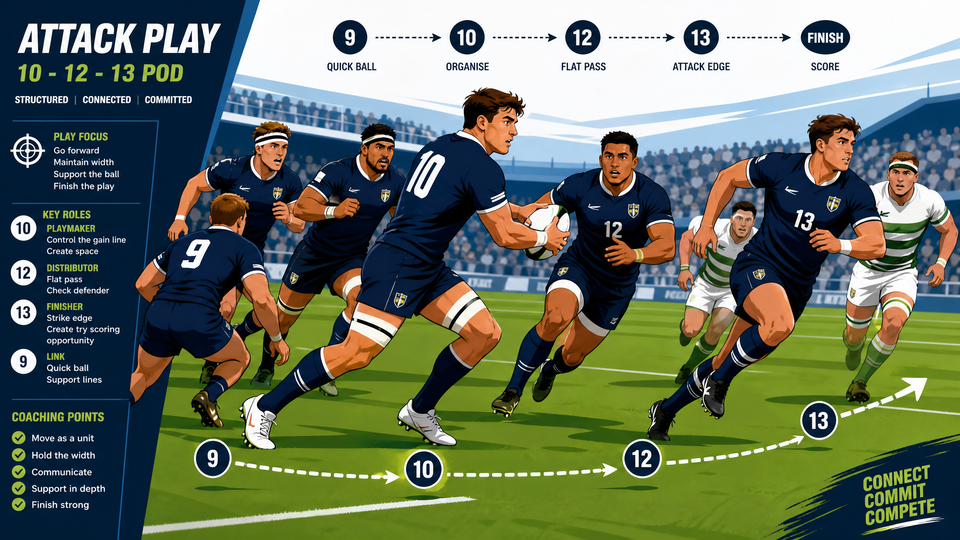
What you need
Rugby balls, Cones for marking positions
1. Overview
This penalty corner attack play is a highly structured maneuver designed to exploit disorganized defenses immediately following a penalty or free-kick near the opposition's 22-meter line. By utilizing a rapid tap and a meticulously organized 10-12-13 pod, the attacking team can deliberately manipulate the defensive line's spacing. This intentional manipulation creates a distinct numerical advantage on the edge of the field, offering a prime scoring opportunity. It is most effective when the defensive line is either retreating slowly or struggling to organize its formation quickly.
2. Setup
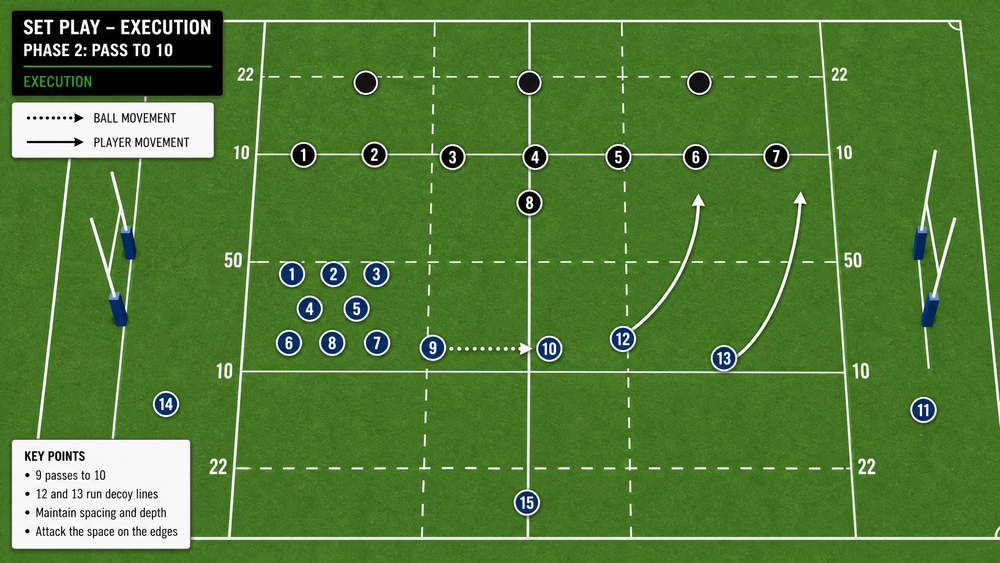
The setup for this play requires precise positioning and specific pitch locations to ensure maximum effectiveness.
Pitch Location: The ideal location for executing this play is between the attacking 22-meter line and the 10-meter line. This positioning provides enough space to stretch the defense while keeping the try line within striking distance.
Player Positions:
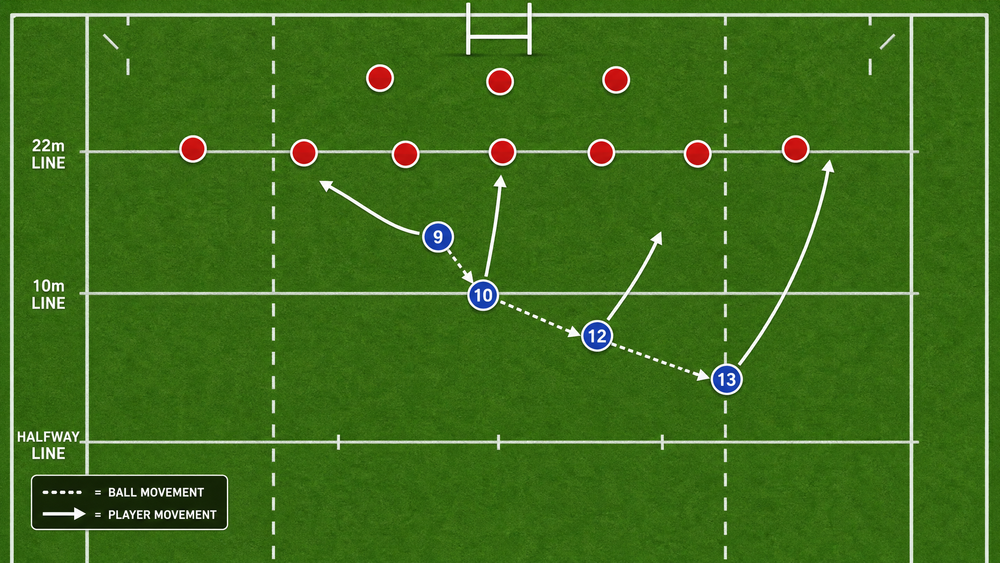
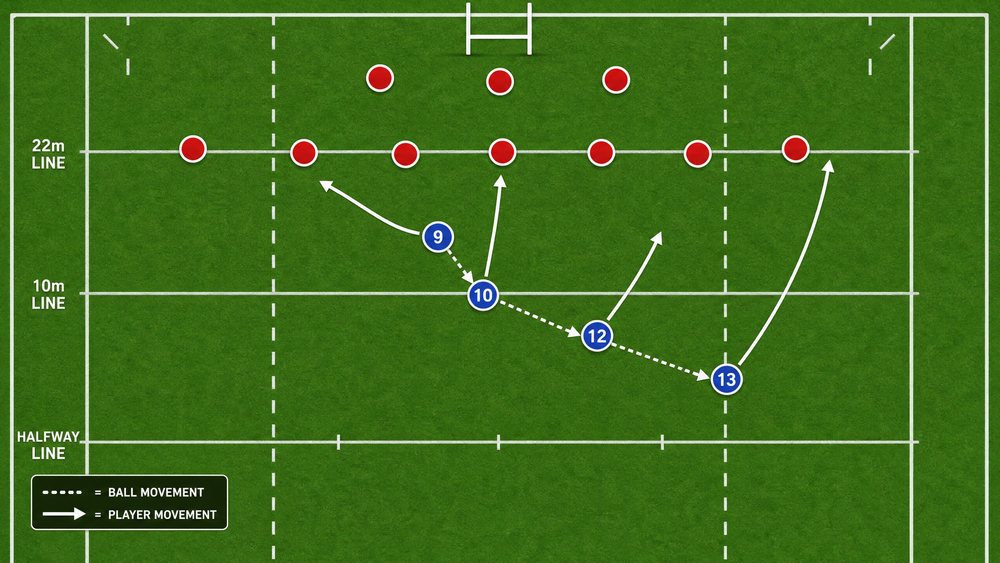
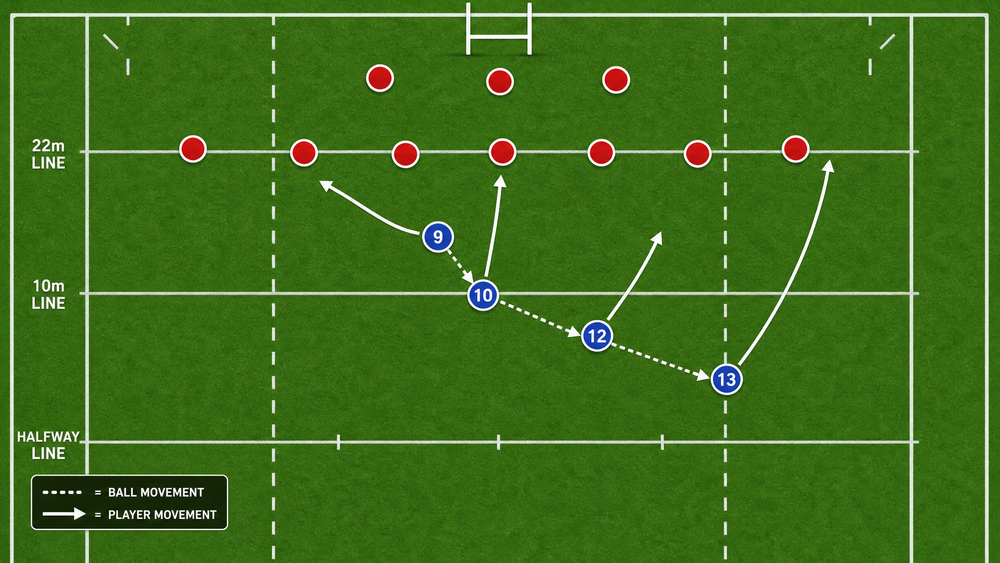
The scrum-half (9) positions themselves directly at the mark, fully prepared to initiate a quick tap. The fly-half (10) aligns flat and wide, assuming the role of the primary distributor. The inside center (12) sets up on the inside shoulder of the 10, ready to run a hard, convincing decoy line. The outside center (13) positions themselves on the outside shoulder of the 10, preparing to run a sweeping line aimed at attacking the outer edge of the defense.
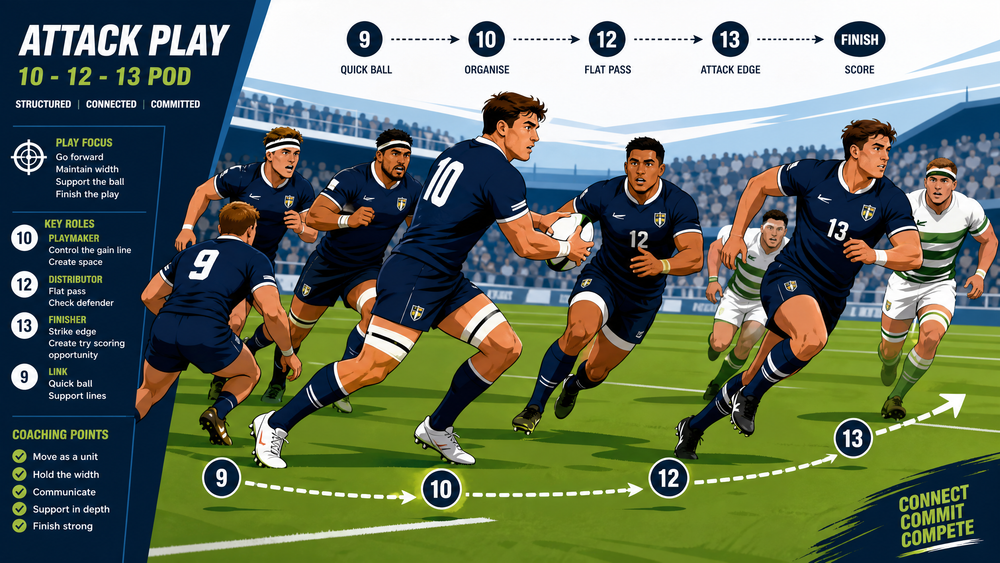
3. Step-by-Step Instructions
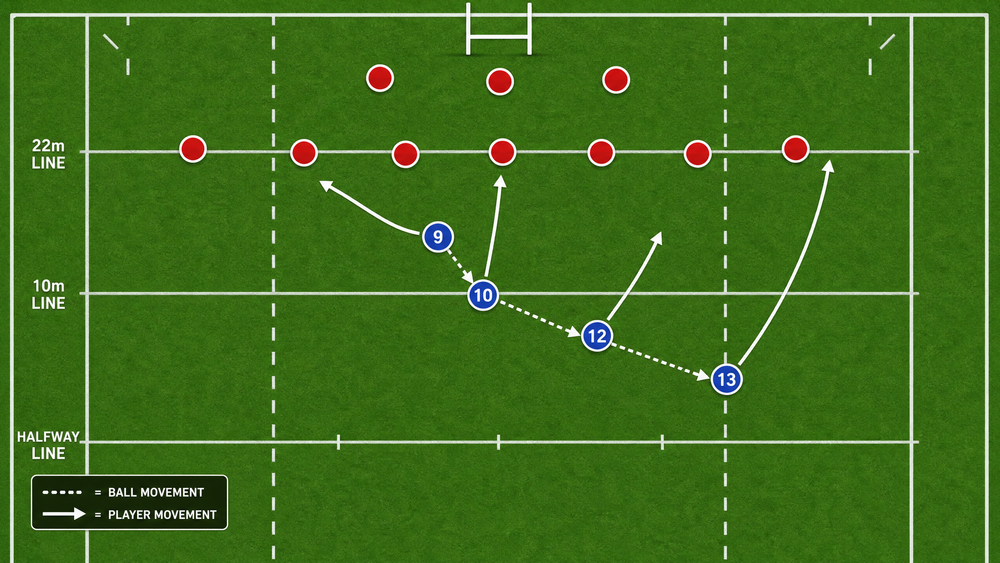
- The Quick Tap: The scrum-half (9) executes a rapid tap at the mark. They immediately drive forward to engage the nearest defender, forcing them to commit to the tackle and creating initial momentum.
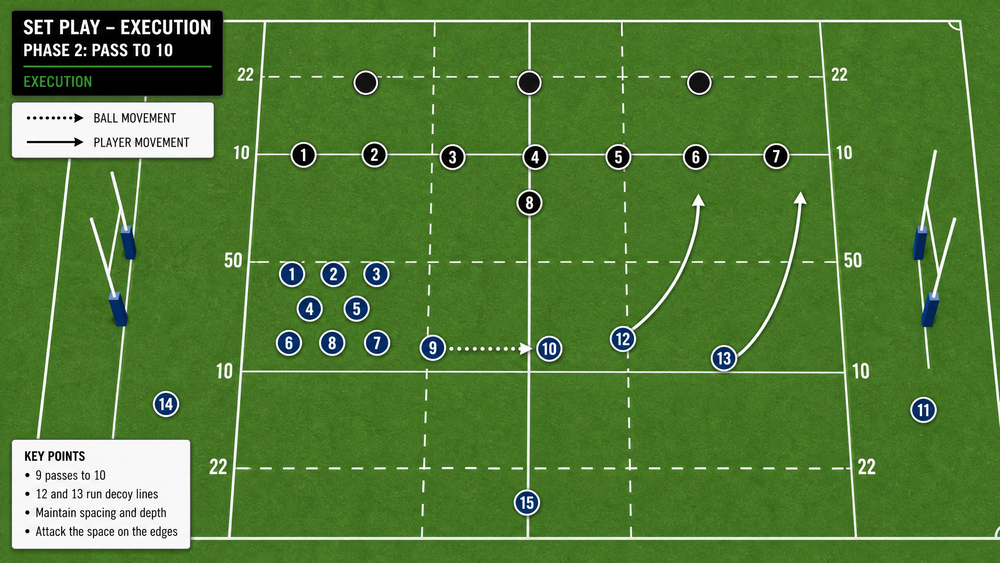
- The Distribution: The 9 delivers a swift, flat pass to the fly-half (10), who is positioned aggressively to attack the gain line and dictate the flow of the play.
- The Decoy: The inside center (12) runs a hard, direct line on the inside shoulder of the 10. This run is crucial; it must be convincing enough to draw the attention and commitment of the inside defenders, thereby creating a gap further out.
- The Strike: The 10 reads the defensive reaction. If the inside defenders commit to tackling the 12, the 10 immediately executes a flat, wide pass to the outside center (13).
- The Finish: The 13 receives the ball at full pace on the outside shoulder of the 10. They attack the newly created space on the edge, aiming to break the defensive line completely or secure a try.
4. Key Coaching Points
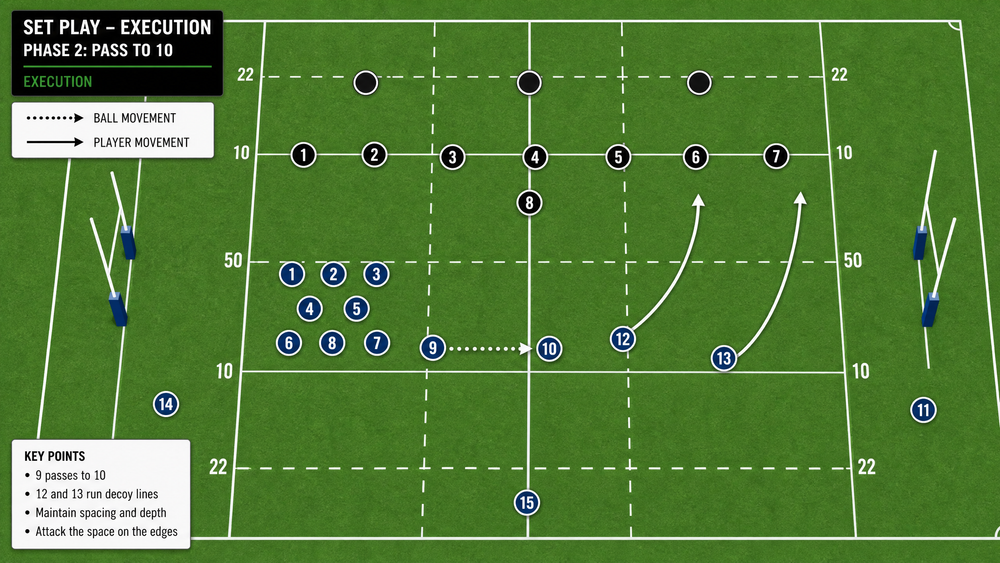
- Speed of Execution: The entire success of this set play hinges on the speed of the quick tap and the subsequent passes. The scrum-half must execute the tap and pass seamlessly to catch the defense entirely off guard.
- Timing of the Decoy: The inside center must run their decoy line with absolute conviction and perfect timing. If they run too early or too late, the defense will not commit, and the play will fail to open the necessary space.
- Flat and Wide Alignment: The fly-half, inside center, and outside center must maintain a flat and wide alignment. This positioning is essential to stretch the defensive line horizontally and create the desired space on the edge.
- Communication: Clear, concise, and continuous communication between the 9, 10, 12, and 13 is paramount. This ensures everyone is on the same page, understands their role, and executes the play effectively as a cohesive unit.
5. Common Mistakes
- Slow Quick Tap: If the scrum-half takes too long to execute the quick tap, the defense will have ample time to set their line and organize, completely negating the element of surprise and the advantage of the play.
- Poor Decoy Line: If the inside center runs a weak, unconvincing, or poorly timed decoy line, the defense will simply ignore them and drift outwards, meaning the space for the outside center will never open up.
- Deep Alignment: If the attacking pod (10, 12, and 13) aligns too deep, the defense will have significantly more time to react to the play and drift sideways, effectively closing down the space on the edge before the ball arrives.
6. Variations & Progressions
- The Inside Ball: If the defense anticipates the wide pass and drifts heavily to cover the outside center (13), the fly-half (10) can adapt by playing a short, inside pass back to the inside center (12). The 12 can then exploit the gap created by the drifting defenders.
- The Miss Pass: If the defense rushes up aggressively in an attempt to shut down the play early, the fly-half (10) can execute a miss pass over the top of both the 12 and 13. This pass targets a winger or fullback who is positioned wider out, bypassing the rushing defenders entirely.
7. Age Adaptations
- Under 12s: For younger players, focus primarily on the basic mechanics of the quick tap and the fundamental pass from the 9 to the 10. Simplify the decoy lines significantly and encourage the players to simply identify and attack open space.
- Under 16s: At this level, introduce the full 10-12-13 pod structure. Emphasize the critical timing of the decoy runs and begin teaching the fly-half (10) how to read the defensive alignment and make the correct passing decision.
- Open/Senior: For senior teams, the focus shifts to the absolute speed of execution, the pinpoint precision of the passes, and the ability of the pod to adapt seamlessly to different defensive structures and unexpected reactions in real-time.
