

Rugby
Box Kick Chase & Sideline Press: 20-Minute Transition Set Play
A repeatable box-kick transition system that turns a high kick into an organised aerial contest, sideline funnel and immediate defensive press.

What you need
balls, cones
Overview
The box kick chase and press is a territory-and-pressure set play used when the ball is available at the base of a stable ruck between your own 22 and halfway. The objective is not simply to kick long. It is to deliver a contestable ball into a narrow sideline corridor, arrive with a connected five-lane chase, and force the receiving side to play under pressure with limited infield options.
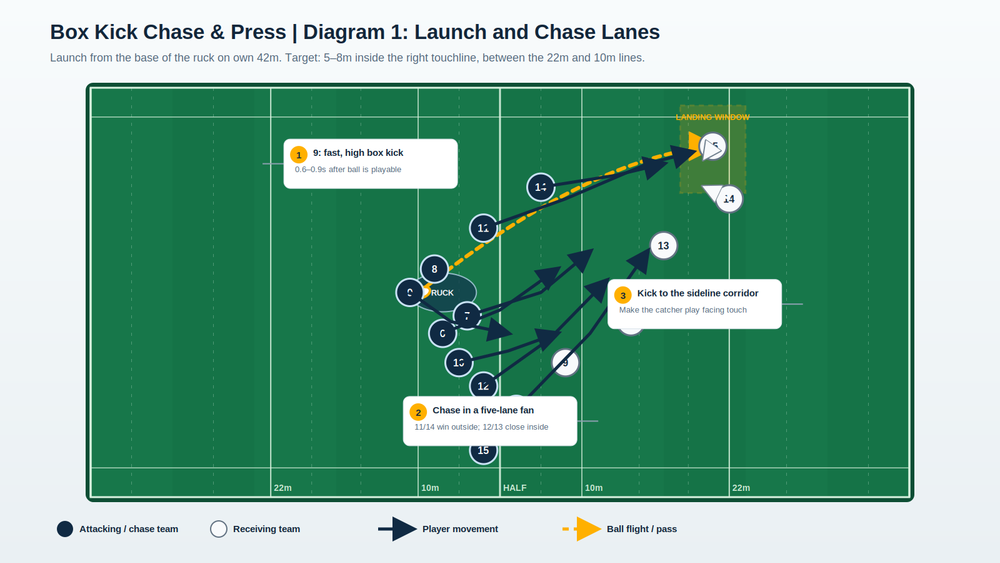
This version targets the right touchline. The scrum-half, 9, launches a high right-foot box kick; the nominated aerial chaser, shown as 11 in Diagram 1, attacks the landing point; 14 protects the touch-side exit; 13 and 12 squeeze the inside lane; and the back-row fold provides a second-wave press. The play is successful if the chase regains possession, wins a dominant tackle, forces touch, creates a poor return kick, or pins the opposition behind their gain line.
Setup
Use the full 100m x 70m pitch, working from a ruck on the attacking 42m line. Mark a landing window 5–8m inside the right touchline, between the opposition 22m and 10m lines. That window gives the catcher little space to step infield while leaving enough margin to avoid kicking directly into touch.
The minimum rehearsal unit is ten attacking players: 9, 10, 11, 12, 13, 14, 15, 6, 7 and 8. Add five opposition players when progressing to a live contest: a full-back, winger, centre, fly-half and scrum-half. Start with one ball at the ruck and four cones around the target window. The call is Box Right. On the call, all chasers launch on the ball leaving 9's hands, not on the sound of the kick.

Step-by-Step Instructions
Create a clean launch platform. The forward pod finishes the ruck square, with 8 and 7 protecting the ball and 6 ready to fold around the far side. 9 scans before lifting the ball. If the opposition backfield has only one deep player, keep the same call but shorten the kick by 3–5m to increase the contest. The ball should be playable for no more than 0.6–0.9 seconds before 9 acts.
9 delivers the box kick. From one to two metres behind the ruck, 9 steps slightly towards the touchline and kicks with height before distance. The desired flight is 2.8–3.5 seconds, with the ball descending in the marked sideline corridor. The kick should travel roughly 28–34m and hang above the receiver rather than drifting beyond them. 9 immediately follows the kick by folding into the second defensive wave; do not stand admiring the kick.
Launch the five-lane chase. The first chase lane is the aerial chaser, 11. Their job is to beat the ball to the landing point and compete legally with eyes fixed on the ball. 14 tracks outside and slightly behind 11, protecting the touch-side bounce or a spill towards the sideline. 13 runs the next inside lane, about 3–4m inside 11, and 12 closes another 3–4m further inside. The fifth lane is 6 or 7, arriving behind 12 as the first folding forward. All five chasers must stay connected within a 12m-wide fan.
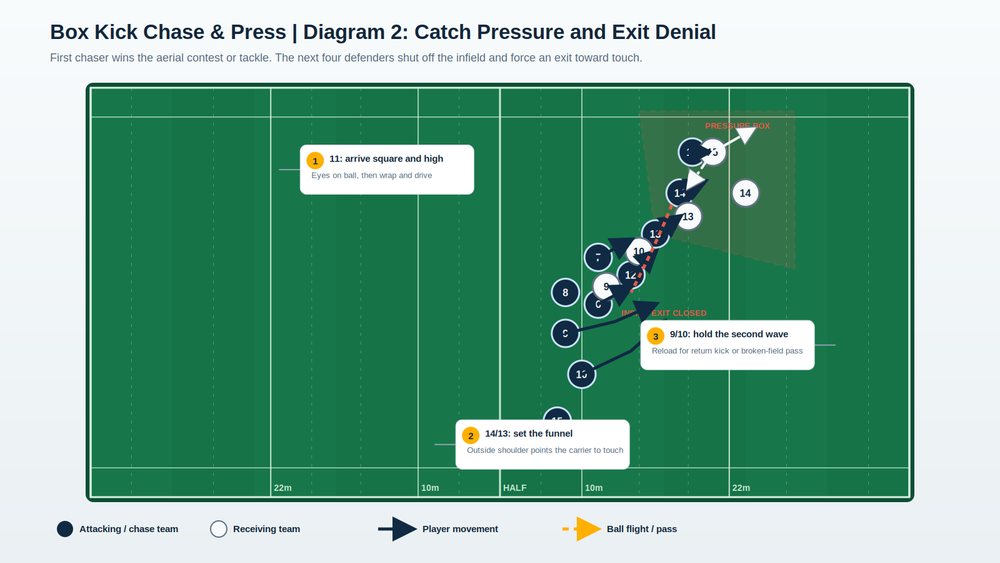
Win the first collision. The primary chaser should arrive in the final two strides as the ball drops. If the ball is catchable, compete in the air with both hands available and land through contact. If the receiver catches cleanly, 11 tackles square and wraps above the knees, while 14 removes the outside escape and 13 targets the ball-side shoulder. The first tackle must occur within 1.0 second of the catch whenever possible.
Press the receiver towards touch. The chase does not overrun the ball. 14 sets the outer edge approximately 2m from touch and keeps their outside shoulder free. 13 and 12 advance together from the inside, taking away the pass back to the receiving fly-half or centre. Their body language tells the carrier that the only available exit is towards the sideline. The aim is to create a tackle, touch outcome or panicked pass inside a 3–5 second pressure window.
Reload behind the press. 9, 10 and 15 form the second wave. 10 scans for a return kick and holds a central position rather than joining the first collision. 15 stays deepest, generally 12–15m behind the front press, to cover a chipped return or loose ball. The back-row arrive in order: first forward protects the infield seam, second forward cleans the breakdown, and the last forward becomes the guard for the next phase.
Key Coaching Points
The kick must be contestable, not merely high. Coach 9 to strike through the lower half of the ball with a controlled follow-through, producing a vertical flight that allows the chase to arrive at the same moment as the receiver. A low, long kick gives the opposition time to form a return-kick shape; an over-hit kick gives them an easy mark or touch exit.
The chase should be a connected fan, not ten isolated sprints. Use the cue ball up, line up, squeeze up. Players maintain their lane until the ball is caught, then work from outside to inside. The first chaser competes or tackles, the next player secures the sideline, and the inside players remove the pass and carry lanes.
Demand legal aerial work. The chaser must not take out a player in the air, obstruct the catcher, or chase from an offside position. Practise tracking the ball, presenting a strong jumping shape, and landing safely before adding full contest pressure.
Common Mistakes
A frequent error is kicking too close to touch. This relieves pressure by handing over a lineout or providing a simple touch exit. Move the target inward until 9 can repeatedly land the ball 5–8m from the line.
The next error is an early, disconnected chase. Players who leave before the ball is kicked either become offside or arrive in separate waves. Use a visible launch cue from 9's kicking leg and insist the first five chasers cross the gain line within a two-second window.
Finally, teams often chase the ball but forget the press. If 14 and 13 drift outside the ball or overrun it, the receiver steps infield. Coach the outer defender to hold the touchline gate and the inside defenders to close space together.
Variations & Progressions
Start with a shadow progression: no opposition, a stationary ball target and a five-lane chase to the correct landing corridor. Progress to a coached full-back who catches but cannot run for the first two repetitions. Then allow the full-back to carry, pass or return kick, requiring 10 and 15 to make the second-wave decision.
For a left-sided version, call Box Left and mirror the roles. If the opposition station two deep receivers, use a shorter kick into the space in front of the touch-side winger. Against a vulnerable aerial receiver, give 11 permission to compete aggressively but legally. Against a strong counter-attacking full-back, keep 11 on the tackle and use 14 to protect the loose bounce instead of committing two players to the air.
Age Adaptations
For under-12 and younger groups, remove the live aerial contest. Use a catch-and-touch condition, allow a longer 4-second kick flight, and focus on chase spacing, communication and safe tackle tracking. Use a softer ball if appropriate.
For under-14 and under-16 groups, introduce contested catches only after players demonstrate safe landing mechanics. Keep the target 8–10m inside touch initially, then tighten the sideline corridor as kicking accuracy improves. For open-age teams, add a live counter-ruck or return-kick phase and score the chase on regain, dominant tackle, forced touch and territory won.
