Gate-to-Drive: Ruck Clear-Out & Clean-Out Continuity Drill
A progressive, coach-ready ruck drill that teaches players to identify the threat, enter legally, clear with purpose, and play the next phase at speed.

Equipment Needed
Overview
A fast ruck is not simply a collision won; it is the platform that lets your No. 9 dictate the next picture. This Gate-to-Drive drill develops the habits that turn a tackle into usable possession: the ball carrier gives a long, accurate presentation; the first arriving cleaner identifies the immediate threat; the second cleaner protects the ball and restores attacking shape. Use it early in a contact session, then revisit the final progression before your conditioned game. The drill is built around the legal ruck framework. An arriving player must be on their feet and join from behind the offside line; they must bind before or simultaneously with contact, and players should endeavour to remain on their feet through the ruck.1 That is the standard you coach from the first walk-through, not a detail added once the drill becomes competitive.
| Session outcome | Coach’s evidence of success |
|---|---|
| Secure possession | The ball is visible and available to No. 9 within 3 seconds of the carrier going to ground. |
| Clear the threat | The first cleaner displaces the jackal or removes their access to the ball without diving or entering from the side. |
| Build continuity | The second cleaner stays connected, then reloads into the next support line as the ball moves. |
Setup
Mark a 15 m x 20 m working grid across the width of a regulation-sized 100 m x 70 m rugby pitch. Inside it, cone a central 8 m x 10 m ruck channel and, for the first learning block, a 5 m x 7 m technique box. You need 12 players: No. 9, No. 10, No. 12, No. 13, No. 5, No. 6, No. 7, No. 8, and four defenders. Bring 12–16 cones, two rugby balls, two tackle shields, four hit-shields or flat pads, coloured bibs, and a stopwatch. Start at walk-through speed with a shield as the jackal picture. Progress only when players can show the correct entry line, head position, and finish position without collapsing. For contact work, set clear session expectations: controlled body height, no neck contact, no diving onto bodies, and immediate stop on the whistle.
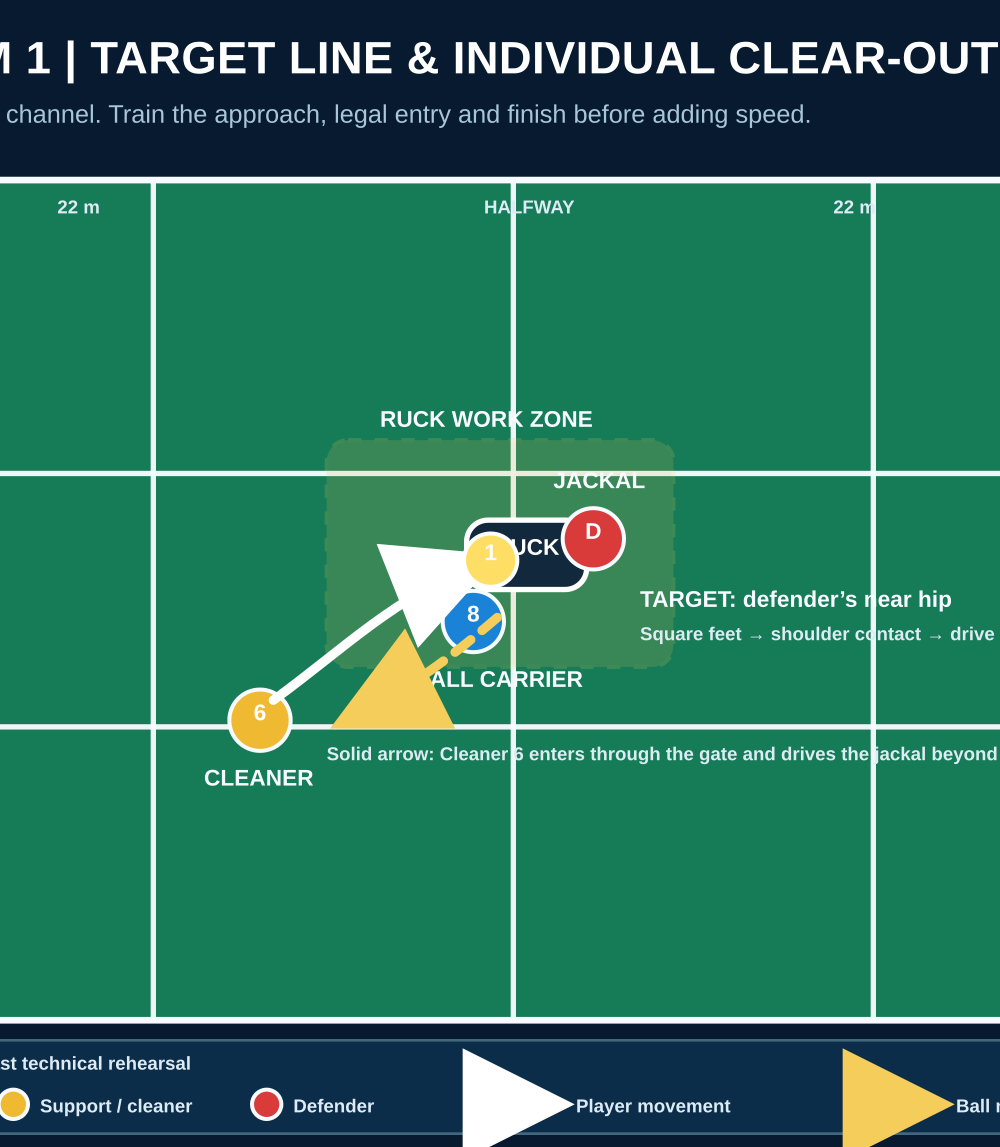
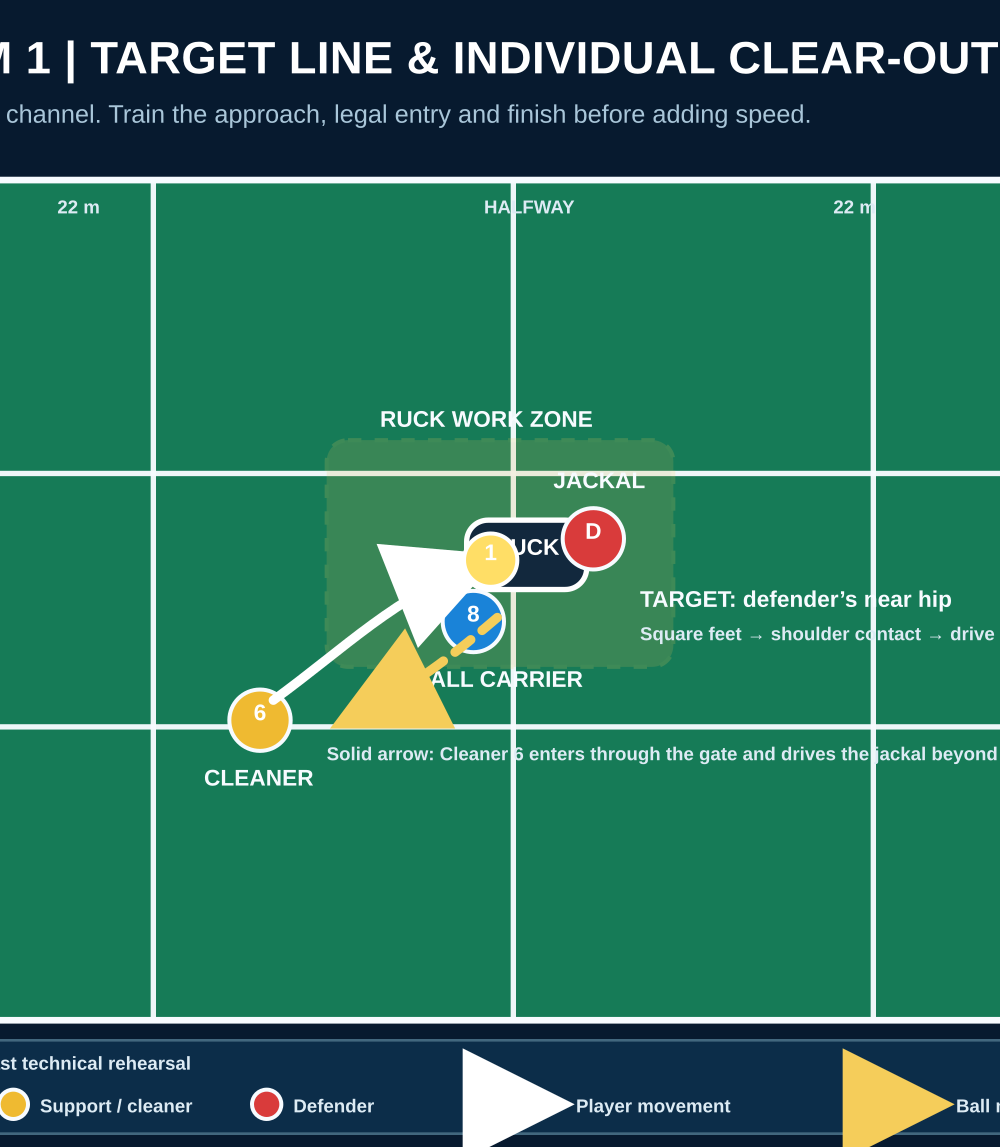
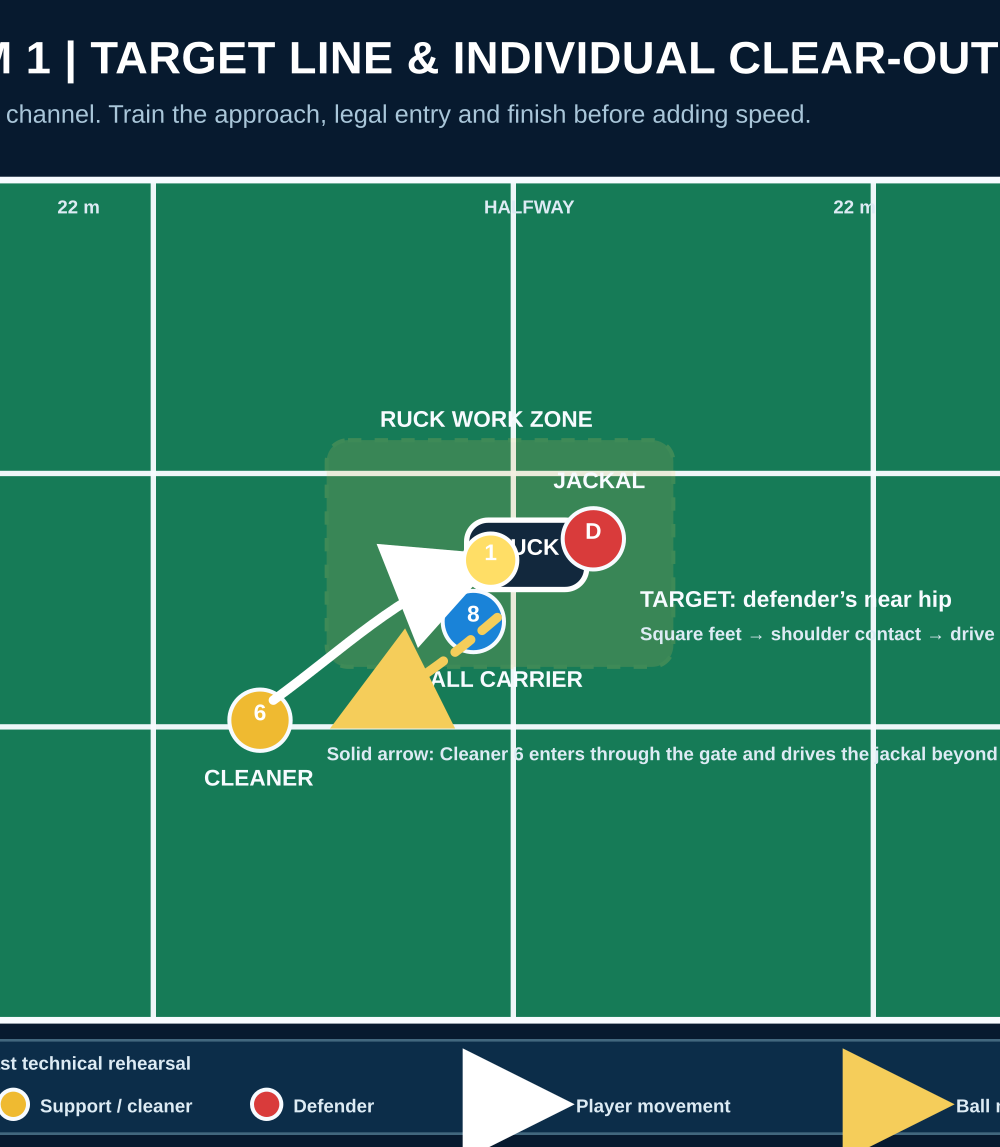
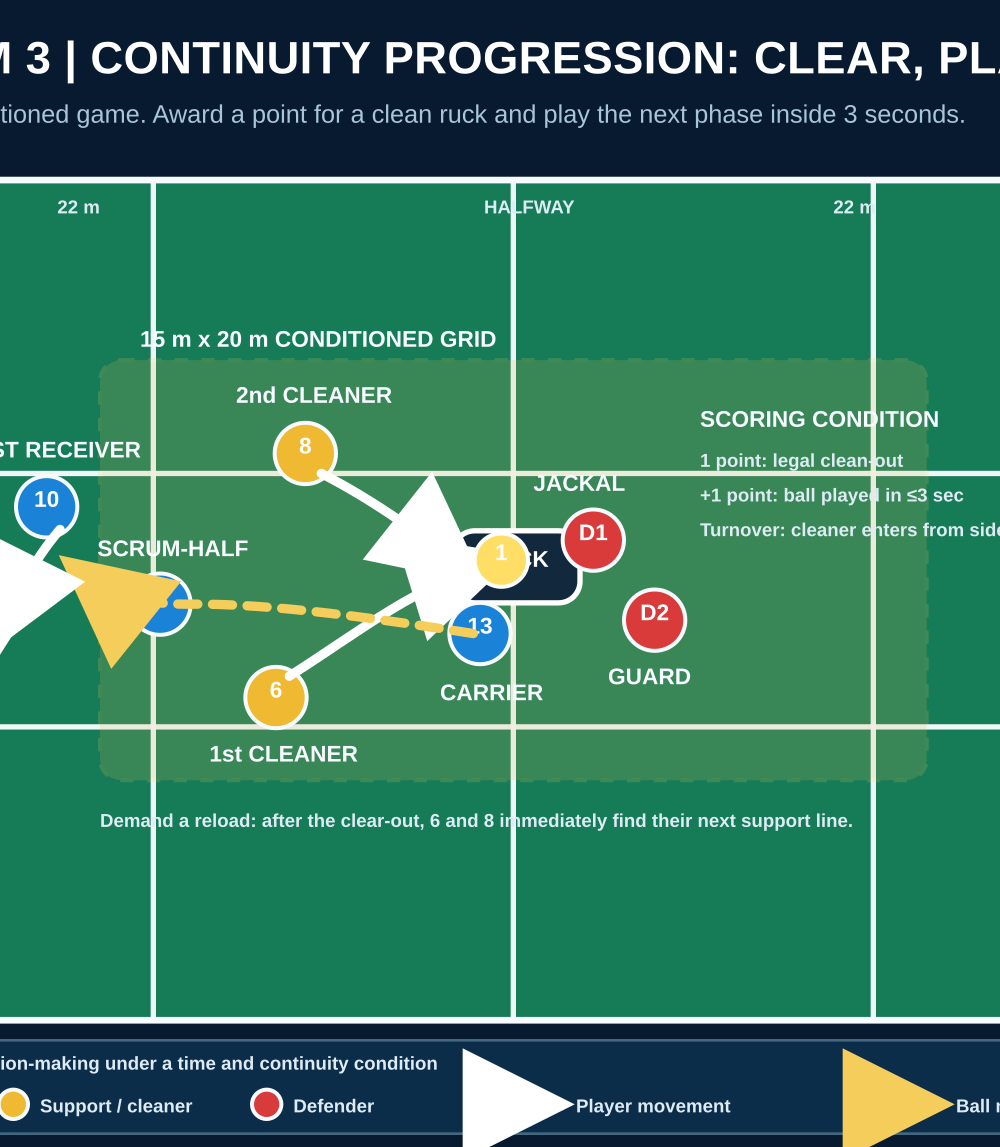
Diagram 1 is your first coach huddle. Place No. 8 as the ball carrier and a defender in the jackal position. No. 6 starts 5 m behind and 3 m inside the gate line. Explain that the solid white arrow is player movement; the dashed gold arrow is ball movement.
Step-by-Step Instructions
Set the tackle picture. No. 8 carries square for 3 m, makes controlled contact on the shield, then lands long and places the ball back toward the arriving support. The coach calls either “jackal” or “no threat” before the ball carrier hits the floor. No. 8 must not roll toward the ball or create a blocked presentation.
Scan, call, and enter. No. 6 accelerates from 5 m away, shortens their last two steps, and calls “clean” when a jackal is present. Their final approach is through the gate—behind the hindmost teammate’s feet—not around the side. Coach the phrase: “see it, name it, own it.”
Win the individual clear-out. No. 6 arrives with hips lower than shoulders but with head and shoulders no lower than the hips at the ruck. They make legal, connected contact to the defender’s near shoulder/hip line, drive with short feet for two steps, and finish past the ball. The target is removal of the threat, not a dramatic knock-down. Stop and reset immediately if the cleaner loses their feet, contacts the neck or head area, or comes in from the side.
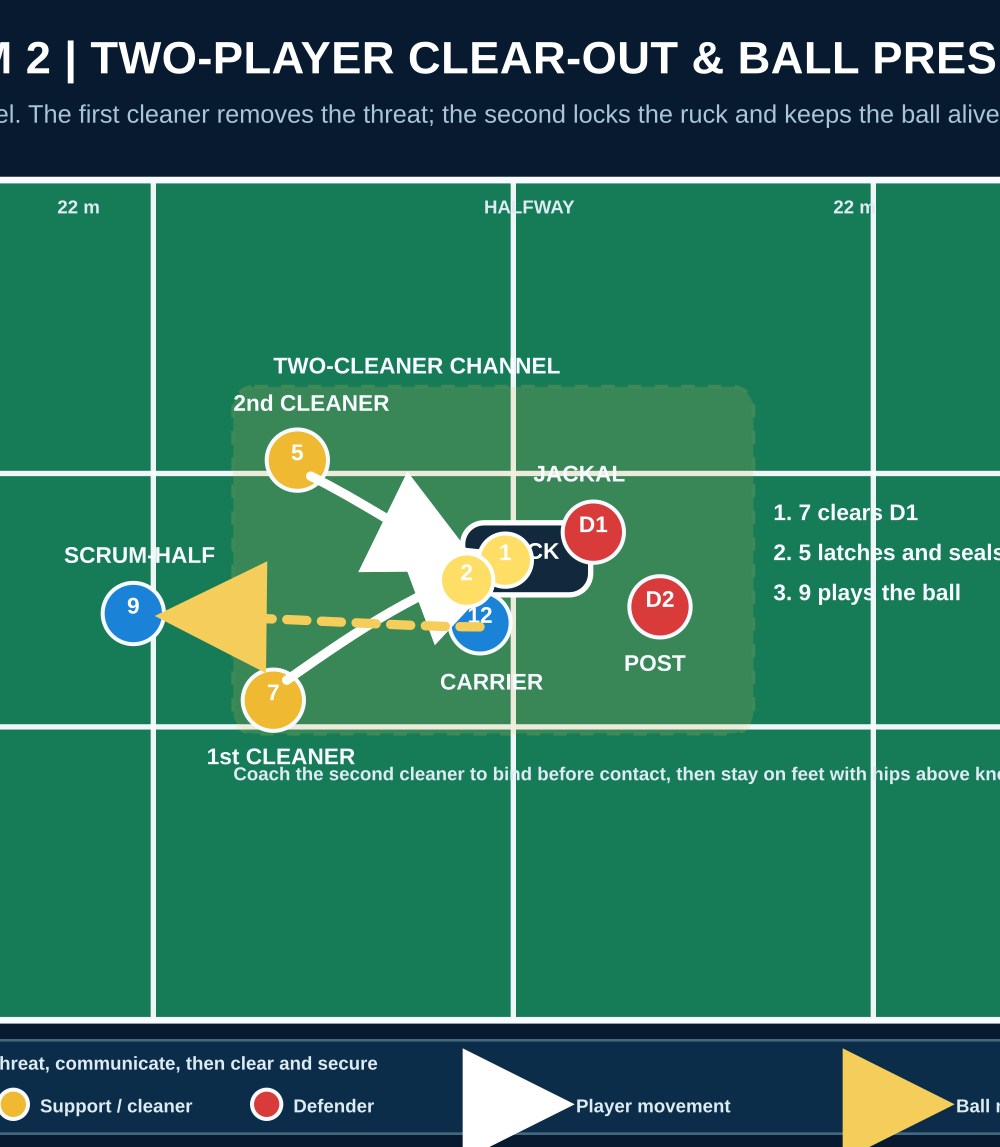
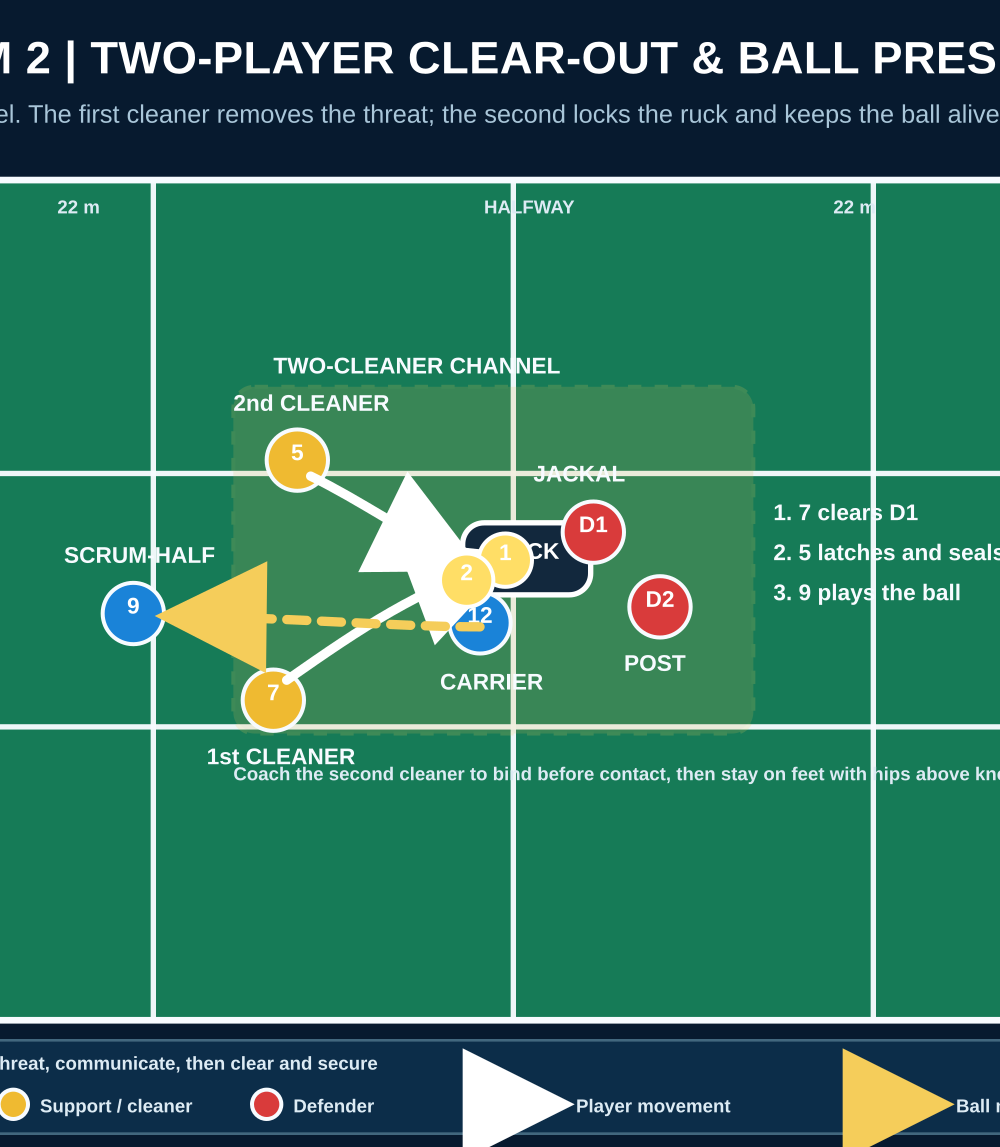
Add the second cleaner. Introduce No. 5 from a 45-degree support line, 4 m from the ruck. No. 5 calls “latch,” binds before contact, and supports the first cleaner’s drive without sealing the ball. Their job is to create a stable platform, stay connected over the ball, and then release to reload when No. 9 has the ball.
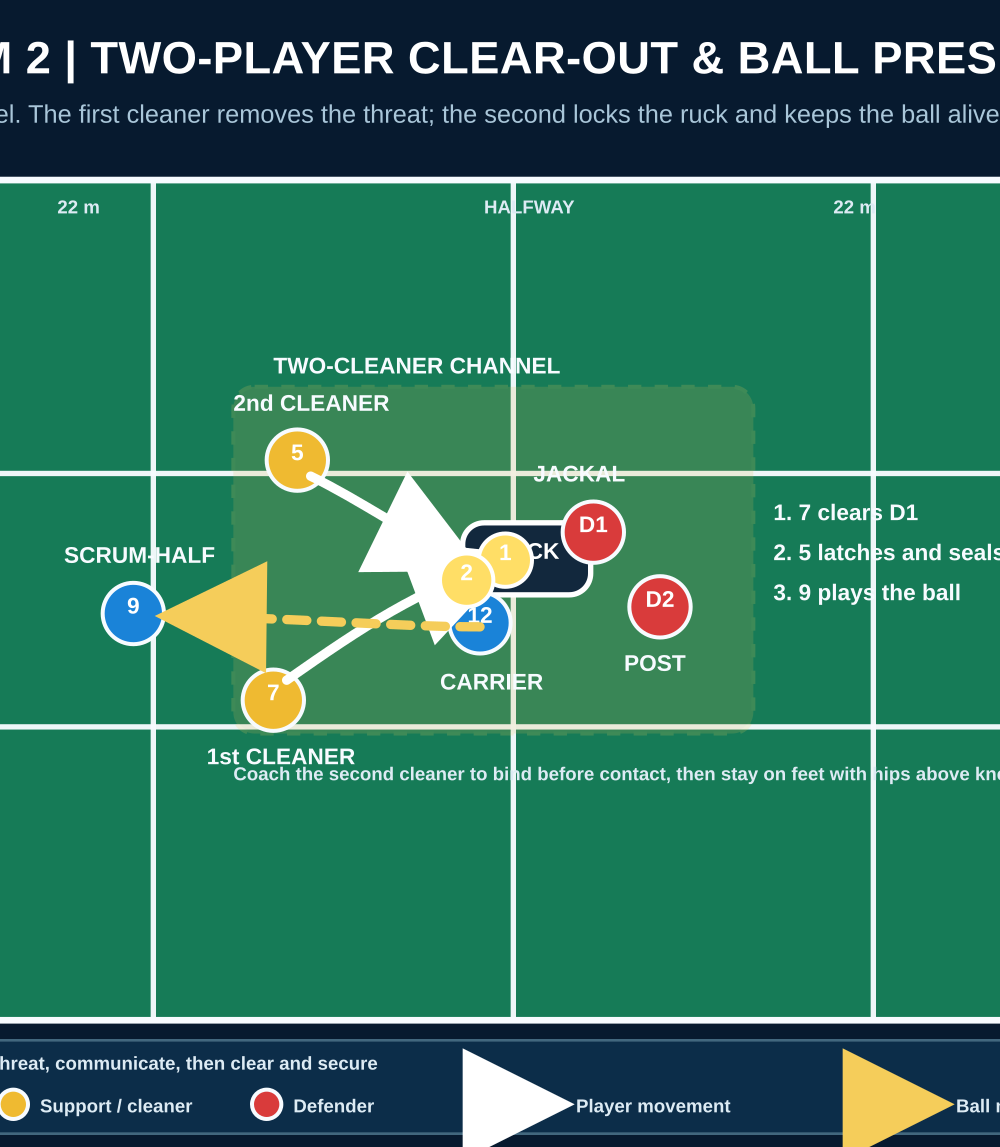
Play the ball on a clock. No. 9 begins 4 m behind the ruck and cannot touch the ball until the coach sees a stable platform. When the ball is available, No. 9 calls “away” and passes to No. 10 or No. 12. Time from the ball carrier hitting the deck to No. 9’s pass. Start with a 5-second target; once technique is reliable, demand 3 seconds.
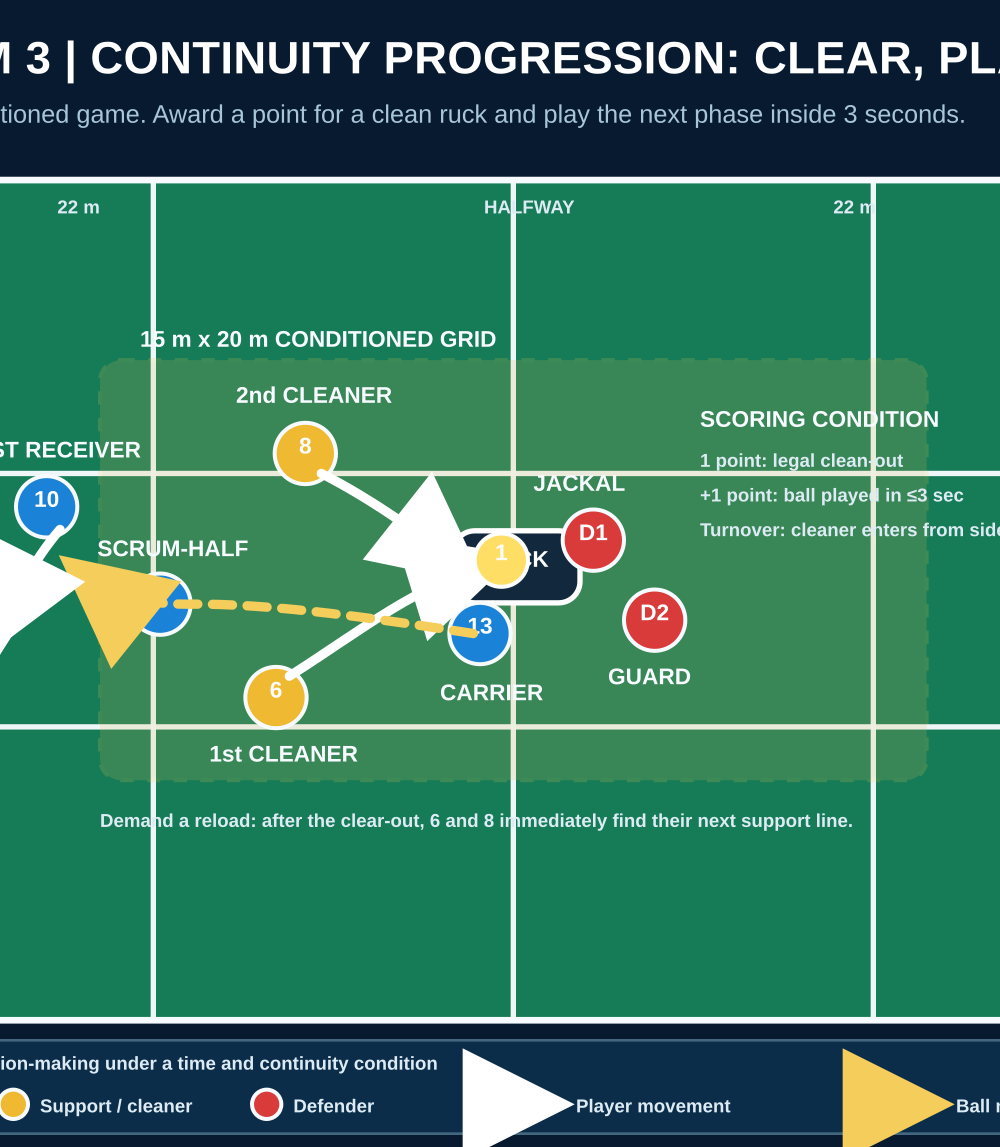
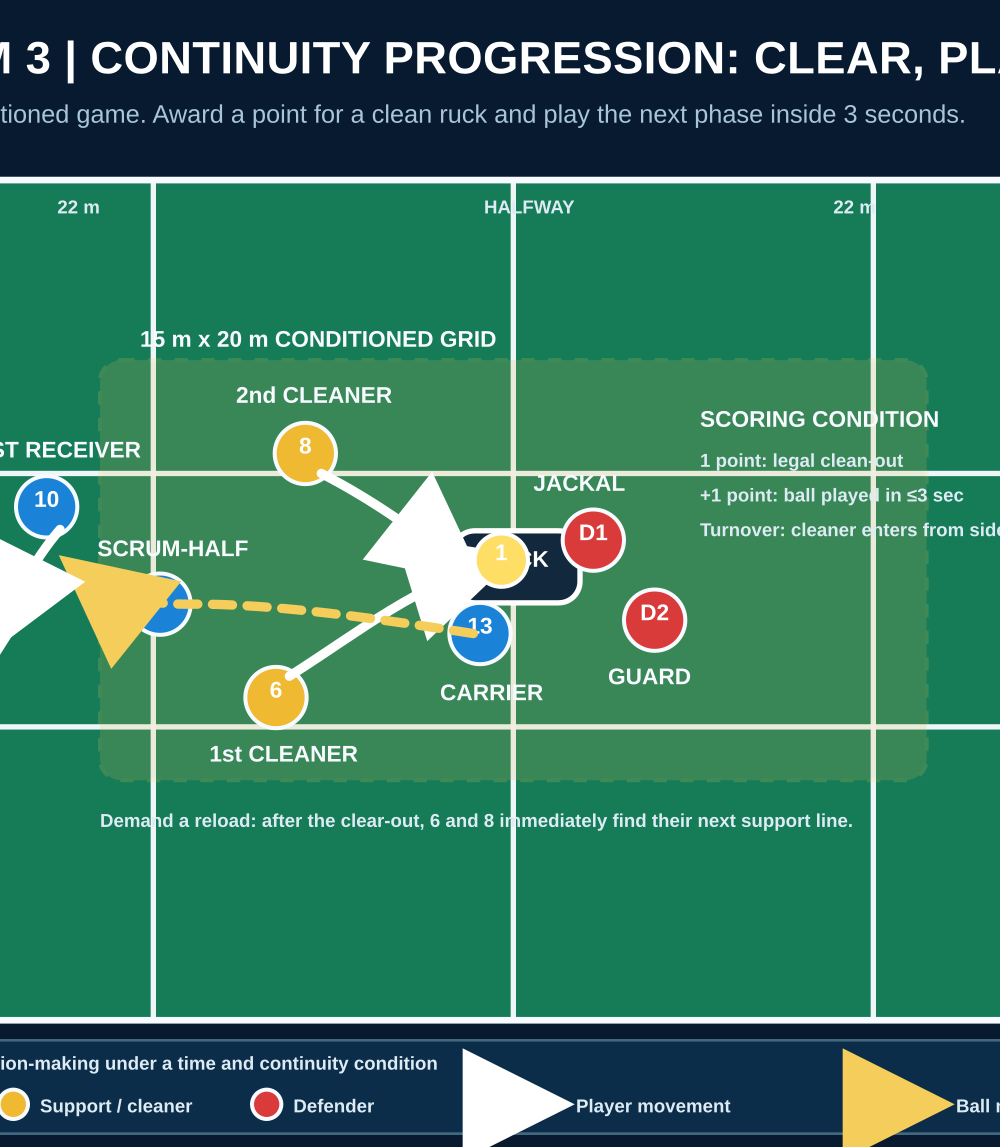
Turn it into continuity. In the final block, No. 13 carries into the conditioned grid against D1 and D2. No. 6 and No. 8 must decide who clears and who latches; No. 9 links No. 10 to No. 12. Award one point for a legal, stable ruck and a second point if the ball is played in 3 seconds or less. A side entry, a collapse, or an unprotected ball is an immediate turnover. Run 4 x 90-second bouts with 45 seconds to coach, hydrate, and rotate roles.
Key Coaching Points
| Coaching point | What to say and what to look for |
|---|---|
| Arrive with a role | “First player clears; second player secures.” Do not allow two players to perform the same job. |
| Own the gate | “Last two steps through the back door.” The entry must come from behind the hindmost teammate. |
| Win the height battle safely | “Eyes up, spine long, hips working.” Demand a strong, legal body shape and immediate correction for unsafe contact. |
| Connect before force | “Bind, then drive.” A bound cleaner is more stable and less likely to fall over the ball. |
| Drive beyond the ball | “Two short steps past it.” The cleaner’s finish clears space rather than parking on possession. |
| Reload after the pass | “Your job is not finished at the ruck.” Cleaners find the next inside support line immediately. |
Common Mistakes
The first common error is a side entry. Players often see the jackal late and take the shortest route. Freeze the picture, move the cleaner back behind the hindmost foot, and rehearse the correct two-step approach before restarting.
The second is diving onto the ruck. It may look committed, but it kills ball speed and often creates a penalty. Coach feet first, bind first, and a two-step finish. If a player cannot remain on their feet, reduce the contest and rebuild their body shape.
Third, cleaners frequently hit high or lead with a loose shoulder. Revert to shield work, slow the entry, and demand eyes-up accuracy. The target is the opponent’s legal near shoulder/hip line, never the head or neck. Finally, do not let the second cleaner become a spectator. Their body should be connected early, with the ball clearly presented for No. 9.
Variations & Progressions
For an easier version, use a passive shield holder and remove the second defender. Allow No. 6 to call their own entry and give No. 9 a 5-second release target. This is ideal for the first exposure of the session.
For a game-real version, use a live jackal who may contest only if they arrive on their feet. Give the attack one cleaner on the first two repetitions, then two cleaners on the next two; players must read whether the threat needs a clear-out or whether the ball can be played without committing another body.
For the advanced progression, play 5 v 4 inside the 15 m x 20 m grid. The attack has three phases to score. Every ruck must have an audible role call, the ball must be played inside 3 seconds, and each cleaner must reload before the next tackle. This exposes whether players can transfer technical ruck habits into a changing picture.
Age Adaptations
| Group | Adaptation | Contact emphasis |
|---|---|---|
| Under 8–10 | Use a ball-placement and support race with no clear-out contact. Players arrive, tag the ball carrier, step over legally, and pass away. | Safe arrival, ball presentation, communication. |
| Under 12 | Use shields and a passive jackal. Limit each bout to 45 seconds and coach one outcome at a time. | Feet first, correct entry route, body shape. |
| Under 14–16 | Introduce controlled live contests, one defender, then two cleaners. Keep a 3–5 second ball-speed target. | Connected contact, legal removal of the threat, reload. |
| Open age | Use the full continuity progression with role calls, live jackal pressure, and tactical scanning. | Decision-making under fatigue and accurate ruck speed. |
Finish with one final question at the huddle: “What did we do before the contact that made the ruck fast?” The best answers should include early support lines, a loud role call, and a clean gate entry. That is how you make the drill transfer to match day.