

Rugby
Blindside Attack from the Scrum: Creating the Overlap
Master this low-risk, high-reward scrum set play to exploit the narrow channel, isolate defenders, and generate quick front-foot ball.

What you need
1 Rugby ball, 8 cones, Training bibs
1. Overview
The Blindside Attack from the Scrum is a highly effective, low-risk attacking set play designed to exploit the narrow channel between the scrum and the touchline. This play is typically used when the scrum is positioned 8 to 15 metres from the touchline, forcing the opposition to defend a condensed space while keeping their primary defensive line focused on the openside threat. By committing the opposition's back row to the scrum and isolating the defending blindside winger or scrum-half, the attacking team can create a 3-on-2 or 2-on-1 overlap. It is an excellent tactic for generating quick front-foot ball, relieving pressure in your own half, or finishing near the opposition's try line.
2. Setup
- Pitch Area: Ideally 8–15m from the touchline (the 'blindside' channel).
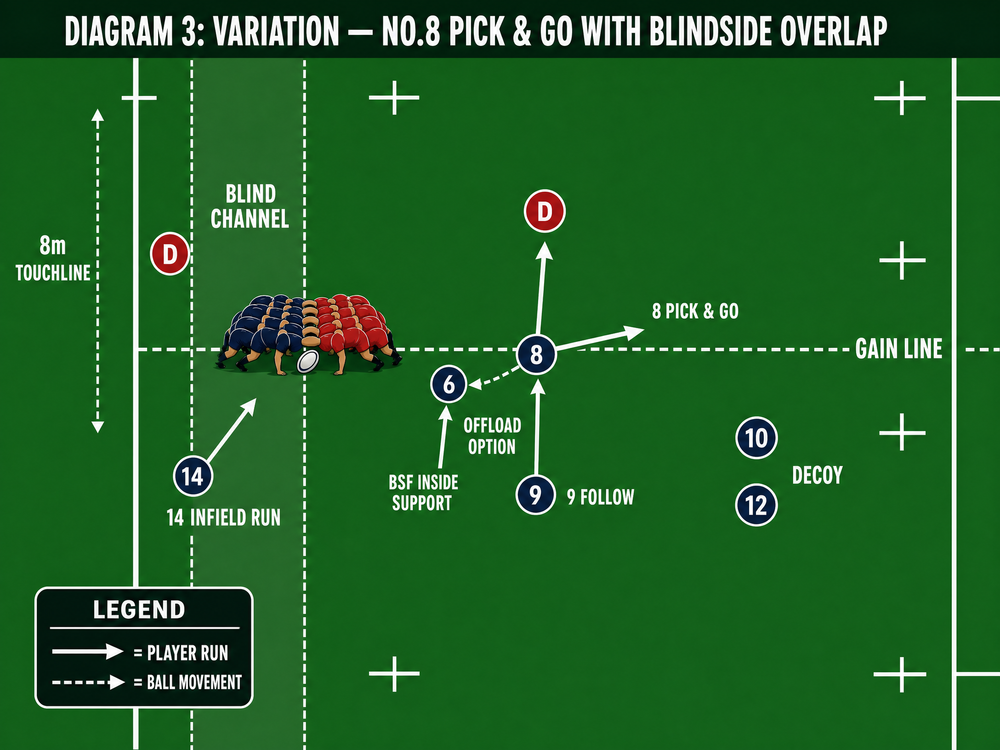
- Equipment Needed: 1 Rugby ball, 8 cones (to mark the scrum position, the touchline, and the gain line), and bibs for the opposition defence.
- Player Positions:
- Forwards (1-8): Standard scrum formation.
- Scrum-half (9): Positioned at the base, ready to clear the ball.
- Backs (10, 12, 13): Positioned wide on the openside to act as a credible decoy threat.
- Blindside Winger (14/11): Holding width on the blindside touchline.

3. Step-by-Step Instructions
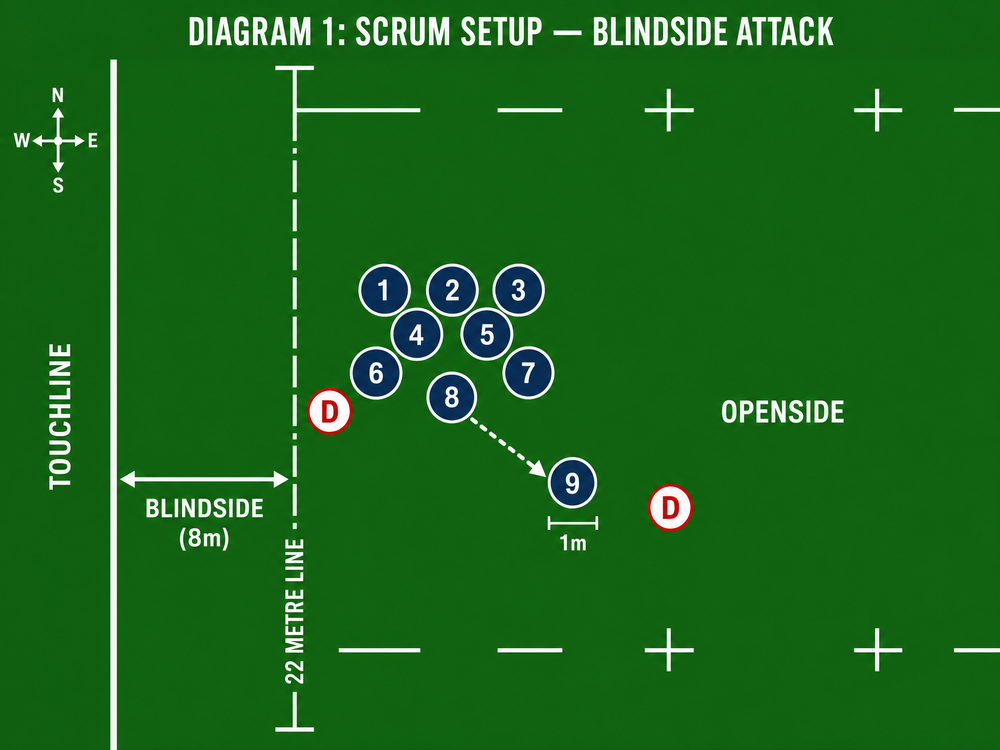
- The Setup and Call: The Number 8 (8) or Scrum-half (9) identifies the defensive alignment on the blindside. If the opposition winger is deep or the defending scrum-half is out of position, the 'Blindside' call is made. The openside backs (10, 12, 13) must communicate loudly to draw the defence's attention away from the blind channel.
- The Strike and Channel: The Hooker (2) strikes the ball cleanly, and the pack channels it quickly to the feet of the Number 8 to ensure the opposition back row remains bound.
- The Breakaway: As the ball reaches the base, the Blindside Flanker (6) immediately unbinds and accelerates on an arcing line towards the touchline, staying flat to the gain line.
- The Delivery: The Scrum-half (9) clears the ball rapidly from the base with a flat, accurate pass hitting the Flanker (6) in stride.
- The Support: The Number 8 (8) unbinds and follows as the primary inside support runner. Simultaneously, the Loosehead Prop (1) peels from the scrum to act as the secondary support or to secure the ensuing breakdown.
- The Execution: The Flanker (6) engages the defending winger. If the defender commits, the Flanker passes to the attacking winger holding width. If the defender drifts, the Flanker carries hard over the gain line, supported by the Number 8 and Prop to secure quick possession.
4. Key Coaching Points
- Speed of Delivery: The success of this play relies entirely on the speed of the ball from the base of the scrum. The Scrum-half must clear the ball in one motion without taking a preliminary step.
- Decoy Credibility: The openside backs must run genuine, hard lines and call for the ball. If the defence does not respect the openside threat, the blindside will be heavily congested.
- Flanker's Line: The Blindside Flanker must run an arcing line that straightens up just before contact. Running completely sideways will push the attack into touch.
- Scrum Stability: The front five must hold the scrum square and steady. Any rotation will disrupt the Number 8's control and the Flanker's breakaway angle.
- Immediate Support: The Number 8 and peeling Prop must react instantly. The ball carrier must not be isolated if tackled; a two-second ruck is the secondary objective if the line break fails.
5. Common Mistakes
- Telegraphing the Play: The Scrum-half looking exclusively down the blindside before the ball is out, alerting the defending back row.
- Slow Unbinding: The Flanker or Number 8 staying bound too long, allowing the defence to drift across and close the space.
- Drifting into Touch: The ball carrier failing to straighten their run, allowing the defender to easily tackle them into touch without committing to a decision.
- Ignoring the Overlap: The Flanker taking the tackle when the winger is completely unmarked on the outside.
6. Variations & Progressions
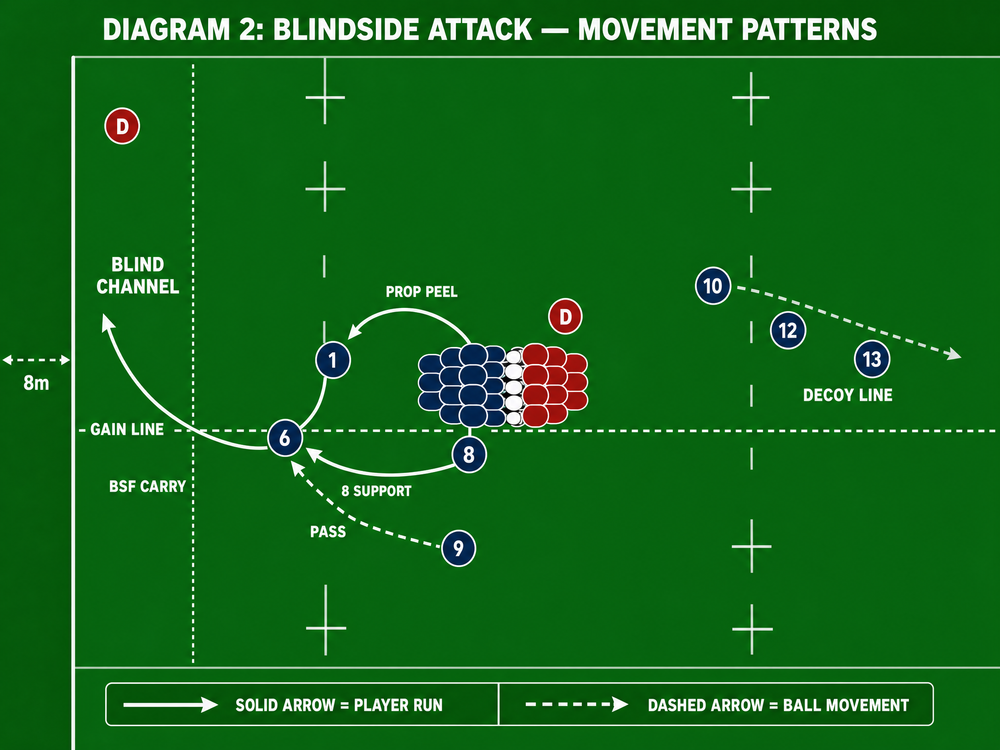
- Variation 1: The Number 8 Pick & Go: Instead of the Scrum-half passing, the Number 8 picks the ball and attacks the blindside directly, with the Flanker running a tight inside support line and the Scrum-half following as a second receiver.
- Variation 2: The Winger Cut-In: The attacking blindside winger runs a hard line back inside off the Flanker's shoulder, targeting the seam between the defending scrum-half and the flanker.
- Progression 1: Introduce a live defending Flanker and Scrum-half to force the attacking Flanker to make a read-and-react decision (pass or carry).
- Progression 2: Run the play off a moving scrum (walking forward) to challenge the Number 8's ball control and the Flanker's timing.
7. Age Adaptations
- Under 10s / Under 12s: Focus heavily on the Number 8 pick-and-go variation, as passing from the base can be technically difficult. Emphasize running straight and securing the ball in the tackle.
- Under 14s / Under 16s: Introduce the Scrum-half pass to the Flanker. Work on the timing of the unbind and the accuracy of the pass under pressure. Begin introducing the winger's decision-making on the outside.
- Open / Senior: Execute the full play with all variations. The focus shifts to the speed of execution, manipulating the defending scrum-half with eye contact, and securing sub-two-second ruck ball if the initial break is stopped.
