

Rugby
Blindside Strike: Exploiting the Short Side from the Scrum
Learn how to manipulate the opposition defense and create numerical advantages on the blindside with this devastating scrum set play.

What you need
Standard Rugby Pitch, Rugby Balls, Training Cones, Tackle Shields
1. Overview
The Blindside Strike is a highly effective set play designed to exploit the short side (blindside) of the pitch from a scrum. By drawing the opposition's defensive focus toward the open field, this play creates a numerical advantage or a one-on-one mismatch in a confined space. It is particularly lethal when executed near the opposition's 22-metre line or when the defending team's openside flanker is overly eager to detach and cover the wider channels.
This play relies on deception, precise timing, and aggressive ball carrying. When executed correctly, it forces the defense to make split-second decisions under pressure, often resulting in line breaks or crucial territory gains.
2. Setup
Pitch Location: Best utilized when the scrum is positioned between the 5-metre and 15-metre lines, leaving a viable but tight blindside channel.
Equipment Required:
- Standard Rugby Pitch (100m x 70m)
- Rugby Balls
- Training Cones (to mark defensive positions and channels)
- Tackle Shields (optional, for defensive resistance during training)
Player Positions:
- Forwards (1-8): Standard scrum formation. The pack must provide a stable platform and hold their bind until the ball is securely away.
- Number 9 (Scrum-half): Positioned at the base of the scrum, ready to distribute quickly.
- Number 10 (Fly-half): Positioned approximately 10 metres deep on the openside, acting as a credible threat to draw the defensive line.
- Number 6 (Blindside Flanker): Bound on the blindside of the scrum, ready to detach explosively.
- Number 8: Controlling the ball at the base, ready to support the blindside movement.
- Number 11 (Left Wing) / Number 14 (Right Wing): Positioned 5-7 metres from the touchline on the blindside, holding their width to stretch the defense.
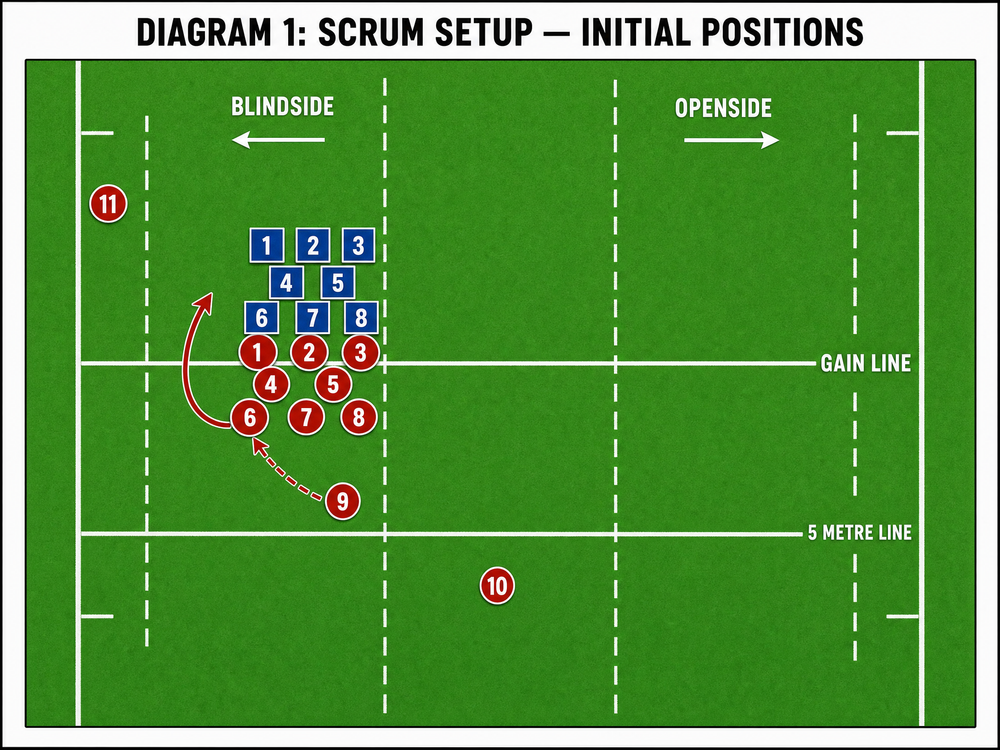
3. Step-by-Step Instructions
- The Engagement and Platform: The forward pack engages and secures the ball. The Number 8 controls the ball at the base of the scrum, ensuring it is available for the Number 9.
- The Decoy Movement: As the ball reaches the back of the scrum, the Number 10 and the openside backline initiate a realistic attacking movement. This visual cue is crucial to draw the opposition's openside flanker (Number 7) and fly-half away from the blindside.
- The Detachment: The Number 6 (Blindside Flanker) detaches from the scrum explosively, wrapping around the Number 8 and the Number 9 toward the blindside channel.
- The Delivery: The Number 9 clears the ball swiftly and accurately to the wrapping Number 6. The pass must be flat and in front of the receiver to maintain forward momentum.
- The Attack: The Number 6 attacks the gain line aggressively, targeting the space between the opposition's blindside winger and the scrum.
- The Support: The Number 8 immediately detaches and runs a hard support line on the inside shoulder of the Number 6, while the blindside winger holds their width to create a two-on-one scenario against the defending winger.
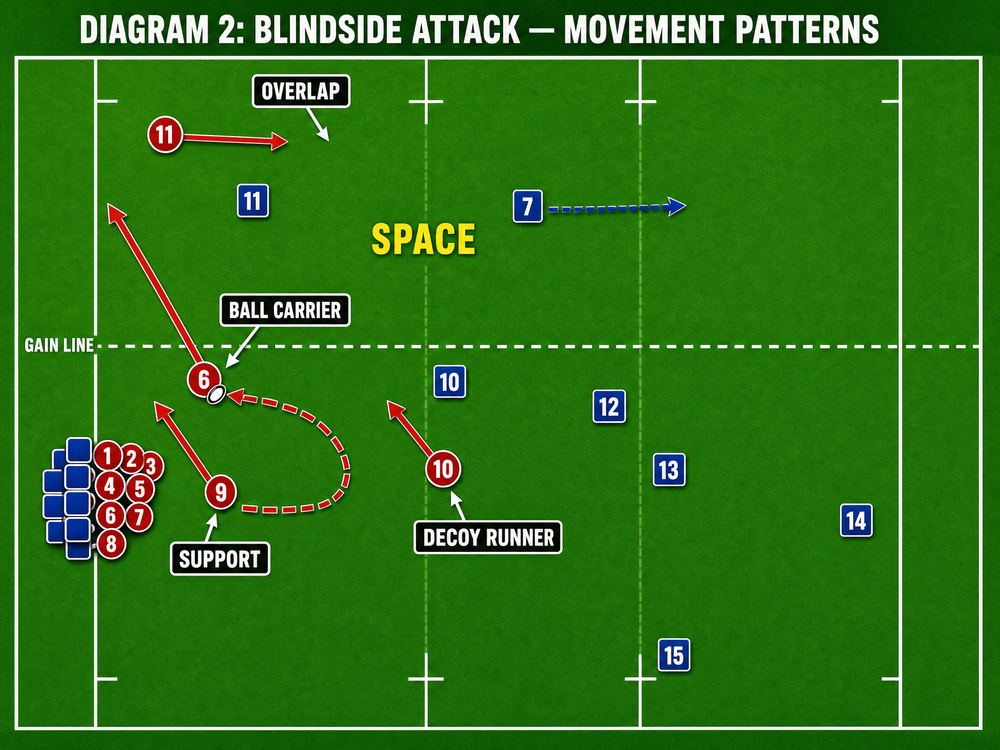
4. Key Coaching Points
- Scrum Stability: The play is impossible without a solid scrum platform. The front row must hold the pressure, and the Number 8 must present the ball cleanly.
- Selling the Decoy: The Number 10 must communicate and move as if they are receiving the ball. If the decoy is unconvincing, the defense will simply drift to cover the blindside.
- Explosive Detachment: The Number 6 must time their run perfectly. Detaching too early alerts the defense; detaching too late kills the momentum. They must hit the ball at pace.
- Accuracy of the Pass: The Number 9's pass is the critical link. It must be swift, flat, and perfectly weighted to allow the Number 6 to run onto it without breaking stride.
- Decision Making: The Number 6 must read the defending winger. If the defender commits to the tackle, the Number 6 must execute a timely offload to their supporting winger. If the defender drifts wide, the Number 6 must back themselves to break the line.
5. Common Mistakes
- Premature Detachment: Flankers detaching before the ball is out of the scrum, resulting in a penalty.
- Poor Timing: The Number 6 overrunning the pass or having to check their run, allowing the defense to realign.
- Lack of Support: The Number 8 or the winger failing to provide immediate support options, leaving the ball carrier isolated.
- Telegraphing the Play: The Number 9 looking directly at the blindside before the pass, giving away the intention to the defense.
6. Variations & Progressions
Variation A: Number 8 Pick and Go
Instead of the Number 9 passing to the Number 6, the Number 8 picks the ball directly from the base of the scrum and attacks the blindside. The Number 9 and Number 6 then become the primary support runners. This is highly effective if the opposition scrum-half is positioned poorly.
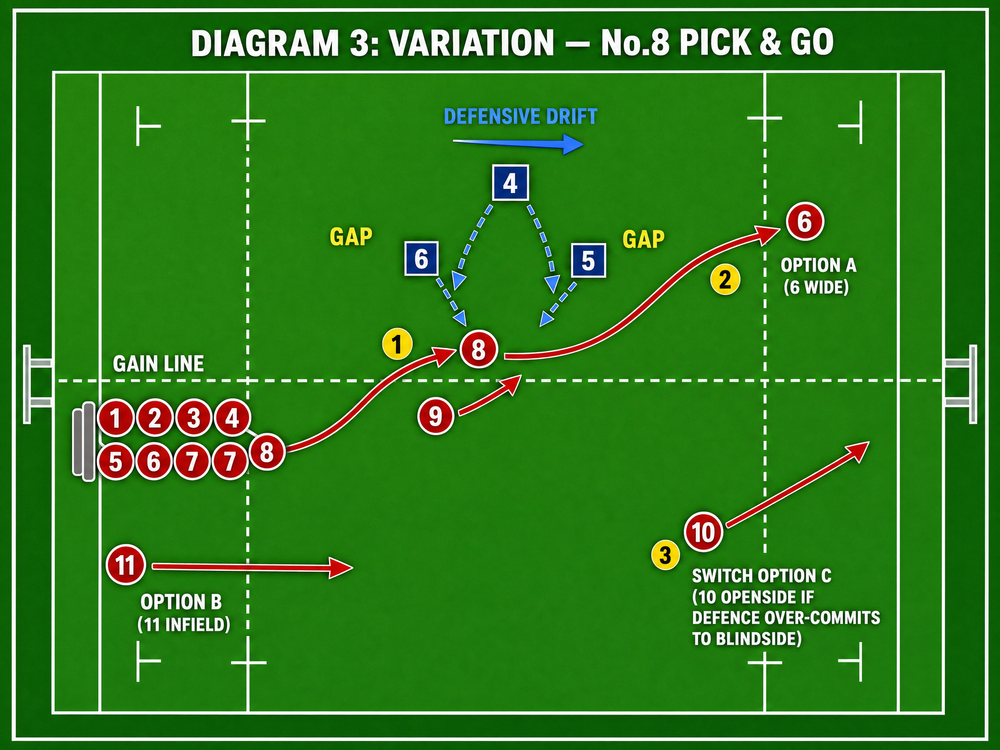
Variation B: The Switch
If the defense begins to over-commit to the blindside in anticipation of the strike, the Number 9 can fake the pass to the blindside and switch the attack back to the Number 10 on the openside, exploiting the vacated space.
Progression:
Introduce live defenders (initially just the opposing scrum-half and winger) to force the attacking players to make real-time decisions based on defensive reads.
7. Age Adaptations
- Under 10s / Under 12s: Focus heavily on the basics of scrum stability and safe detachment. Simplify the play to a direct pass from 9 to the blindside winger, removing the complex wrapping run of the flanker.
- Under 14s: Introduce the wrapping run of the flanker, but emphasize the importance of the two-on-one decision making against the defending winger. Use touch or tag variations to build confidence in the passing execution.
- Under 16s / Open: Implement the full play with all variations and decoy movements. Focus on the speed of execution, the quality of the decoy running, and the physicality of the ball carry.
