

Rugby
Rugby Set Play: Wide Overlap from Lineout
A comprehensive guide for Rugby coaches on how to execute a wide overlap play from a lineout to create space and score tries.

What you need
Rugby ball, Cones or markers, Full-size Rugby pitch
1. Overview
This set play is designed to quickly move the ball from a lineout to the wide channels, creating a numerical advantage (an 'overlap') for the attacking team. It is most effective when launched from a stable lineout platform inside the opposition's half, ideally between the 10-meter line and the 22-meter line. The goal is to stretch the defense, isolate the defending winger, and create a 2-on-1 or 3-on-2 situation to put your winger or fullback in for a try.
2. Setup

- Equipment: One Rugby ball, cones or markers to delineate the lineout and backline positions.
- Pitch Setup: A full-size Rugby pitch (100m x 70m). The play is run from a lineout on either the left or right side of the pitch.
- Player Positions:
- Forwards (in the lineout): Hooker (2), Locks (4, 5), Flankers (6, 7), Number 8 (8).
- Backs: Scrum-half (9), Fly-half (10), Inside Centre (12), Outside Centre (13), Left Wing (11), Right Wing (14), Fullback (15).
3. Step-by-Step Instructions


- The Lineout: The play begins with a clean lineout win. The hooker (2) throws to a designated jumper (usually 4 or 5), who secures the ball and delivers it quickly to the scrum-half (9).
- The Transfer: The scrum-half (9) passes the ball to the fly-half (10), who is positioned deep to create time and space.
- The Distribution: The fly-half (10) immediately passes to the inside centre (12), who then moves the ball on to the outside centre (13). The ball should be moving quickly through the hands to outflank the defense.
- Creating the Overlap: As the ball reaches the outside centre (13), the fullback (15) injects into the backline from a deep position, running a hard line to create the extra man on the outside.

- The Draw and Pass: The outside centre (13) attacks the space, forcing the defending winger to make a decision. The 13 must 'fix' their defender before passing to the winger (14) in space.
- The Finish: The winger (14) receives the ball at pace and should have a clear run to the try line. The fullback (15) and other support players should be on hand to take an inside pass if the last defender covers across.
4. Key Coaching Points
- Draw and Pass: Each player must 'fix' their defender before passing. This means running a hard enough line to force the defender to commit to them. A pass made too early allows the defense to drift.
- Communication: The backline must be in constant communication. The fly-half should be calling the shots, and players outside them should be calling for the ball.
- Fullback's Injection: The fullback's timing is critical. They must inject into the line at pace and from depth, appearing in the channel just as the final pass is being made.
- Hold Your Width: The winger must stay wide to stretch the defense. If they drift infield, they make the defender's job easier.
- Hands Up, Ready to Catch: All players in the backline should have their hands up and ready to receive the ball. This small detail can make a huge difference in the speed of the play.
5. Common Mistakes

- Slow Ball from the Lineout: A slow, messy lineout win kills the play before it even starts. The defense will have time to reset and shut down the space.
- Backline is Too Flat: If the backline is too flat, they will have no time to accelerate onto the ball and will be easily tackled.
- Passing Too Early: Players passing before they have committed their defender allows the defense to simply drift and cover the overlap.
- Fullback is Too Early or Too Late: If the fullback injects too early, the defense will spot them. If they are too late, the opportunity will be gone.
- Winger Drifting Infield: This is a very common error. The winger gets impatient and comes looking for the ball, which closes down the space and negates the overlap.
6. Variations & Progressions

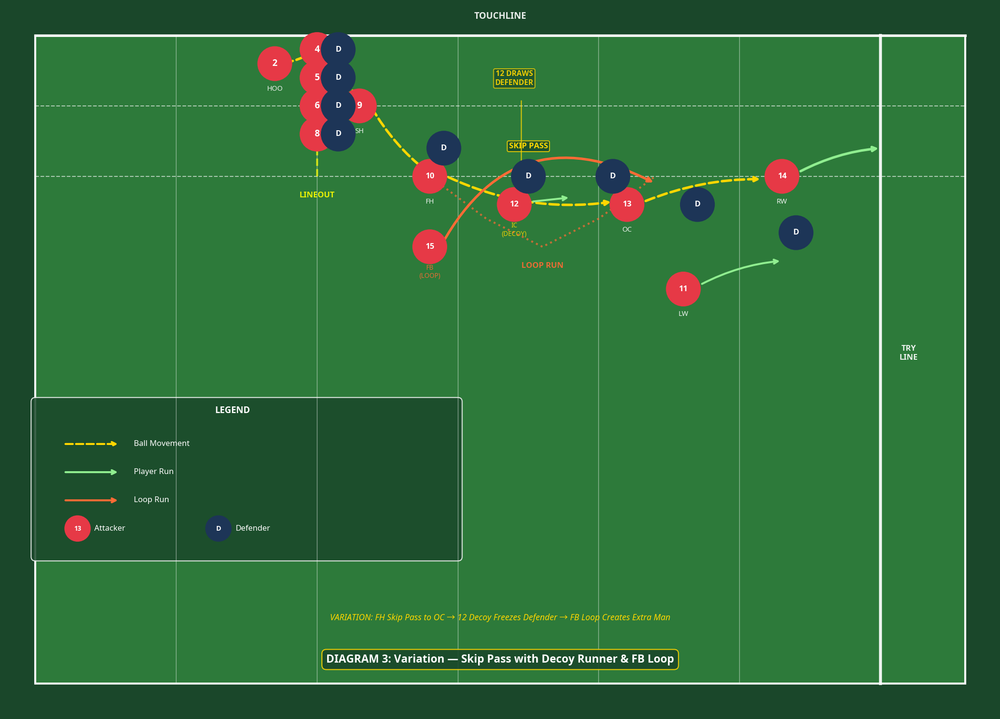
Variation: The Skip Pass

- Instead of going through the hands, the fly-half (10) can throw a long 'skip pass' directly to the outside centre (13). This is a higher-risk option but can be devastating if the defense is narrow.
- A 'dummy' runner (the inside centre, 12) can run a hard unders line to hold the inside defenders and create more space for the skip pass.
Variation: The Loop
- The fly-half (10) can pass to the inside centre (12) and then 'loop' around them to receive a return pass. This changes the point of attack and can confuse the defense, often creating an extra man on the outside.
Progression: Adding Defenders
- Start by running the play against no defense to get the timing right.
- Progress to adding passive defenders who can only shadow the attackers.
- Finally, run the play against a full, live defense to simulate match conditions.
7. Age Adaptations

- Under 12s: Focus on the core skills of catching and passing. Simplify the play by removing the fullback's injection. Just focus on moving the ball to the winger.
- Under 14s: Introduce the concept of 'drawing and passing'. Use drills to teach players how to commit a defender before making a pass. The fullback can be introduced as a support runner.
- Under 16s: The full play can be run, but with an emphasis on the timing and communication. Coaches should stop the play frequently to provide feedback.
- Open Age: At this level, the play should be executed at high speed and with precision. Introduce more complex variations, such as the loop and skip pass, and expect players to make decisions under pressure.
