

Rugby
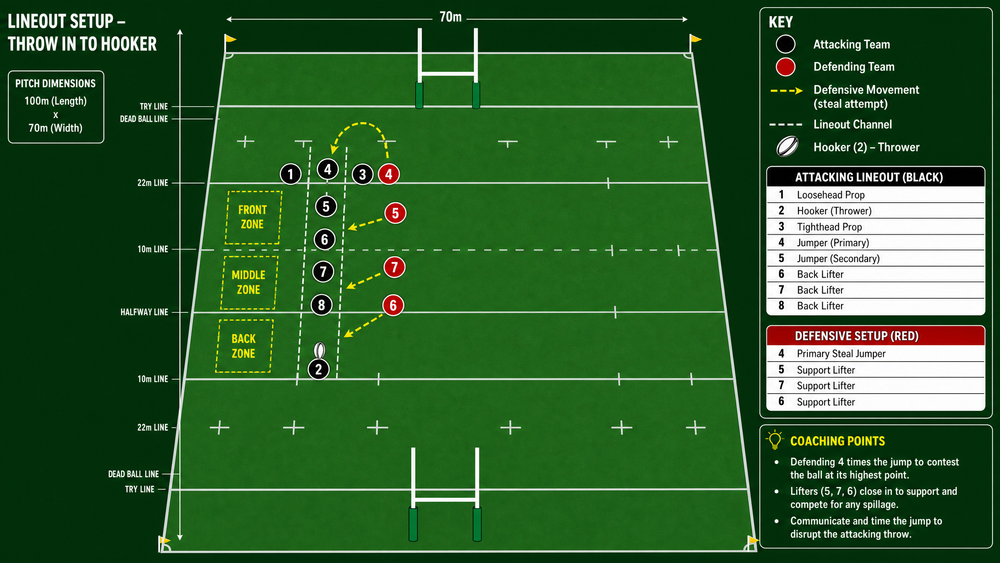
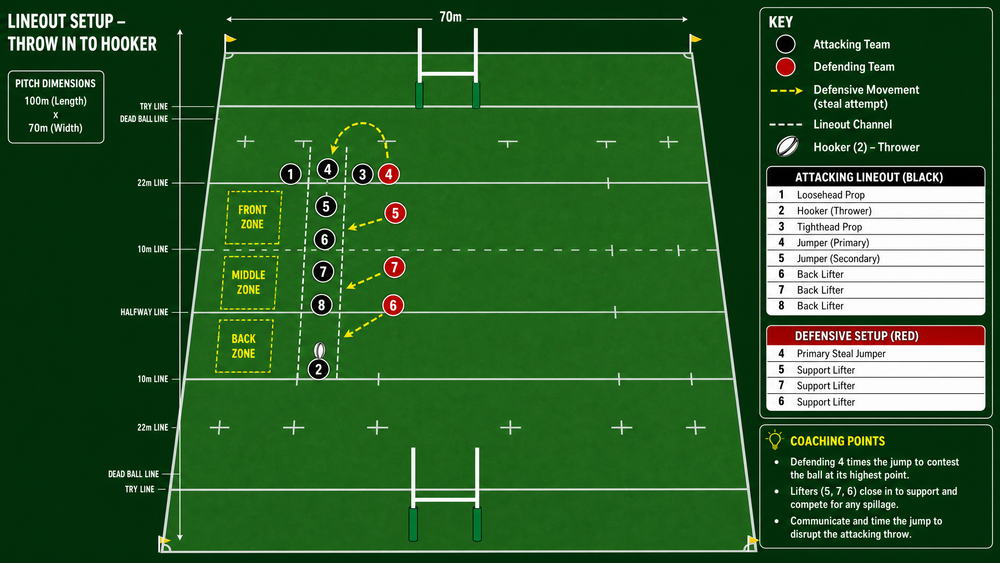
Shadow 5: Middle-Pod Lineout Steal on Opposition Throw
A coach-ready defensive lineout system for reading a predictable middle throw, winning the ball cleanly, and converting the steal into a fast nine exit.

What you need
4 rugby balls, Two colours of training bibs, 12 flat cones, 6 tall marker cones, Whistle, Pitch or marked 22 m x 20 m training area
1. Overview
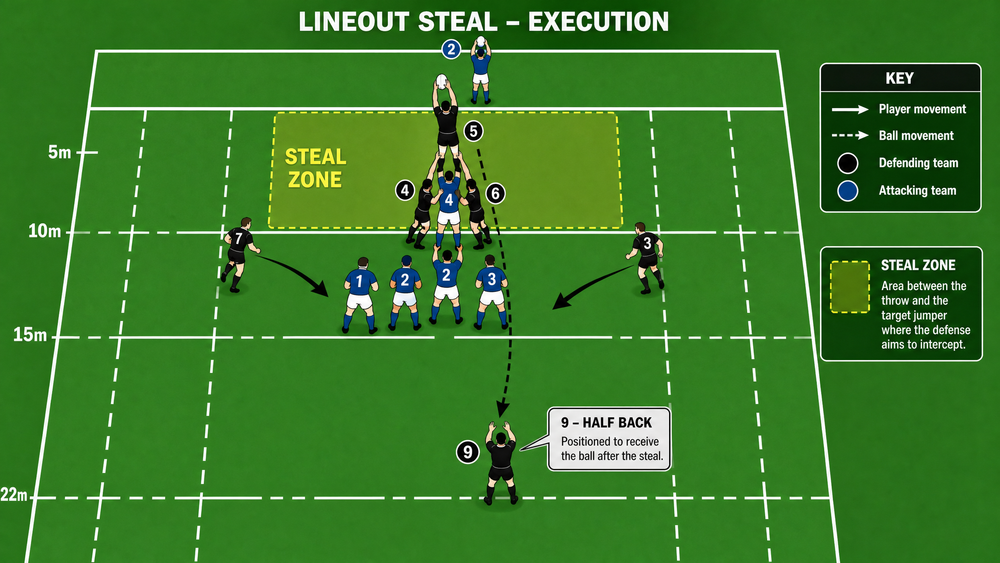
Shadow 5 is a defensive lineout steal designed to take away an opposition middle-pod throw. The defensive caller reads the attacking shape and the hooker’s pre-throw cue, then lifts Lock 5 into the ball’s flight line ahead of the opposition target. The preferred finish is a clean catch; the fallback is a controlled two-hand tap into Scrum-half 9. The aim is not a reckless aerial collision. It is to own a defined area of air, land safely and convert the turnover into immediate possession.
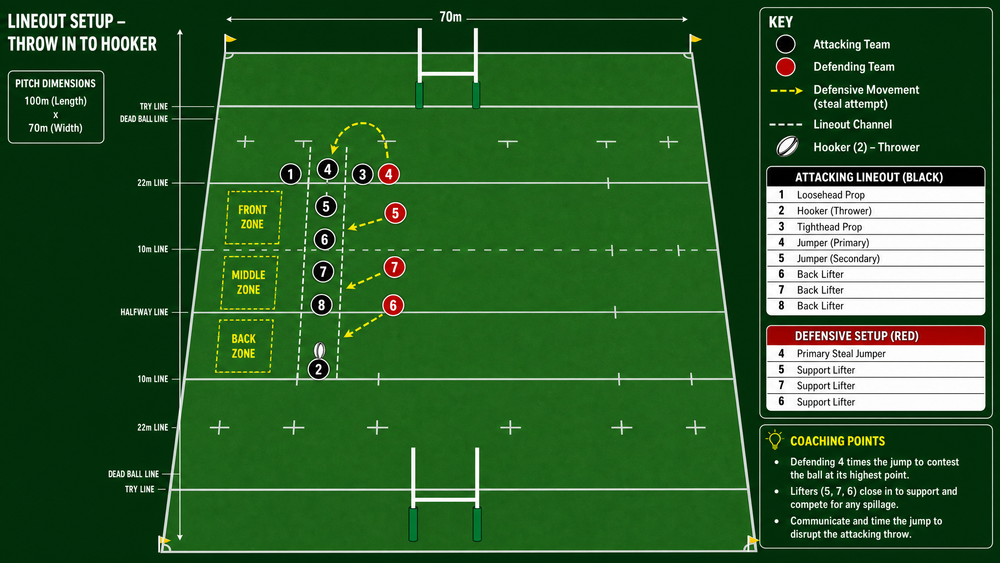
Use it when the opposition repeatedly targets the middle at 9–11 m from touch, or when their hooker throws a quick, flat ball. On a standard 100 m x 70 m pitch, rehearse inside the legal lineout channel between the 5 m and 15 m lines. Mark front, middle and back reference cones at 6 m, 10 m and 14 m from touch.
Coaching intent: Call early, move late, lift vertically and make the first pass after the steal decisive.
2. Setup
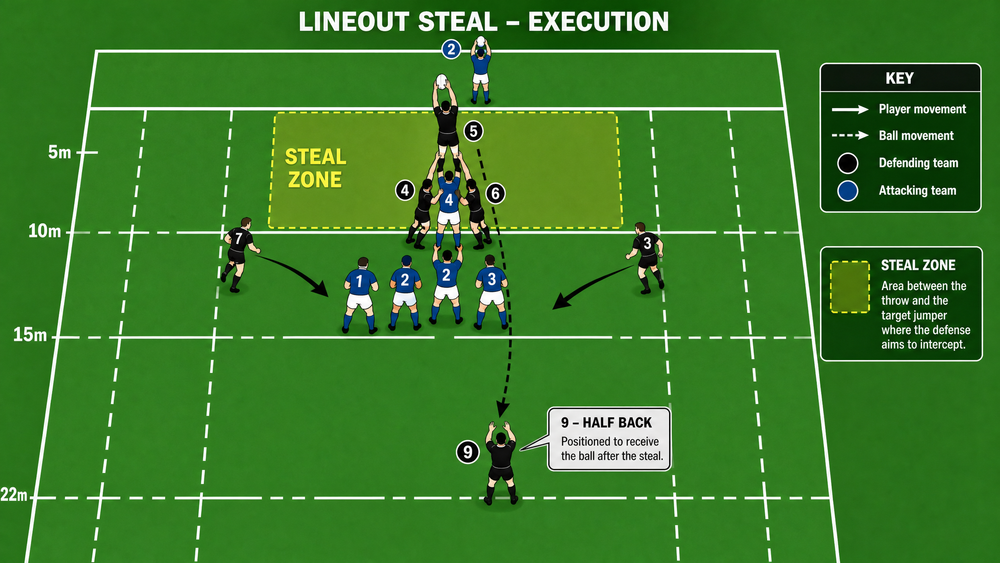
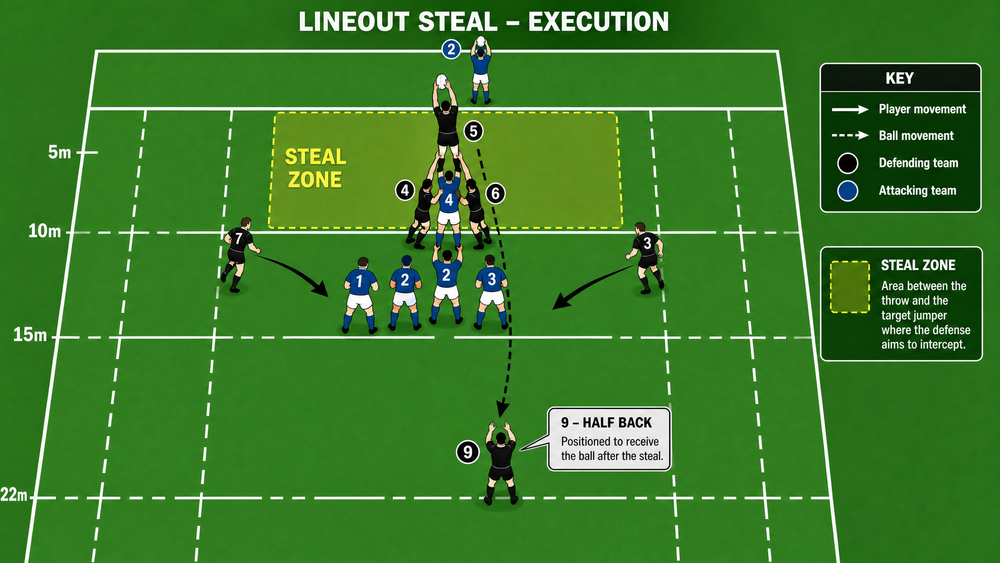
For learning, use a 22 m x 20 m area beside touch. The live version needs two lineout units, two hookers, a defensive 9, and a ball; 16 players is ideal. Use two bib colours and mark a 2 m x 2 m receiving box for 9, 2–3 m behind the rear lifter and 2 m infield from the lineout. It gives the jumper a safe, repeatable target for a tap or transfer.
| Role | Player number | Starting job | Coaching detail |
|---|---|---|---|
| Caller / primary jumper | 5, Lock | Own the 10 m middle zone | Make the call, remain neutral, then jump through the ball. |
| Front lifter | 6, Blindside Flanker | Set at 5’s front thigh | Step in on the trigger; drive up with a long spine. |
| Rear lifter | 7, Openside Flanker | Set tight behind 5 | Lift through the hips and guide a balanced landing. |
| Front decoy | 4, Lock | Hold the 6 m front pod | Stay credible so the attack cannot easily read the middle steal. |
| Back cover | 8, Number Eight | Protect the 14 m back zone | Track a delayed or overthrown ball. |
| Receiver | 9, Scrum-half | Set in the receiving box | Call “mine”, present two hands and play away in two steps. |

Set the middle pod with lifters no more than 40 cm from the jumper. A large gap creates a reaching lift and costs height. Lock 4 must look like a genuine front option without drifting into the middle channel. Agree the simple call, “Shadow 5,” before the hooker settles. Once the thrower starts the routine, no repeated call is needed; late noise gives the opposition information.
3. Step-by-Step Instructions
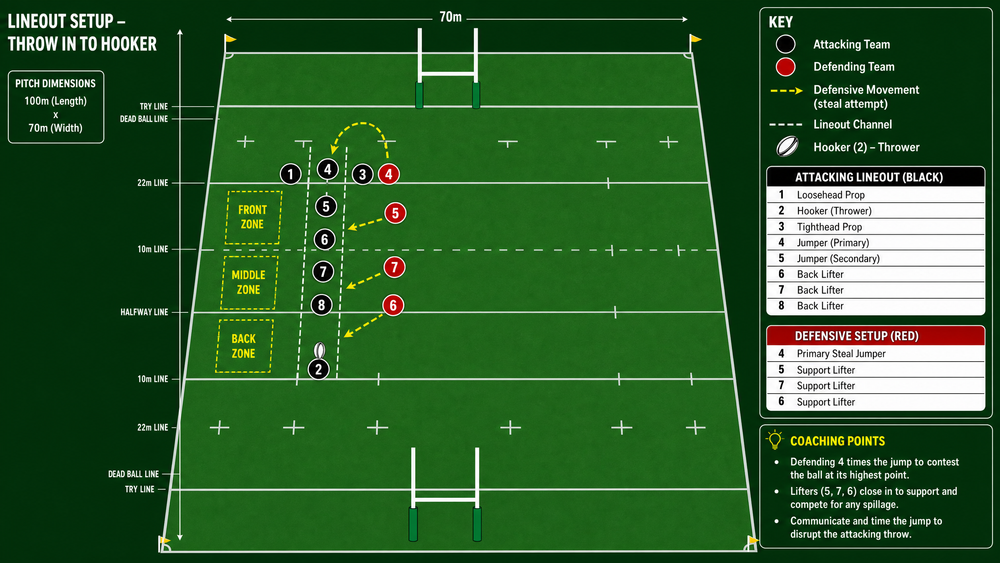
Scan and select. As the attacking unit walks in, 5 identifies the likely target from pod spacing, the opposition jumper’s body angle and the hooker’s sightline. Do not rely on shirt number alone. If the attack splits its pod or shows late tail movement, 5 calls “hold.” A disciplined no-jump is better than lifting into empty space.
Build a neutral picture. Set 4 at the 6 m cone, 5–6–7 at the 10 m cone, and 8 at 14 m. The middle pod stays square to touch with no obvious forward lean. Number 9 checks that the receiving box is clear and calls the exit side, “left” or “right.”
Key off the thrower. The trigger is the hooker’s final weight shift and the ball dropping into the loading position below the chest. On that trigger, 6 and 7 tighten their feet and 5 gives a short knee dip. The pod does not jump before the throwing action commits.
Win the half-step. As the hooker releases, the middle pod makes one compact adjustment—no more than 0.5 m—into the expected lane. Lifters close the space first while 5 remains tall through the chest. Avoid several shuffling steps; they advertise the contest and cost power.
Lift and own the ball. Aim for 5 to reach maximum height as the ball arrives in the centre of the channel. Number 6 lifts from the lower thigh; 7 lifts from the hips/glutes. Both drive straight up, not inwards. Number 5 reaches with two hands, leading with the inside arm closest to the thrower, and catches at full extension. Do not reach across or contact an opposition jumper in the air.
Choose the finish. If balanced, 5 secures the ball to the chest, looks over the outside shoulder and transfers to 9 after landing. If the ball is beyond safe catching range, use a controlled two-hand tap down and back into the receiving box. A blind slap is not a steal; it is a 50–50 ball. Number 9 moves onto the ball rather than waiting flat-footed.
Exit or reload. Once 9 receives, pass to the open-side first receiver or hit a short forward carry. If the opposition retain the ball, 5 and the lifters land safely, re-square and prepare to defend the next phase instead of chasing a lost contest.
4. Key Coaching Points
- Call early, disguise late. The unit needs time to organise, but its final movement happens only after the hooker commits.
- Lift vertically, not towards the opposition. Power comes from the ground through straight legs and braced trunks.
- Make 5 rigid through the core. A short dip is followed by a long, strong body position at full height.
- Track the ball, not the opponent. Two hands meet the ball at the highest controllable point.
- Give 9 the same picture every rep. The receiving box, exit-side call and first action must be consistent.
- Land before playing. Possession matters only if the unit secures it safely and legally.
5. Common Mistakes
| Mistake | What it looks like | Immediate correction |
|---|---|---|
| Early jump | Attack throws over the contesting pod. | Delay the lift until the hooker’s release action. |
| Reaching lift | Lifters start wide and pull 5 towards them. | Reset the gap to 40 cm or less; rehearse the step-in without a ball. |
| Jumper opens early | 5 turns to find the opponent and loses the ball line. | Use a soft toss: eyes up, inside arm leads, two hands finish. |
| Tap without a target | Ball drops into a crowd. | Re-mark 9’s box and name the receiver before each rep. |
| Chasing after a miss | Lifters lose defensive shape. | Use the cue “land, square, defend.” |
6. Variations & Progressions
Static timing: Start with attack announcing a middle throw. Defence rehearses trigger, lift and safe landing at 60% speed. Award one point only for a clean catch.
Three-zone decision: Attack may throw front, middle or back. Defence may steal only after 5 confirms the cue. Reward the correct “hold” call when the ball goes elsewhere; it teaches judgement rather than gambling.
Live exit: Add attacking pressure around the receiving box. Defence earns two points for a clean steal plus a completed first pass or forward carry beyond a 5 m gain line.
Front Shadow: Use 4 as the 6 m primary jumper and make 5 the middle decoy against teams that repeatedly hit their first pod. If the opposition catches and brings the ball down, switch immediately to your team’s lawful maul-defence roles.
7. Age Adaptations
For Under 8 and Under 10, remove lifting and contested aerial play. Players race to front, middle or back cones, jump unassisted for a soft toss, then pass to 9. The outcome is scanning and communication, not height.
For Under 12 and Under 14, use only the lifting and contesting permitted in local age-grade regulations. Keep the drill semi-opposed, insist on controlled landings, and stop immediately when spacing or body position deteriorates.
For Under 16 and open-age teams, use the full live version. Film five reps from touchline height and review only the trigger, lifter distance and 9’s exit. Finish a 30-minute block with three sets of three reps: one point for a clean steal, two for a steal plus successful exit, and one point to attack whenever defence jumps early.
Safety and legality: Apply current union laws and age-grade regulations. Do not lift or contest where it is not allowed, and stop the drill if the jumper cannot be lifted and lowered under full control.
