

Rugby
Lineout Wide Overlap: 10–12–13 Sweep to the Far Edge
Teach a fast, repeatable lineout launch that fixes the inside defence and releases the far wing into a genuine overlap.

What you need
balls, cones
Overview
This is a 10-player wide-overlap set play for a lineout between the 22-metre line and halfway, with the attacking lineout on the near touchline. It turns a middle lift into a fast far-edge attack: 9 exits, 10 stays square, 12 runs a hard unders decoy, 13 receives late and fixes the outer defender, and 14 finishes in the space beyond the defensive edge. The objective is not simply to move the ball wide; it is to make defenders commit in sequence so the final pass is taken outside the last defender, with the wing running infield to score.
Use it after the opposition has condensed around the lineout or shown a narrow midfield fold. The play should take no more than 2.0 seconds from the throw to 14 receiving the ball. The call is “Wide Sweep”. For a beginner-intermediate group, repeat the launch until players can name their job, timing and decision without a coach prompt.
Setup
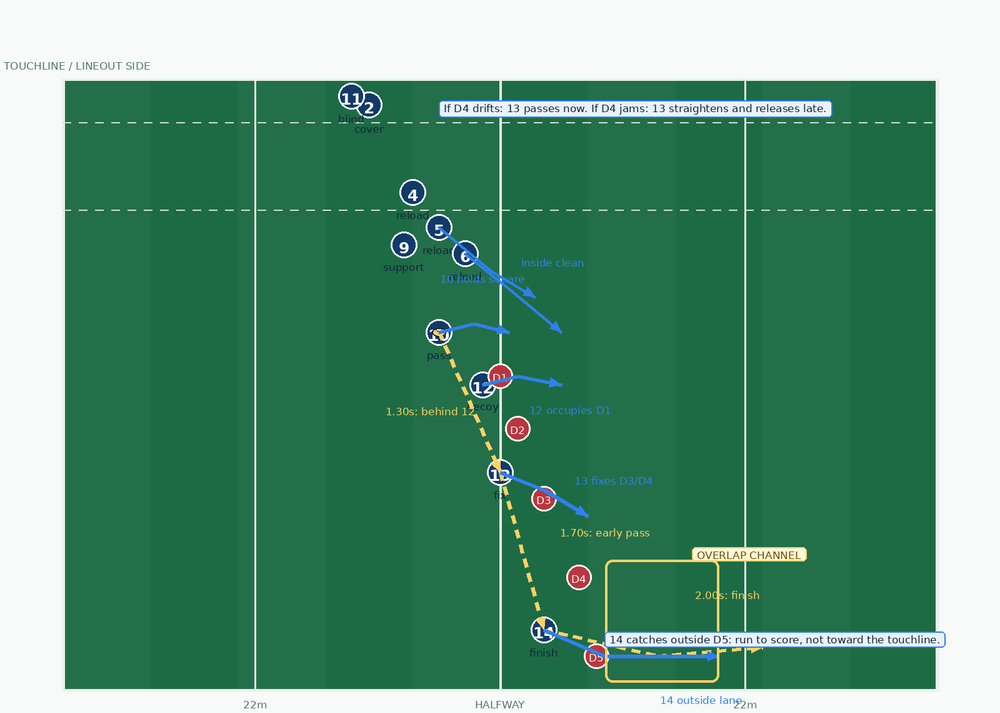
Set a full 100 m x 70 m pitch, but work first in a 35 m x 45 m channel from the near touchline. Put four attackers in the lineout: 2 throws; 4 lifts at the front; 5 is the middle jumper; and 6 is the rear lifter. 11 holds a short-side safety position, two metres behind the thrower, and is not part of the main sweep. 9 starts two metres behind the receiver lane.
Set 10 seven metres behind 9, square to the gain line. Place 12 six metres outside 10 and one metre flatter. Put 13 four metres wider and two metres deeper than 12. Keep 14 at full width, three metres infield from the far touchline, initially one metre deeper than 13. Mark five defenders: D1 opposite 10, D2 opposite 12, D3 opposite 13, and D4–D5 across the edge. Start with passive defenders, then progress to live line speed. Have one ball and cones for the lineout, 5 m, 15 m and outside-width reference points.

Step-by-Step Instructions
Call and cue (before the throw): 9 gives the “Wide Sweep” call only when the far edge has width and 10 can see D1–D3. 5 confirms the middle pod with a hand signal. 12 and 13 quietly check that 12 will attack inside shoulder and 13 will stay late.
Throw and transfer (0.00–0.55 seconds): 2 throws a flat ball to 5 in the middle lane. 4 and 6 lift through the ball, then land and turn toward the attacking side. 5 transfers immediately to 9; do not bring the maul down. 9 has hands up early and catches facing 10.
Exit to 10 (0.55–1.05 seconds): 9 passes from the floor or takes one lateral step, never drifting backwards. The pass must arrive in front of 10’s body so 10 can run square. As the ball leaves 9, 12 launches a hard unders line at D1’s inside shoulder. His job is to make D1 turn in, not to receive.
Square decision by 10 (1.05–1.30 seconds): 10 takes two square steps at D1, showing running threat. He passes behind 12 to 13 only when D1 is held by 12’s line. If D1 shoots early and 12 is clear, 10 may hit 12 short; otherwise the default is the sweep pass to 13. 10 immediately follows his pass as inside support.
Fix and release by 13 (1.30–1.70 seconds): 13 catches while moving laterally only after straightening for one step. He must fix D3 and read D4. If D4 drifts onto 14, 13 gives the ball early. If D4 jams hard, 13 carries square through the inside shoulder, draws contact if needed, and releases a late pass to 14. Do not throw a speculative long pass across an uncommitted defender.
Finish by 14 (1.70–2.00 seconds): 14 stays wide until 13’s hands lift. He calls “wide”, catches outside D5 and runs back towards the posts, not at the touchline. If the edge defender turns in, 14 pins the ears back. If D5 gets across, 14 takes the outside shoulder, uses a controlled kick ahead only if there is clear grass, or returns inside to 13/10 support.
Key Coaching Points
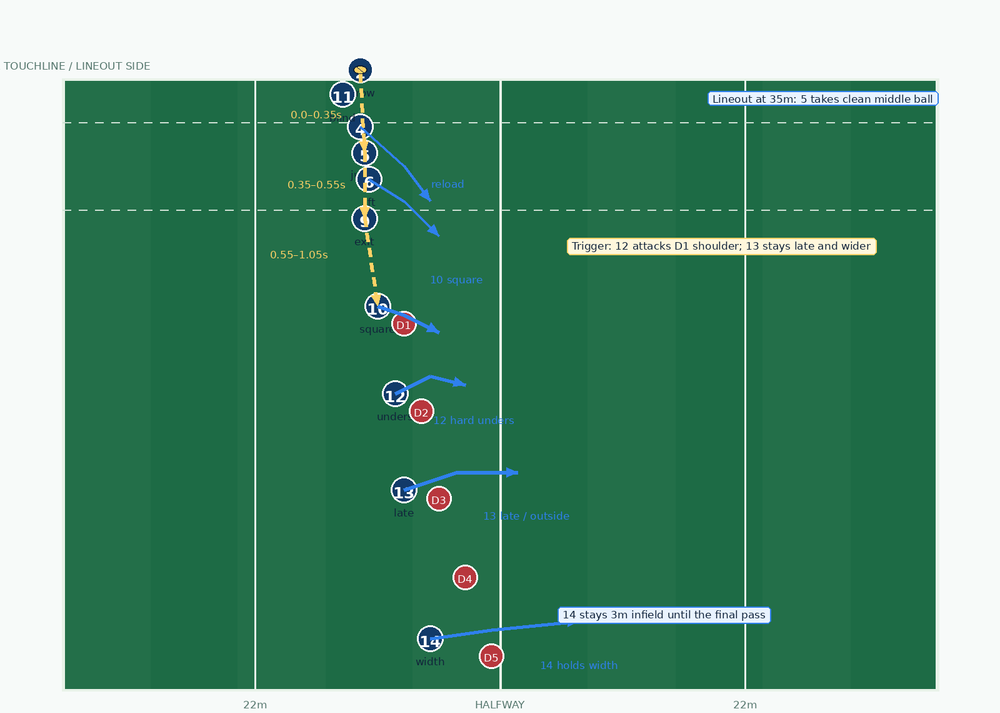
The shape works only if width is held before speed is added. Coach 14 to resist chasing the ball; every unnecessary inward step shortens the pass and helps D5 cover. 12’s decoy must be credible: hips and shoulders square, eyes through the gap, and no glance over the outside shoulder. 10 needs soft hands and a square chest so D1 cannot read the pass early.
Coach 13’s decision using a simple picture: “drift = pass, jam = straighten.” Insist that 13 catches with two hands and scans D4 before committing. The lineout forwards must reload as a connected inside-cleaning unit, with 4 and 6 tracking behind the pass line rather than admiring the launch. 9 communicates any late defensive fold, while 11 protects the blind side and becomes first chase/support player if the ball is lost.
Common Mistakes
The usual failure is 10 drifting across field, which puts 12 and 13 on the same defender and kills the overlap. Correct it by placing a cone on 10’s square line and demanding two forward steps before the pass. A second error is 12 jogging or running too wide; D1 then stays free to drift onto 13. Make 12 attack a shoulder at pace and finish his line.
A third mistake is 13 passing before D3 or D4 has committed. Freeze the rep and ask, “Who have you fixed?” If the answer is nobody, 13 must carry one more square step. Finally, wings often catch too close to touch. Re-mark the three-metre infield cone and coach 14’s last action as an arcing run to the posts.
Variations & Progressions
For the first variation, use the same lineout but let 10 play a short tip to 12 when D1 shoots; 12 then gives a soft out-the-back pass to 13. This punishes an aggressive inside defender without changing 14’s width job. For the second variation, send 5 around the back after the transfer so he becomes a late inside support runner, useful when D4 jams and 13 needs a pull-back option.
Progress from walkthrough to 60% defensive line speed, then full live defence with a five-second score-or-reset condition. Add a sixth defender folding from the lineout only after the attack can complete the base pattern. Finally, call the play from different lineout positions: inside your own 22, favour a secure carry exit; beyond halfway, demand that 14 finishes with a line break or positive kick return.
Age Adaptations
For Under-12, use uncontested lineouts or a coach-fed transfer, reduce the backline to 9–10–12–14, and remove the live D4 decision. The coaching target is catch-pass accuracy and holding width. For Under-14, retain the four-player lineout but use passive defensive shields first; let 13 make the drift-or-jam read at 70% pace. For Under-16 and open age, use contested lineouts, live folding defenders and a real ruck option if 13 is caught. Keep the core non-negotiables at every age: safe lineout technique, square first receiver, believable decoy, late fix, and a wing who finishes infield.
