Rugby Union Box Kick Chase & Press: Win the Air, Own the Next Phase
A coach-ready system for turning a box kick into a legal aerial contest, connected chase wave and touchline pressure play.

Equipment Needed
Overview
The box kick chase and press is a territorial attacking set play, not a hopeful clearance. It gives your side a repeatable way to move the contest from a ruck into the opponent’s backfield, challenge the aerial catch, and—if the catch is clean—trap the first carry near touch. Use it when the ruck is stable, the scrum-half has a clear kicking lane, and the receiving full-back has been pulled to a side or is standing deep. It is particularly effective from your own 22m to just beyond halfway, where a high, contestable kick can turn exit-ball into a pressure phase.
The shared outcome is simple: win the ball in the air, or win the next tackle with the receiver isolated near touch. Keep the chase legal: players in front of the kicker must not interfere, and retiring players must respect the 10-metre restriction at the catch or landing point.2
Coach’s intent: “Nine owns the kick, the first chaser owns the air, and everybody else owns an exit.”
Setup
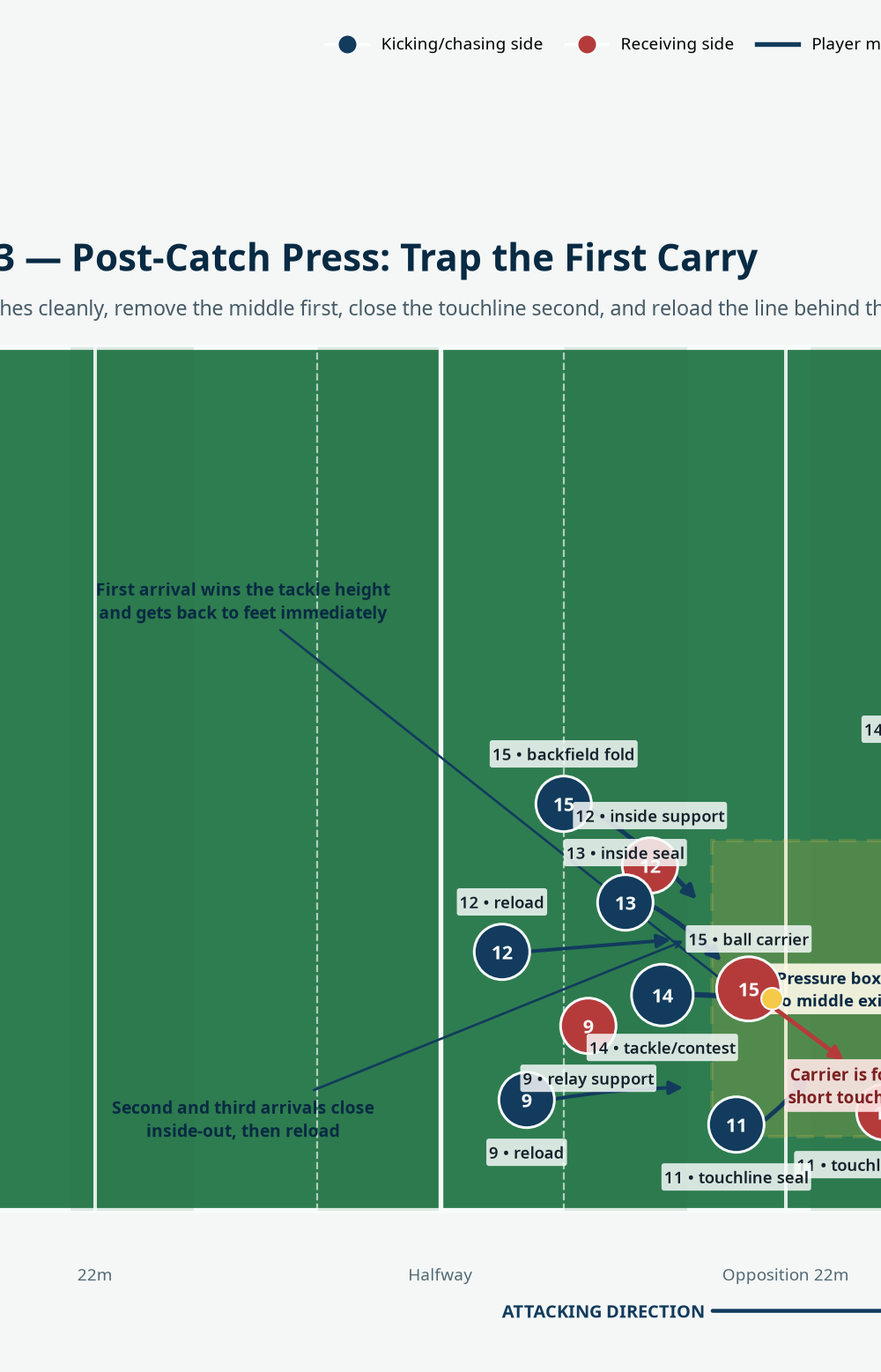
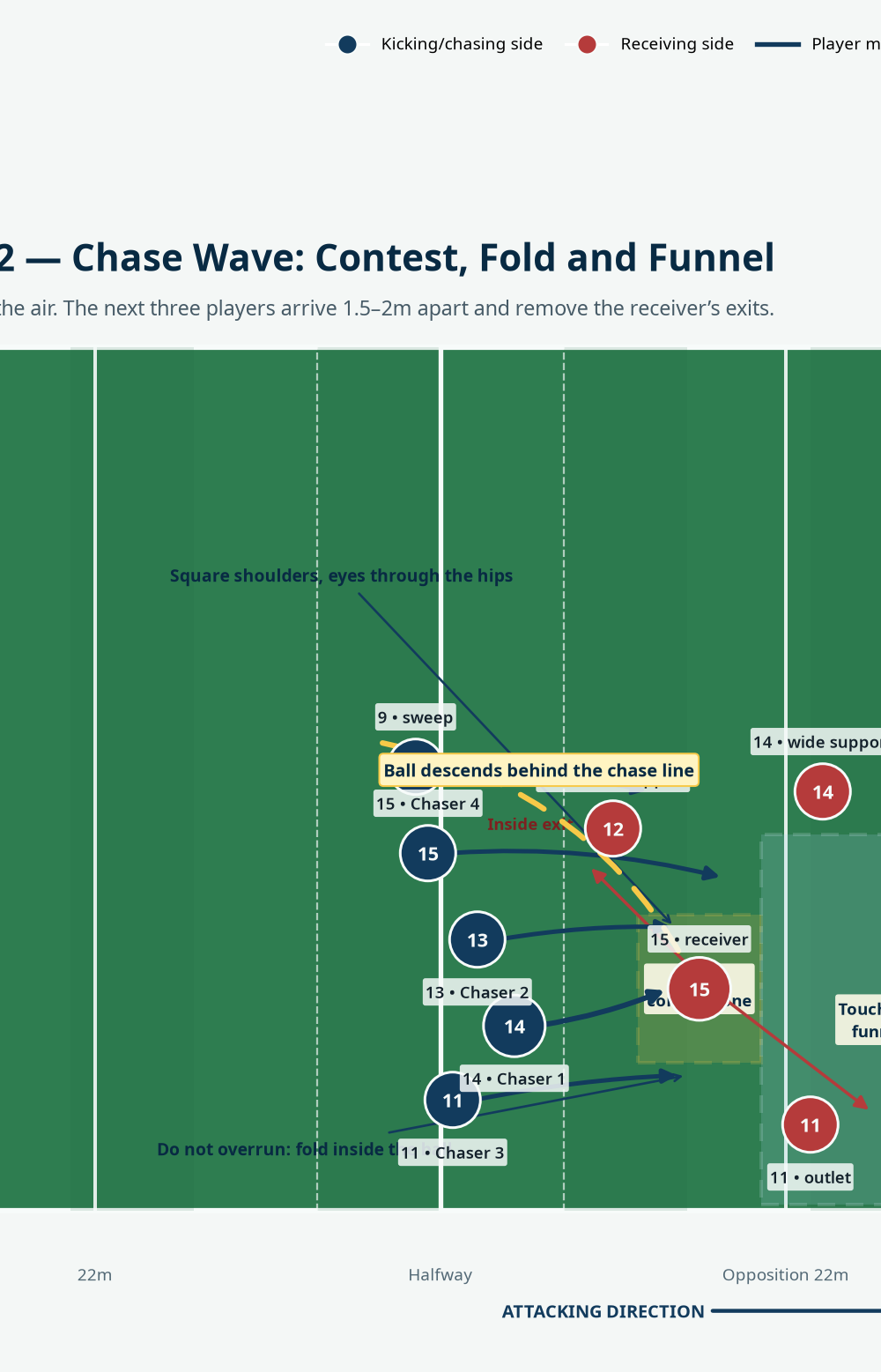
Use a full-width rugby pitch marked to a 100m x 70m playing area, with the 22m, halfway, 10m, 15m and 5m lines visible. These are the maximum Law 1 dimensions; on a smaller pitch, keep the same channels and shorten the kick.1 Set the launch ruck 35m from your own try line and 18m in from the right touchline. Mark the target box 8–12m short of the opposition 22m and 8–15m infield from touch.
| Detail | Coaching setup |
|---|---|
| Players | 20 players: 9 kicking/chasing players against 11 receivers/defenders. Run 15-a-side once the pattern is secure. |
| Equipment | 8–12 cones, 2 tackle shields, 1–2 rugby balls, coloured bibs, whistle, and a 10m tape or marked grid. |
| Kick-side shape | 9 (scrum-half) at the base; 14 as first aerial chaser; 13 as inside seal; 11 as touchline or far-lane chase; 15 as backfield fold; 10 screens and connects. |
| Receiving shape | 15 receives; 11/14 offer wide outlets; 12 is the nearest inside support. Keep a realistic return line. |
| Rep duration | One 12–18 second action, followed by a 25-second coach reset. Work 6 reps each side before changing the launch picture. |

Player responsibilities before the kick
Keep the ruck compact and the ball behind the hindmost foot. 9 scans and calls the target before a decisive third-step kick. 14 starts 4–6m behind the kick line and leaves on the leg swing. 13 works inside, 11 owns the wide lane, and 15 stays 12–18m behind the wave as the fold communicator.
Step-by-Step Instructions
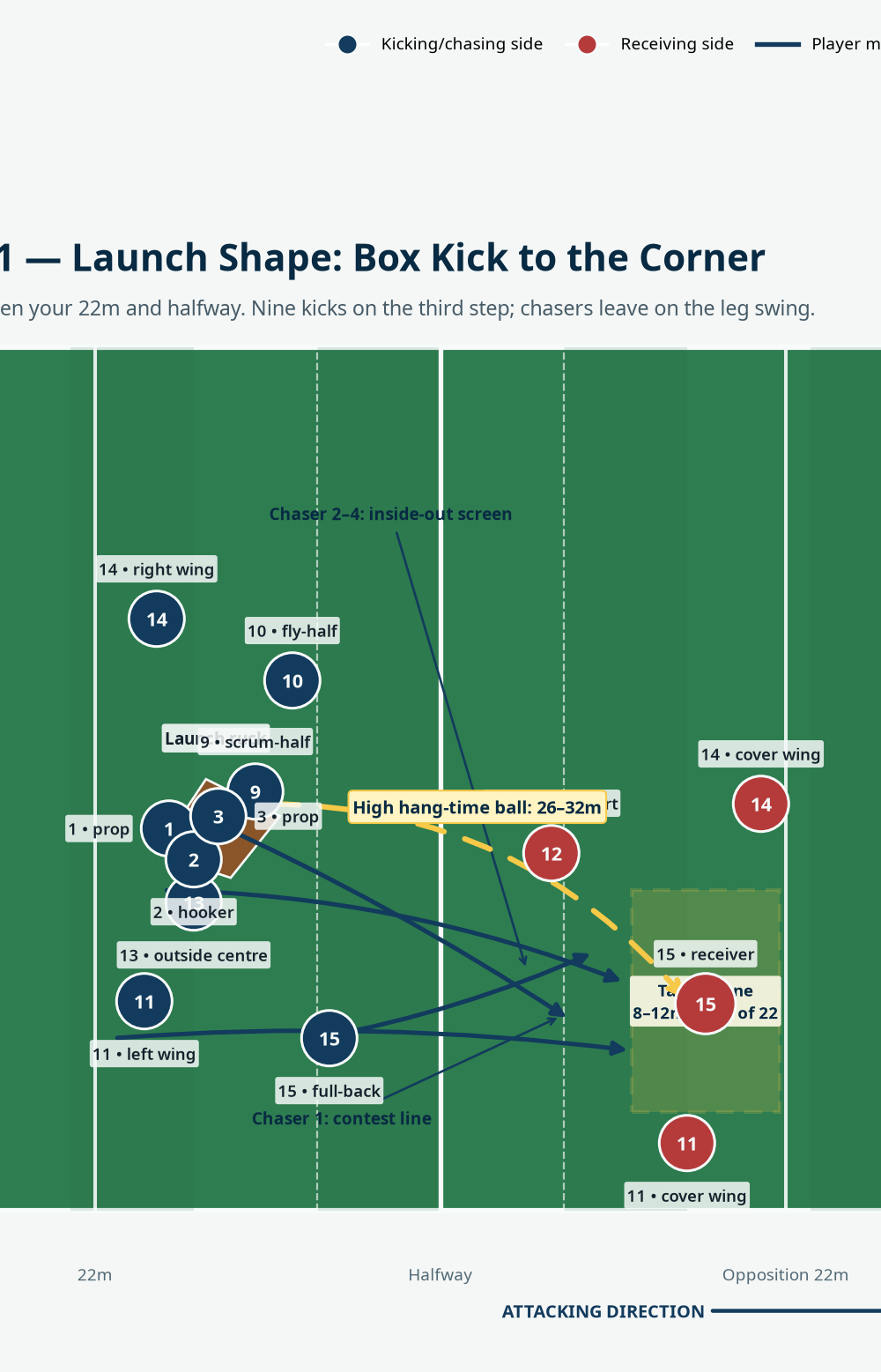
Build the picture. Start from the launch cone. Put 15 in the target box, 11 and 14 as outlets, and 12 on the receiver’s inside shoulder. The defence moves only after the kick.
Call the destination. Nine calls “right, 10 short” before touching the ball. Target the receiver’s inside shoulder, 8–12m short of the 22m line, so the receiver must move forward into the chase.
Execute the box kick. Nine takes cleanly, stays tall and kicks on the third step. Demand 26–32m of high flight—never a flat clearance—and finish slightly toward the touchline funnel.
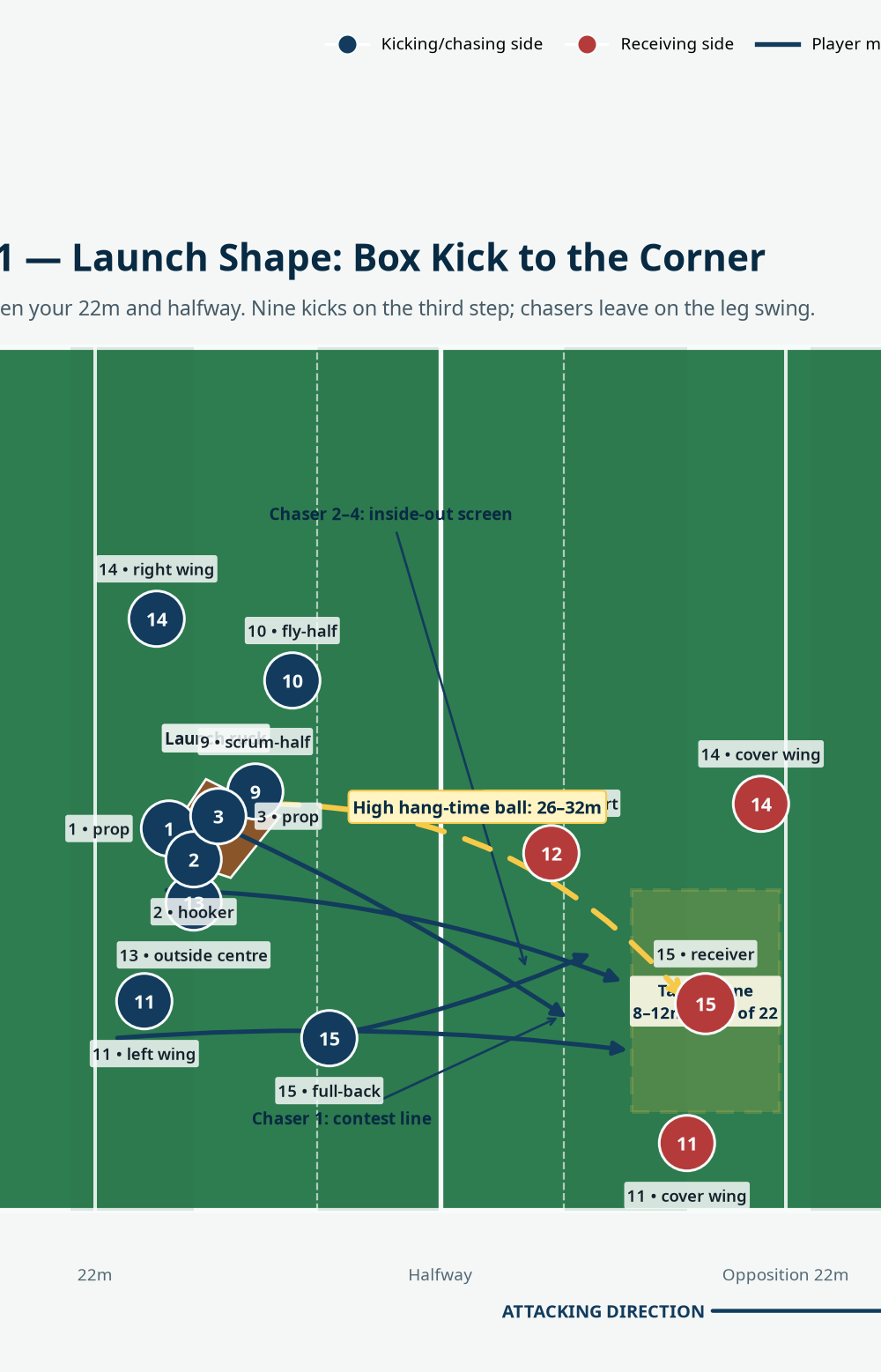
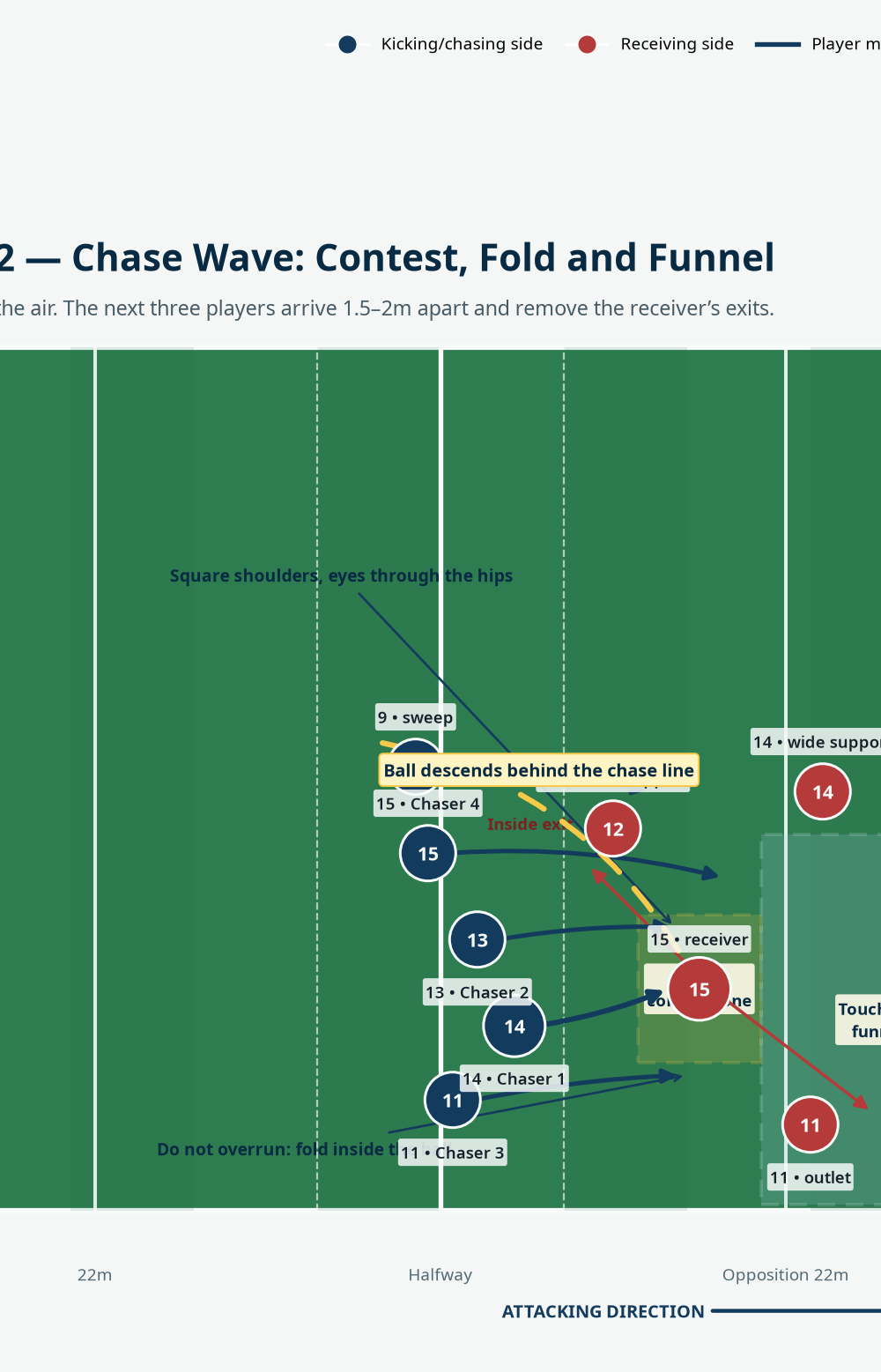
Release the first chaser. Fourteen leaves on the leg swing, tracks the descent and arrives square. Compete for the ball, never the player; if the catch is clean, become the low first tackler.
Build the chase wave. Thirteen arrives 1.5–2m inside 14 and 11 shuts the touchline. Ten and forwards fold inside-out. Sprint for 15m, then shorten the stride as the ball falls.
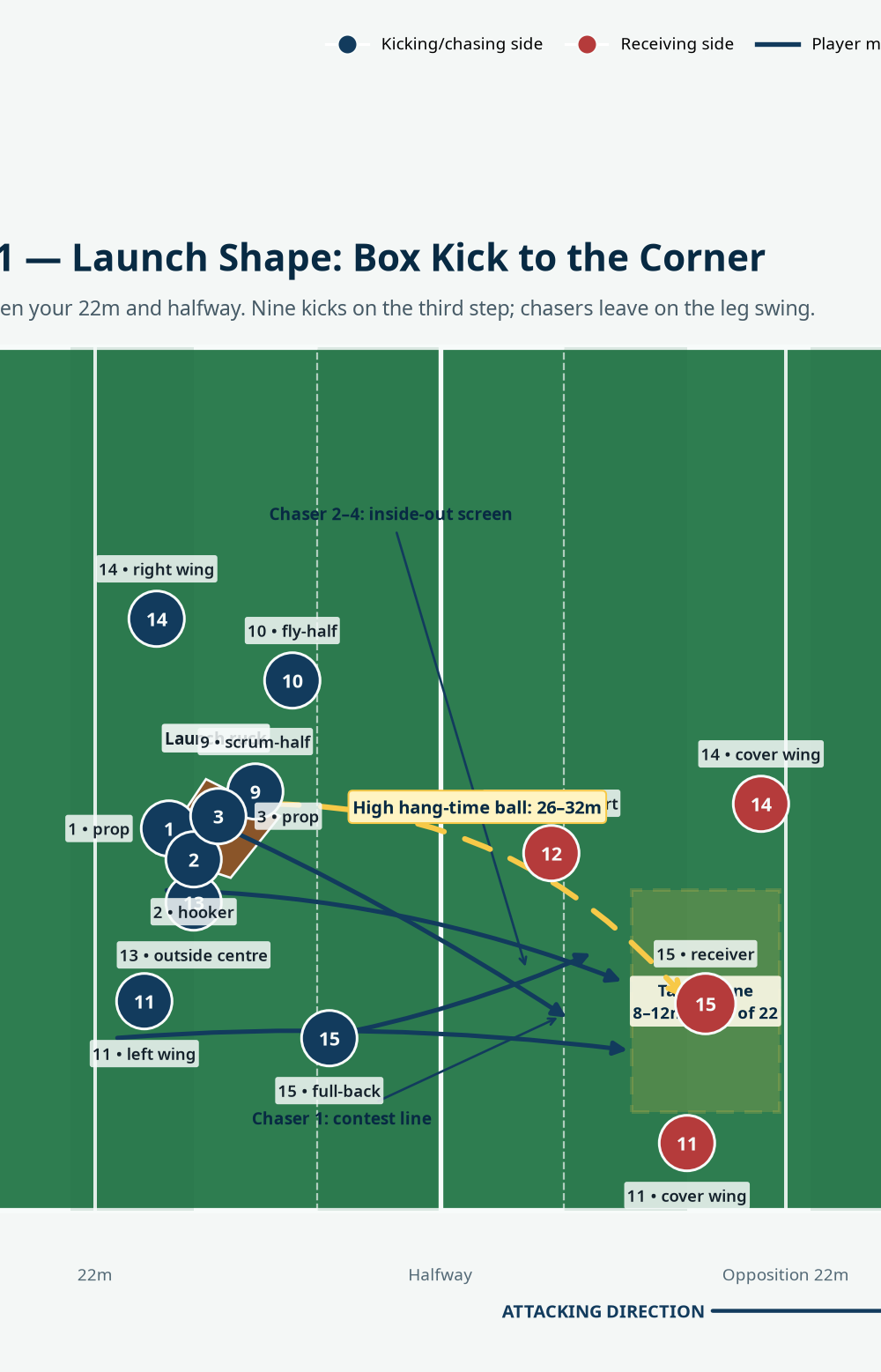
Contest or secure. If it is contestable, 14 calls “mine” and jumps through the ball. If 15 is set early, 14 stays on feet and wins the tackle height while 13 seals the inside shoulder.
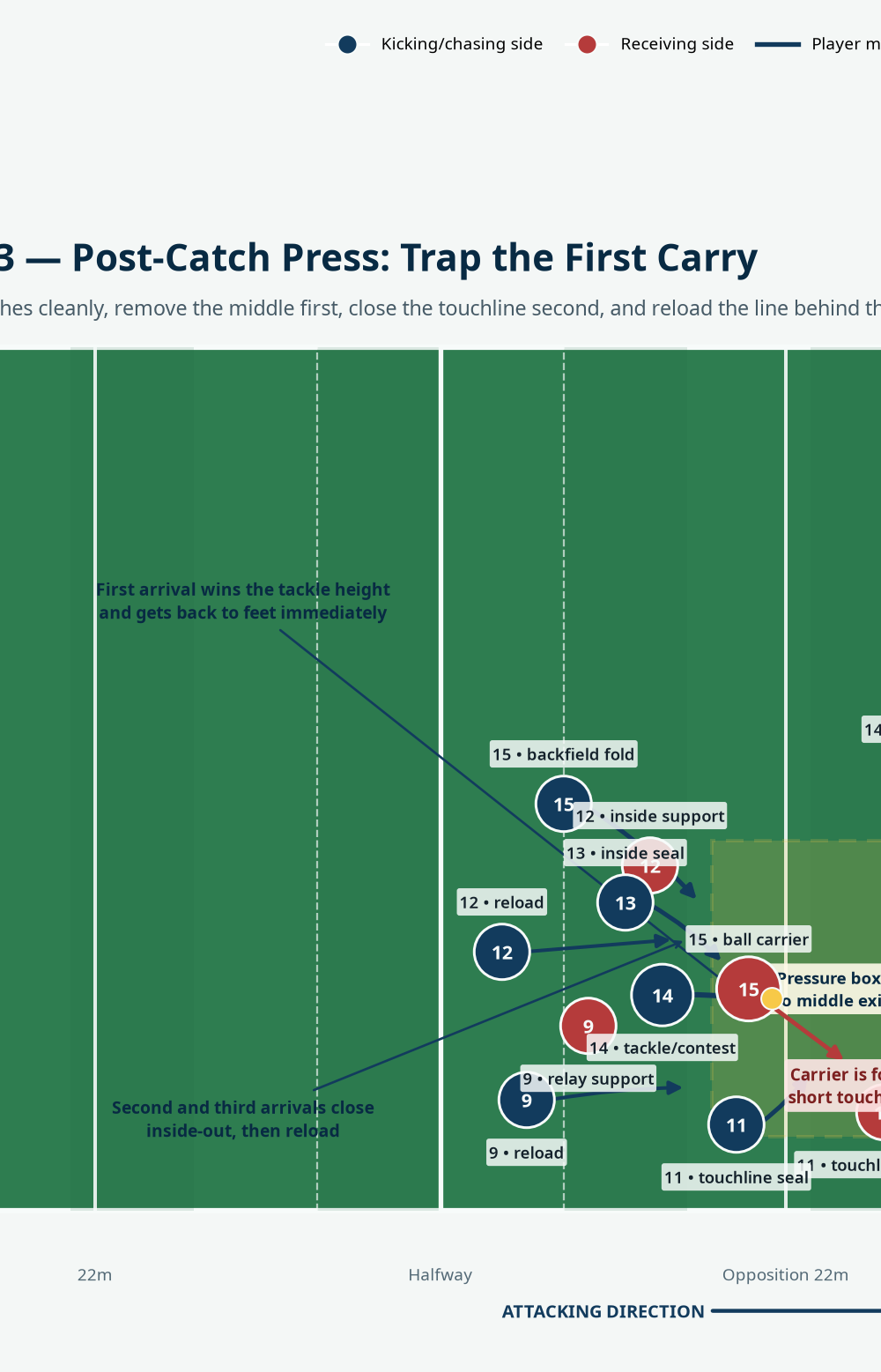
Press the first carry. First player tackles, second seals the inside pass, third owns touch. Force a 3–5m touchline carry or a static ruck in the pressure box.
Reload the next line. Nine, 10 and 15 call the fold. The tackler gets to feet or releases correctly; the nearest legal support contests only if the picture is clean. End at the first ruck or turnover.
Key Coaching Points

| Coaching point | What good looks like | Immediate cue |
|---|---|---|
| Kick quality | The ball lands in the target box with the receiver moving, not waiting comfortably. | “Height before distance.” |
| Chase timing | The lead chaser leaves on the leg swing and is onside from the kicker’s foot. | “Go on the swing.” |
| Aerial safety | The first chaser competes for the ball, never the player; no contact in the air. | “Eyes on ball, land on feet.” |
| Line integrity | Chasers are staggered 1.5–2m apart and connected from inside to touch. | “No daylight.” |
| Tackle picture | First arrival squares up and wins below the ball; second arrival seals the inside shoulder. | “Middle first, touch second.” |
| Reload discipline | Players who cannot affect the first tackle fold early instead of spectating at the ruck. | “Tackle, talk, reload.” |
Common Mistakes
| Error to watch | Why it fails | Coach correction |
|---|---|---|
| Nine kicks flat or too long | The receiver catches at speed with time to counter. | Bring the target 5m closer and require a higher finish. |
| Chasers leave after the ball | The contest becomes a free catch and the receiver has momentum. | Use a leg-swing start cue and freeze-frame the first two strides. |
| First chaser over-runs | The receiver steps inside or spins through the contact. | Sprint early, then shorten in the final 4m; arrive square. |
| Everyone chases the ball | An inside pass or touchline step opens a clean counterattack. | Assign 14 to ball, 13 to inside, 11 to touchline, 15 to fold. |
| Players stand in front of the kick | A promising pressure play becomes a penalty. | Paint an offside line through the kicker’s foot and penalise any early interference. |
Variations & Progressions
| Version | How to run it | Coaching purpose |
|---|---|---|
| Easier: catch-and-fold | Start with 9, 14, 13, 11 and 15 against a single receiver. The receiver must catch and carry; no pass. | Teaches kick height, legal aerial approach and first-tackle roles. |
| Core: live outlets | Add 11, 12 and 14 for the receiving side. Allow one pass after the catch and score a point if the chase traps the ball inside the pressure box. | Trains the chase wave to remove both middle and touch exits. |
| Harder: decision kick | Give 9 a live ruck and two calls: “box” or “play.” The receiving side may load one wing late. | Demands pre-kick scanning and stops the box kick becoming automatic. |
Mirror the pattern left with 11 as aerial chaser and 14 as wide seal. You can also use a shorter cross-field box from a central ruck when there is a clear aerial mismatch. For advanced squads, allow two-phase counterattack after a clean catch unless the chase makes the first tackle behind the target line.
Age Adaptations
| Group | Adaptation | Non-negotiable focus |
|---|---|---|
| Under 8–10 | Replace kicking with a high coach-fed throw or soft punt. Use tag/touch and a 15–20m target. | Safe tracking, communication and spacing—not aerial competition. |
| Under 12 | Allow a short punt from a static cone; keep one chaser and one support player. | Catching, legal approach and a controlled touch tackle. |
| Under 14 | Use a 20–25m box kick with three chasers and shields at the contact point. | Third-step kick, chase timing and low tackle height. |
| Under 16 and open | Use the full 26–32m kick, live receiving outlets and a contested—but safe—breakdown. | Legal aerial contest, press line and immediate reload. |
Scoring the rep
Award the chase three points for a regather, two for a dominant first tackle or forced ruck in the pressure box, and one for touch or a forced kick. Award the receiving side two for a clean catch and line break beyond the box. Judge the kick by the pressure it creates, not only by metres gained.