

Netball
WA Feeding Patterns Drill: Unlocking the Attacking Third
Develop your Wing Attack's ability to receive, position, and deliver precise feeds into the shooting circle using structured pattern work that builds timing, angles, and decision-making under pressure.

What you need
netballs (4-6), cones (8), bibs (WA, C, GA, GS, WD colours), whistle, coaching clipboard
Overview
The WA Feeding Patterns Drill is a structured attacking drill designed to develop the Wing Attack's core skill set: receiving the ball cleanly from the Centre, holding a strong body position at the edge of the attacking third, and delivering accurate, well-timed feeds into the shooting circle for the Goal Attack and Goal Shooter. This drill sits at the heart of any effective attacking system because the WA is the primary link between the midcourt and the shooting end — and a WA who can feed with both hands, from multiple angles, and under defensive pressure is worth her weight in gold.
Use this drill in the skill development phase of your training session (typically 15–20 minutes in), after players have completed their warm-up and any preliminary ball-handling work. It is equally effective as a pre-match activation drill to sharpen the attacking unit's timing and communication before game day.
Setup
Equipment Required
| Item | Quantity |
|---|---|
| Netballs | 4–6 |
| Cones (for marking zones) | 8 |
| Bibs (WA, C, GA, GS colours) | 1 set per group |
| Whistle | 1 |
| Coaching clipboard / whiteboard | 1 |
Court Setup
This drill uses the attacking third and the adjacent portion of the centre third — roughly the back 20 metres of the 30.5m x 15.25m court. You do not need a full court. Place four cones to mark the transverse line clearly if it is not painted, and two cones at each sideline to define the WA's working corridor (approximately 4–5 metres wide on each wing).
Player Positions
| Position | Role in Drill | Starting Location |
|---|---|---|
| WA (Wing Attack) | Primary feeder — receives from C and feeds into circle | Right or left wing, attacking third, near transverse line |
| C (Centre) | Ball distributor — initiates the pattern | Centre third, 2–3m behind transverse line |
| GA (Goal Attack) | Lead runner — creates Option A (near post) | Centre of attacking third, 3–4m from circle edge |
| GS (Goal Shooter) | Lead runner — creates Option B (far post / circle top) | Inside or just outside the shooting circle |
| GK / GD (optional) | Passive or active defender on GA/GS | Shadowing GA or GS |
For groups of fewer than 5, rotate a spare player into the WA or C role every 3 minutes.
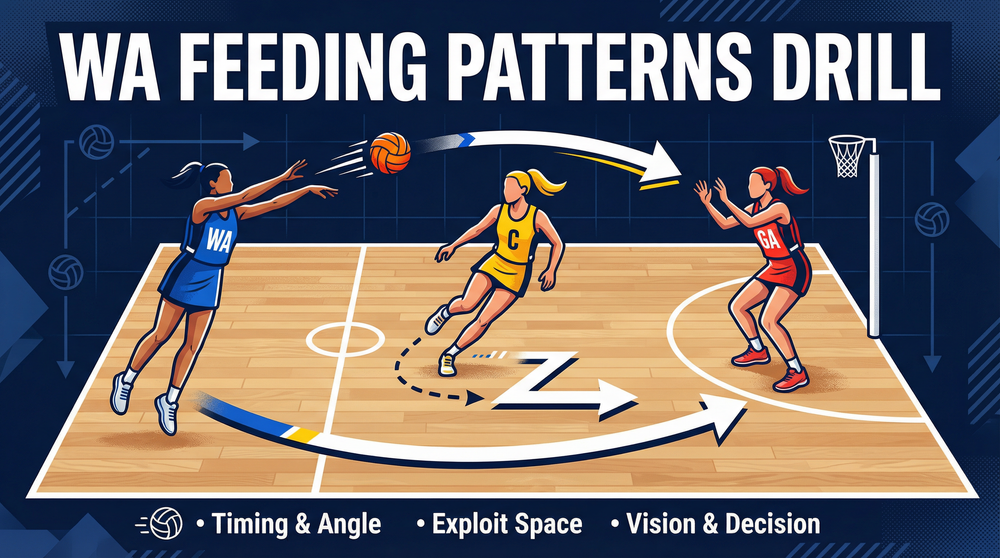
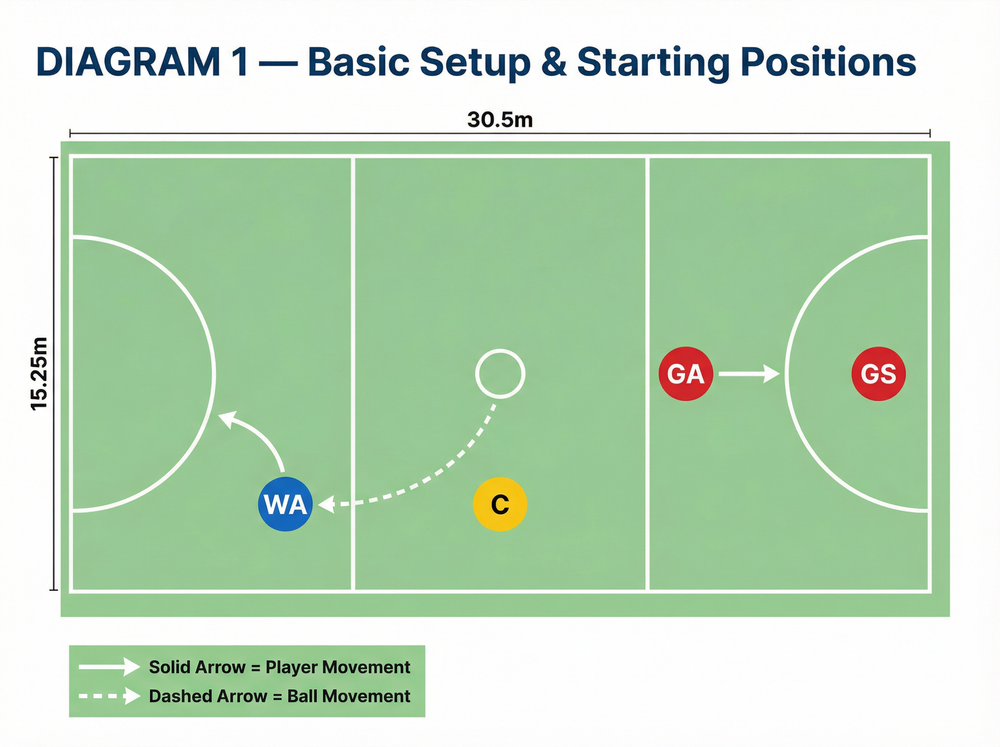
Diagram 1 shows the basic starting positions. WA begins on the wing near the transverse line, C holds the ball in the centre third, GA and GS are spaced in the attacking third and shooting circle respectively.
Step-by-Step Instructions

Phase 1 — Pattern Without Defenders (10 minutes)
- C holds the ball in the centre third, approximately 2 metres behind the transverse line. GA and GS take their starting positions as shown in Diagram 1.
- WA makes a sharp lead from the wing, driving at a 45-degree angle toward the transverse line to receive from C. The lead should cover 3–4 metres and finish with the WA's body side-on to the circle, creating a clear passing lane into the shooting end.
- C delivers a flat, chest-height pass to the WA's leading hand. The pass must arrive as the WA plants her outside foot — timing is everything here.
- WA receives the ball and immediately scans the circle. She has a maximum of 3 seconds (reinforce the 3-second rule from the outset) to identify her best feed option.
- GA executes a lead to the near post (Option A) — a sharp diagonal run from the centre of the attacking third toward the post closest to the WA's position. This run should begin the moment WA catches the ball.
- GS executes a lead to the circle edge or far post (Option B) — moving away from GA to create separation and a second feed option.
- WA selects the best option and delivers the feed. Encourage a two-handed overhead pass for accuracy to the near post, and a flat chest pass or lob for the circle-edge feed depending on distance.
- The receiving shooter catches, pivots, and takes a shot (if a goal post is available) or simply holds the ball as confirmation of a clean receive.
- Rotate after every 5 feeds: WA rotates to C, C rotates to GA, GA rotates to GS, GS rotates to WA.

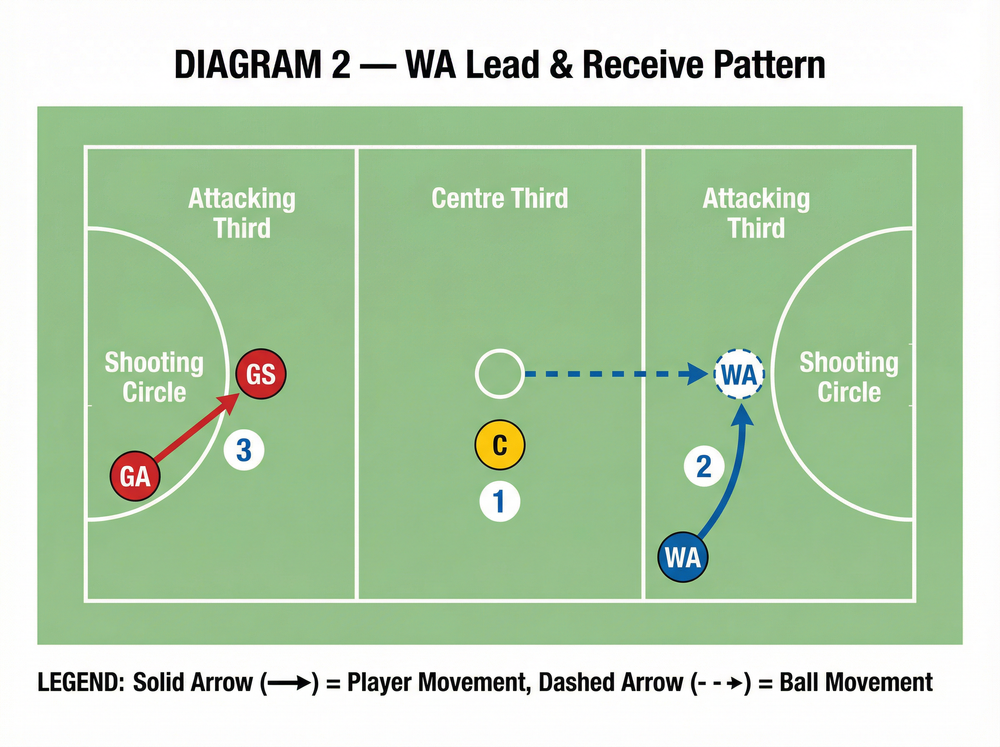
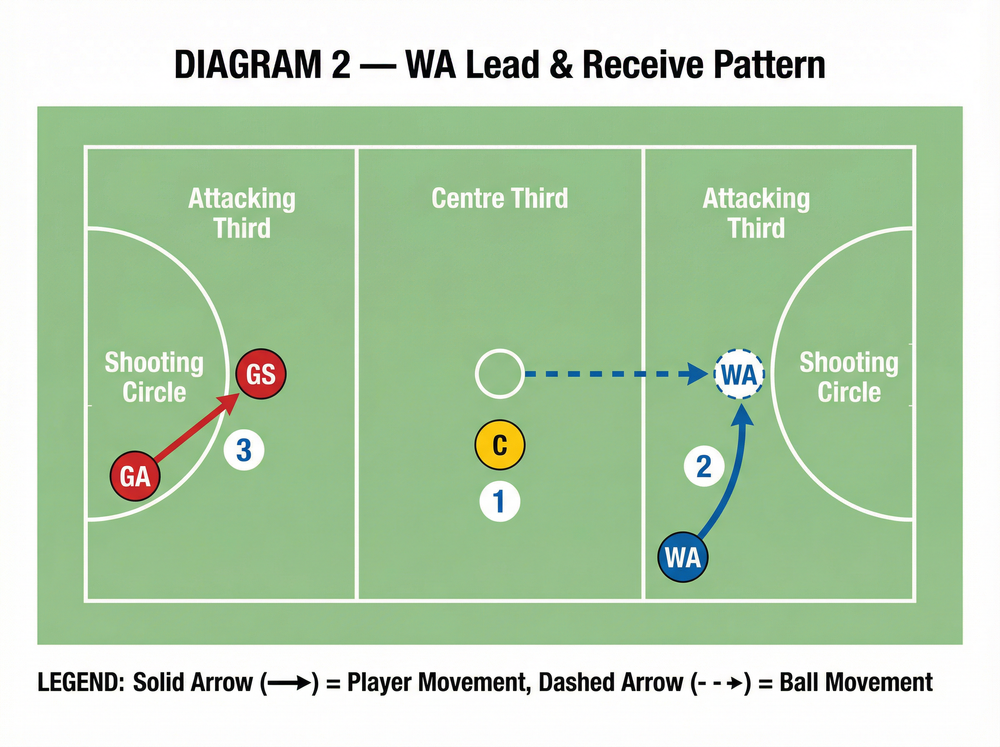
Diagram 2 illustrates the WA lead and receive sequence. Note the numbered steps: (1) C holds ball, (2) WA drives the lead and receives, (3) GA simultaneously leads to the near post to receive the feed.
Phase 2 — Introduce Passive Defender on WA (5 minutes)
- Add a WD (Wing Defence) who shadows the WA at 0.9m distance (regulation defending distance) but does not intercept — she simply forces the WA to adjust her body position and pass selection.
- WA must now protect the ball on landing, pivot away from the WD, and still deliver a clean feed. Emphasise holding a low, strong body position before releasing.
- Repeat the same 5-feed rotation.
Phase 3 — Live Decision-Making (5 minutes)
- Add a GD (Goal Defence) who plays live defence on the GA. The WD also becomes fully active.
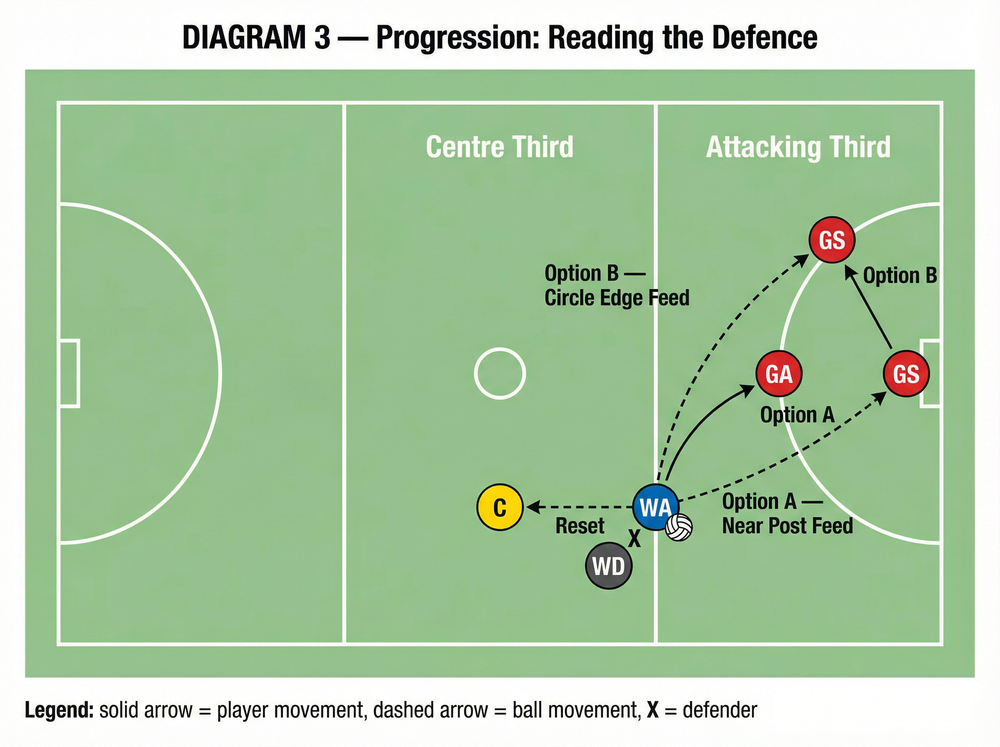
- WA must now read the defence and choose between Option A (GA near post), Option B (GS circle edge), or a reset pass back to C if neither option is available.
- As shown in Diagram 3, the WA has three clear decisions. Coach from the side and call out the correct choice after the decision is made — do not pre-empt the player's read.

Diagram 3 shows the full progression. WA (with ball) faces pressure from WD and must choose between feeding GA (Option A — near post), feeding GS (Option B — circle edge), or resetting to C. This replicates real match decision-making.
Key Coaching Points
1. The Lead Must Create the Pass, Not the Other Way Around.
The most common error in junior netball is the WA standing still and waiting for the ball. Reinforce constantly: the lead earns the pass. WA must drive hard for 3–4 metres before the ball is released, and the C must hold the pass until the WA is moving at pace.
2. Land Side-On — Every Single Time.
When the WA receives the ball, her body position determines everything that follows. She must land with her outside foot forward, hips turned side-on to the circle. This opens the passing lane, protects the ball from the WD, and gives her a full view of both feed options. If she lands square-on (chest facing the circle), she telegraphs the pass and loses peripheral vision.
3. Soft Hands, Strong Core.
Feeds into the shooting circle require precision, not power. WA should use a relaxed, "soft hands" catch and a controlled, deliberate release. Rushed or tense feeds sail long or land short — both are unacceptable when a shooter is mid-lead.
4. Read the Shooter's Lead, Not the Defender.
A common mistake is for the WA to watch the defender rather than the shooter. Teach WA to track the shooter's leading hand — when the GA or GS reaches out their hand, that is the signal to release the ball. The hand is the target; the defender is irrelevant.
5. Vary the Feed — Near Post, Circle Edge, Lob.
A predictable WA is a defended WA. Encourage players to practise all three feed types in every session: the flat near-post feed (fast, direct), the circle-edge chest pass (medium distance, accuracy-dependent), and the lob (used when the defender is cutting the passing lane). Variety keeps the GD guessing.
6. Communicate Before, During, and After.
Netball is a talking game. WA should call "ball" when ready to receive from C, and GA/GS should call "here" or use a hand signal when their lead is on. Silence on court is a coaching red flag — address it immediately.
Common Mistakes

Mistake 1 — WA Drifting Too Deep into the Attacking Third.
If the WA positions herself too close to the shooting circle, she loses the angle to feed effectively and crowds the GA's working space. Correct this by placing a cone 3 metres from the circle edge and instructing WA to receive the ball outside that cone. The WA's power zone is the area between the transverse line and 3 metres from the circle.
Mistake 2 — Holding the Ball Too Long.
Under the 3-second rule, any hesitation after receiving is a turnover waiting to happen. Watch for WA players who catch and look, catch and look, then panic-pass. Drill the habit of scanning before receiving — WA should know her first option before the ball arrives in her hands.
Mistake 3 — Telegraphing the Pass with Eye Contact.
If WA stares at GA before releasing, the GD will read the pass and intercept. Coach WA to use peripheral vision and to look away from the intended target for a split second before releasing. This is an advanced skill but can be introduced even at U12 level as a concept.
Mistake 4 — Flat-Footed Leads from GA and GS.
The feed is only as good as the lead it is delivered to. If GA or GS are walking into their leads, the timing breaks down and the WA is forced to hold the ball. Demand explosive, committed leads from the shooters — even in a drill without defenders.
Mistake 5 — Feeding Across the Body.
WA players who have not developed their non-dominant hand will always feed across their body, reducing accuracy and telegraphing direction. Identify this early and dedicate 5 minutes of each session to non-dominant hand feeds from the WA position.
Variations & Progressions
Variation 1 — Two-Ball Continuous Flow
Introduce a second ball so that as WA feeds into the circle, C is already holding a second ball ready for the next WA lead. This removes the natural pause between repetitions and forces WA to recover her position quickly, simulating the continuous nature of match play. Ideal for intermediate to advanced groups.
Variation 2 — Switch-Side Rotation
After every 3 feeds from the right wing, WA switches to the left wing. This forces both left- and right-hand feeds and prevents players from becoming one-sided. Many WAs are significantly weaker feeding from their non-dominant side — this variation exposes and addresses that gap directly.
Progression — Full Attacking Unit (5v4)
Expand the drill to a 5v4 scenario by adding a WD and GD in full defence, with C also being pressured by a CD. The WA now operates in a live match environment. The objective remains the same — receive cleanly, read the options, feed accurately — but the decision-making load is significantly higher. This is the final progression before moving to a full game-based activity.
Age Adaptations
| Age Group | Adaptation |
|---|---|
| Under 10 | Remove the WD entirely. Use a larger ball if available. Allow WA to take 2 steps before feeding. Focus only on Phase 1 (no defenders). Praise effort on the lead, not just the outcome of the feed. |
| Under 12 | Use Phase 1 and Phase 2 only. Introduce passive WD in the final 5 minutes. Simplify to one feed option (GA near post only) before adding the second option. |
| Under 14 | Run all three phases. Introduce the reset pass to C as a legitimate option. Begin coaching non-dominant hand feeds. |
| Under 16 / Open | Full progression including 5v4 live scenario. Add a time pressure element: WA must feed within 2 seconds of receiving. Introduce video review of feed decisions post-drill. |
For mixed-ability groups, pair a stronger WA with a developing shooter and vice versa — this naturally scaffolds the challenge level without requiring the coach to run two separate drills simultaneously.
