

Netball
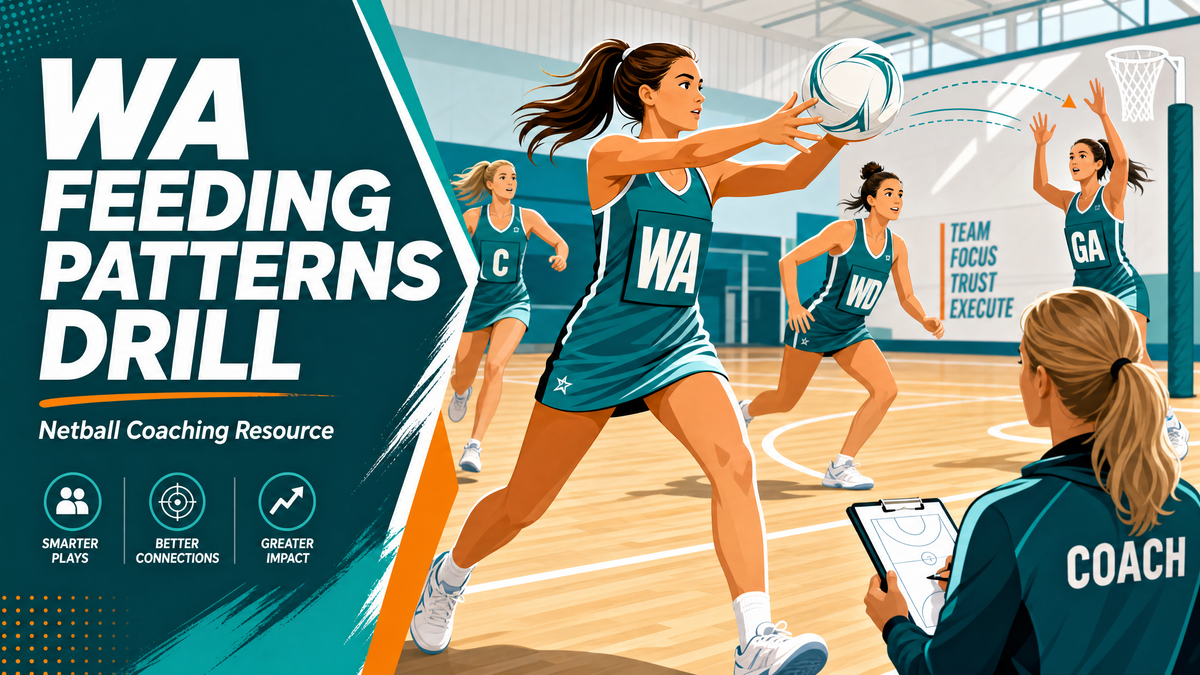
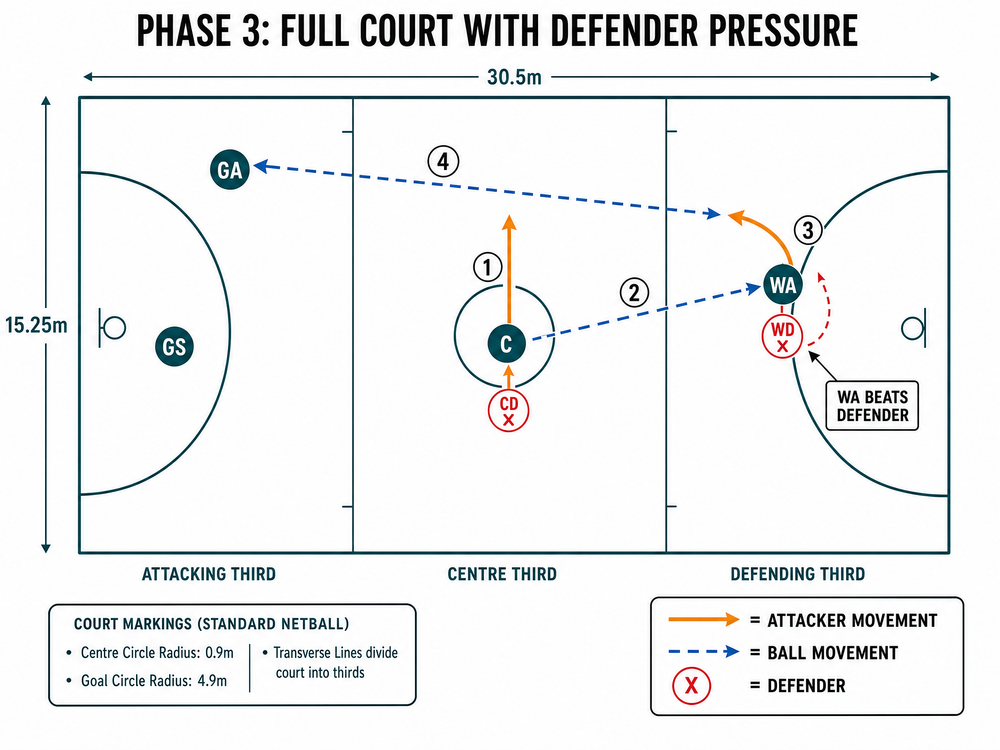
Mastering the WA Feeding Patterns Drill
Equip your Wing Attack with the vision and timing to consistently deliver precision feeds into the goal circle under pressure.
What you need
1 Netball, Bibs (WA, C, GA, GS, WD, CD), Cones (optional)
1. Overview
The Wing Attack (WA) is the primary playmaker in the attacking third, responsible for connecting the midcourt to the shooters. The WA Feeding Patterns Drill is designed to develop the WA's ability to hit the circle edge with speed, read the movements of the Goal Attack (GA) and Goal Shooter (GS), and deliver accurate feeds under defensive pressure. This drill progresses from unopposed fundamental movements to full-court, game-realistic scenarios, making it an essential resource for coaches looking to sharpen their team's attacking connections.
2. Setup
Equipment Needed:
- 1 Netball
- Bibs (WA, C, GA, GS, WD, CD)
- Cones (optional, for marking starting points)
Court Setup:
- Standard netball court (30.5m x 15.25m).
- Use the centre third and one attacking third.
Player Positions:
- WA: Starting wide in the centre third or near the transverse line.
- C: Starting in the centre circle.
- GA & GS: Starting in and around the goal circle.
- WD & CD: (Introduced in later progressions) Marking the WA and C respectively.
3. Step-by-Step Instructions
Phase 1: Initial Ball Movement (Basic Setup)
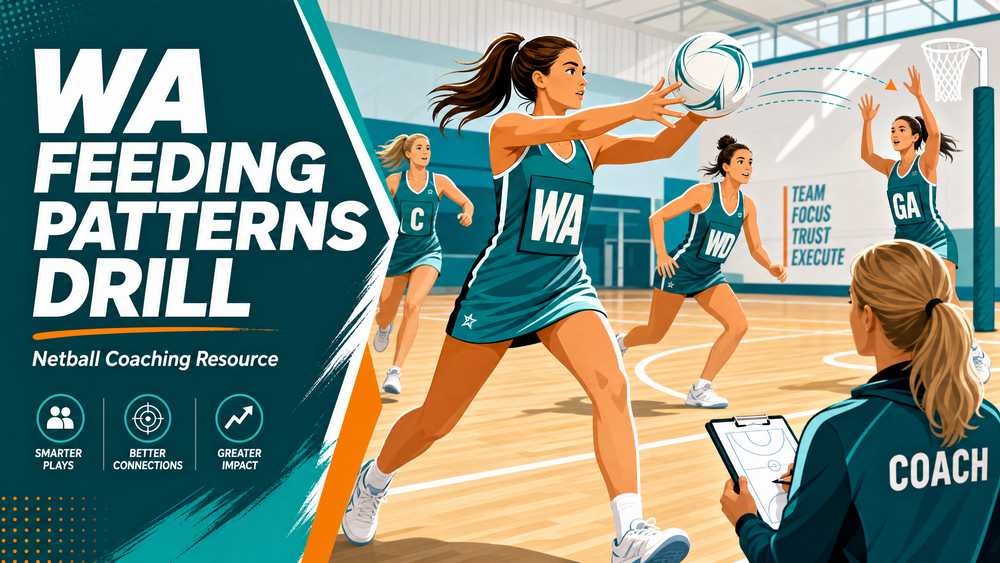
- The drill begins with the C in the centre circle with the ball.
- The WA starts wide on the right side of the centre third and makes a sharp, 45-degree angled drive toward the centre circle to receive the first pass.
- As the WA receives the ball, the GA initiates a lead out of the goal circle toward the top edge.
- The WA must quickly turn, balance, and deliver a crisp chest or shoulder pass to the GA on the circle edge.
- Reset and repeat from the opposite side.
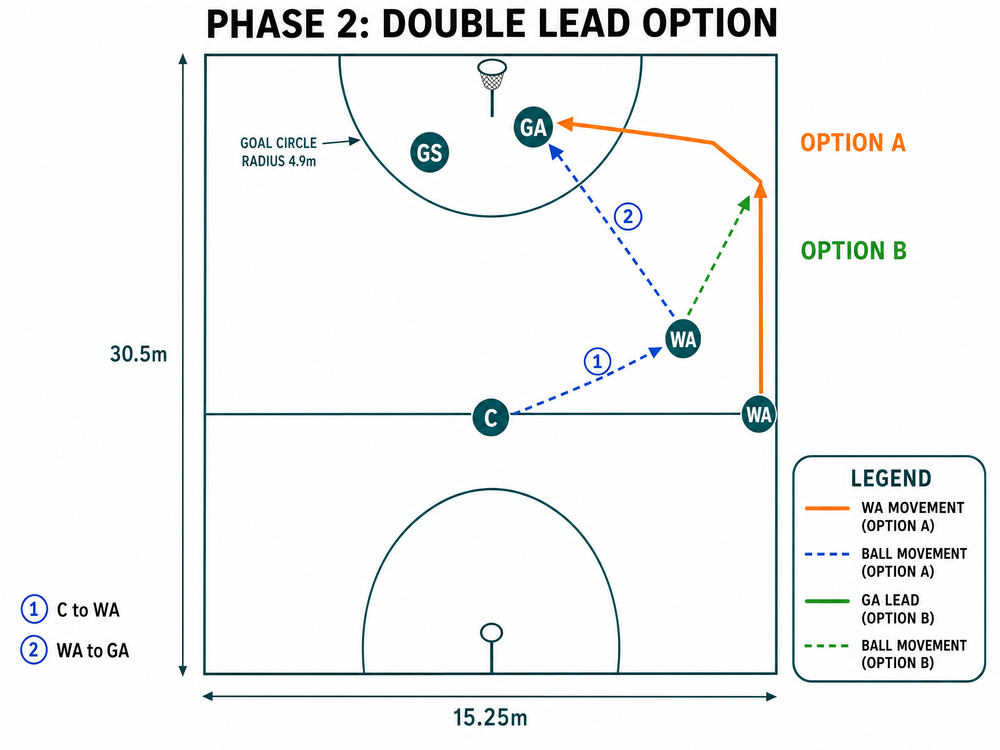
Phase 2: Double Lead Option
- The C starts at the transverse line and passes to the WA, who has driven forward along the sideline.
- As the WA receives the ball near the goal third, the GA and GS must coordinate their movements to offer two distinct passing options.
- Option A: The WA cuts inward at a 45-degree angle toward the top-right of the goal circle, while the GA leads sharply toward the right post to receive the feed.
- Option B: The WA holds their wide position. The GA leads out to the top of the circle to receive the ball, drawing the defender, which opens up the GS under the post for the next pass.
- The WA must read the defenders (simulated or real) and choose the best option quickly.
Phase 3: Full Court Progression with Defender Pressure
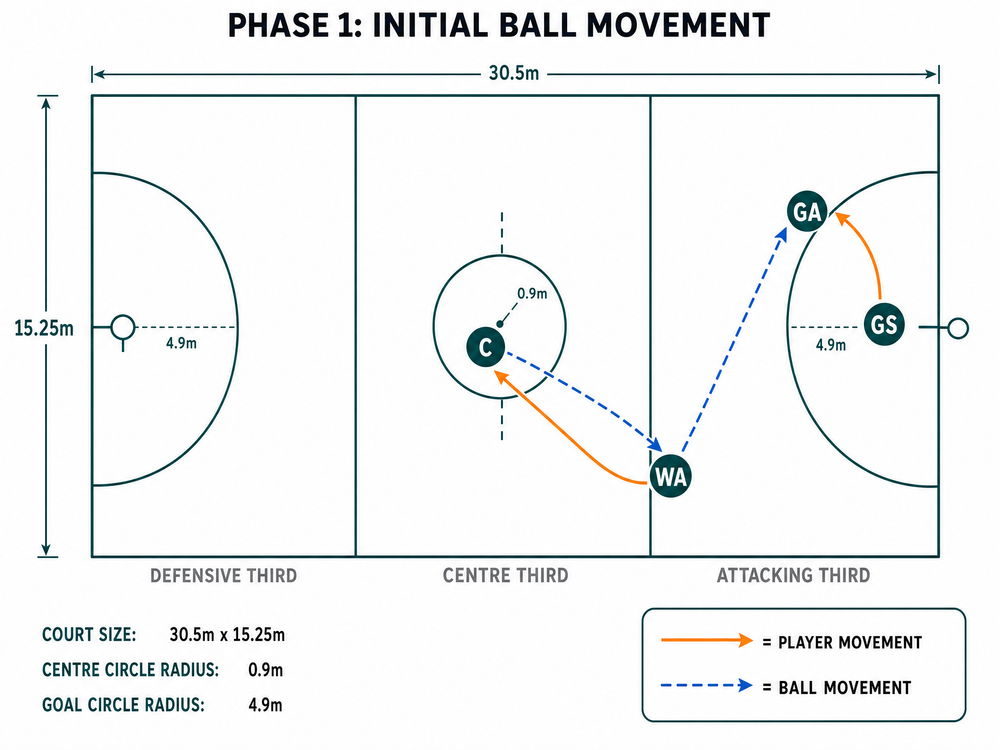
- Introduce defenders: WD marking the WA, and CD marking the C.
- The C drives forward from the centre circle to initiate the play.
- The WA must use preliminary movements (dodges, rolls, or changes of pace) to beat the WD and receive the pass from the C.
- Upon receiving the ball, the WA pivots and drives hard toward the goal circle edge.
- The GA leads to the top of the circle to receive the final feed from the WA.
- The focus here is on the WA maintaining vision down the court despite the physical pressure from the WD.
4. Key Coaching Points
- Strong Preliminary Movements: The WA must use decisive dodges or changes of direction to lose their defender before calling for the ball.
- Vision Down Court: Before receiving the ball, the WA should already be scanning the goal circle to anticipate the shooters' movements.
- Hitting the Circle Edge: The WA must drive aggressively to the top of the goal circle to shorten the passing distance and increase accuracy.
- Quick Release: Encourage the WA to release the ball within 1-2 seconds of receiving it to prevent the defense from resetting.
- Pass Selection: The WA must choose the appropriate pass (e.g., bounce, lob, chest) based on the defender's positioning and the shooter's hold.
5. Common Mistakes
- Running Away from the Ball: The WA fading away toward the sideline instead of driving strongly toward the ball carrier.
- Tunnel Vision: The WA only looking at one shooter and ignoring the secondary option, making the feed predictable.
- Floating Passes: Delivering slow, looping passes into the circle that allow defenders time to intercept.
- Crowding the Space: The WA driving too deep into the pocket, cutting off the GA's driving lanes.
6. Variations & Progressions
- Progression 1 (Add Circle Defense): Introduce a Goal Defense (GD) and Goal Keeper (GK) to challenge the shooters, forcing the WA to make tighter, more precise feeds.
- Progression 2 (Time Limit): Require the attacking team to score within 10 seconds of the centre pass to simulate late-game pressure.
- Variation 1 (Opposite Side): Run the entire drill starting from the left side of the court to ensure the WA is comfortable feeding from both wings.
7. Age Adaptations
- Under 10s: Focus purely on Phase 1 without defenders. Emphasize basic catching, turning, and passing technique.
- Under 12s/14s: Introduce Phase 2 and basic 1-on-1 defense (WD on WA). Focus on timing the leads between the WA and GA.
- Under 16s/Open: Run Phase 3 at match intensity with full defense. Emphasize split-second decision-making, advanced pass selection (e.g., disguised passes), and dealing with physical pressure.
