

Netball
WD to GA Transition Play: Fast Court Linkage
Master the critical transition from defence to attack by effectively linking your Wing Defence to your Goal Attack for seamless full-court flow.
What you need
1 Netball, 14 Marker cones (optional), Full set of positional bibs
Overview
The transition from defence to attack is a pivotal moment in any netball match. The "WD to GA Transition Play" is designed to exploit the space created immediately following a defensive turnover or a backline pass. By utilizing the Wing Defence (WD) as the primary link through the centre third, this set play bypasses the congested midfield and delivers the ball swiftly to the Goal Attack (GA) in a dangerous attacking position. This strategy is particularly effective against teams that employ a heavy zone defence or struggle to transition quickly back into their defensive structures.
Setup

Equipment Needed:
- 1 Netball
- 14 Marker cones (optional, for visualising zones during practice)
- Full set of positional bibs
Court Setup:
- Full standard netball court (30.5m x 15.25m)
- Focus areas: Defensive transverse line, centre third, and attacking goal circle edge
Player Positions:
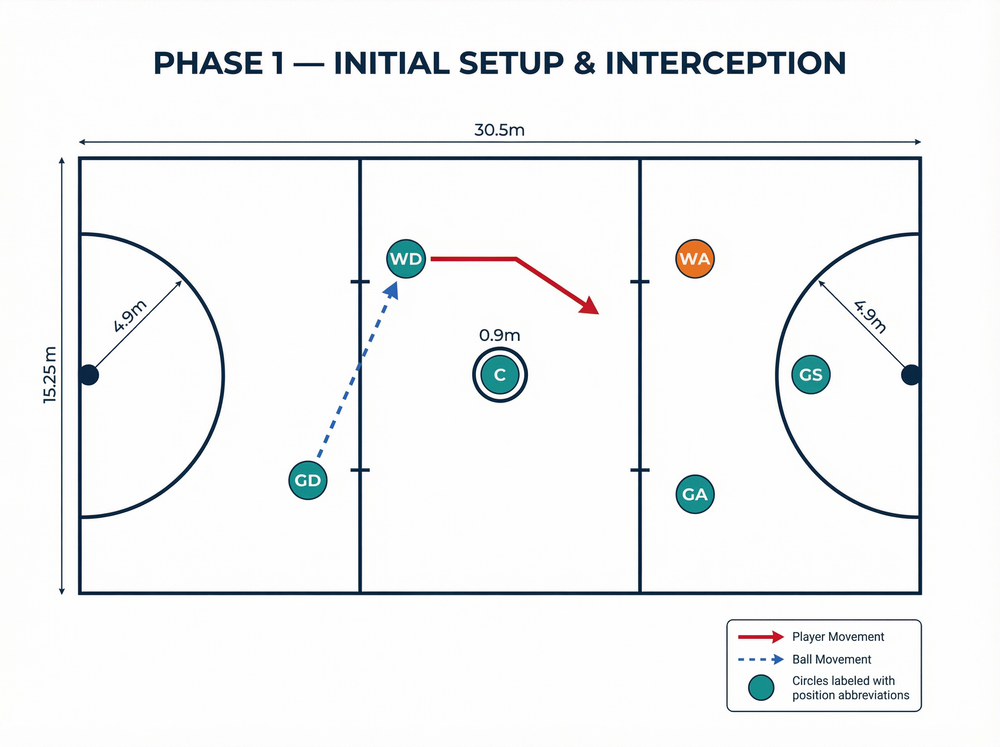
- WD (Wing Defence): Starts deep in the defensive third or near the defensive transverse line.
- GA (Goal Attack): Starts high in the attacking third, near the attacking transverse line.
- C (Centre): Positioned centrally to draw the opposing Centre away from the primary passing channel.
- GS (Goal Shooter): Positioned deep in the shooting circle to occupy the Goal Keeper (GK).
- GD (Goal Defence): Initiates the play with the ball from a defensive turnover or backline pass.
Step-by-Step Instructions

Phase 1: The Initial Link
- Initiation: The play begins with the GD securing the ball in the defensive third. Upon securing possession, the GD immediately looks forward.
- The WD Drive: The WD makes a sharp, angled drive from the defensive transverse line into the centre third. The drive should initially curve toward the sideline to create separation from the opposing Wing Attack (WA), then flatten out to present a clear passing option.
- The First Pass: The GD delivers a firm, flat pass to the WD as they hit the top of their drive in the centre third.

Phase 2: Advancing the Ball
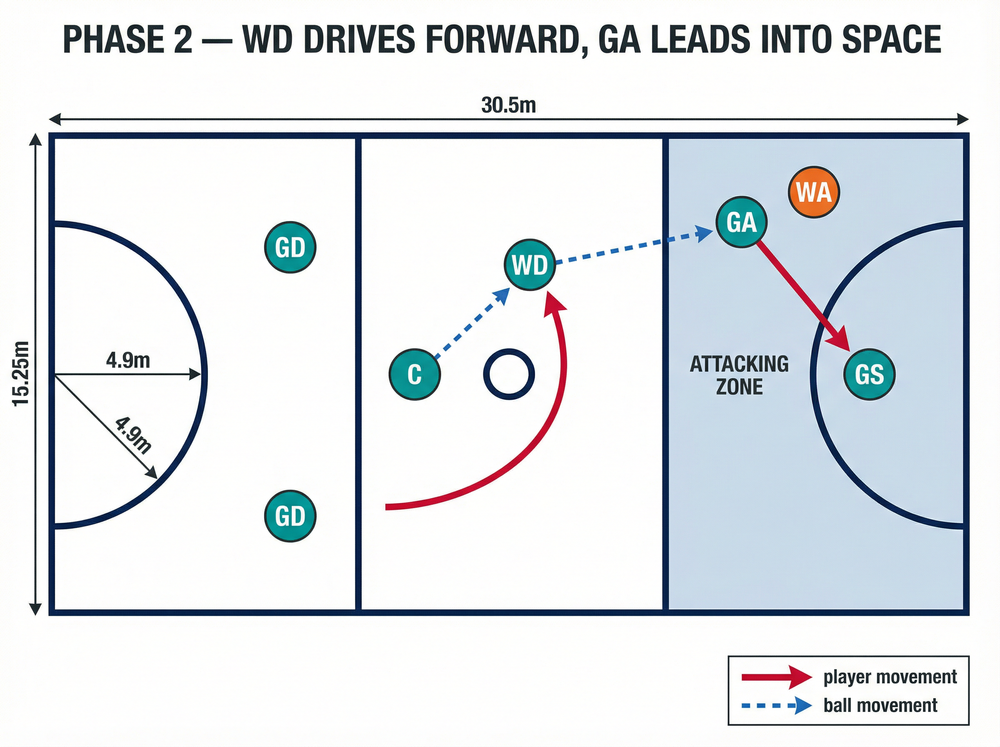
- WD Vision: Upon receiving the ball, the WD must land balanced and immediately turn their vision down the court toward the attacking third.
- The GA Lead: Anticipating the WD receiving the ball, the GA initiates a strong diagonal lead from the right side of the attacking third, driving toward the top left edge of the shooting circle. This movement drags the opposing Goal Defence (GD) out of position.
- The Decisive Pass: The WD delivers a penetrating pass into the space created by the GA's lead. This pass must be weighted correctly to allow the GA to take the ball on the move without breaking stride.

Phase 3: The Final Execution
- GA Possession: The GA receives the ball near the edge of the shooting circle, ideally on a dynamic two-foot landing to maintain passing options.
- The GS Clear: As the GA receives the ball, the GS makes a sharp, decisive clear across the shooting circle, moving from the left side toward the right post. This isolates the GK and creates a clear shooting opportunity or a simple feed.
- The Feed or Shot: The GA assesses the situation. If the GS is open, the GA feeds the ball into the circle. If the GS is covered, the GA turns and takes the shot themselves.
Key Coaching Points
- Timing is Everything: The GA must time their lead perfectly. If they lead too early, they will run out of space; if they lead too late, the WD will be forced to hold the ball, allowing the defence to recover.
- Strong Drives: The WD must drive onto the ball with intent. A weak or floating drive will be easily intercepted by the opposing WA or C.
- Vision and Awareness: The WD must have their eyes up before they even receive the ball. They need to know where the GA is moving before the pass is made.
- Accurate Passing: The passes from GD to WD and WD to GA must be flat, hard, and out in front of the receiver to maintain the speed of the transition.
- Clearing Space: The Centre (C) must actively work to clear the space for the WD's drive, dragging their opponent away from the primary passing channel.
Common Mistakes

- Hesitation by the WD: If the WD catches the ball and hesitates before turning down the court, the attacking momentum is lost, and the defence has time to set up.
- GA Leading Too Early: A GA who leads before the WD has secured the ball will end up waiting for the pass, allowing their defender to recover and contest the ball.
- Poor Pass Selection: Forcing a long, high pass from the WD to the GA when the passing lane is congested often results in an interception. Players must recognize when to use a shorter, safer option (like the Centre) if the primary play is covered.
- Lack of Support: If the initial pass to the WD is covered, the C or WA must quickly offer a secondary option. Failure to do so will result in a held ball or a forced pass.
Variations & Progressions

- The Dummy Lead (Advanced): The GA makes a hard lead toward the sideline, drawing the defender, before quickly changing direction and driving into the centre channel to receive the pass from the WD.
- Using the C as a Link (Intermediate): If the direct pass from WD to GA is covered, the WD can pass to the C, who then immediately feeds the GA on a secondary lead.
- Adding Defensive Pressure (Progression): Introduce passive, then active, defenders during practice to simulate match conditions and force the attacking players to make quick decisions under pressure.
Age Adaptations

- Under 10s: Focus heavily on the basic mechanics of the drives and the accuracy of the passes. Reduce the distance of the passes and encourage players to use two hands for both passing and catching.
- Under 12s/14s: Introduce the timing aspect of the GA's lead. Emphasize the importance of the WD turning fully down the court upon receiving the ball.
- Under 16s/Open: Focus on the speed of execution and the ability to read the defence. Introduce the variations and encourage players to make split-second decisions based on the defenders' positioning.
