

Football
The Asymmetric Wing Overload: Creating and Exploiting Wide Superiority
Master the art of creating 3v2 situations on the flank to unlock stubborn low-block defenses with precision crossing and dynamic box arrivals.
What you need
1 full-size goal, 10-12 training bibs (two colors), Plenty of footballs, Cones to mark zones (optional)
1. Overview
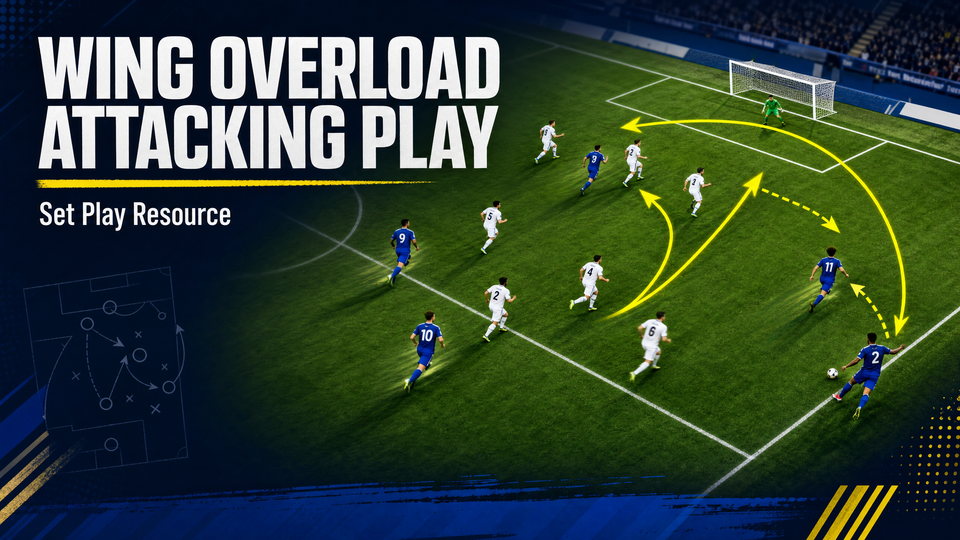
The Asymmetric Wing Overload is a sophisticated attacking pattern designed to dismantle compact defensive blocks. By intentionally committing numbers to one side of the pitch (typically the right flank), we force the opposition to shift their defensive structure. This creates a numerical superiority (a 3v2 or 4v3) in wide areas, providing the time and space necessary to deliver high-quality crosses or cutbacks.
This play is particularly effective against teams employing a narrow 4-4-2 or a deep 5-3-2, where the wide areas are the primary avenues for chance creation. The success of this pattern relies heavily on synchronized off-the-ball movement, precise passing weights, and aggressive, varied runs into the penalty area.
2. Setup
Pitch Dimensions: Standard 11v11 pitch (approx. 105m x 68m). Focus on the attacking half.
Equipment Needed: 1 full-size goal, 10-12 training bibs (two colors), plenty of footballs stationed near the halfway line.
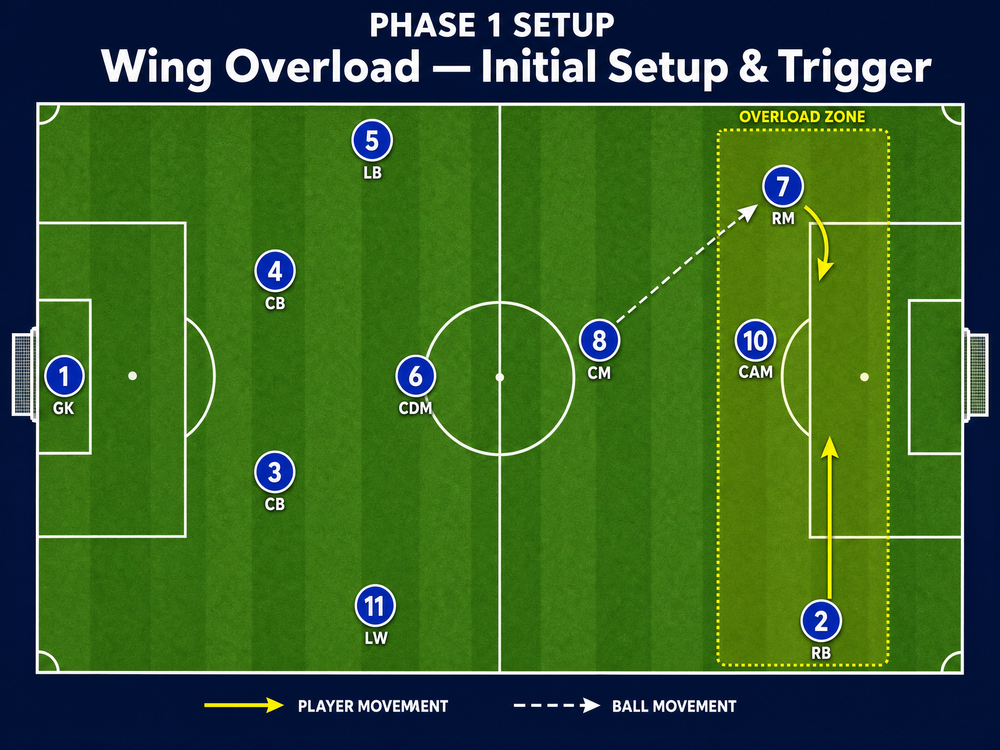
Player Positions (Attacking Team): Set up in a 4-2-3-1 or 4-3-3 shape.
- #2 (Right Back): Positioned high and wide, ready to overlap.
- #7 (Right Winger): Starting wide but prepared to invert.
- #8 (Central Midfielder): Positioned in the right half-space to support the overload.
- #10 (Attacking Midfielder): Floating centrally, ready to attack the box or support the wide play.
- #9 (Striker): Positioned centrally, pinning the opposition center-backs.
- #11 (Left Winger): Holding maximum width on the opposite flank to stretch the defense.
3. Step-by-Step Instructions
Step 1: The Trigger Pass
The play initiates when the ball is circulated to the central midfielder (#8) or the right-sided center-back (#4). The trigger is a firm, driven pass into the feet of the right winger (#7), who has dropped slightly to receive.
Step 2: The Inverted Run & Overlap
As the ball travels to #7, the right back (#2) immediately launches a high-speed overlapping run down the touchline. Simultaneously, #7 takes their first touch inside, driving diagonally toward the penalty area. This dual movement forces the opposition full-back into a critical decision: track the winger inside or follow the overlapping run.
Step 3: Creating the Overload
The central midfielder (#8) moves into the space vacated by #7, creating a triangle on the right flank. The attacking team now has a 3v2 superiority against the opposition's full-back and wide midfielder.
Step 4: The Delivery
Player #7 has three primary options:
- Slip the ball down the line for the overlapping #2 to cross.
- Play a quick one-two with #8 to bypass the defender.
- Continue driving inside and shoot or cross directly.
Assuming option 1 is taken, #2 receives the ball near the byline with time to deliver.

Step 5: Box Arrivals (The Execution)
As #2 prepares to cross, the remaining attackers execute synchronized, pre-planned runs:
- #9 (Striker): Makes an aggressive near-post run, dragging the near-side center-back.
- #10 (Attacking Midfielder): Arrives late at the penalty spot (Target Zone) for a cutback.
- #11 (Left Winger): Attacks the far post, anticipating a deep cross.
- #8 (Central Midfielder): Holds position at the edge of the box for clearances and second balls.
4. Key Coaching Points
- Timing of the Overlap: The right back (#2) must not start their run too early. The run should begin exactly as the ball is traveling to the winger (#7) to maximize the element of surprise and maintain momentum.
- Quality of the First Touch: The winger (#7) must take their first touch aggressively inside. A negative or static first touch allows the defense to recover and neutralizes the overload.
- Synchronized Box Runs: The runs into the box must be staggered and varied (near post, far post, cutback). If all attackers run to the same area, they become easy to mark.
- The Weight of the Pass: The pass releasing the overlapping full-back must be weighted perfectly into their stride, allowing them to cross without breaking stride.
- Rest Defense: Ensure the defensive midfielder (#6) and remaining defenders maintain a strong structural shape behind the ball to prevent counter-attacks if possession is lost.
5. Common Mistakes
- Static Receiving: The winger receives the ball standing still, allowing the defender to get tight and prevent the turn inside.
- Premature Crossing: The overlapping full-back crosses blindly without picking out a specific run or target zone.
- Clustered Box Arrivals: Attackers arrive in the box at the same time and in the same zone, making it easy for the defense to clear the ball.
- Ignoring the Switch: The attacking team becomes too focused on the right flank and ignores the completely unmarked left winger (#11) on the far side.
6. Variations & Progressions
Variation 1: The Underlap
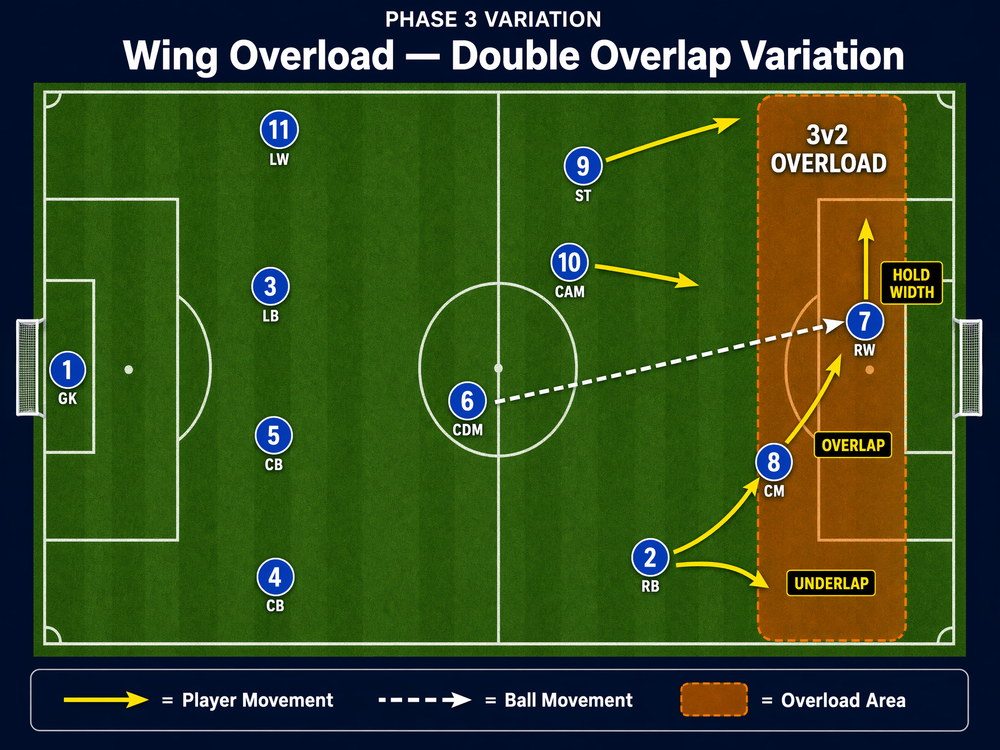
If the opposition full-back anticipates the overlap and stays wide, the winger (#7) can hold the width, and the right back (#2) can make an underlapping run through the half-space, receiving a reverse pass inside the penalty area.
Variation 2: The Switch of Play
Once the opposition has fully committed to defending the right-sided overload, the central midfielder (#8) can receive the ball and immediately hit a long diagonal switch to the isolated left winger (#11), creating a 1v1 isolation on the far side.
Progression: Introduce active defenders. Start with passive resistance (shadow defending) and gradually increase to full-pressure, live-game scenarios.
7. Age Adaptations
- Under 10 - Under 12: Focus purely on the overlapping run and the concept of a 2v1. Simplify the box runs to just one player attacking the near post and one at the far post.
- Under 14 - Under 16: Introduce the central midfielder's role in creating the 3v2 triangle. Emphasize the quality of the cross and the specific timing of the cutback run.
- Open/Senior: Implement the full pattern with complex variations (underlaps, switches). Demand high-speed execution and perfect synchronization of all moving parts.
