

Rugby
Attacking Backs: First Phase Strike Plays to Break the Gain Line
Master the art of first-phase attacks with these structured backline set plays designed to manipulate the defence, create overlaps, and guarantee go-forward ball.
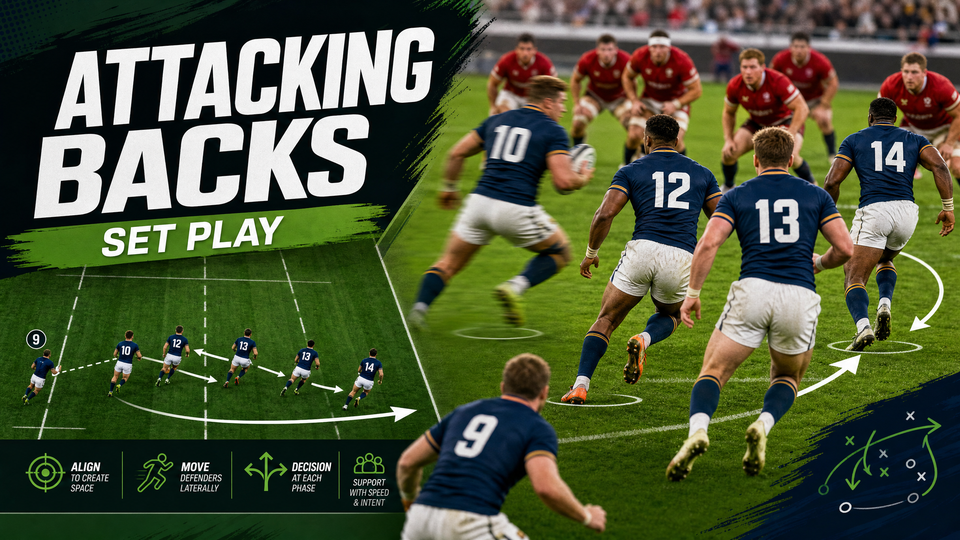
What you need
4-6 Rugby balls, Training bibs (two colours), Cones
Overview
First-phase possession off a scrum or lineout provides the perfect platform to launch a structured attack. Because the opposition forwards are committed to the set-piece, the defensive line is static and predictable. This set play focuses on manipulating the midfield defence to create a clean line break or generate quick, front-foot ball for the second phase. By using decoy runners, hard lines, and precise timing, we can force defensive errors and exploit the resulting space.
This resource covers the fundamental alignment, a core strike play using the inside centre (12), and a progression involving the fullback (15) to create an overlap out wide.
Setup
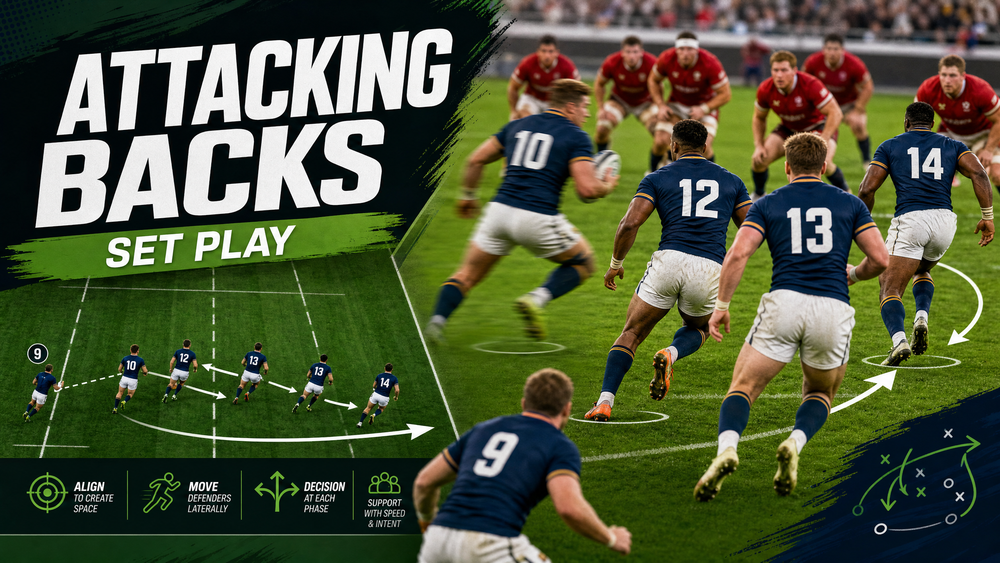
To run this session effectively, you will need the following setup:
- Pitch Area: A full-width pitch (approximately 100m x 70m) or at least a 50m x 50m grid to simulate a match scenario.
- Equipment: 4-6 Rugby balls, training bibs (two colours to distinguish attack and defence), and cones to mark the set-piece starting point and target zones.
- Player Positions: A full backline (9, 10, 12, 13, 11, 14, 15) and at least 4-5 defenders to provide realistic opposition.
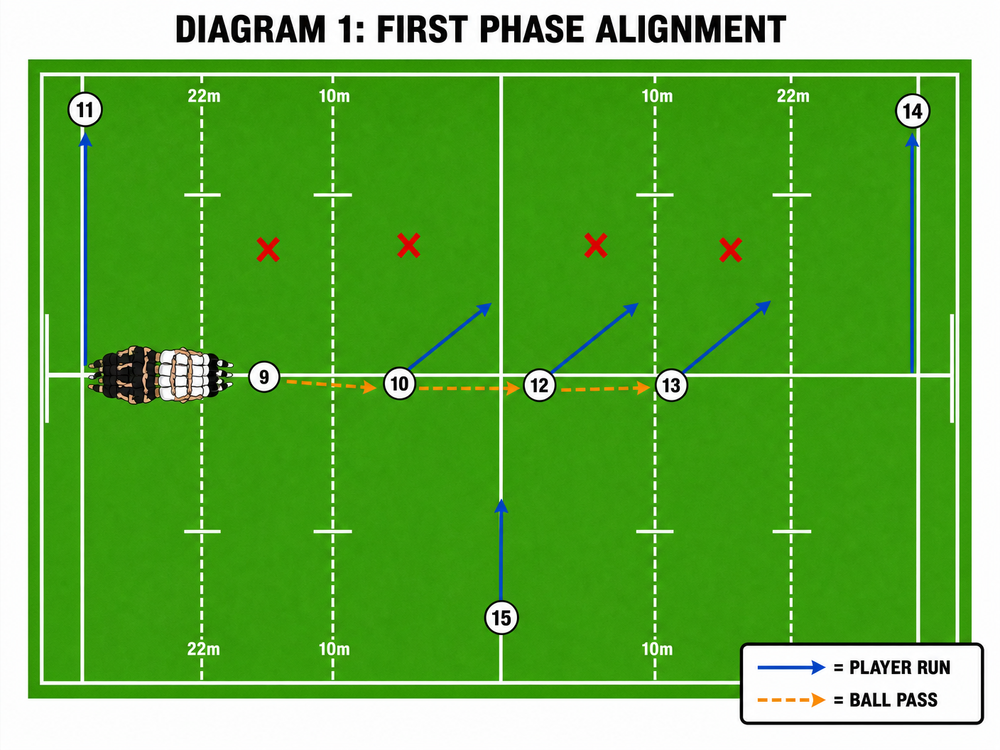
Initial Alignment
Before executing the specific plays, the backs must align correctly to threaten the defence across the width of the pitch.
- Scrum-half (9): Positioned 1m behind the set-piece base, ready for a fast, sweeping pass.
- Fly-half (10): Standing approximately 10m wide of the scrum and 5m deep. This depth allows time to read the defensive line speed.
- Inside Centre (12): Positioned 5m outside the 10, maintaining the same 5m depth.
- Outside Centre (13): Standing 5m outside the 12, ready to run a wide arc or cut back inside.
- Wings (11 & 14): Holding width on the touchlines to stretch the defence.
- Fullback (15): Hovering 15m behind the main line, ready to inject pace into the attack.
Step-by-Step Instructions
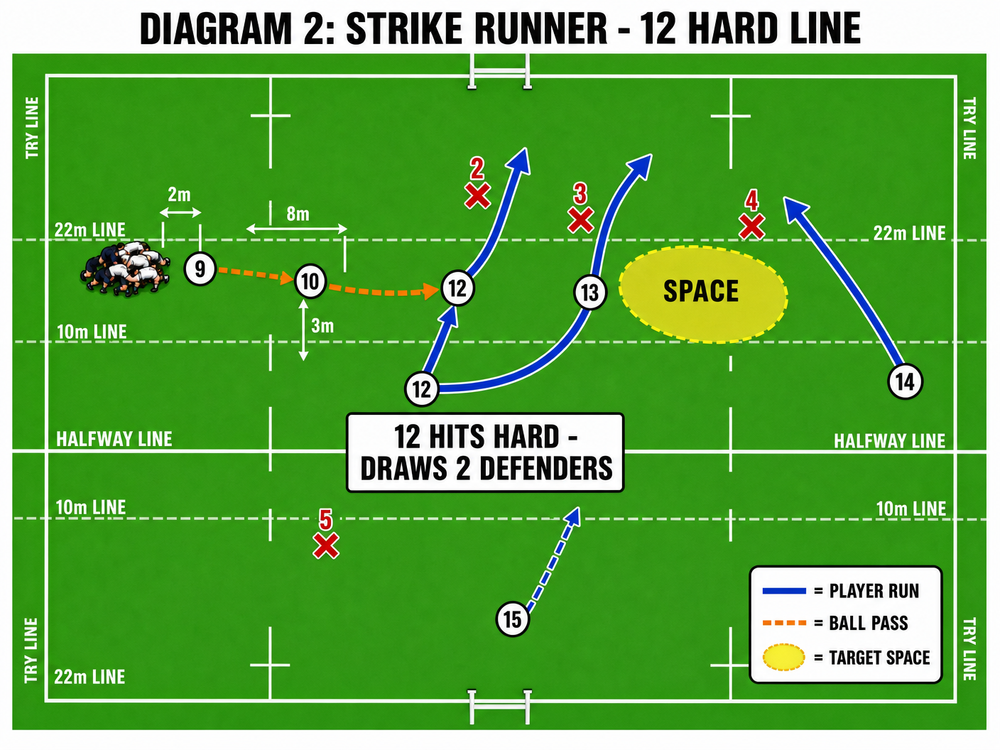
Play 1: The 'Strike Runner' (12 Hard Line)
This is a foundational play designed to get over the gain line quickly and commit multiple defenders.
- The Delivery: The scrum-half (9) clears the ball swiftly to the fly-half (10).
- The Threat: The fly-half (10) catches the ball on the move, taking two hard steps straight at the defensive line to fix the opposing 10.
- The Strike: The inside centre (12) accelerates onto a hard, flat, angled line, aiming directly at the inside shoulder of the opposing 12.
- The Pass: The fly-half (10) delivers a flat, fast pass to the 12 just before the defensive line.
- The Decoy: Simultaneously, the outside centre (13) runs a wide, sweeping arc behind the 12, drawing the attention of the opposing 13 and creating a gap.
- The Result: The 12 crashes over the gain line, ideally drawing two defenders, ensuring quick ball for the next phase.
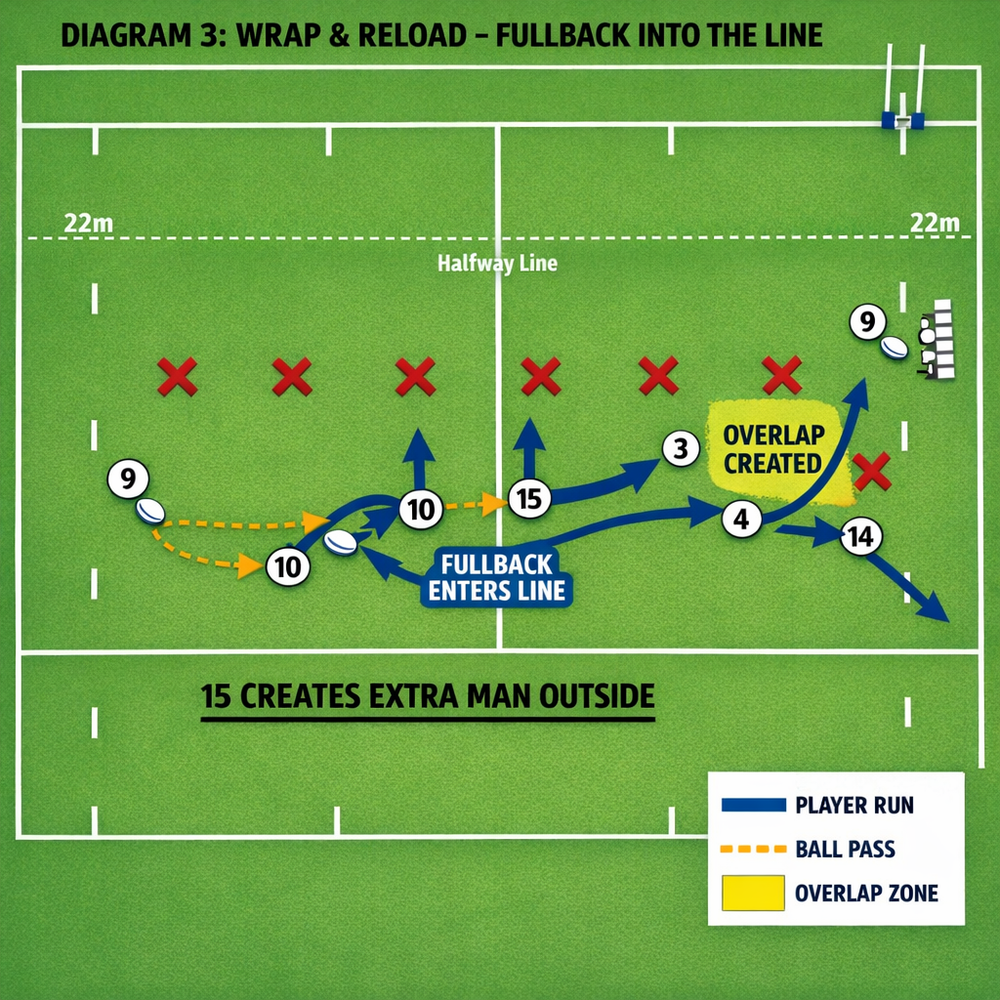
Play 2: Wrap & Reload (Fullback Entry)
This progression builds on the 'Strike Runner' play by using the fullback to exploit the space created out wide.
- The Setup: The initial movement is identical to the 'Strike Runner' play. The 9 passes to the 10.
- The Dummy: The 10 shapes to pass to the 12, who runs the same hard line as a decoy.
- The Wrap: Instead of passing to the 12, the 10 runs a short, flat line, wrapping behind the 12.
- The Injection: The fullback (15) times their run from deep, accelerating into the line between the 12 and the 13.
- The Execution: The 10 passes out the back to the surging fullback (15).
- The Overlap: The fullback (15) now has the ball in space, with the 13 and 14 outside them, creating a clear overlap against the remaining defenders.
Key Coaching Points
- Timing is Everything: The decoy runners must genuinely threaten the line. If they arrive too early or too late, the defence will simply drift past them.
- Square Shoulders: The fly-half (10) must keep their shoulders square to the try line until the last possible moment. Drifting sideways makes it easy for the defence to slide.
- Depth: The attacking line must start deep enough to hit the ball at full pace. Catching the ball while standing still kills the momentum.
- Communication: Clear, concise calls are vital. The 10 must dictate the play, and the support runners must call for the ball to maintain the deception.
- Support Play: After the initial line break or contact, the nearest players must react instantly to secure the ruck and generate quick ball.
Common Mistakes
- Telegraphing the Pass: The 10 looking directly at the intended receiver too early, allowing the defence to anticipate the play.
- Flat Alignment: Starting too flat to the defensive line, resulting in the attack being caught behind the gain line.
- Lazy Decoys: Decoy runners jogging through their lines without intent. The defence will ignore them and focus on the ball carrier.
- Poor Pass Quality: A slow or inaccurate pass from the 9 or 10 disrupts the timing of the entire move.
Variations & Progressions
- The Inside Ball: If the defensive line is sliding quickly to cover the wide threat, the 10 can pop an inside pass to a blindside winger or back-row forward running a hard line against the grain.
- The Kick Pass: If the defence rushes up aggressively, leaving space in the backfield, the 10 can execute a cross-field kick to the winger.
- Adding Defensive Pressure: Start with passive defenders (touch only) and gradually progress to full contact as the execution improves.
Age Adaptations
- Under 10s / Under 12s: Focus purely on the fundamental handling and running straight. Simplify the plays to basic 'hands down the line' and basic loops.
- Under 14s / Under 16s: Introduce the concept of decoy runners and fixing defenders. Emphasize timing and depth.
- Open Age: Implement the full plays with variations. Focus on reading the defensive alignment and making split-second decisions at the line.
