

Basketball
1–2–2 Full-Court Press Break: Inbound, Middle Flash & Advance
Teach a dependable 1–2–2 press break that creates a safe middle outlet, beats the first trap, and converts full-court pressure into an organised attack.

What you need
basketballs, 8–10 flat cones, pinnies, whistle, stopwatch
Overview
A full-court press is designed to speed up your decision-making, shrink passing windows, and force the ball toward the sideline. This 1–2–2 press break gives your team a repeatable answer: inbound quickly, show a central outlet, keep two release players wide, and advance the ball before the trap can form. It is an excellent base call after a made basket, especially when the opponent is matching up in man-to-man pressure or showing a 1–2–1–1 look. The first goal is not a highlight pass; it is to secure a controlled catch, get the ball out of danger, and create a numbers advantage on the far end.
Use the full FIBA 28 m × 15 m court for your teaching progression. The extra space is the lesson: players must occupy width early and keep a safety behind the ball rather than bunching around the inbound. 1
Setup
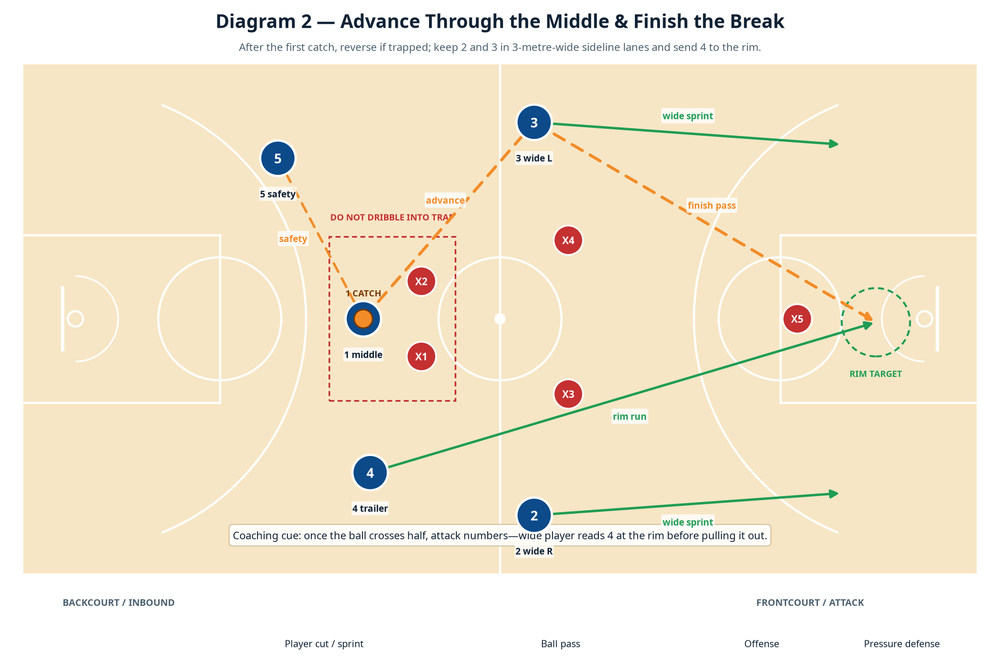
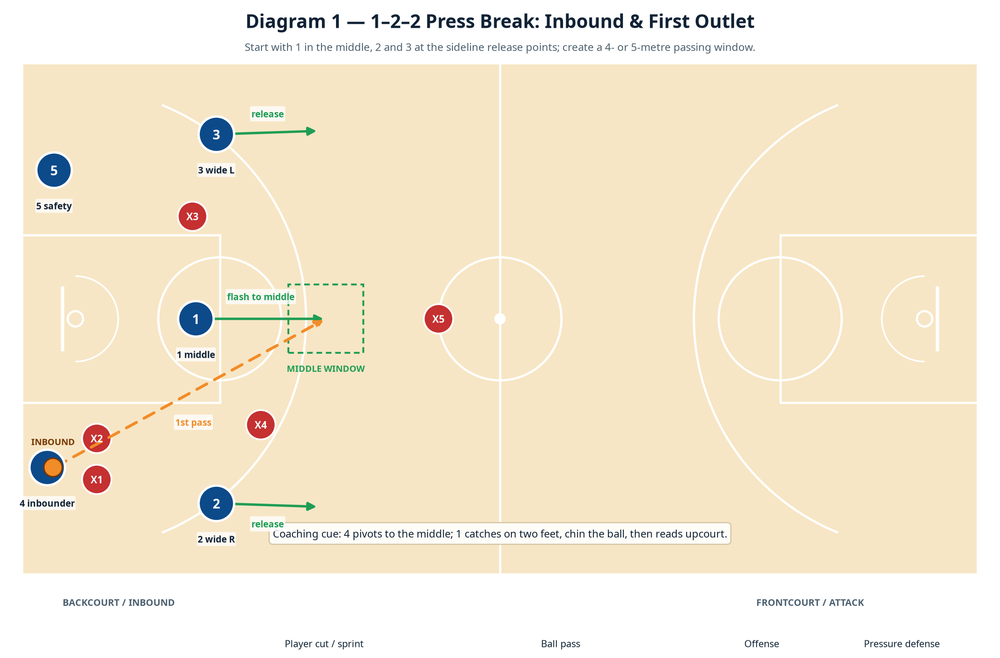
Place one ball with 4 (power forward), who is the designated inbounder under the baseline. 1 (point guard) begins in the middle channel, 4–5 m from the baseline and roughly 2 m inside each sideline. 2 (shooting guard) and 3 (small forward) line up as wide receivers, 4–5 m from the baseline and a minimum of 3 m from 1. 5 (centre) is the safety outlet high on the weak-side lane line, ready to reverse the ball and protect against a steal. Use five defenders once the spacing is understood; their job is to deny the first pass, build a sideline trap, and keep a defender between ball and basket.
| Item | Coaching setup |
|---|---|
| Players | 5 offence, 5 defence; begin 5v0 and progress to 5v5 |
| Court | Full 28 m × 15 m FIBA court; mark a 3 m wide sideline lane with flat cones if players crowd the boundary |
| Equipment | Basketballs, 8–10 flat cones, pinnies, whistle, stopwatch |
| Teaching block | 25 minutes: 6 min walkthrough, 7 min guided defence, 8 min live 5v5, 4 min scoring constraint |

Step-by-Step Instructions
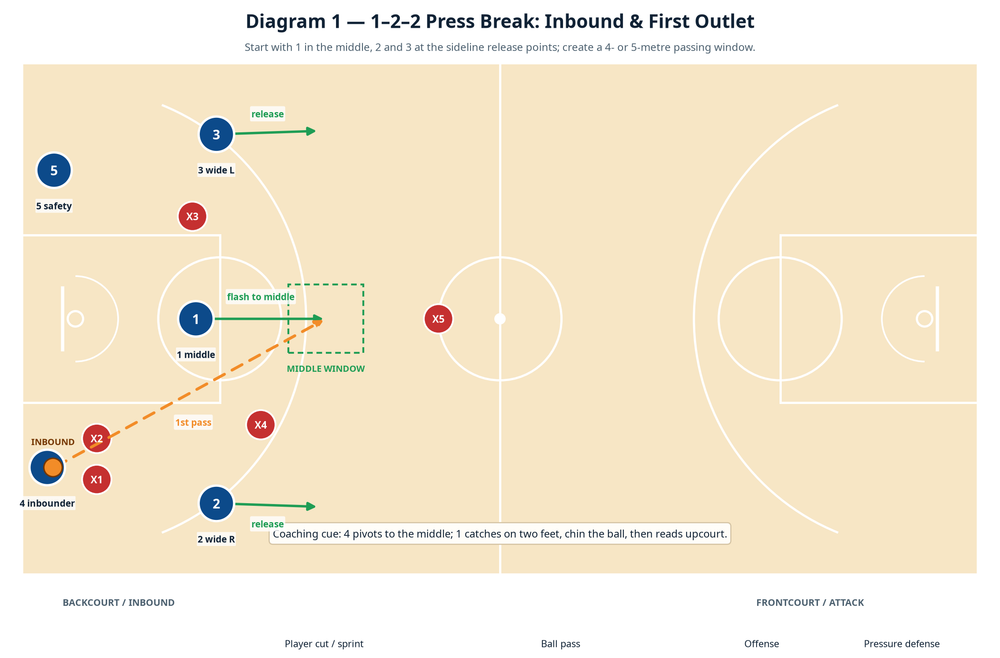
Call “Flash” before the inbound. On the referee’s made-basket signal or your drill whistle, 4 establishes a legal inbound position with both feet outside the end line. 1 shows hands and starts square to the ball; 2 and 3 begin wide enough that one defender cannot guard both them and the middle. 5 scans backcourt depth and identifies the safety lane.
Make the first three steps explosive. On 4’s hand signal, 1 flashes hard into the middle window, aiming to receive around 6–8 m from the baseline. 2 releases toward the right sideline and 3 releases toward the left sideline; neither runs parallel with 1. Those first steps should create a 4–5 m passing triangle, not three receivers on one horizontal line.
4 pivots away from the nearest trap. If the defence closes from the baseline side, 4 uses a reverse pivot to see the middle. The preferred first pass is a firm chest or overhead pass to 1’s outside hand. If a defender jumps the middle, 4 immediately uses the wide player on that side; do not hold the ball waiting for the perfect option.
1 catches to score the middle. 1 meets the ball with two feet, chins it, and turns their eyes upcourt before dribbling. The rule is simple: pass ahead if the middle is open; reverse if the trap arrives; dribble only to escape into space. If both defenders step to 1, 5 is the safety reversal, not a spectator.
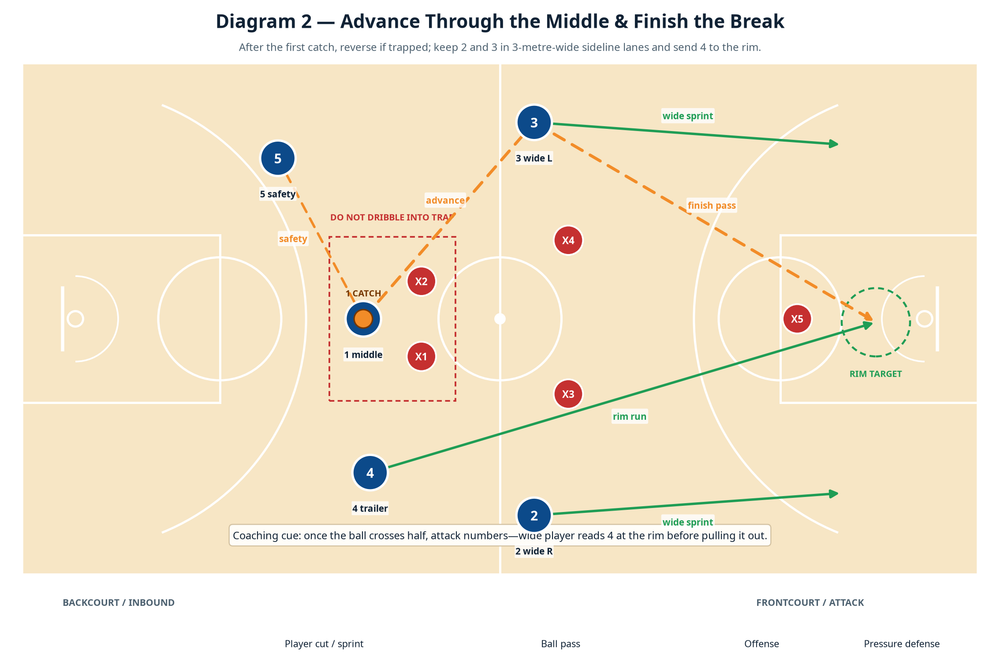
Advance before the second trap. The first open player, normally 2 or 3, catches facing upcourt in the wide lane and moves the ball beyond halfway with one pass whenever possible. 4 transitions from inbounder to rim runner after releasing the pass; 5 trails behind the ball in a support angle. Insist that the ball travels faster than the dribble.
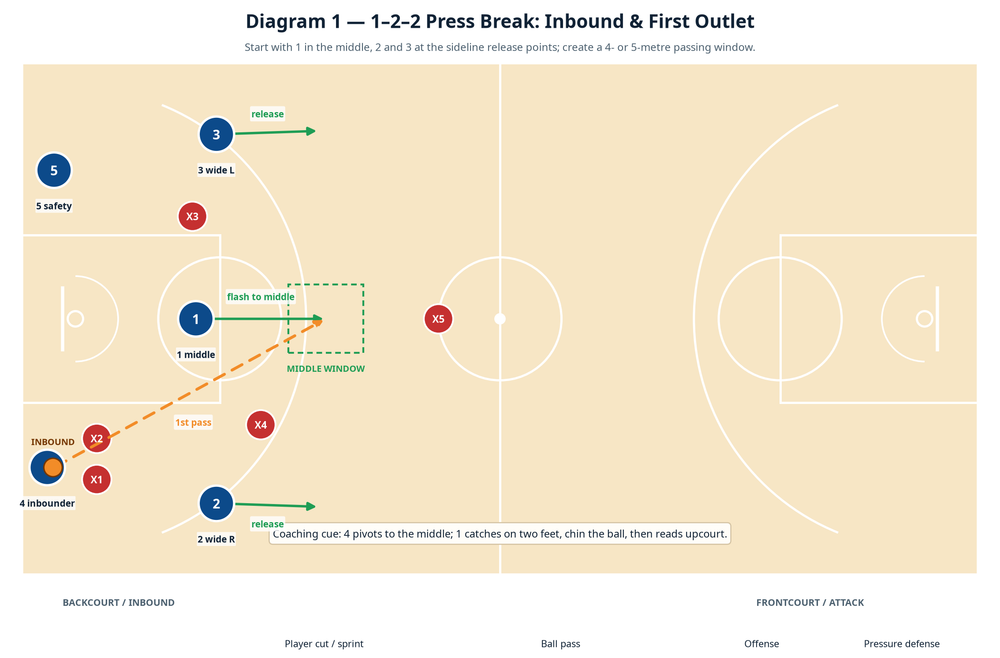
Finish with a numerical read. Once the ball crosses half-court, 2 or 3 looks first for 4 cutting to the rim, then the opposite wide player, then a controlled pull-out. If the defence has recovered, call your normal secondary offence rather than forcing a contested lay-up. The press break is successful when the team enters the frontcourt organised, balanced, and on time.
Train the recovery rule. On every lost pass, the nearest player sprints to stop the ball, 5 protects the rim, and the remaining players match the closest dangerous receiver. That recovery standard lets your players attack assertively without becoming careless.
Key Coaching Points
| Teaching point | What you should coach on the floor |
|---|---|
| Show hands and meet passes | Receivers should move toward the ball, catch on two feet, and keep the ball below shoulder height only long enough to secure it. |
| Own the middle without living there | 1 flashes into the centre lane to break the first line; once crowded, the ball must move out, not be dribbled into a two-player trap. |
| Use width as a weapon | Keep 2 and 3 at least 3 m apart from 1 and close enough to the sideline to stretch the press, but not so close that a catch becomes a trap. |
| Pivot first, dribble second | Inbounders and first receivers must pivot out of pressure and see the next pass. A premature dribble is the trigger for most traps. |
| Keep a safety behind the ball | 5 is your insurance policy. Teach 5 to stay deep enough to reverse safely, then arrive as the trailer once the ball is advanced. |
Common Mistakes
| Mistake | Correction |
|---|---|
| All three receivers start on the same line | Freeze the action, move 1 into the middle channel, and physically mark the three passing lanes with cones. |
| 1 dribbles toward a waiting sideline trap | Make the catch-and-decision rule mandatory: one scan, then pass ahead or reverse. In a constrained game, count a sideline trap as a turnover. |
| 4 admires the inbound pass | Demand an immediate rim run or trail route after passing; the inbounder becomes the fifth attacker, not a backcourt observer. |
| 2 and 3 drift toward the ball | Tell wide players to sprint away from pressure until the ball crosses half, then fill a frontcourt spacing spot. |
| 5 leaks too early | Hold 5 behind the ball until 1 has a clean catch or the ball is clearly advancing; a safety outlet prevents the most damaging live-ball turnover. |
Variations & Progressions
For a simpler entry, begin 5v0 and give 4 a five-second inbound count. Then move to 5v3, with three defenders allowed to deny but not trap; this lets the offence rehearse spacing and pass timing. Next, run 5v5 from a made basket with a rule that the offence earns one point for crossing half under control and a second point for reaching the paint within the next six seconds.
To make the set harder, start the defence in a 1–2–1–1 diamond press and allow a live sideline trap after the first dribble. Require the offence to cross half-court in eight seconds and award the defence two points for a trap that forces a reversal behind the free-throw line. For an advanced variation, switch 4 and 5: let 5 inbound while 4 becomes the high safety, then add a call for 1 to clear through and receive the return pass if the middle is denied.
Age Adaptations
| Group | Adaptation |
|---|---|
| Under 8–Under 10 | Use half-court first, remove trapping, and give every receiver a cone lane. Coach one message only: “Get wide, show hands, pass to space.” |
| Under 12 | Use full court with a passive five-second count. Teach 1 to flash central and 5 to be the safety before adding live defenders. |
| Under 14–Under 16 | Use live 5v5, enforce an eight-second advance target, and give the defence a sideline trap. Demand proper pivots, pass fakes, and early frontcourt organisation. |
| Open / senior | Add scouting calls for the opponent’s press alignment, build a second inbound option, and flow directly into your transition or secondary offence after the break. |
Session Finish
End with a three-possession competition. The offence begins after a made basket and must either cross halfway under control or create a paint touch within eight seconds; the defence scores for a turnover, a ten-second violation, or a trap that forces the ball backward. Film the last round if possible and review three things only: initial width, middle-catch decisions, and whether the inbounder joined the attack.
