

Basketball
Flex Continuity: Baseline Screen to Rim-Cut Play
Teach a repeatable Flex continuity that creates rim cuts, purposeful reversals and clear weak-side spacing against half-court defence.
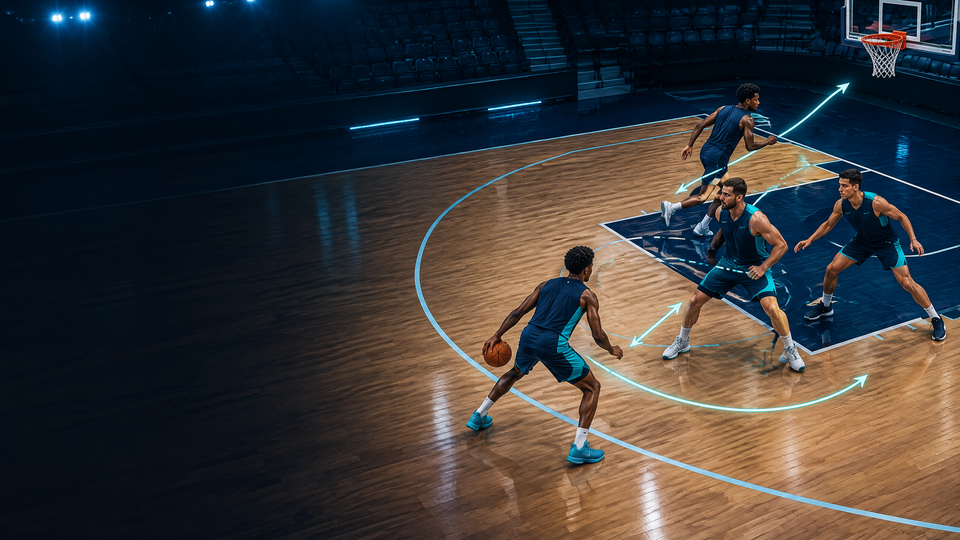
What you need
balls, cones
Overview
The Flex offense is a five-player continuity built around a baseline cross-screen, a decisive rim cut and a ball reversal that recreates the same problem on the opposite side. It is an excellent teaching structure for U14+ groups because every player must screen, cut, pass and fill. This version starts from a 1–2–2 alignment on a FIBA 28 m × 15 m court and gives the ball-handler one consistent first read: find the cutter at the basket.
The goal is not to memorise a pattern. The goal is to create a two-foot advantage at the rim from a legal, well-timed screen, then punish help with simple spacing. Run it for 20 seconds live, resetting only after a score, stop or clean defensive win.
Setup
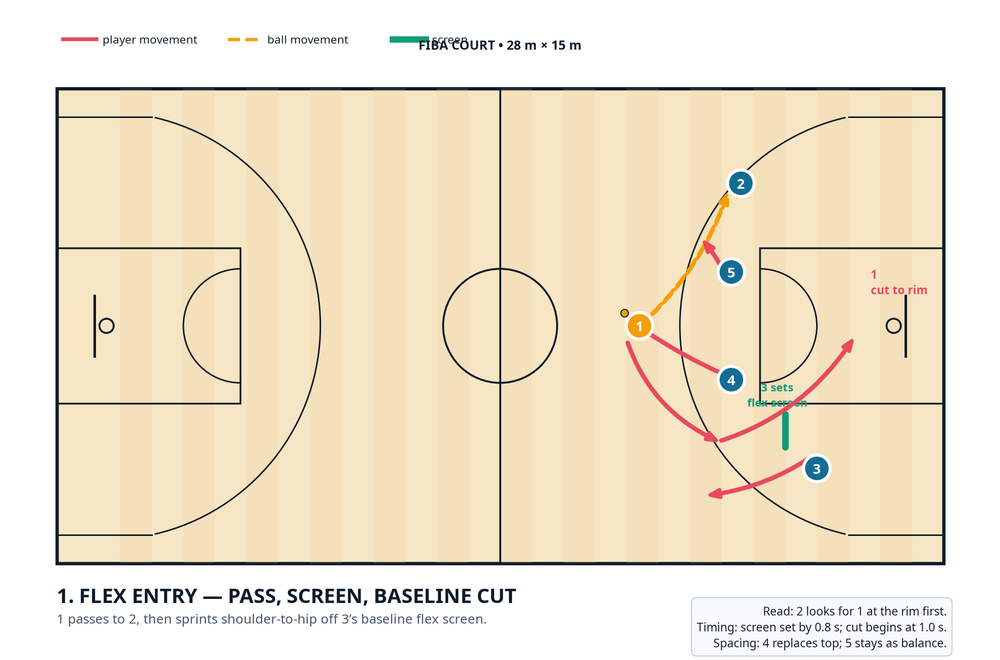
Use five attackers and five guided defenders. 1 starts at the right slot with the ball, approximately one step outside the three-point line. 2 is on the right wing above free-throw-line extended; 3 is in the right corner; 4 is at the right elbow/slot area; and 5 is on the high-post line. Keep the opposite corner vacant initially; the continuity fills it.
Coach the role rather than the jersey number: passer becomes cutter, corner becomes screener then wing, and high-post player becomes the next screener. Use cones one metre inside each corner and at both slots to establish the correct spacing. Keep a second ball ready so the next unit enters immediately.
Step-by-Step Instructions
0.0–0.8 seconds — Entry. 1 takes two controlled dribbles and passes sharply to 2 on the right wing. 2 catches on two feet, chin to the rim and sees the entire floor. The ball should arrive above free-throw-line extended and outside the three-point line.
0.4–1.0 seconds — Screen preparation. As the pass travels, 3 steps up from the corner and plants a legal baseline Flex screen just below the right block. 3 is balanced, chest parallel to the baseline, feet still, and calls the screen early. 4 lifts from the elbow to the top slot, replacing 1's departure. 5 slides up a half-step as the high-post balance outlet.
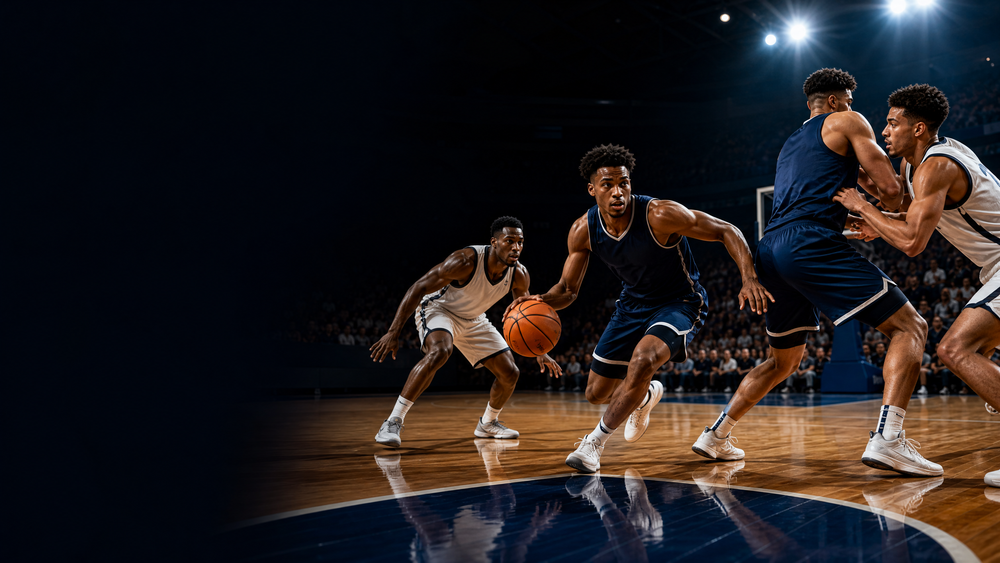
1.0–1.8 seconds — First scoring cut. 1 sprints shoulder-to-hip over 3's screen, changes pace at the screen and cuts across the lane to the front of the rim. 2 looks inside before putting the ball on the floor. Use a bounce pass if the defender trails, or a direct chest pass if 1 has clear daylight. Against a switch, 1 seals the smaller defender for one second before continuing.
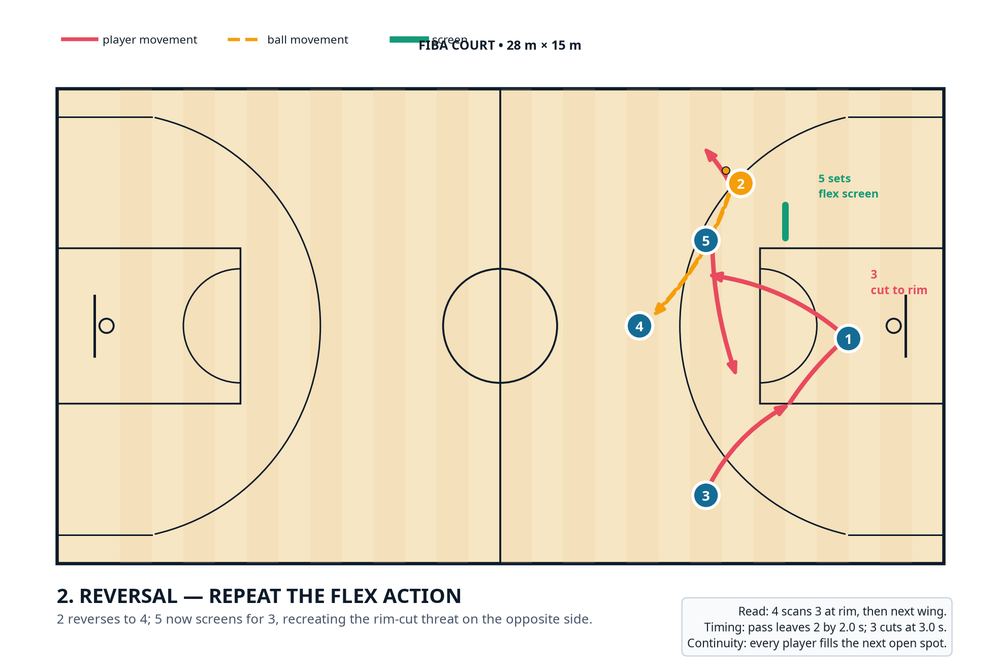
1.8–2.2 seconds — No rim pass. If 1 is covered, 2 immediately reverses to 4 at the top. There is no hesitation dribble: the ball must leave 2 within 0.4 seconds of deciding the cutter is unavailable. 1 clears through to the left low area, 3 replaces upward to the wing and 5 becomes the next screener.
2.2–3.4 seconds — Mirror the action. 4 catches, squares and looks first for 3, who uses 5's Flex screen to cut across the lane. 5 stops, sets the screen and then opens to the ball. 4's reads are: rim pass to 3, hit 5 if the screener's defender helps, then move it to the next wing.
3.4–5.0 seconds — Continuity. Every reversal restarts the same action on the other side: passer cuts, corner screens, high player fills and the ball reverses. If nothing is created after two complete sides, call “flow” and allow a driving-gap attack from the ball-side slot while the other four preserve Flex spacing.
Key Coaching Points
- Screen first, then move. The screener arrives early and is stationary before the cutter uses it. A moving screen removes the advantage and risks an offensive foul.
- Change of pace wins. The cutter walks the defender into the screen, then explodes through it with hands ready. Cut to a front-rim target rather than drifting under the basket.
- Passer's eyes create the shot. On every catch, read rim → screener pop → reversal. A wing who looks outside first teaches the defence to ignore the cut.
- Spacing is non-negotiable. Keep the slot replacement above the three-point line and the screener outside the restricted area until the cut begins.
Common Mistakes
- The screen arrives late or with feet moving. Require two stopped feet and an early screen call.
- 1 cuts before 3 is set. Make the cutter wait for the verbal cue; an early cut gives the defender an easy trail route.
- 2 holds the ball and kills the continuity. Apply a 0.5-second decision rule: rim read, then reversal.
- Players admire the cut instead of filling. Freeze the action and ask which spot is now empty before replaying it.
- The cutter rounds the route too widely. Place a cone at the shoulder-to-hip landmark beside the screen.
Variations & Progressions
UCLA release: After 1 passes to 2 and cuts, 3 pivots into a down-screen for 2 if the rim action is switched off. 4 can then hit 2 curling to the top for a catch-and-shoot three. This is a useful counter versus teams that top-lock wings.
Post touch: After setting the screen, 5 pops to the elbow. 4 feeds 5; 3 continues through, 1 drifts to the short corner and 2 lifts as the safety pass. Give 5 two dribbles maximum and teach high-low vision before the hand-off.
Dribble-at trigger: If the wing is denied, the ball-handler dribbles directly at that player. The wing backcuts hard and the corner immediately becomes the Flex screener. This protects the continuity against aggressive denial without changing formation.
Decision game: Play live 5v5. Award two points for a rim score created directly from the Flex cut, one point for a paint touch and no bonus for a static perimeter shot.
Age Adaptations
Under 12: Teach three spots only—wing, corner and slot—and use no defence for the first five repetitions. Walk the screen and cut, then add a coach as a guided defender. If the cutter is not clearly open, the wing always reverses. Keep each rep to four seconds.
Under 14: Add guided 5v5 with a defender trailing the cutter. Demand a verbal screen call and a jump-stop catch. Let the passer choose the rim pass or reversal, but do not yet allow switches.
Under 16/Open: Play live against switches, top-locks and help-side tags. Require counters: seal on the switch, reject if the defender jumps under, and use the post touch after two denials. Film five consecutive possessions and grade screen legality, rim-read timing and whether all four off-ball players filled correctly.
