

Basketball
Baseline Box Cross: Rim-Seal Inbound Play Under the Basket
Teach a reliable baseline out-of-bounds set that creates a front-rim seal first, a weak-side corner shot second, and a safe nail release third.
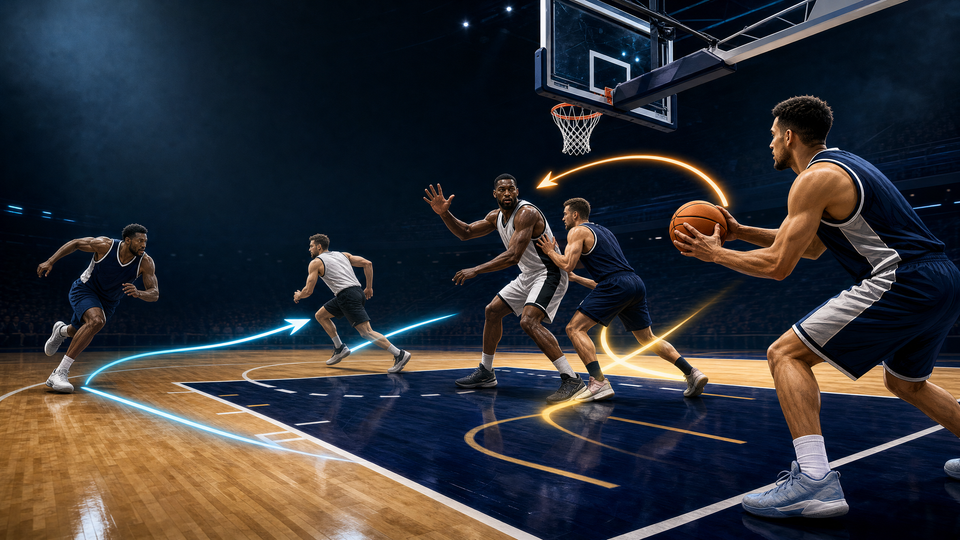
What you need
1 basketball, 4 flat cones or floor spots, one basket with standard court markings, training bibs for live defenders, coaching whiteboard
Baseline Box Cross: Rim-Seal Inbound Play Under the Basket
Overview
This baseline out-of-bounds (BLOB) set gives your team a simple, repeatable scoring package when the ball is inbounded under the offensive basket. The primary objective is a two-foot finish by the 5 (centre) on a front-rim seal. If the defence loads the paint, the second read is the 3 (small forward) in the weak-side corner. If neither is available, the 4 (power forward) becomes a high, safe release at the nail so the possession continues cleanly. It is an excellent late-clock, after-timeout, or momentum-play call because every player has a defined job and the inbounder has a clear read order.
Use the action on a standard FIBA court, whose inner playing area is 28 m x 15 m. Keep the entire action in the frontcourt half: the lane, both low blocks, the corners, and the nail. Coaches should call it “Box” and use the 1 raising the ball above the forehead as the universal trigger. The action needs to be moving by the referee’s count of one, with the primary pass released by count three. [1]
Setup
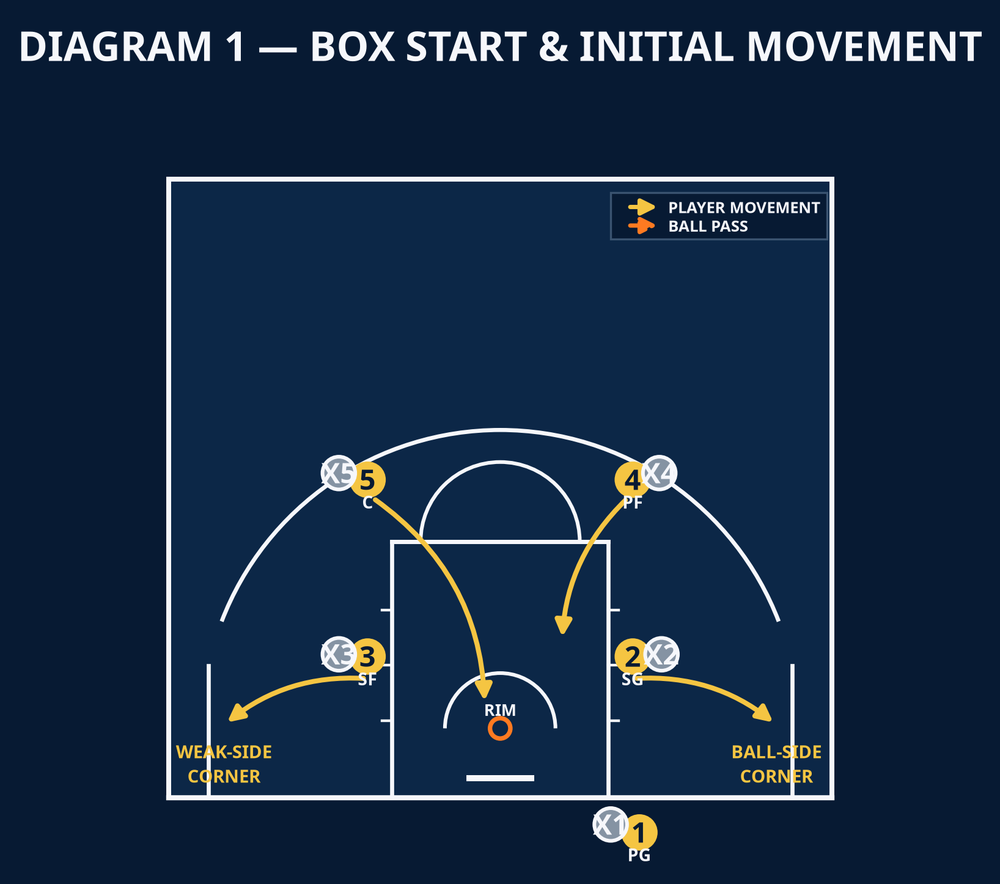
Bring one ball, four flat cones or floor spots, and ideally 10 players for live rehearsal: five on offence and five as guided defenders. If numbers are limited, run the timing with five offence players against chairs before adding pressure. Place a cone one metre behind each corner three-point line, one on the ball-side elbow, and one on the weak-side elbow. Those landmarks stop young players from compressing the lane.
| Player | Starting position | Landmark and job |
|---|---|---|
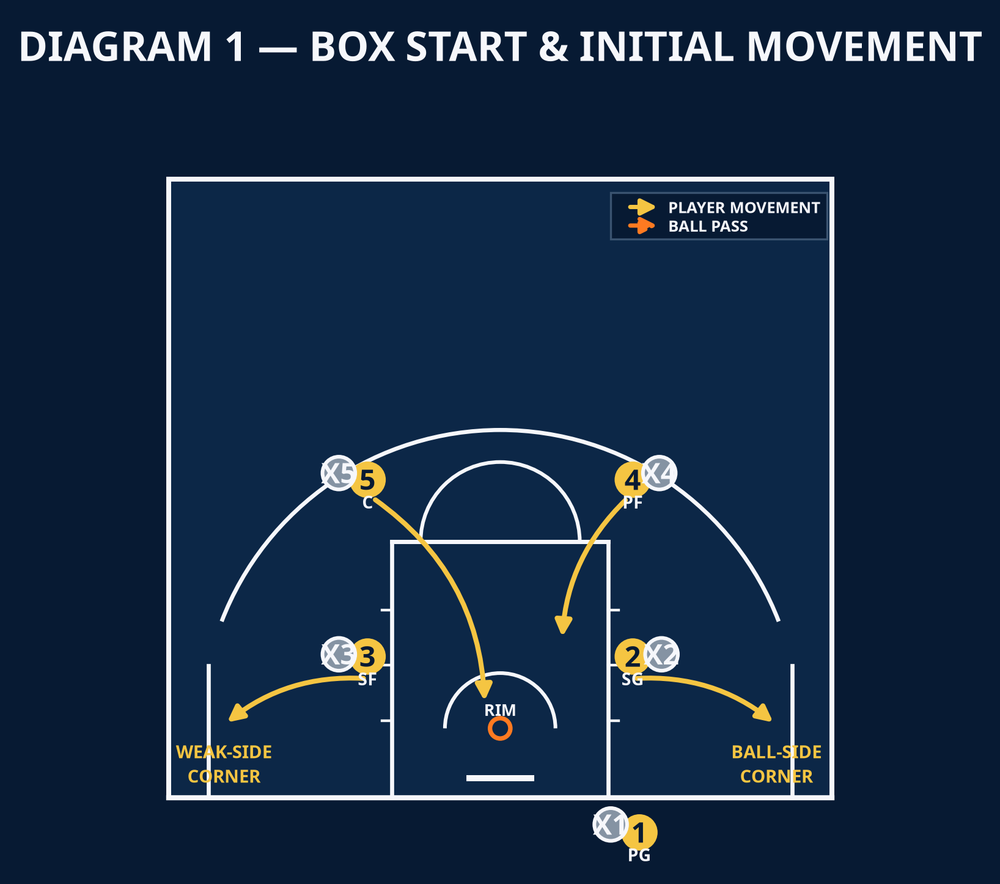
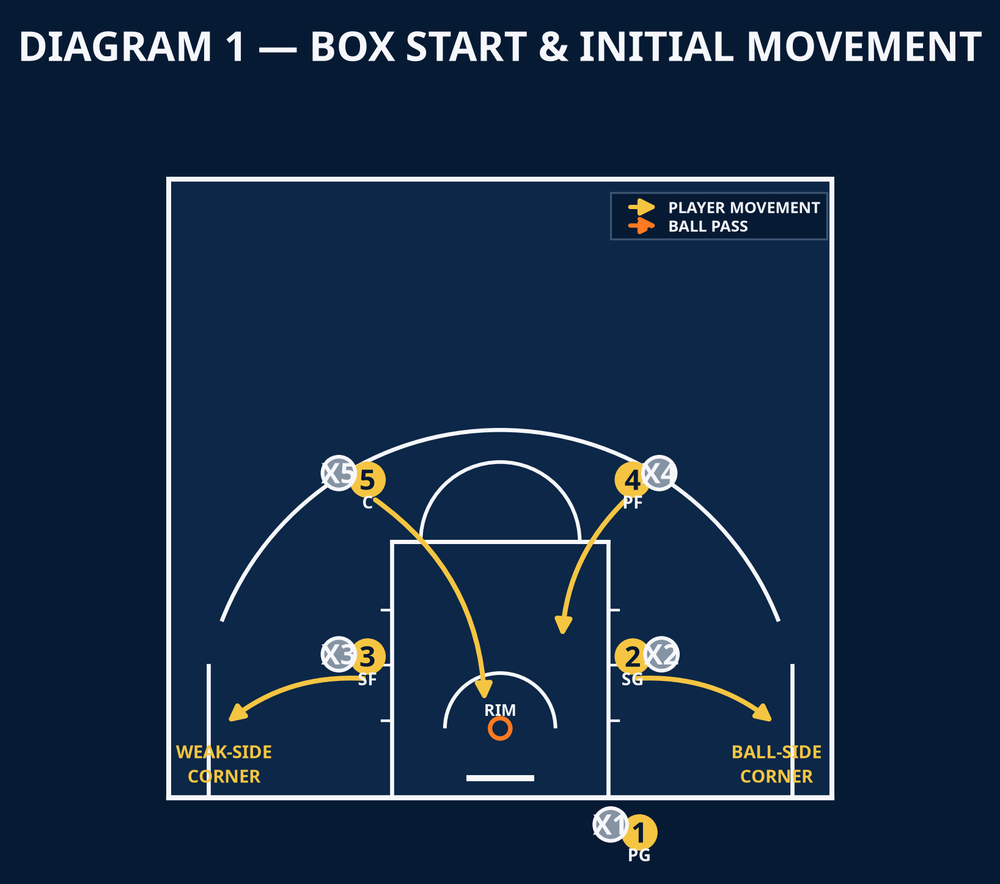
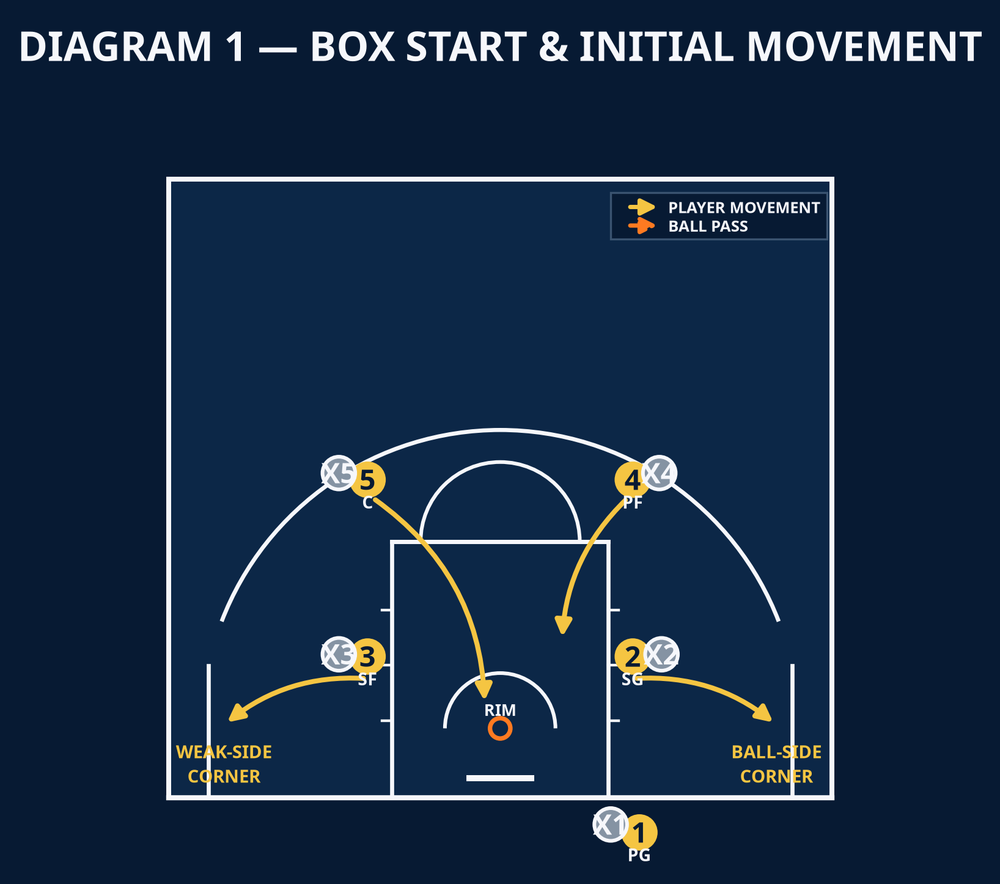
| 1 — PG / inbounder | Outside the endline | Stand 0.5–1.0 m from the ball-side lane line; see the whole lane and pass by count three. |
| 2 — SG | Ball-side low block | Start one step outside the lane line; sprint flat to the ball-side corner. |
| 3 — SF | Weak-side low block | Start one step outside the lane line; clear hard to the weak-side corner. |
| 4 — PF | Ball-side elbow | Step into the lane and set the legal cross-screen; then pop to the nail. |
| 5 — C | Weak-side elbow | Wait for the screen, cut over it, and seal at the front of the rim. |
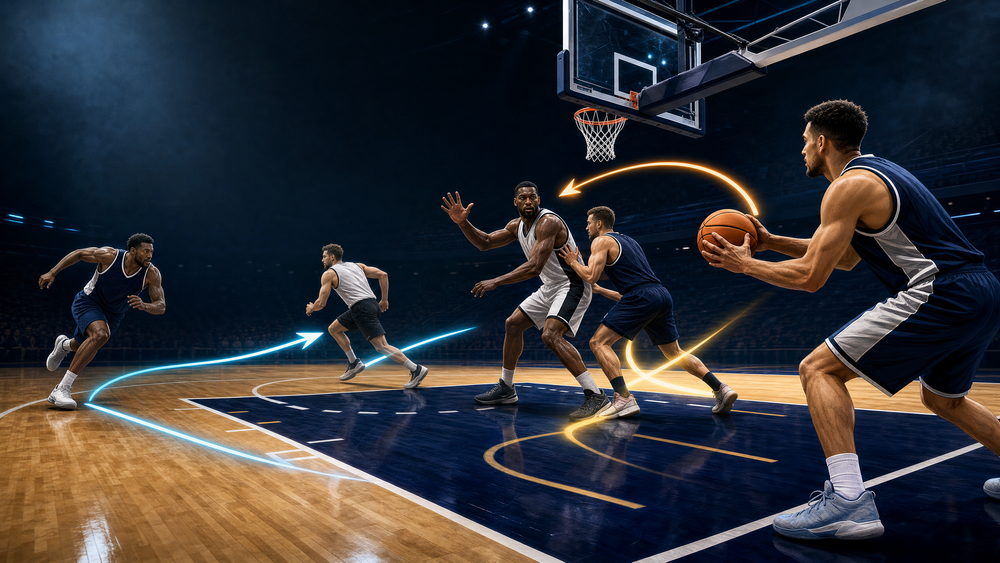
The box is deliberately compact at the start, but the solution is not. The 2 and 3 must stretch the defence to both corners. The 4 and 5 must create the scoring window in the middle. Tell your team, “We start tight to finish wide.” The 1 holds the ball at chest height until the trigger, stays visibly out of bounds, then lifts it high to announce the action.
Step-by-Step Instructions
Clear the ball-side corner. On 1’s ball lift, 2 sprints flat along the endline to the ball-side corner. The finish point is outside the three-point line and at least two feet behind the corner. 2 arrives with hands ready, not with hands at the side. This is the safety outlet and it removes a low defender from the middle.
Empty the weak-side help. At the same instant, 3 runs under the basket line to the weak-side corner and presents both hands. Demand a game-speed cut; a jog allows the low helper to stay near the rim and cover two players.
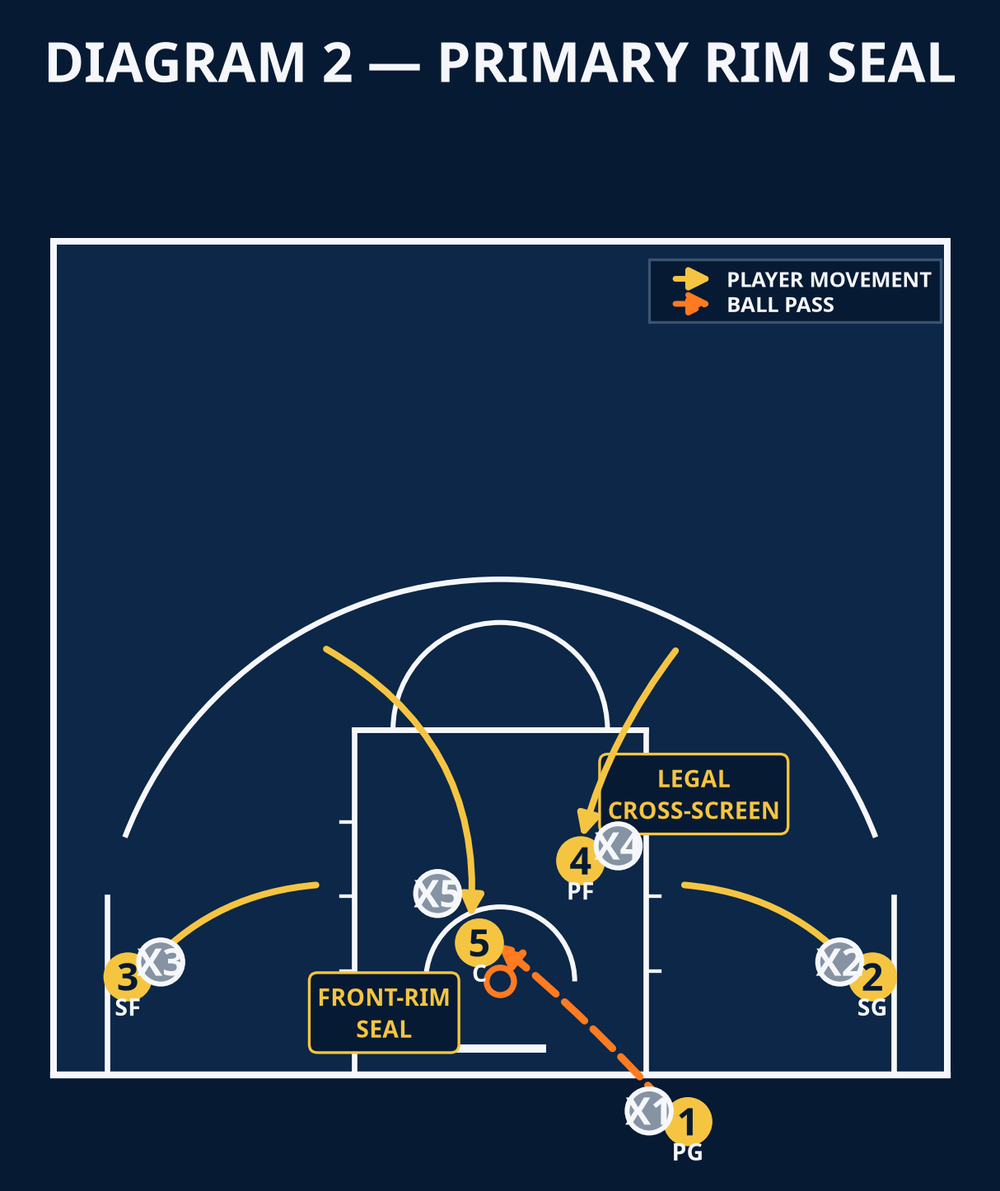
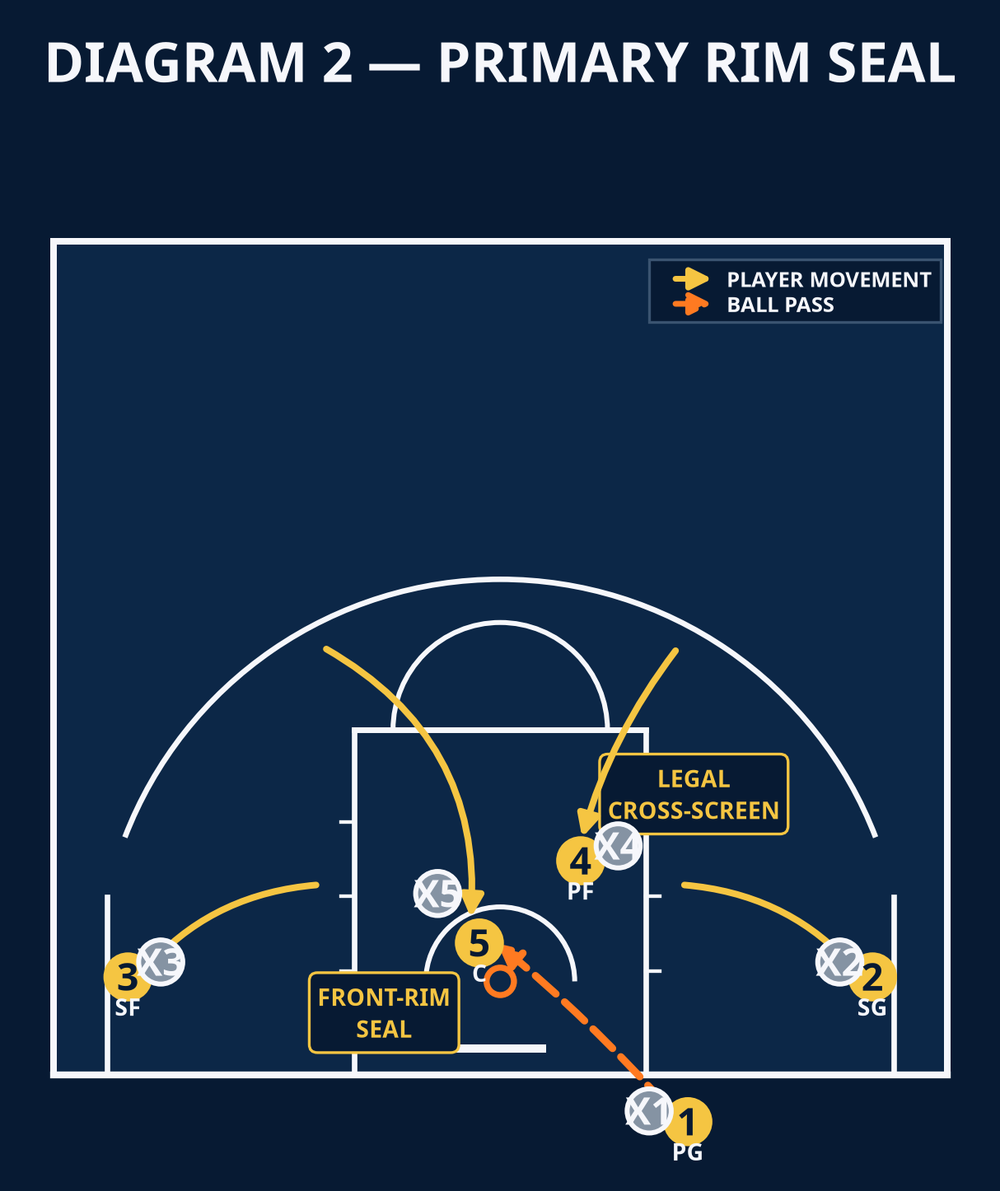
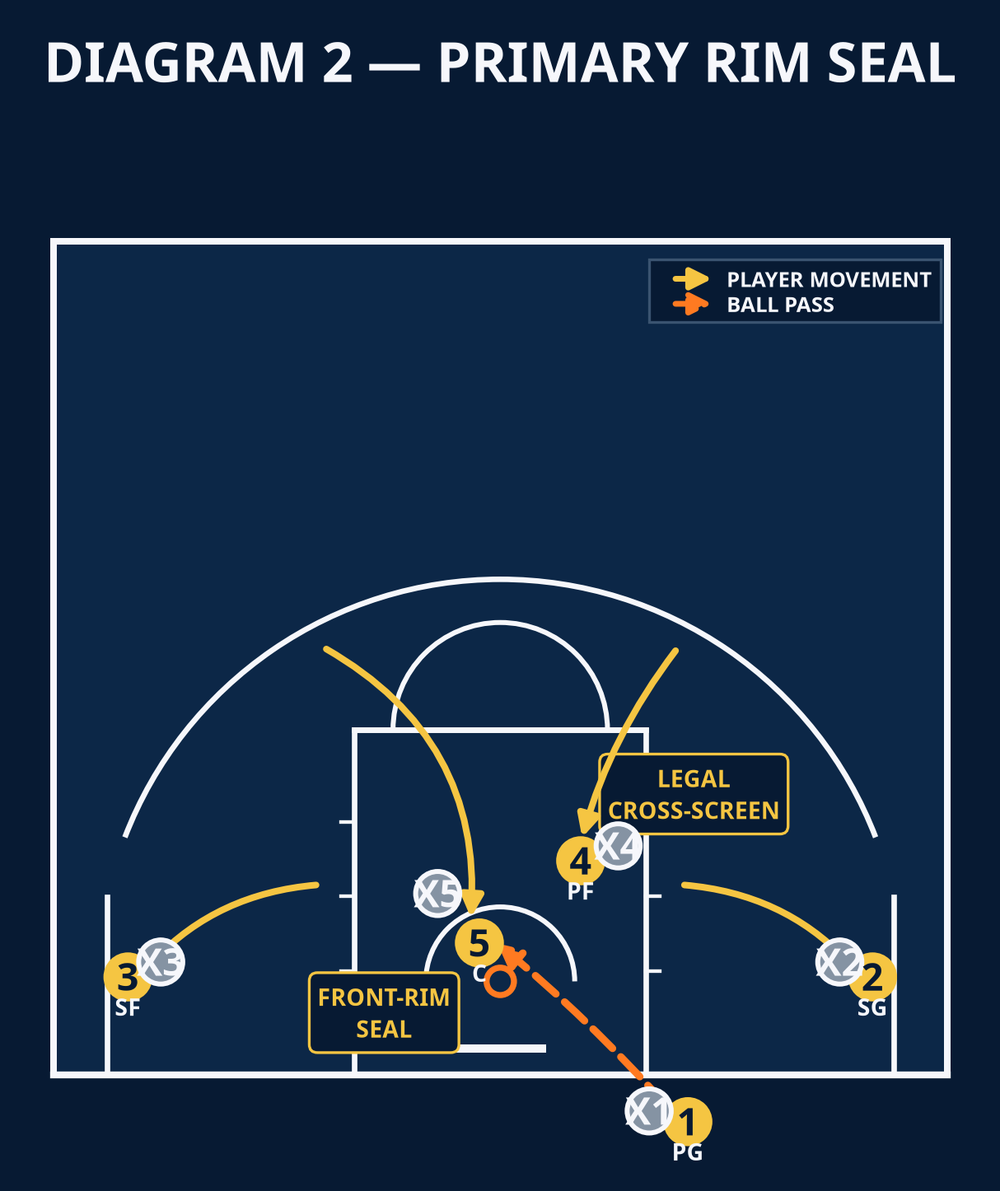
Set the screen on time. 4 takes one sharp step toward the centre of the lane, gets low and wide, then becomes still roughly one metre above the restricted area. 4’s chest faces the weak-side sideline. The screen is not a chase; 4 beats the defender to a legal screen angle, shows hands away from the defender, and absorbs contact without leaning.
Win the front rim. 5 waits a half-beat for 4’s feet to be set, shoulder-to-hip brushes the screen, and cuts over the top toward the ball-side front rim. Finish the cut with a reverse pivot into a seal: outside foot down, hips low, target hand high, and body between defender and basket. The catch window is in front of the rim, approximately a 1 m x 1 m space—not under the backboard.
Make the first clean pass. 1 reads 5’s defender. If the defender trails, throw a direct chest pass to 5’s outside hand. If the defender is underneath or the defence switches early, place a soft pass to the near-side shoulder. 5 catches with two hands, chins the ball, and finishes off two feet before help can arrive.
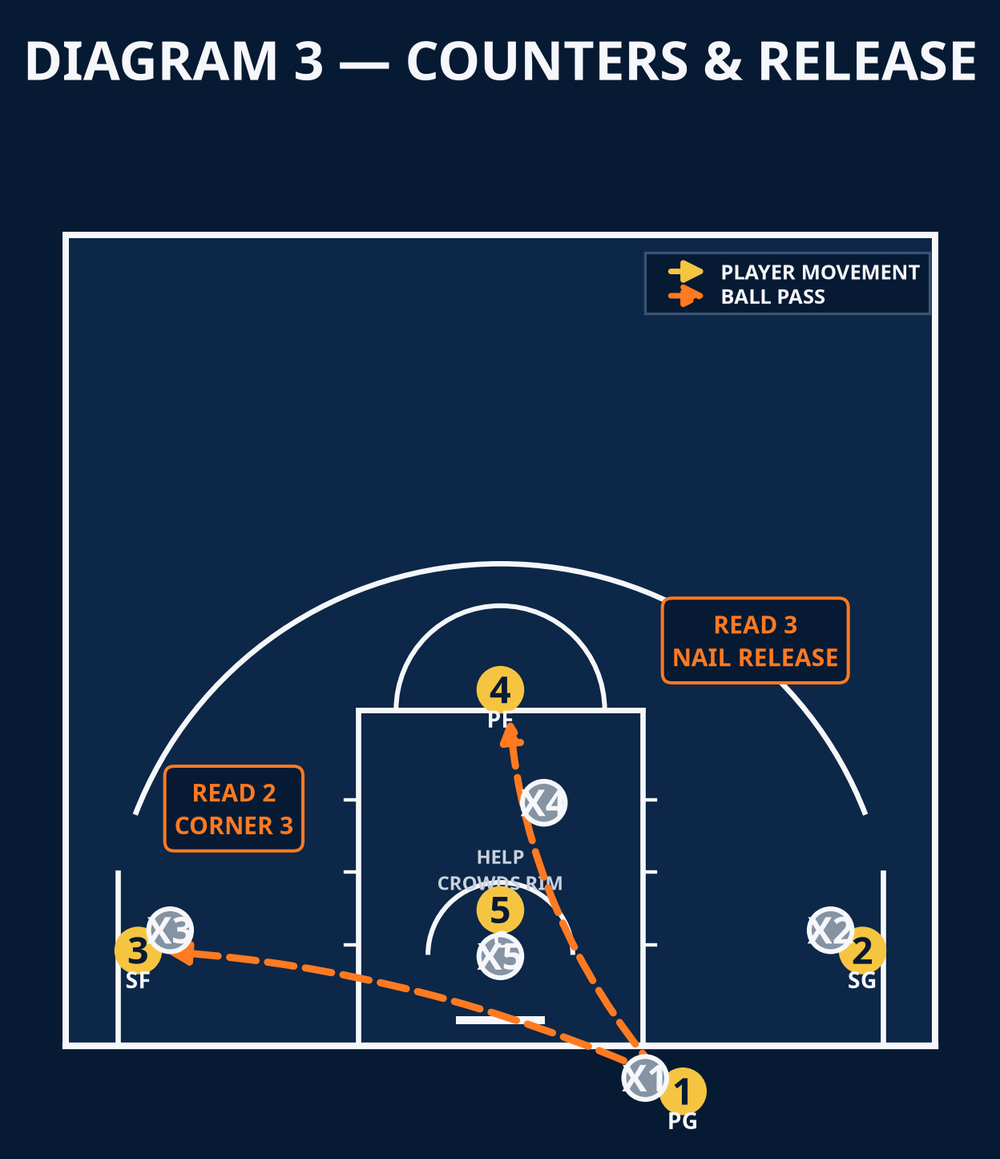
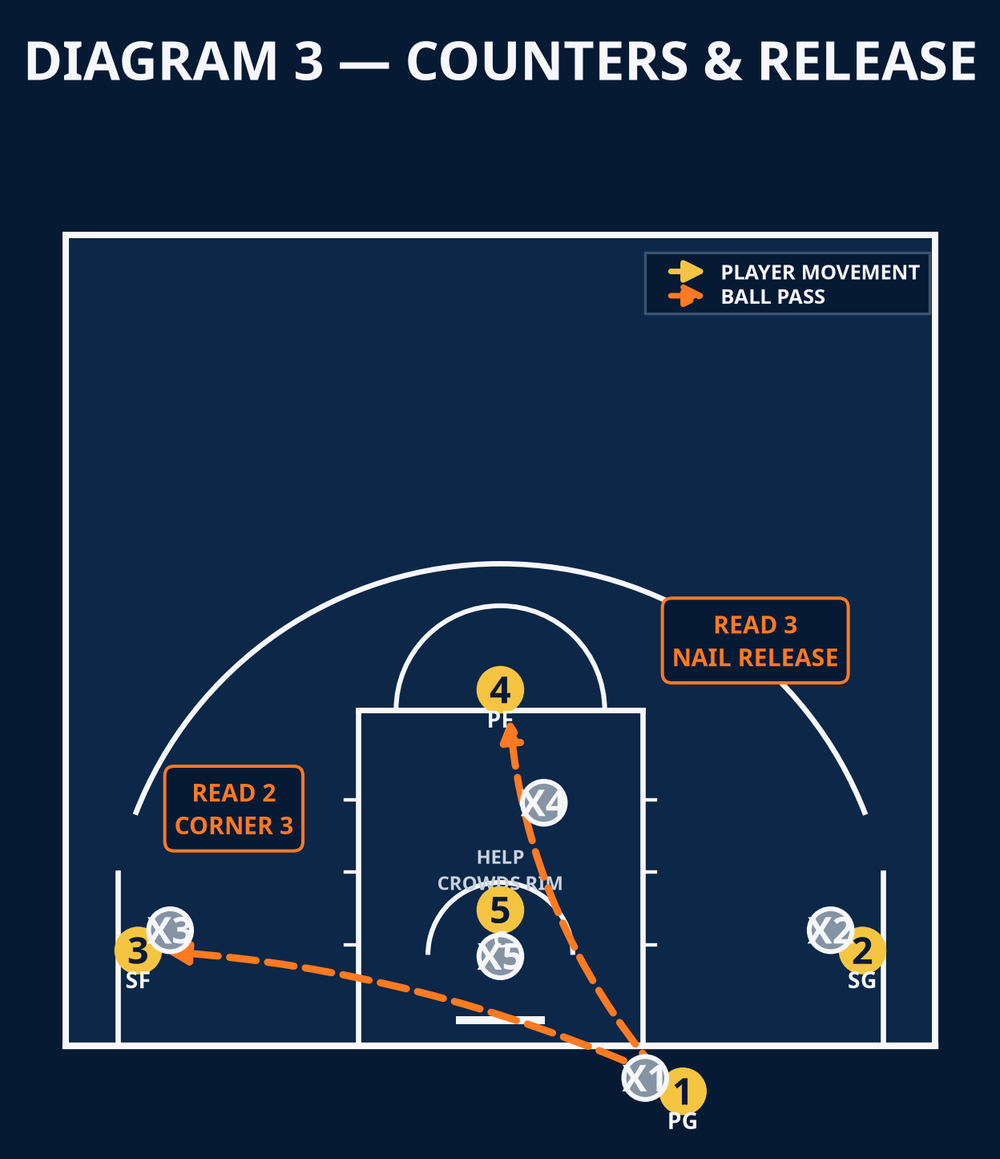
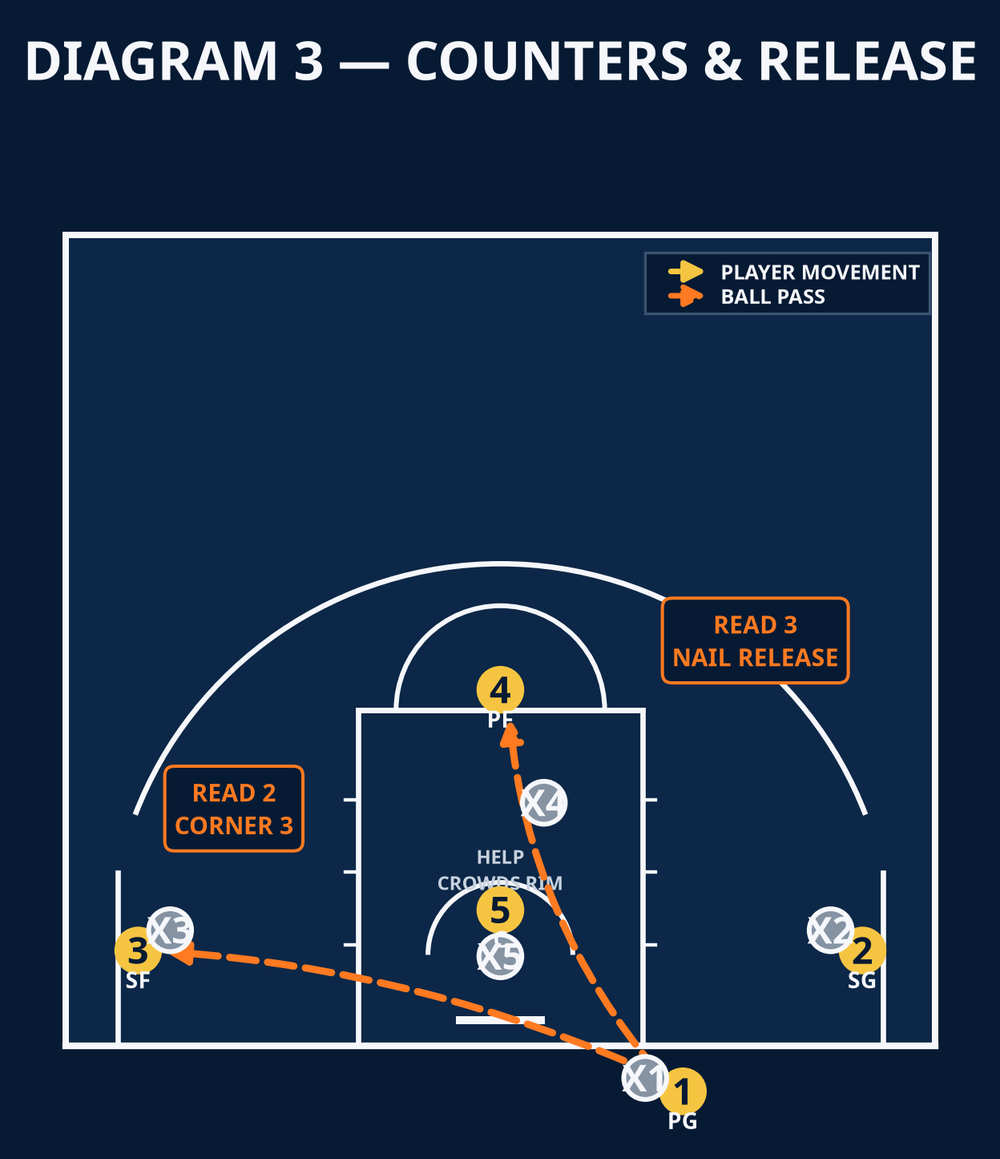
Flow if the rim is covered. If Read 1 is not clean by count three, 1 scans 3 in the weak-side corner, then 4 at the nail. After screening, 4 opens to the free-throw-line area, 4–5 m from the basket. After the inbound pass, 1 steps in to the ball-side wing. That leaves a balanced 4-out, 1-in shape instead of forcing a late, low-percentage inbound.
Key Coaching Points
| Teaching point | Coach’s cue |
|---|---|
| Timing before speed | “Screen set, then cut.” A fast cut before the screen is a defended cut. |
| Legal screening | “Beat them there and freeze.” 4 must arrive early, set the base, and avoid a moving screen. |
| Rim positioning | “Seal in front, not under.” 5 should own the front-rim catch space. |
| Inbounder vision | “See rim, corner, nail.” 1 must not stare at 5 and telegraph the pass. |
| Corner discipline | “Sprint past the arc.” Both corners create the width that makes the middle available. |
| Finish through contact | “Two hands, chin, two feet.” Secure the pass before looking to score. |
Common Mistakes
The most frequent breakdown is 5 leaving before 4 is stationary. Stop the action at once and rehearse the half-beat: 5 watches 4’s feet, then cuts. The second error is a moving screen by 4. Mark the screen spot with a flat cone and require 4 to arrive square and still. The third error is the inbounder pre-deciding the rim pass. Correct it by giving 1 a verbal scan order—“rim, corner, nail”—on every rep. The fourth is shallow corner spacing; if either wing stops inside the arc, one defender can tag the rim and still recover to the shooter.
Variations & Progressions
Variation 1 — Corner Counter. When the weak-side low defender commits to 5 at the rim, 1 skips to 3 for a shot-ready catch. 3 should be loaded on the outside foot, ready to shoot or drive baseline if the closeout is wild.
Variation 2 — Nail Release. When the defence switches the cross-screen or fills the front-rim window, 1 passes to 4 at the nail. 4 attacks the feet of the closing defender, hits the short jumper, or flows immediately into your regular half-court offence.
Progression — Twist Counter. Against a top-lock or an automatic switch, call “Twist.” Instead of continuing to the ball-side rim, 5 reverse-cuts back to the weak-side rim while 4 slips directly to the ball-side elbow. This turns an aggressive switch into a lay-up or elbow catch.
Age Adaptations
For Under-8 and Under-10, use a half-court, shorten the cuts, and allow a direct chest pass to a stationary 5 on the block. The priorities are safe spacing, a legal inbound spot, and catching with two hands. For Under-12 and Under-14, add the full cross-screen and teach the three-read order. For Under-16 and open-age groups, install live switching, top-locking, and a designated rim tagger; players must communicate the counter before the official’s five-second count begins.
Practice Plan: Install It in 20 Minutes
Begin with five minutes of walk-through timing against cones. Spend the next five minutes on 4’s stationary screen and 5’s seal, resetting any rep with a moving screen or a catch under the backboard. Then run five minutes of 5-on-0 with 1 calling the read aloud before passing. Finish with five minutes of 5-on-5 guided defence: first trail the screen, then switch it, then collapse the low helper. Keep score: award two points for a front-rim finish, three for a corner catch-and-shoot, and one for a clean nail release. The scoring keeps the team committed to making the correct read rather than forcing the first option.
References
[1]: https://www.venueguide.fiba.basketball/vanue-design "FIBA Venue Guide — Venue Design"
