SLOB Box Flare: End-of-Game Buzzer Beater for a Right-Wing Three
Install a timed baseline-out-of-bounds action that creates a right-wing buzzer-beater while preserving an immediate rim counter.
Equipment Needed
Overview
SLOB Box Flare is a baseline out-of-bounds (SLOB) end-of-game action built to free your best catch-and-shoot player for a clean right-wing three, while putting a high-percentage rim option directly behind the first read. It is best used when your team is trailing by three or fewer points, has possession under its own or the opponent’s basket, and has 2.5–4.0 seconds remaining. The design gives the inbounder a simple progression: 2 on the wing, 4 at the rim, 3 as safety. Do not call this play merely because it is your “last shot.” Call it when you know who you want shooting and can trust the other four players to create the passing window without drifting from their jobs.
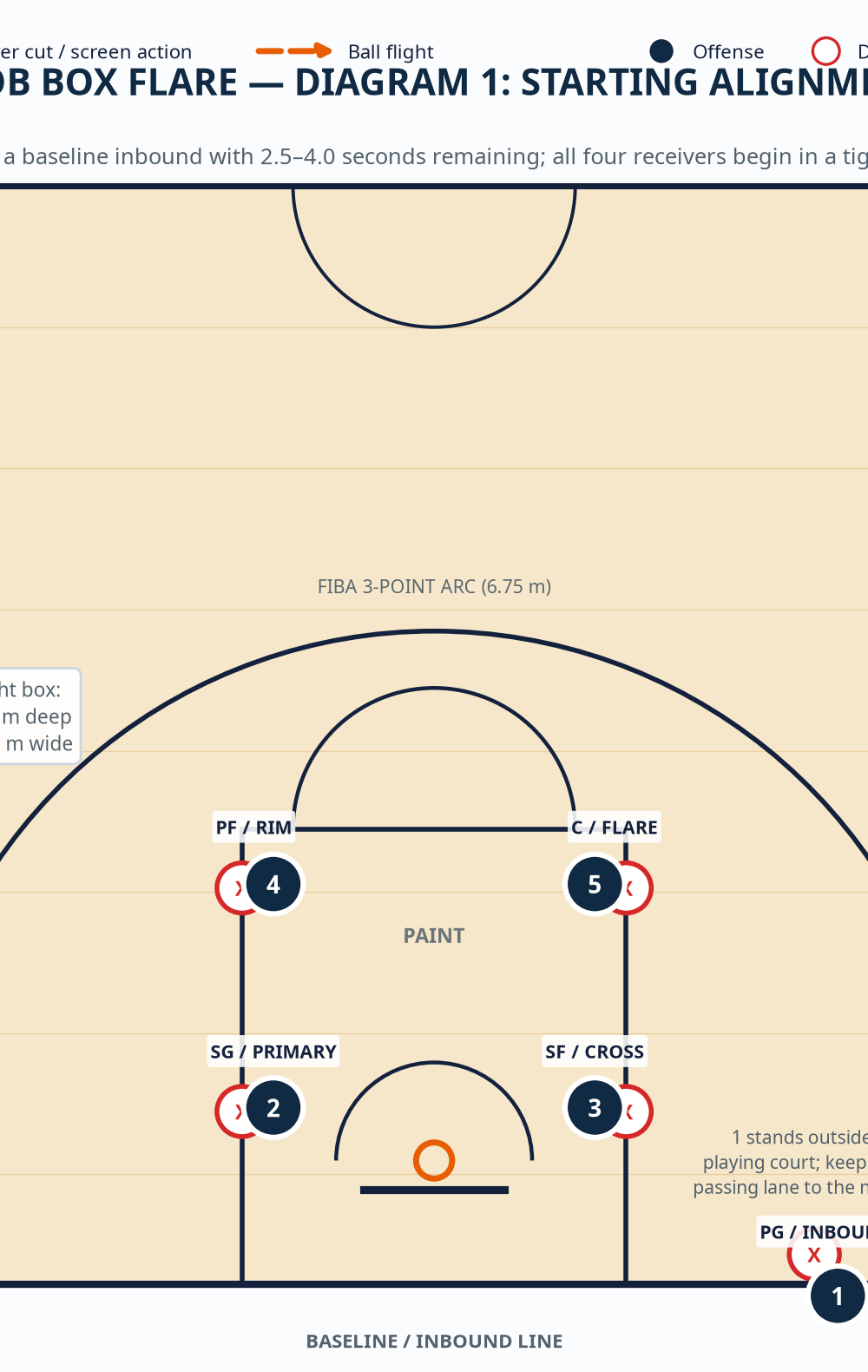
The diagram uses a FIBA half-court from the standard 28 m × 15 m playing court. The 6.75 m arc defines the shooter’s target window.1
Setup
Set this up on the right baseline with a game ball, visible countdown, four cones, and contrasting pinnies. Teach it 5-on-0 first, then add five defenders. Work on the 14 m half-court nearest the basket.1
| Spot | Player and job | Exact starting point | Non-negotiable detail |
|---|---|---|---|
| 1 | Point guard / inbounder | 0.5 m outside the right side of the baseline, level with the lane line | Present the ball high and see all three reads before passing. |
| 2 | Shooting guard / primary shooter | Left low-block area, approximately 2.3 m from the baseline | Sell a cut to the rim before sprinting to the right-wing window. |
| 3 | Small forward / cross-screener | Right low-block area, opposite 2 | Create contact on X2 without extending arms or moving. |
| 4 | Power forward / rim flash | Left elbow, approximately 5.1 m from the baseline | Flash hard to the front of the rim and demand the defense’s eyes. |
| 5 | Centre / flare screener | Right elbow, approximately 5.1 m from the baseline | Turn shoulder-to-hip and hold the flare-screen angle for 2. |
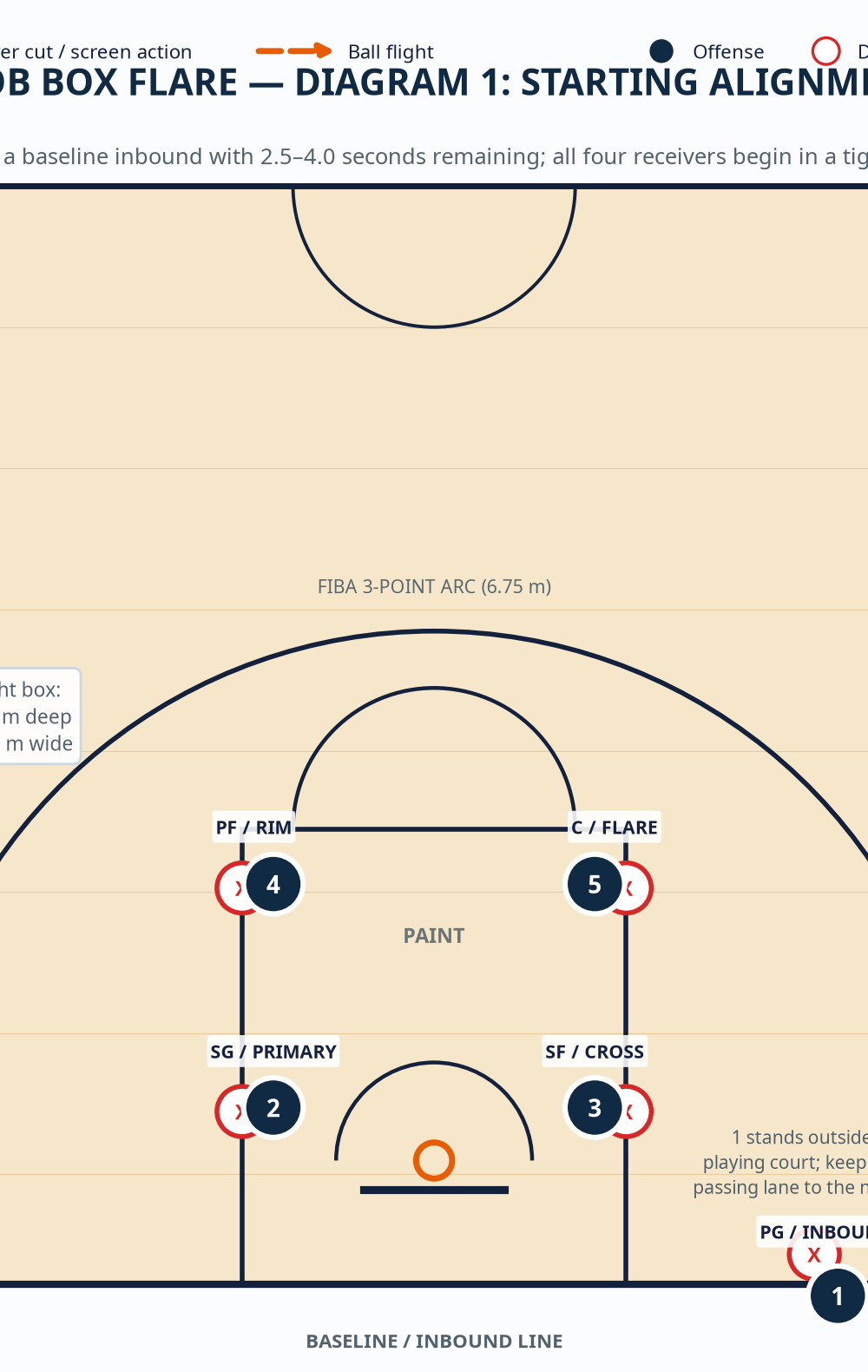
Start with the four receivers in a compact box roughly 4.1 m wide and 2.9 m deep. That congestion is the disguise. The defense should not know whether 2 is the shooter, 4 is the lob threat, or 5 will slip. Put X1 on the inbounder, X2 on 2, and match the remaining defenders normally. Give the players a one-word huddle cue: “Box—Rim—Flare.”
Step-by-Step Instructions
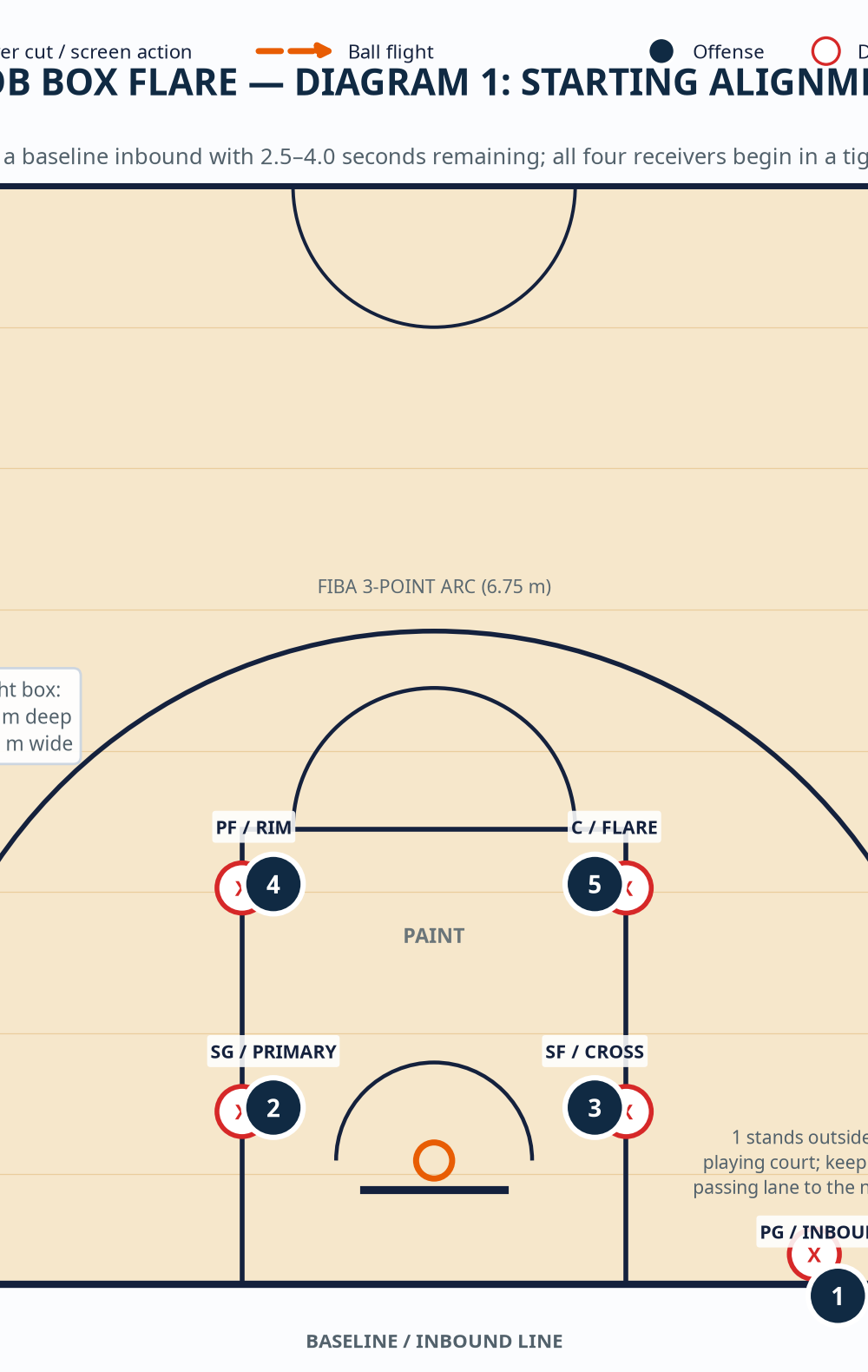
Call the score and clock first. Before the official hands over the ball, 1 confirms the needed score with the bench. If any made basket is enough, make 4 the first look; if a three wins or ties, make 2 the primary.
Show the identical box picture. 2 and 3 set low while 4 and 5 align at the elbows. All four receivers stay balanced and do not lean toward their eventual route. 1 keeps a clear 0.5 m passing lane. Start a 4.0-second count as the referee begins the throw-in count.
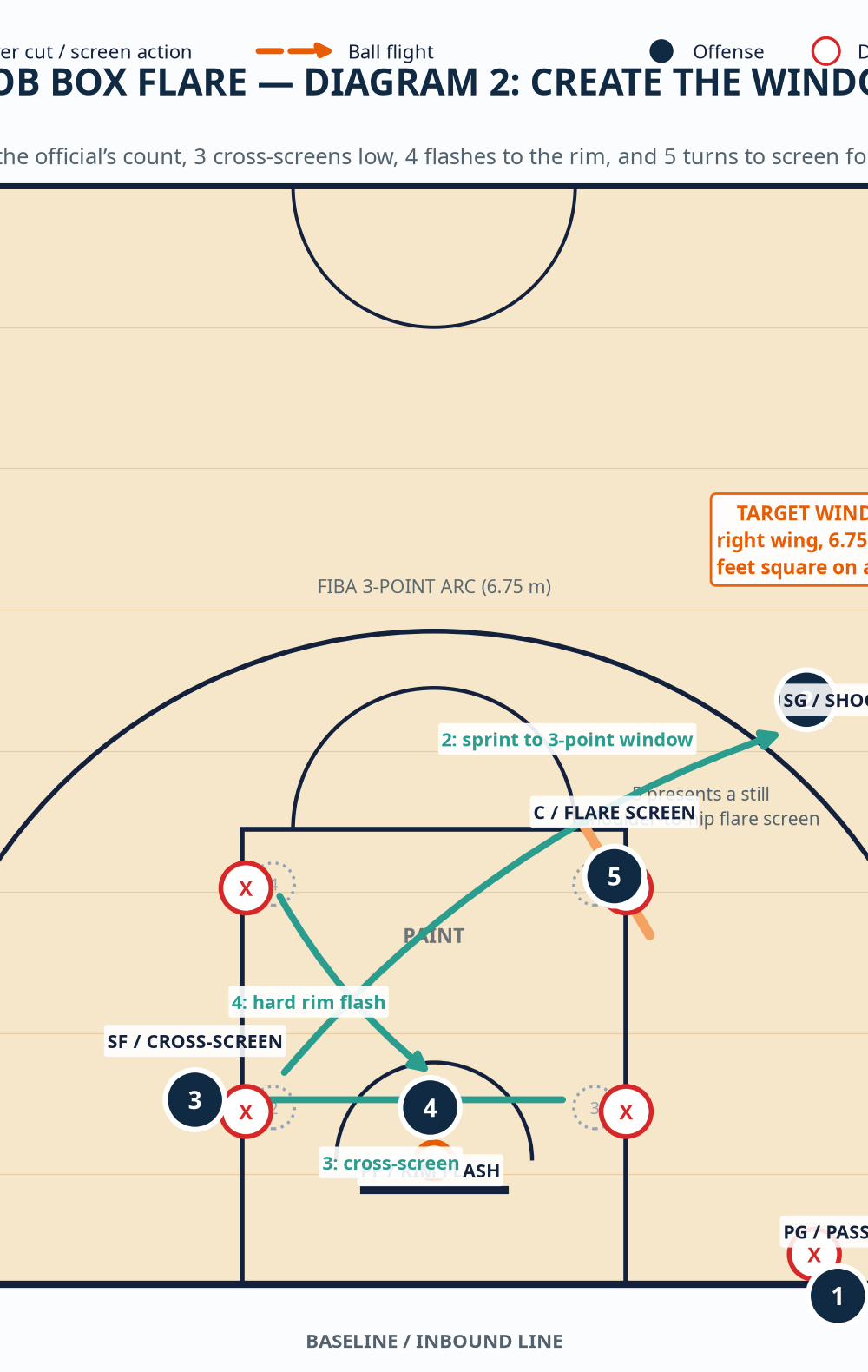
Trigger the low cross-screen at 0.0–0.3 seconds. On 1’s verbal cue, 3 cuts across the lane and sets a legal, stationary cross-screen on X2’s path. 2 takes one hard step toward the front rim first; this forces X2 to protect the layup before chasing the flare. 4 flashes directly to the front of the rim with two hands shown. The rim flash must look real enough to draw the low defender into the paint.
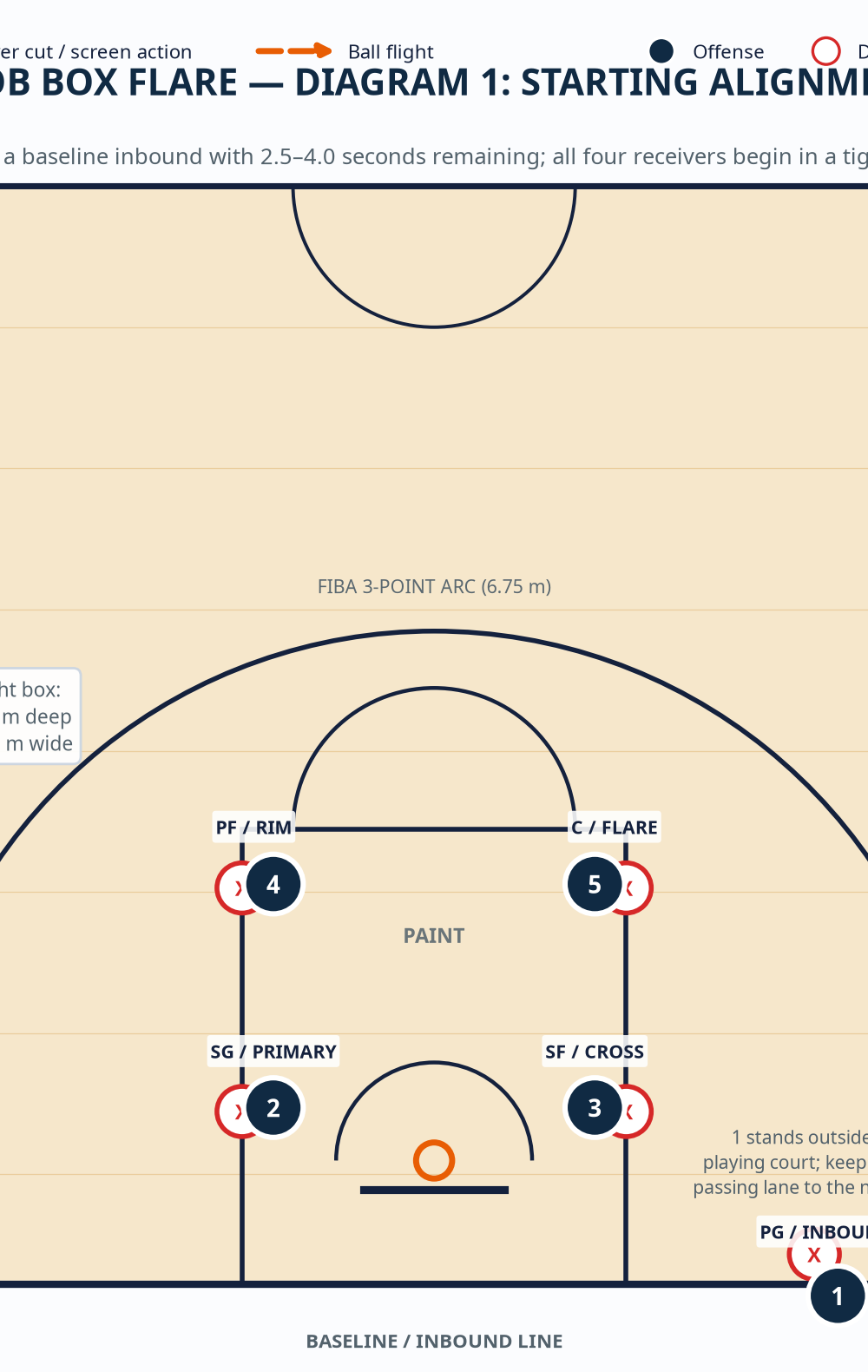
Create the flare at 0.3–0.8 seconds. As 2 clears 3, 5 pivots into a shoulder-to-hip flare screen near the right elbow. 2 sprints through the screen and arrives at the right wing just outside the 6.75 m arc. Coach the route as a straight sprint, not a loop: 2’s outside foot plants first, hips square to the basket, hands show early. 5 must be still before contact; an illegal moving screen loses the possession.
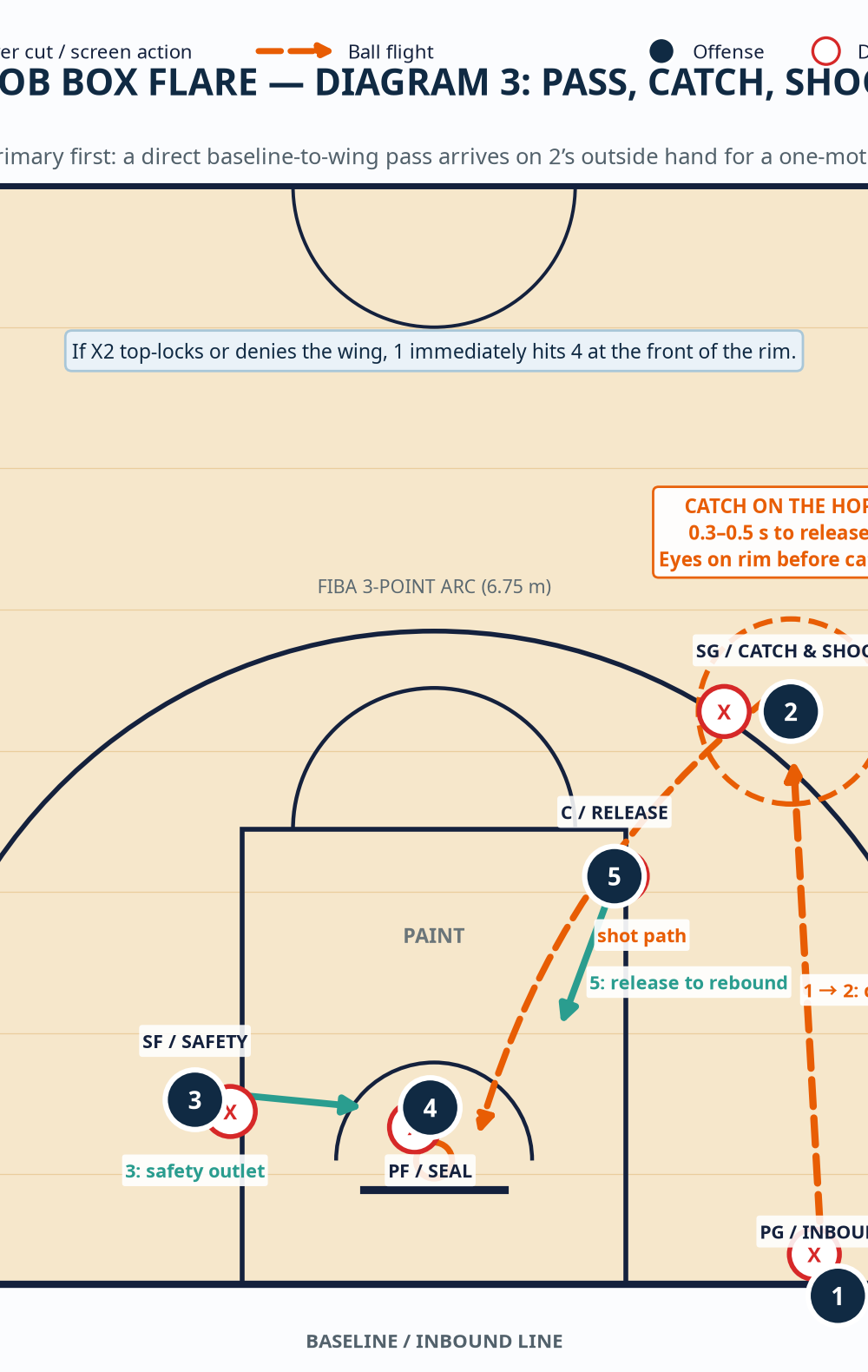
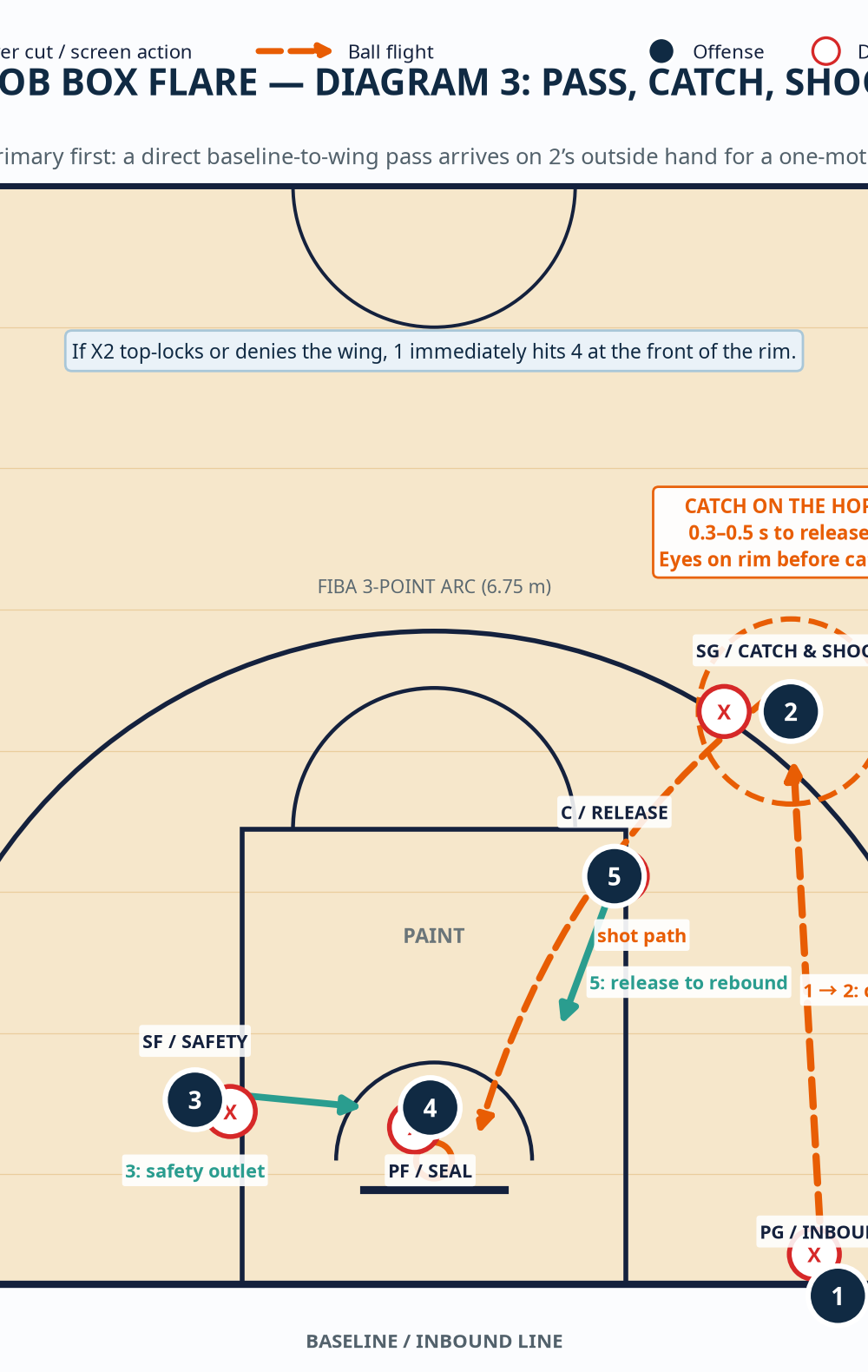
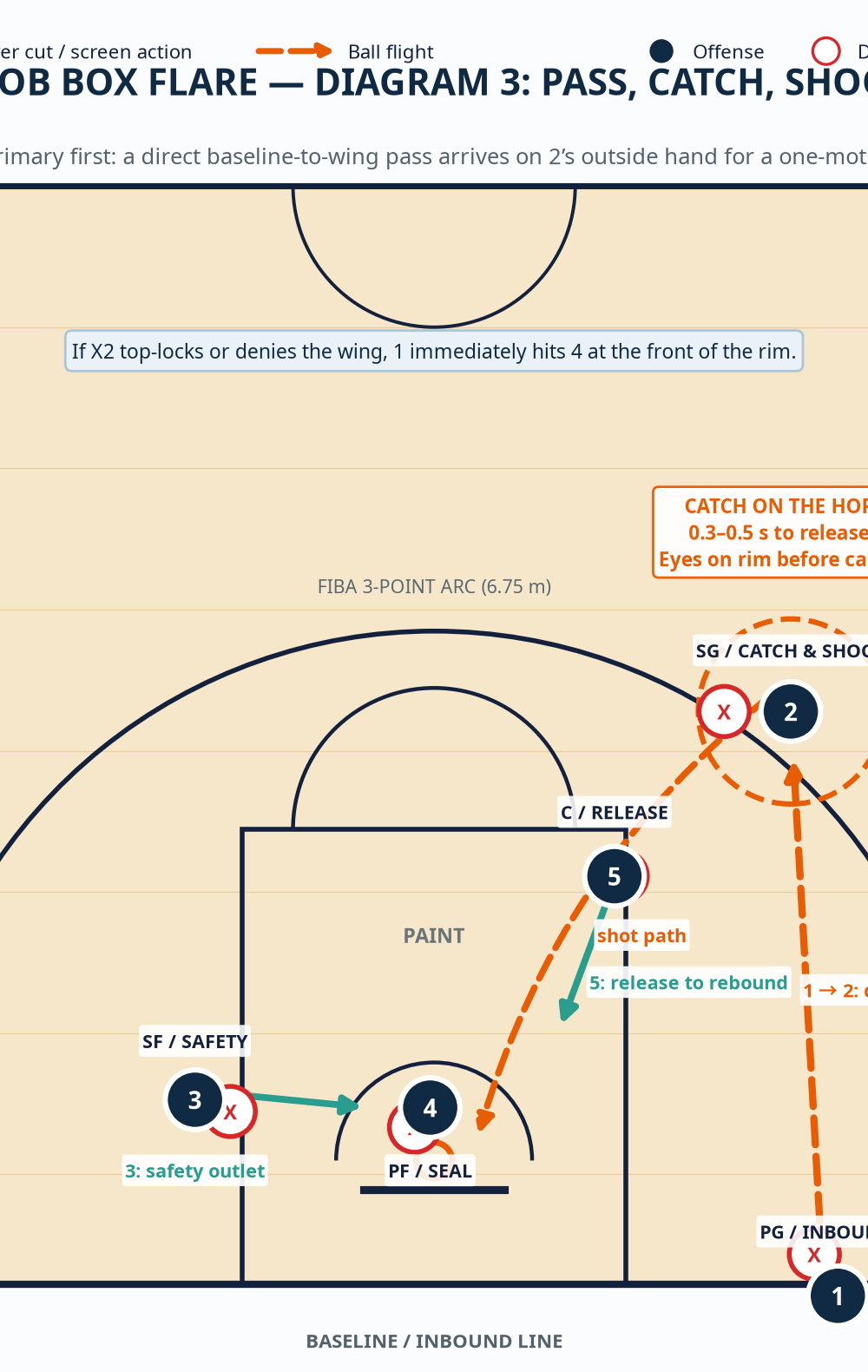
Make the primary pass at 0.8–1.2 seconds. 1 throws a direct, firm pass to 2’s outside shoulder, away from the recovering defender. Do not float the ball. A chest-to-shoulder pass lets 2 catch on the hop and go straight into the shot pocket. For this action to beat the horn, train a 0.3–0.5 second catch-to-release rather than a catch, dip, and pause.
Use the read, not the drawing. If X2 top-locks 2, 1 hits 4 at the front of the rim. If the defense switches the flare, 2 back-cuts while 5 seals. If neither option is safe, 3 settles as the weak-side outlet. One clean read, one decisive pass, one shot.
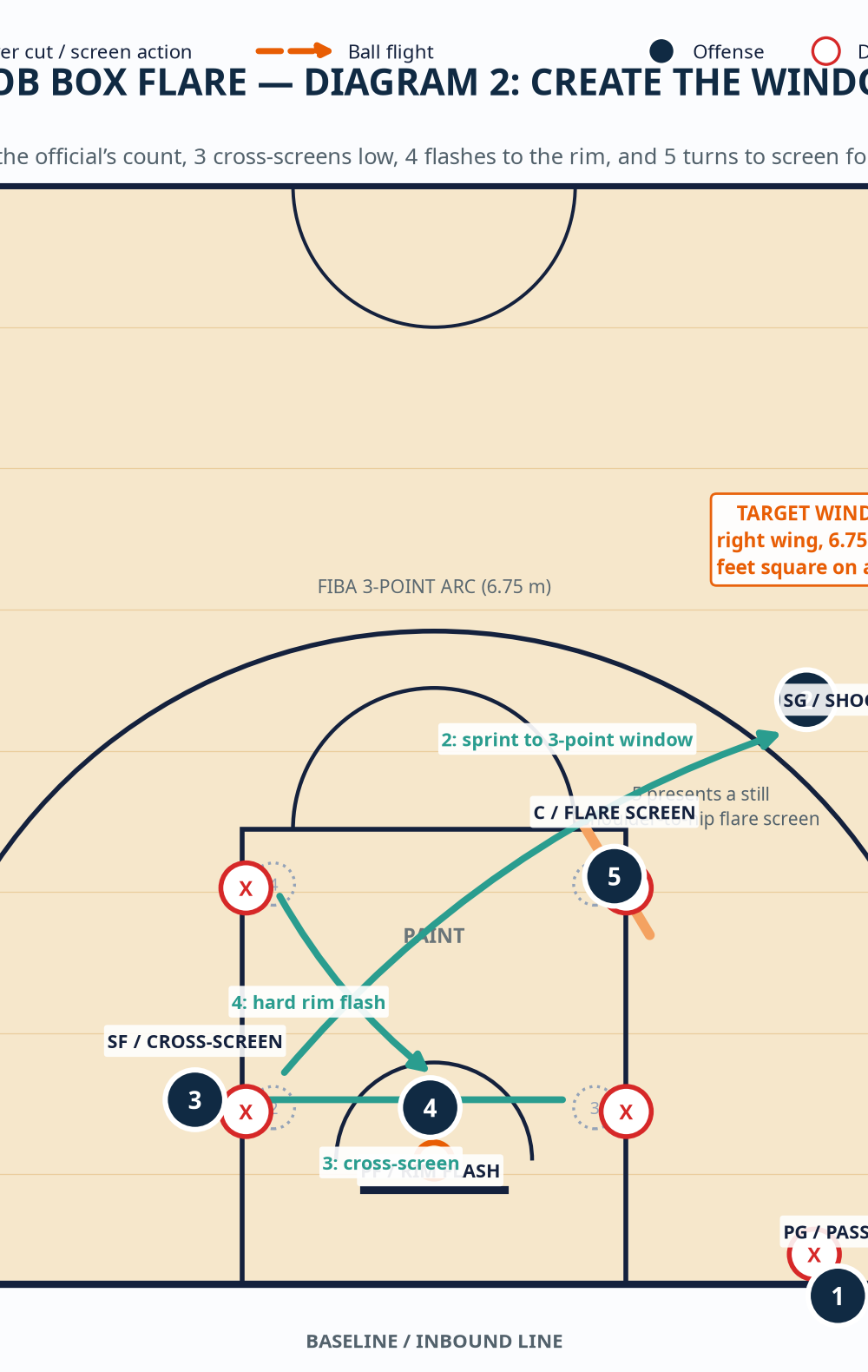
- Finish with game realism. 2 shoots on the first clean catch. 4 seals, 5 releases to rebound, and 3 protects against the long rebound. Run five reps from each baseline. Track a legal inbound and a shot released before the horn.
Key Coaching Points
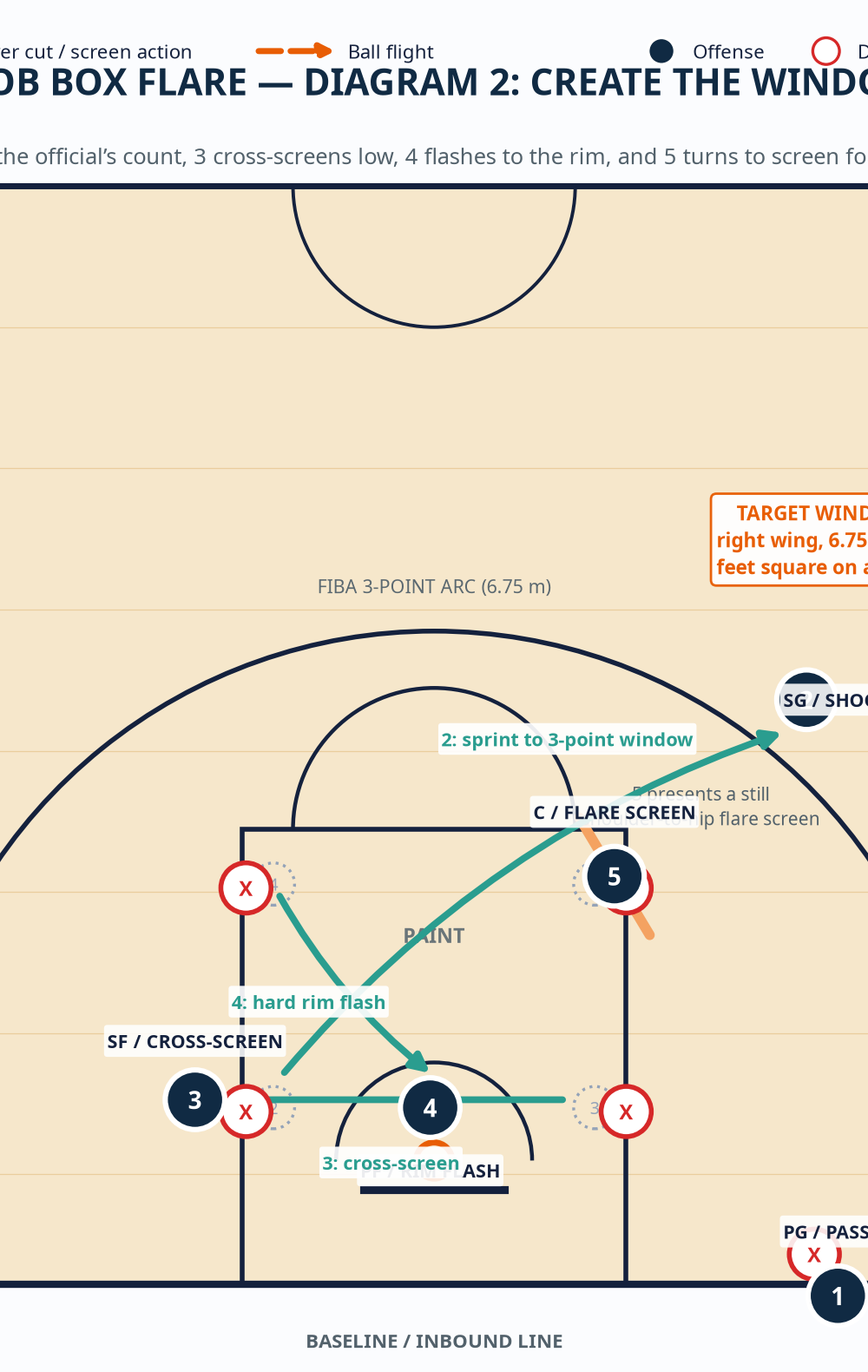
- Sell the first threat. 4’s rim flash is not a decoy jog. Demand a full-speed sprint, hands above chest height, and a body seal if the ball does not arrive.
- Screen angle creates the shot. 5 should put the chest toward the sideline and the back toward the paint, presenting a broad, stationary target that turns X2’s chase path away from the wing.
- Pass to the shooter’s outside hand. A pass that lands on 2’s inside hip brings the defender into the catch. Throw it outside, in front, and on time.
- Make 2’s feet repeatable. Rehearse “sprint, inside-out plant, square, rise” until the feet are automatic. The shot starts before the ball arrives.
- Keep 1 calm and square. The inbounder does not need to throw a spectacular pass. He or she needs a safe passing window and an on-time decision.
- Coach the counter in the huddle. Every player must know that a denial of 2 automatically promotes 4 to first read; no one should freeze waiting for the primary picture to reappear.
Common Mistakes
| Mistake | What it looks like | Immediate correction |
|---|---|---|
| The box spreads early | Defenders can call out every matchup before the cut begins. | Mark the four start spots with cones and demand shoulder-width stances inside the box. |
| 3 chases the screen | X2 slips through untouched or a foul is called. | Teach 3 to arrive first, stop on two feet, and absorb contact with the torso only. |
| 5 moves into contact | The flare looks open but becomes an offensive foul. | Freeze the drill at the screen; require 5 to be set before 2’s defender reaches the hip. |
| 2 drifts beyond the window | The pass becomes longer and the release loses rhythm. | Paint or cone a 1 m target circle just outside the wing arc; 2 must finish inside it. |
| 1 stares at 2 | The defense top-locks the shooter and steals the pass. | Require 1 to look at 4 first for a half-second, then snap eyes to 2. |
Variations & Progressions
Rim-first counter: When you need two points, keep the box but make 4 the primary at the rim; 2 becomes the safety shooter.
Slip variation: Against automatic switching, 5 fakes the flare and slips to the rim. Read 5 only after the switch is confirmed.
Pressure progression: Move from 5-on-0 to guided defense to live 5-on-5 with top-locks, switches, a 4.0-second count, and a scoreboard target.
Age Adaptations
| Group | Adaptation | Coaching emphasis |
|---|---|---|
| Under 10 | Remove the flare screen and have 2 make a simple V-cut to a short wing, 3–4 m from the basket. | Spacing, jump stops, and a strong two-hand pass. |
| Under 12 | Use the box but move the target inside the three-point arc and rehearse a legal stationary screen. | Timing the first cut and seeing the rim flash. |
| Under 14 | Run the full action with a shortened 3.0-second countdown and add one live defender on 2. | Catch-ready feet and reading a top-lock. |
| Under 16 and Open | Use the 6.75 m target, live five-player defense, switching rules, and both baseline sides. | Decision speed, screen legality, and counter execution. |
Practice Script
Give this play 20 minutes in a session: four minutes to walk through landmarks; five minutes of 5-on-0 timing; five minutes of guided 5-on-5 reads; and six minutes of live “score/clock” competition. End with each unit needing two successful legal executions in three attempts. Film the inbounder’s first two seconds and the shooter’s arrival feet; those are the fastest places to improve the play.
Reference