

Basketball
Pressure Window Passing: Accuracy Under Live Ball Pressure
A progressive half-court passing drill that teaches players to protect the ball, create a passing window, and deliver on-target passes while defenders apply real pressure.
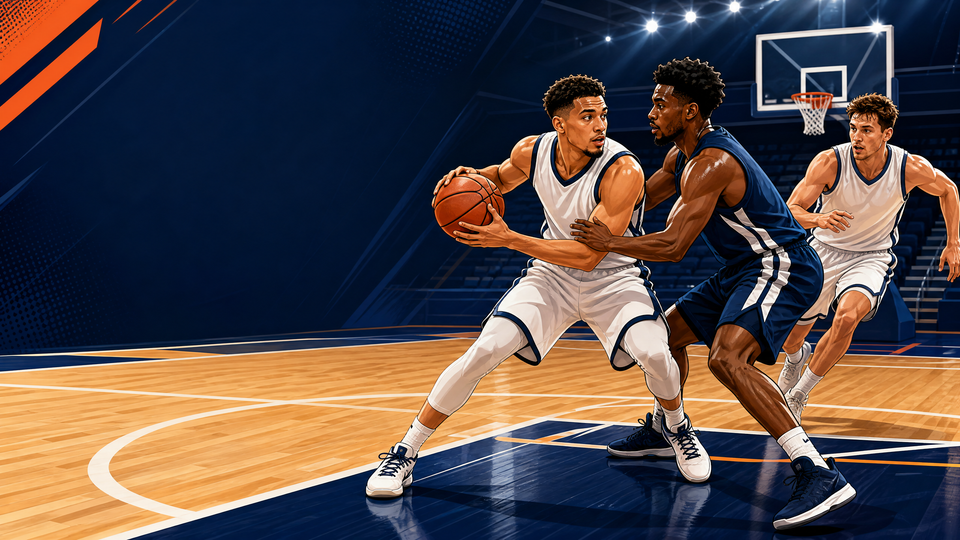
What you need
6 flat cones, 4-6 basketballs, 2 sets of pinnies, whistle, 60-second timer
Overview
Pressure Window Passing is an 18-minute half-court drill that makes players deliver passes on time, on target, and away from the defender’s reach. The ball-handler must absorb pressure, the receiver must win a window, and the next player must move the ball before the closeout arrives. It exposes poor spacing, lazy hands, late pivots, and inaccurate delivery immediately.
Run it after warm-up and before your main half-court offense, especially before opponents who deny wings or pressure the point guard. The design uses the attacking half of a 28 m x 15 m FIBA court and requires every pass to hit the receiver’s outside-hand or chest-side pocket without breaking stride.
Setup
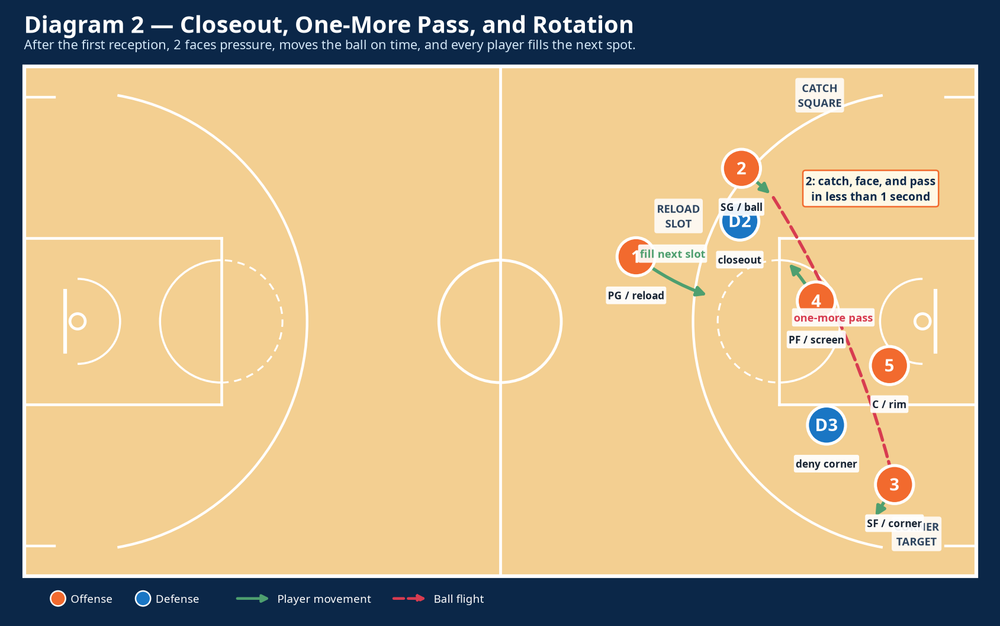
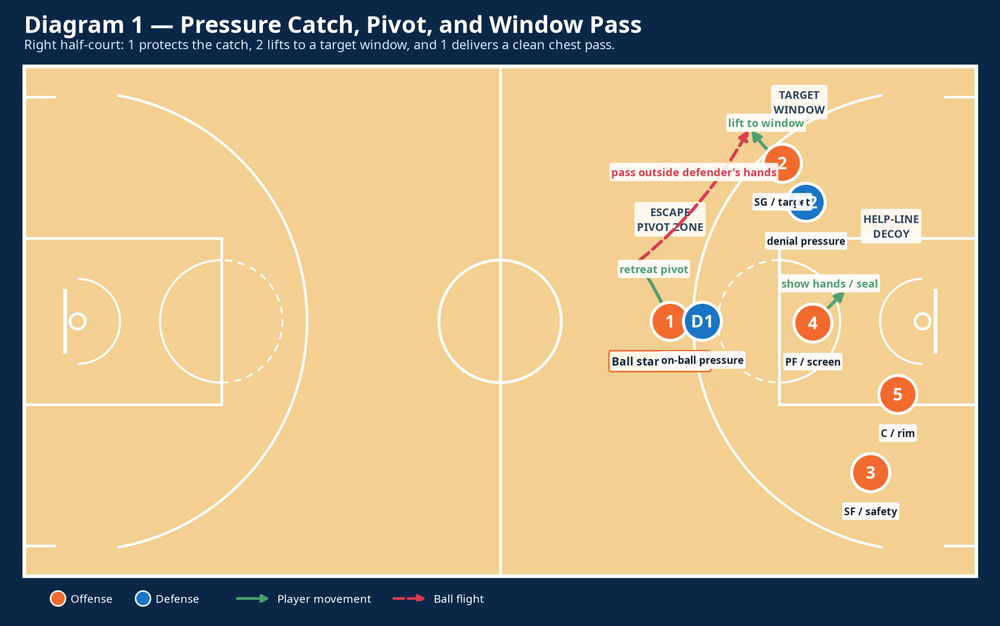
Use the right half-court. Put four flat cones around a 1.5 m x 1.5 m target window on the wing, just outside the lane line and below the free-throw-line extended. Place a second two-cone gate at the reload slot, roughly 4 m from the top of the key. Keep the corner target 1 m inside the sideline and 1 m above the baseline so there is a visible passing lane. The active group has five offensive players and two defenders; with 10 players, the remaining athletes wait on the baseline and enter on the next rotation.
| Role | Starting location and job | Coaching constraint |
|---|---|---|
| 1 — Point Guard | Top/slot with the ball, about 5.5 m from the basket | No dribble after the catch; use a legal pivot to create the angle. |
| D1 — On-ball defender | One arm’s length from 1 | Pressure the ball with active feet and hands, but no reaching across the body on the teaching reps. |
| 2 — Shooting Guard | Wing, initially denied by D2 | Lift hard into the target window and show a clear hand target. |
| 3 — Small Forward | Deep corner safety outlet | Step into the ball and be ready for the one-more pass. |
| 4 — Power Forward / 5 — Center | Elbow and dunker spot | Occupy help defenders, show hands, and do not drift into the passing lane. |
You need six cones, four to six basketballs, pinnies for defenders, a whistle, and a timer. Put the target window down first; if the receiver does not have a defined destination, the drill becomes random running rather than passing practice.
Step-by-Step Instructions
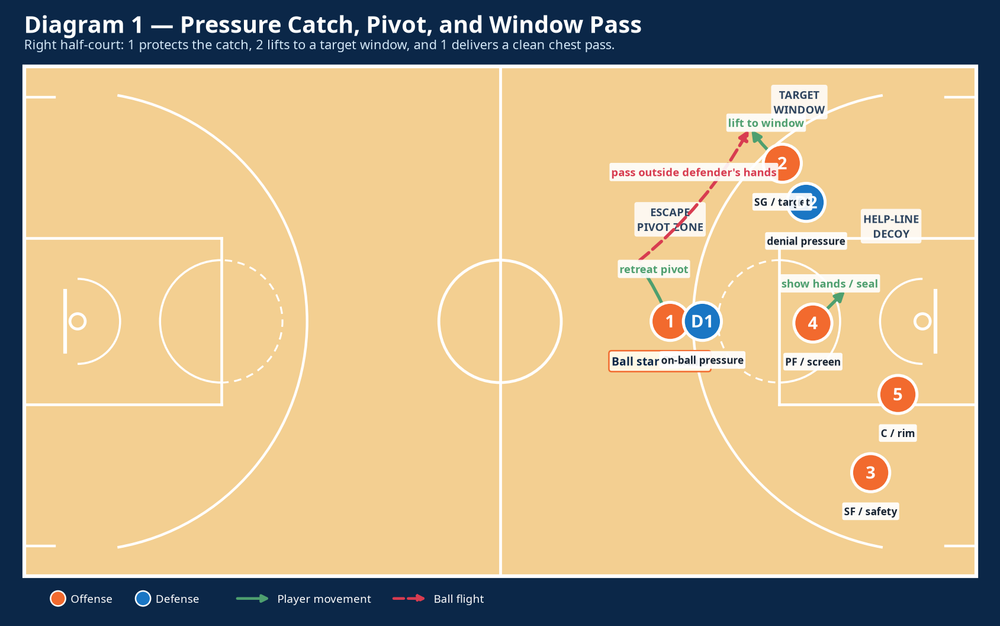
Build the picture. Put 1 at the slot with a ball, D1 in ball pressure, 2 on the wing with D2 denying, 3 in the corner, 4 at the elbow, and 5 near the weak-side dunker spot. Explain the scoring before the first rep: a pass earns one point only if it reaches the target window cleanly; a catch-and-one-more pass earns a second point.
Start under controlled pressure. On the whistle, D1 closes the air space without fouling. 1 must establish a low, balanced base, put the ball on the far hip, and use a retreat pivot or reverse pivot to move the ball away from D1. Do not allow 1 to dribble out of trouble in the first progression. Give the passer a maximum of three seconds to find the window.
Make the receiver win the window. As 1 pivots, 2 plants the inside foot, changes pace, and lifts into the 1.5 m square. 2 should arrive with knees bent, eyes on the ball, and both hands available. D2 plays denial pressure from the ball side; the receiver must create separation with footwork and body position, not by pushing off.
Demand an accurate first pass. 1 sends a firm two-hand chest pass, bounce pass, or overhead pass through the open lane. The ball must travel to 2’s chest-side pocket, not to the defender’s side. If 2 needs a second step, a jump, or a reach back to secure it, record the rep as inaccurate even if the team retains possession.
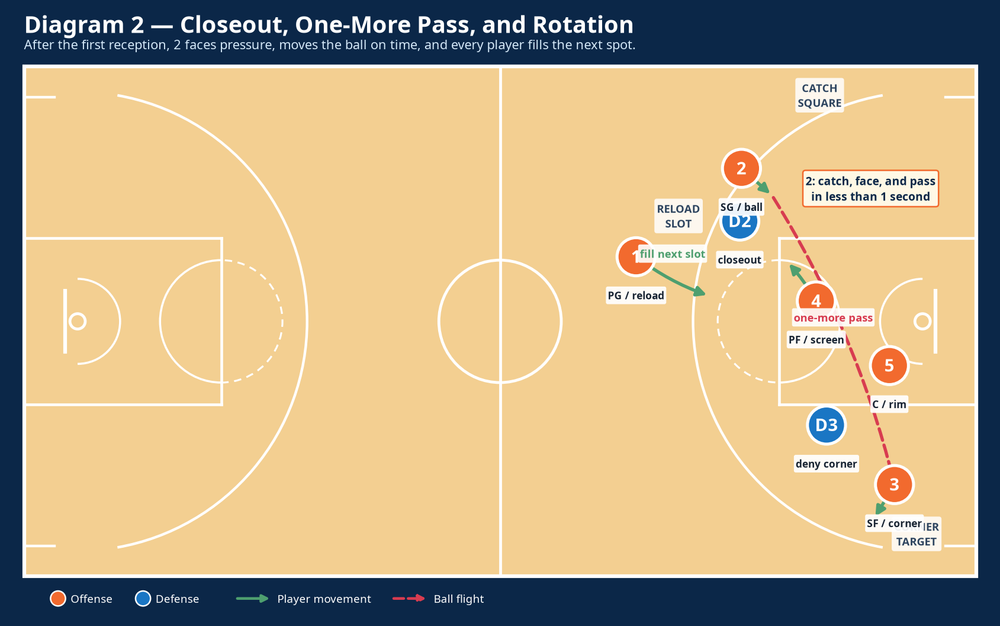
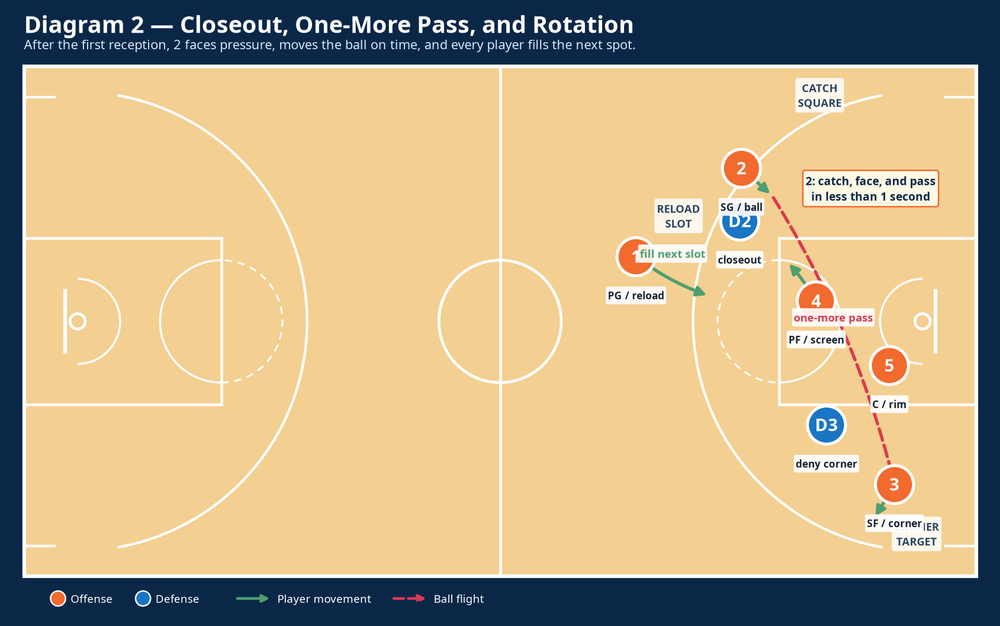
Add the closeout and one-more decision. Once 2 catches, D2 closes under control. 2 must catch on two feet, square the shoulders, and pass to 3 in the corner in one second or less. 3 steps toward the pass while D3 contests the lane. 4 re-angles toward the elbow and 1 fills the reload slot; this teaches players that good passing is followed by purposeful spacing.
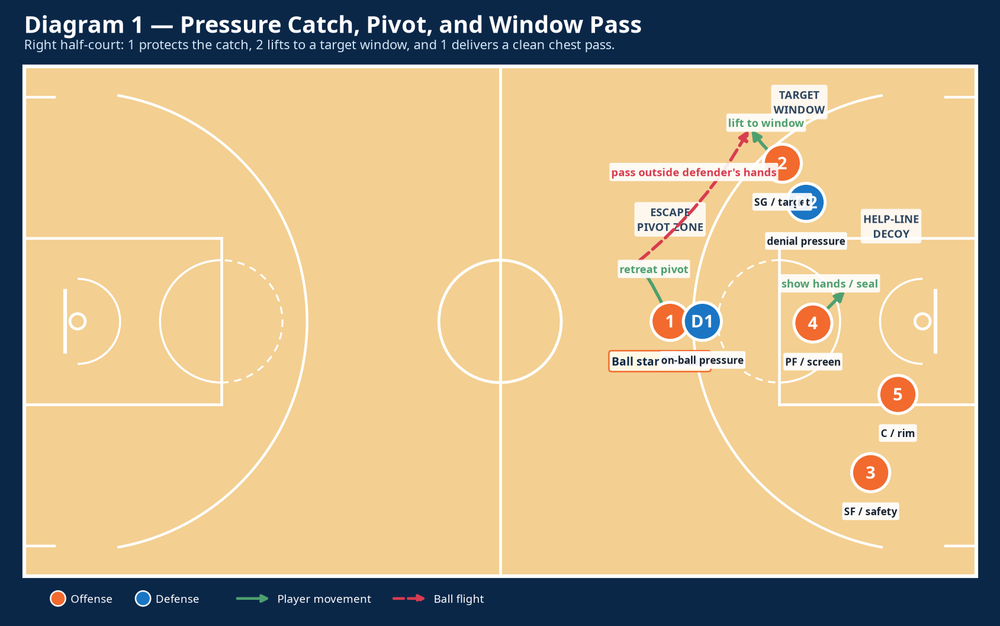
Score short competitive waves. Run three 60-second waves. Each group starts at zero. Award one point for a clean pass from 1 to 2, one point for the on-time one-more pass to 3, and one bonus point if both balls hit the receiver’s target hand or chest pocket. Subtract one point for a turnover, a pass outside the target square, or a violation of the no-dribble rule.
Rotate with pace. After 3 receives, the ball returns to the baseline queue. Rotate 1 to D1, D1 to 2, 2 to D2, D2 to 3, 3 to 4, 4 to 5, and 5 to the queue. If you have only eight players, remove 5 and use a coach or cone as the stationary rim spacer. Keep rotations under 10 seconds.
Key Coaching Points
| Coaching cue | What the coach should see |
|---|---|
| “Feet first, pass second.” | 1 establishes a base and pivots before releasing; there is no off-balance flick around pressure. |
| “Create the window early.” | 2 changes pace before the ball is picked up and arrives in the target square on balance. |
| “Pass to the safe side.” | The ball travels to the side of 2 furthest from D2, ideally to the chest-side pocket. |
| “Show a target, call a name.” | The receiver has visible hands and gives an early verbal cue; silent receivers are late receivers. |
| “Catch loaded.” | 2 and 3 land in an athletic stance with eyes up, ready to pass before the closeout arrives. |
| “Pressure is real; fouls are not.” | Defenders use active feet and legal hand placement so offensive technique stays realistic and safe. |
Coach from the passing lane rather than behind the passer. That angle lets you see whether 1 has actually moved the defender, whether 2 has created separation, and whether the ball crossed the defender’s shoulder line. Correct one detail at a time. A useful immediate correction is: “Move your feet, move the defender, then move the ball.”
Common Mistakes
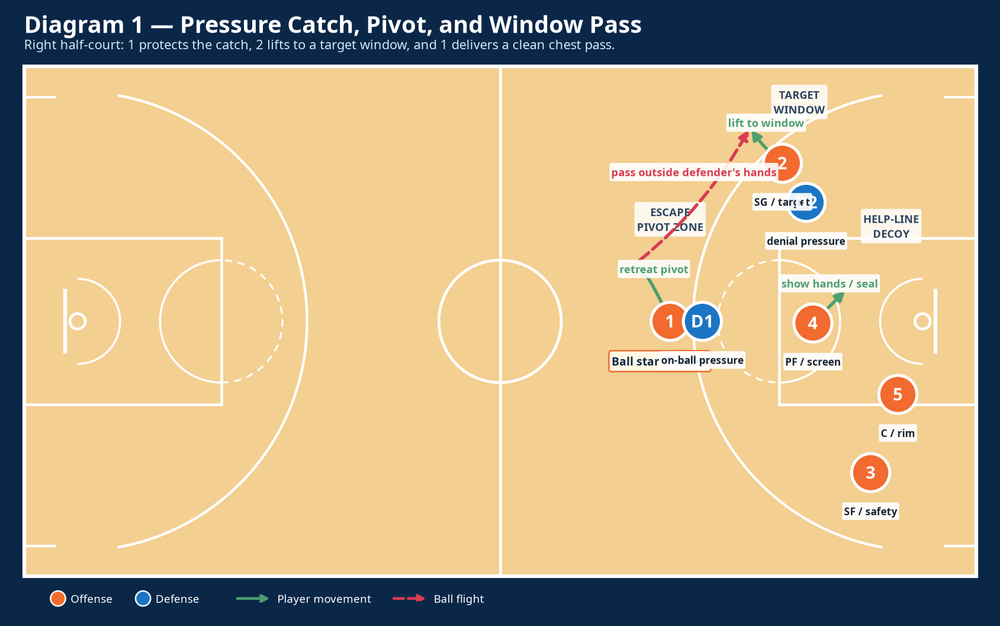
The first common error is that 1 holds the ball at the midline and tries to pass through D1. Stop the rep and demand a far-hip ball position plus a pivot that changes the angle. Second, 2 often drifts sideways instead of cutting to the defined window. Put the target square back in view and require a hard plant before the lift. Third, players throw a soft, looping pass because they are afraid of the defender. Reinforce that a flat, decisive pass to the safe side is safer than a slow pass through traffic. Fourth, 2 catches tall and then needs a recovery dribble. Reset the stance: two feet, hips loaded, eyes to the next target. Finally, do not let defenders turn the drill into a hacking contest; increase denial pressure only when the offense can execute legal, technical reps.
Variations & Progressions
Start with the guided version when introducing the drill. D1 and D2 shadow the action at 60% effort, 1 gets one protective dribble, and the target square is enlarged to 2 m x 2 m. This works.
For the game-speed version, remove the dribble, make D1 and D2 live, and require the first pass within 2.5 seconds. Award the defense two points for a deflection and three for a steal. Now the passer must own the pivot, and the receiver must create the window before the ball comes.
For the decision version, let the coach call “corner,” “elbow,” or “reset” as 2 catches. The call determines whether 2 makes the one-more pass to 3, reverses to 4, or returns the ball to 1. This turns technical accuracy into perception and communication without changing the court setup.
Age Adaptations
For Under-10 players, use six athletes, a 2 m x 2 m target square, passive defenders, and a 4-second decision clock. Teach chest passes and bounce passes only; praise balanced catches more than speed. For Under-12, use one live defender and one guided defender, retain the target square, and begin scoring accurate passes. For Under-14, use the full structure shown in the diagrams with live D1 and D2, a three-second first-pass clock, and competitive waves. For Under-16 and open-age groups, make all defenders live, add D3 on the corner, and track accurate-pass percentage over three waves. A group should target 80% accurate first passes before you reduce the target window or shorten the clock.
Finish with a 30-second debrief: ask where the safe side was, what opened the window, and which footwork answer beat pressure.
