

Basketball
Pressure Free Throw Routine with Transition Execution
A comprehensive drill that combines game-like fatigue, consistent free throw mechanics, and immediate rebounding and transition responsibilities to prepare players for high-pressure moments.

What you need
1 basketball per group of 5, whistle, stopwatch
Overview
The Pressure Free Throw Routine is a comprehensive drill designed to simulate late-game pressure while reinforcing the mechanics of free throw shooting and post-shot responsibilities. Free throws are often practiced in a relaxed environment, which fails to prepare players for the fatigue and mental strain of actual games. This drill incorporates conditioning, structured setup, precise shooting mechanics, and immediate transition responsibilities. It is highly effective for building muscle memory, improving concentration under duress, and ensuring that players do not neglect their rebounding and defensive transition duties after the shot is released. Use this drill during the middle or end of practice sessions when players are already fatigued, as this most accurately replicates game conditions.
Setup

Court: Standard FIBA half-court (28m x 15m). All action takes place within the half-court, centred around the free throw lane and the free throw line, which sits 5.8m from the backboard.
| Equipment | Quantity |
|---|---|
| Basketball | 1 per group of 5 players |
| Whistle | 1 (coach) |
| Stopwatch | 1 (coach) |
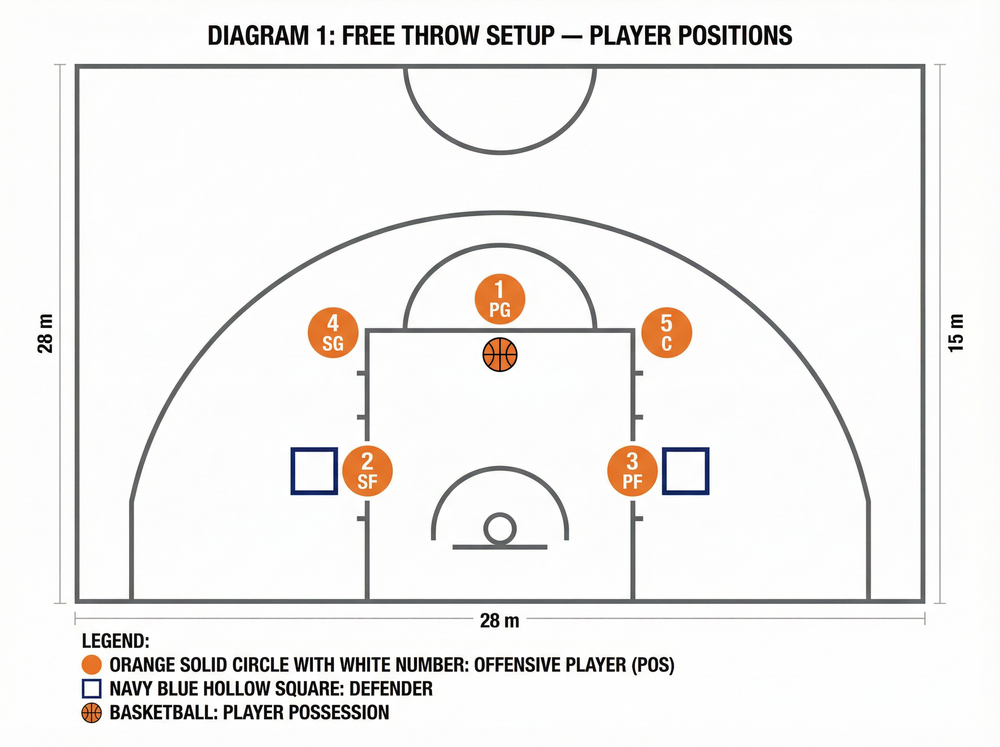
Player Positions at Setup:
| Position | Player | Location |
|---|---|---|
| PG (1) | Shooter | Free throw line |
| SF (2) | Lane player | Left low block lane spot |
| PF (3) | Lane player | Right low block lane spot |
| SG (4) | Lane player | Left elbow lane spot (2nd hash mark) |
| C (5) | Lane player | Right elbow lane spot |
| DEF x2 | Defenders | Outside lane spots (coach or teammate) |
Step-by-Step Instructions

- Conditioning Phase: The five active players run a down-and-back sprint — from the baseline to the opposite free throw line and back (approximately 9m each way) — to simulate the fatigue accumulated during live game play.
- Alignment: Immediately after the sprint, players assume their designated positions along the free throw lane as shown in Diagram 1. The coach or a designated passer delivers the ball to Player 1 (PG) at the free throw line.
- The Pre-Shot Routine: Player 1 executes their personal free throw routine — for example, three dribbles, a deep breath, and a ball spin — taking no more than 10 seconds from the moment the ball is received. The coach should enforce this time limit strictly.
- The Shot: Player 1 shoots the free throw, focusing on a high, arcing release and holding the follow-through (wrist snapped down, fingers pointing toward the basket) until the ball hits the rim or passes through the net.
- Box-Out and Rebound: As the ball leaves the shooter's hands, Players 2 (SF) and 3 (PF) step across the lane to box out the designated defenders, securing the inside rebounding position with a wide stance and hands raised. Player 5 (C) crashes the offensive glass aggressively from the elbow.
- Transition Execution: If the shot is made, the drill resets immediately. If the shot is missed, Players 2, 3, or 5 secure the rebound. Player 4 (SG) retreats to half-court for defensive transition, while the rebounder delivers a quick outlet pass to initiate the fast break, as illustrated in Diagram 2.

Key Coaching Points

Consistent Routine: Every player must perform the exact same pre-shot routine on every single attempt. This is non-negotiable. The routine acts as a mental anchor, triggering a calm, focused state regardless of the game situation, crowd noise, or physical fatigue. Coaches should observe and document each player's personal routine and hold them accountable to it.
Hold the Follow-Through: The shooter must keep their shooting arm fully extended with the wrist snapped down — the classic "hand in the cookie jar" position — until the ball completes its entire flight. Dropping the arm early is one of the most common causes of short, flat free throws.
Aggressive Box-Outs: Lane players must make immediate, physical contact with the defenders the moment the ball leaves the shooter's hands. A passive box-out is no box-out at all. Emphasise a wide base, bent knees, and both arms raised to contest the rebound.
Game-Speed Transition: The drill does not end when the ball hits the rim. The pivot into rebounding, outlet passing, and transition must be executed at full game speed. Lazy transitions in practice become costly turnovers in games.
Common Mistakes

Rushing the Shot: Players often hurry their pre-shot routine due to simulated pressure or physical fatigue. Coaches must enforce the 10-second window while also ensuring players take a genuine, slow breath before shooting. Speed and calm are not mutually exclusive.
Spectating the Flight of the Ball: Lane players standing upright and watching the ball arc toward the basket instead of immediately locating their assigned defender and initiating the box-out. Coaches should cue this with the phrase: "Find your man first, then find the ball."
Dropping the Follow-Through Early: The shooter pulling their shooting arm back before the ball reaches the rim. This is typically caused by anxiety or anticipation of the result and almost always produces a short shot. Reinforce the habit of holding the follow-through until the ball is through the net or off the rim.
Passive Outlet Passing: After securing the rebound, players holding the ball or dribbling out of traffic instead of making a sharp, two-handed overhead outlet pass to the retreating Player 4. Emphasise that the outlet pass is the first action of the transition offence.
Variations & Progressions
Consecutive Makes Challenge: Require the team to make a set number of consecutive free throws (e.g., 5 in a row) before the drill concludes. Every missed shot resets the counter and triggers a conditioning sprint. This variation is excellent for building mental toughness and team accountability.
Swish Only (Advanced): For elite or advanced players, only shots that pass cleanly through the net without touching the rim count as a "make." Any rim contact is treated as a miss, triggering the full rebounding and transition sequence. This sharpens focus on arc and touch.
Crowd Noise Simulation: Have the remainder of the squad or coaching staff create loud, sustained distractions — yelling, stomping, waving towels — to increase the mental pressure on the shooter. This is particularly valuable in the lead-up to high-stakes competitions.
Age Adaptations
| Age Group | Adaptation |
|---|---|
| Under 10 | Focus exclusively on shooting mechanics and a simple 2-step routine. Lower hoop height if necessary. Remove complex rebounding rotations — players simply retrieve the ball and return it. |
| Under 12 | Introduce basic box-out technique at the low blocks. Keep the conditioning element light (a single half-court jog). Emphasise patience at the line. |
| Under 14 | Run the drill as described with full conditioning, box-outs, and outlet passing. Reduce the consecutive-makes target to 3 before progressing. |
| Under 16 & Open | Full drill with maximum intensity. Enforce strict transition responsibilities, penalise missed box-outs with additional sprints, and use the Swish Only variation regularly. |
