Slot Pick-and-Roll Execution: Screen, Pocket Pass & Corner Read
A progressive half-court teaching drill that gives guards and screeners the timing, spacing, and reads to execute a clean slot pick-and-roll against drop coverage.
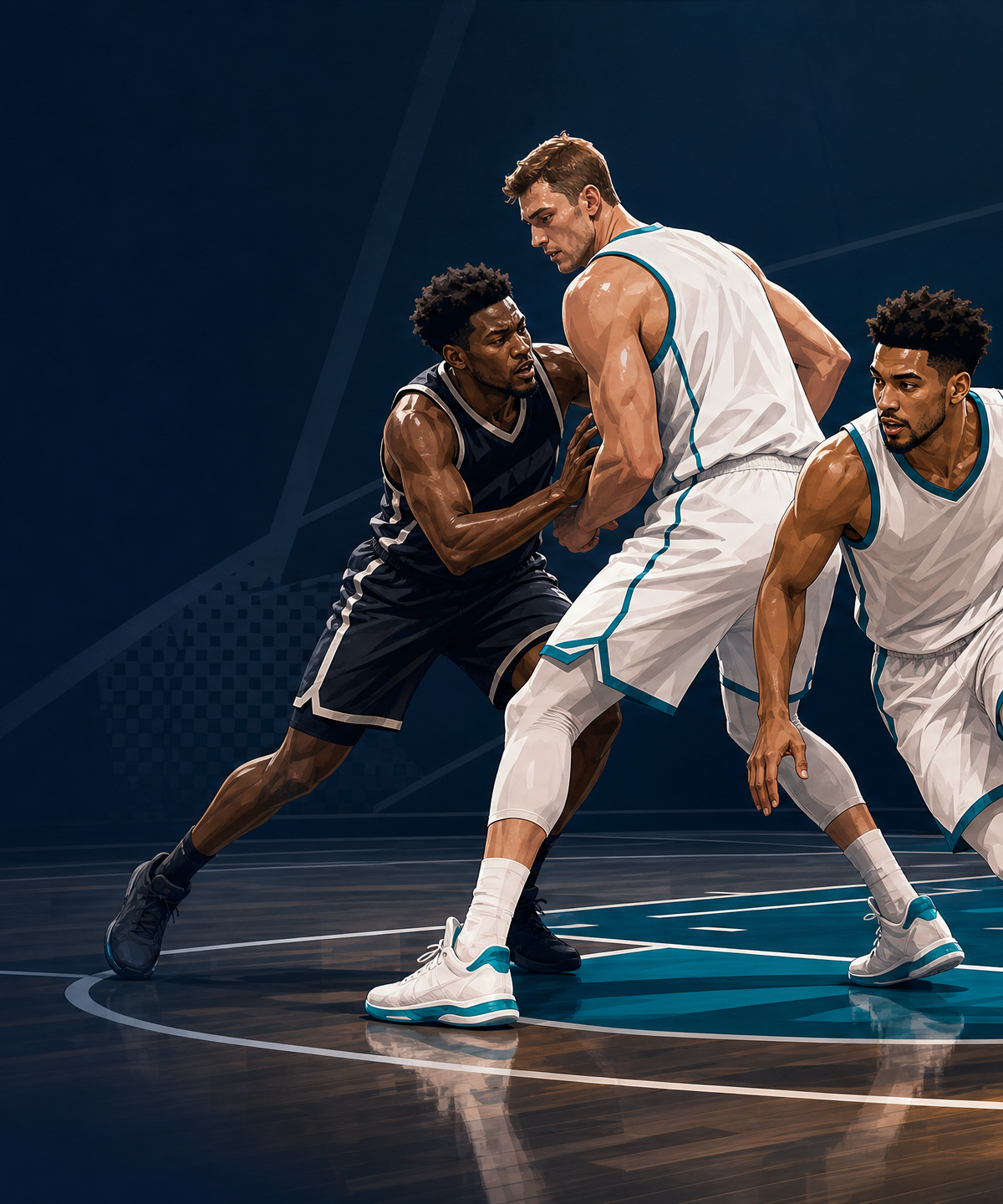
Equipment Needed
Overview
This Slot Pick-and-Roll Execution Drill teaches the two players at the heart of the action—1 (point guard) and 5 (centre)—to create and use an advantage without losing the spacing that makes the action dangerous. Your guard learns to set up the screen, turn the corner shoulder-to-hip, get to the nail with balance, and make the next read. Your screener learns to arrive on time, establish a legal stationary screen, hold it, then roll directly into a catching window. The weak-side players stay involved by maintaining game-real spacing and presenting a clear corner outlet.
Run this in the middle section of a practice, after your players have warmed up their footwork and passing, or use it as the main teaching block before a half-court scrimmage. Begin with guided reads and build to competitive live possessions. The standard is not simply a made lay-up: the standard is a well-timed screen, a decisive first read, and a pass delivered on time and on target.
Setup
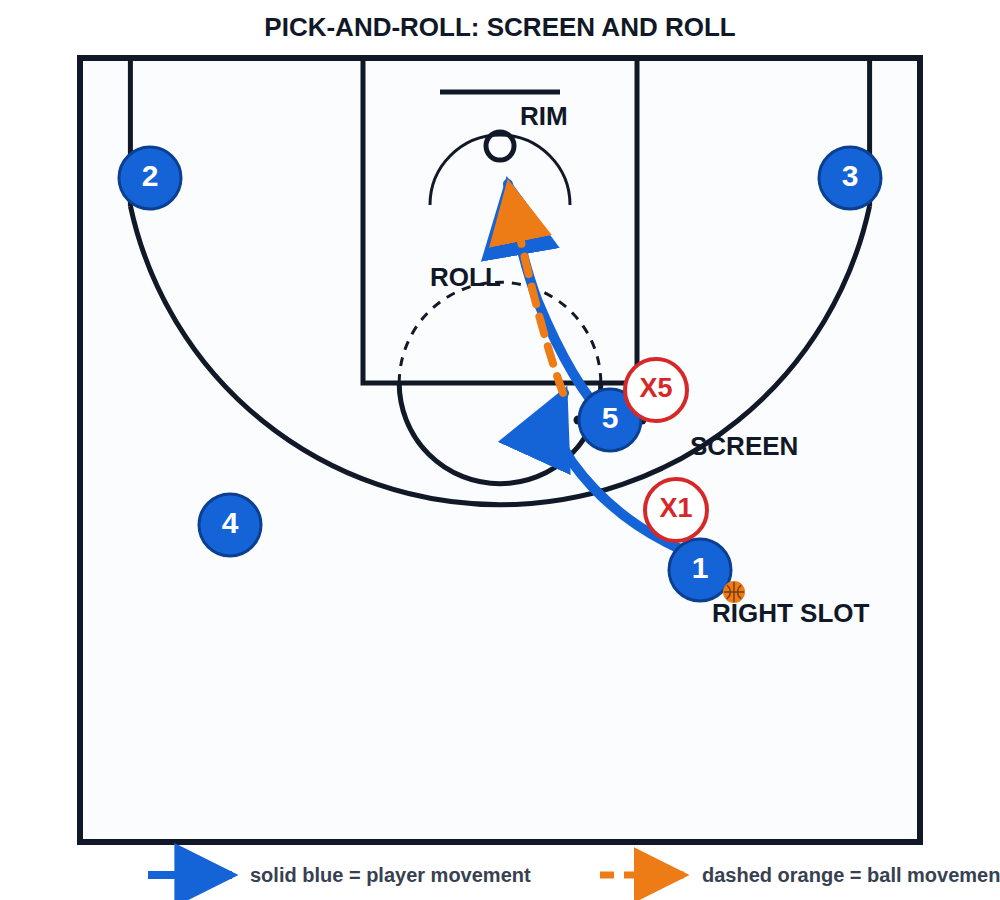
Use one attacking half of a FIBA court. A full FIBA court measures 28 m x 15 m, so the working half-court is approximately 14 m x 15 m. Place 1 in the right slot, one step outside the three-point arc and roughly level with the outer lane line. Place 5 at the right elbow, initially about 2 m from 1. Place 2 in the left corner, 3 in the right corner, and 4 on the left wing, all outside the arc. Start X1 attached to 1 and X5 in the lane for the later drop-coverage phase. Keep spare players on the baseline with a ball, ready to rotate in.
| Item | Coach setup standard |
|---|---|
| Players | 7 active players: 1–5 on offence plus X1 and X5; use additional players as queues |
| Equipment | 6 basketballs, 8–10 cones, two bib colours, whistle, stopwatch |
| Space | One FIBA half-court, 14 m x 15 m; mark the right slot, elbow, nail, and corners with flat cones |
| Work rate | 3 blocks of 2 minutes, with 45 seconds of coaching and reset between blocks |
The key teaching landmark is the nail, the centre of the free-throw line. Ask 1 to get two feet near that area after using the screen. This gives 1 a scoring window against a dropping X5 and opens the pocket pass to 5. Set the screen close enough to X1 to create contact pressure but not so low that 1 is driven toward the baseline.
Step-by-Step Instructions
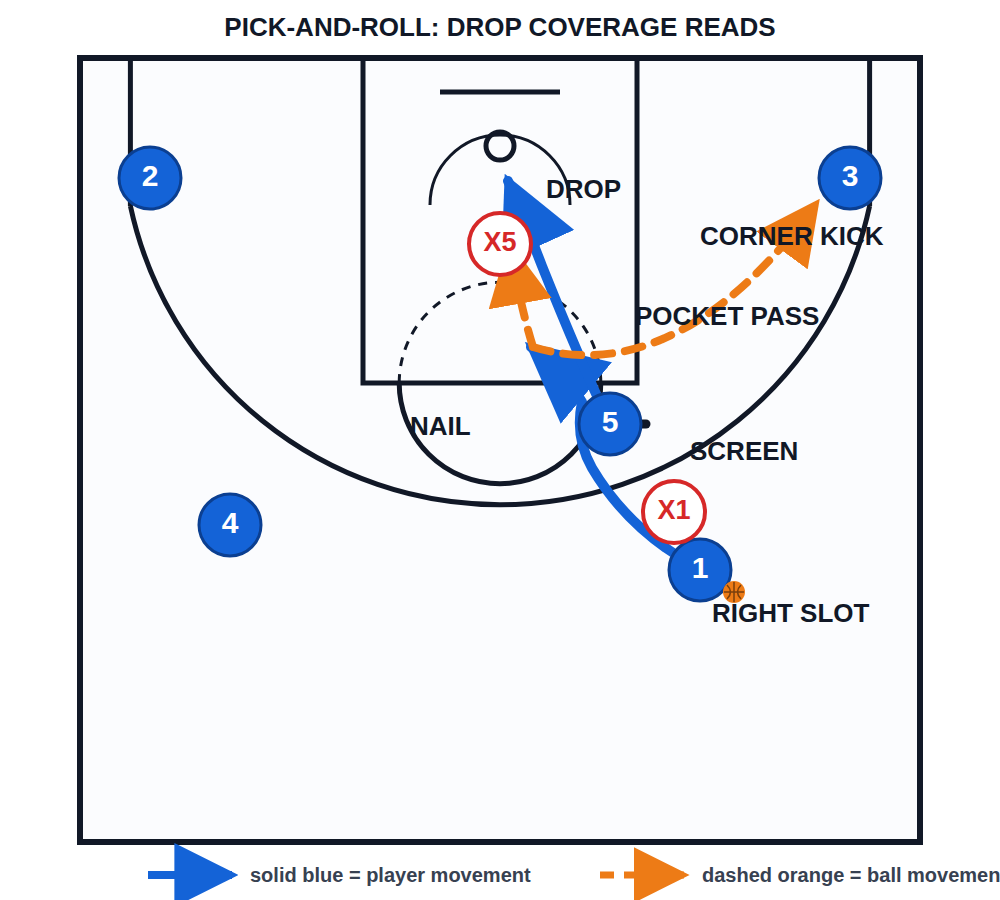
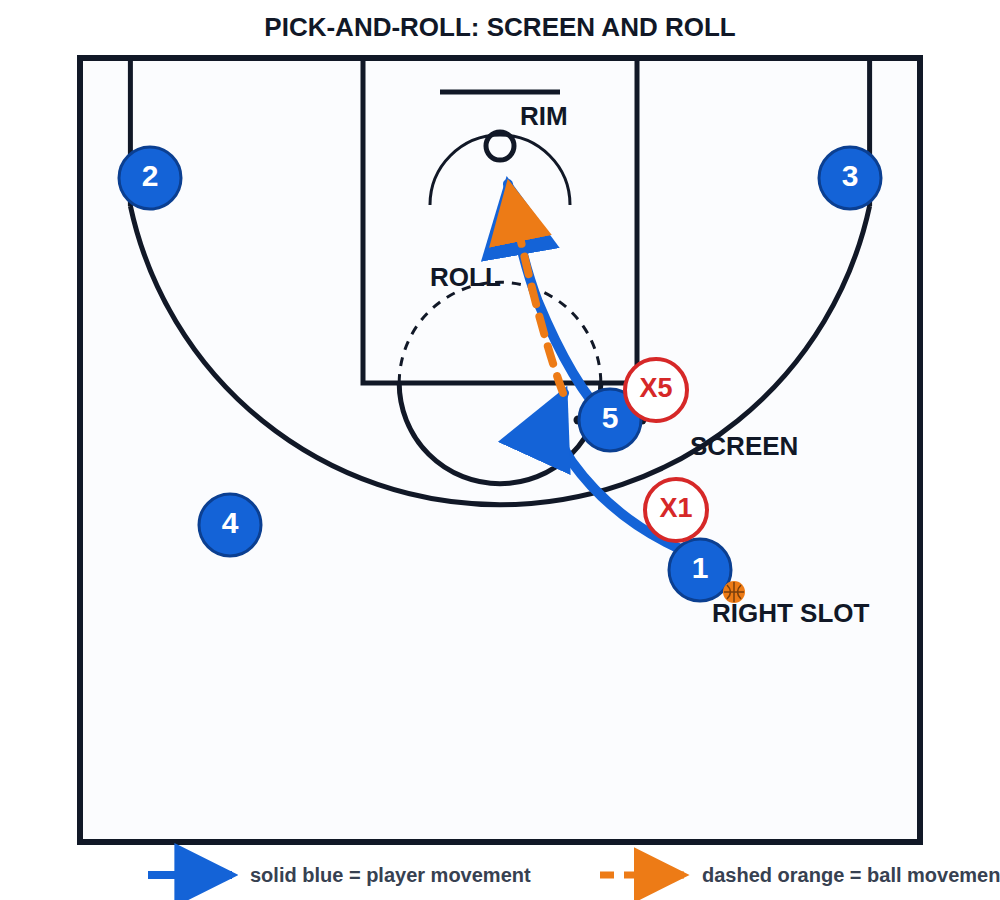
Walk-through: screen angle and route (2 minutes). With no defenders, 1 starts at the right slot with the ball. 5 walks from the elbow into a stationary screen on 1’s defender line. The screen should be square to X1’s route, with 5’s chest facing the left sideline and feet planted just outside the right lane line. Pause the action to check that 1 can come off shoulder-to-hip without drifting wide.
Guard uses the screen (2 minutes). On the coach’s whistle, 1 takes one setup dribble away from the screen, then attacks tightly over 5’s top hip. 1 makes two hard dribbles toward the nail, stays low through the turn, and keeps the ball protected on the outside hand. Give the guard a six-second shot-clock count from the first attack dribble.
Screener rolls and receives (3 minutes). The moment 1’s shoulder clears 5, 5 pivots on the inside foot and rolls directly through the middle of the lane with hands ready at chest height. 1 delivers a bounced or pocket pass in front of 5’s path, not at the player’s knees. 5 catches with two hands, takes a power gather, and finishes at the rim. Run six reps, then switch the action to the left slot for six reps so every player practices both sides.
Add X1 and rehearse the screen fight (3 minutes). X1 now chases 1 over the top of the screen at 70 percent pressure. X5 remains inactive in the lane. The coaching target is the same: 1 turns the corner, 5 rolls, and the pass arrives before 5 reaches the restricted area. Stop a rep immediately if 5 moves into the defender; reset the screen rather than allowing an illegal habit.
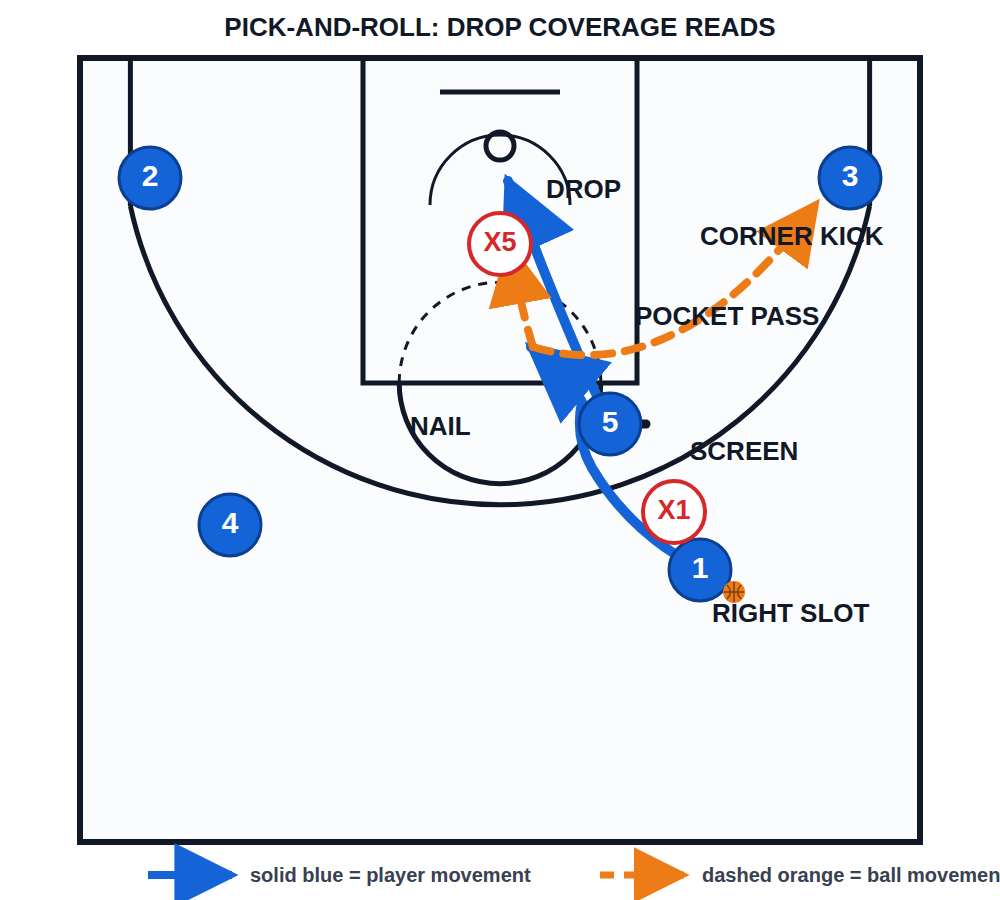
Add drop coverage and three reads (5 minutes). X5 starts with both feet near the restricted-area arc and drops to protect the rim. When 1 reaches the nail, 1 reads X5’s chest. If X5 stays deep, 1 takes the pull-up from the foul-line area. If X5 steps toward 1, make the pocket pass to 5. If the low-side defender tags 5, 1 skips or kicks to 3 in the right corner. 2 and 4 hold their spacing until the pass leaves 1’s hands.
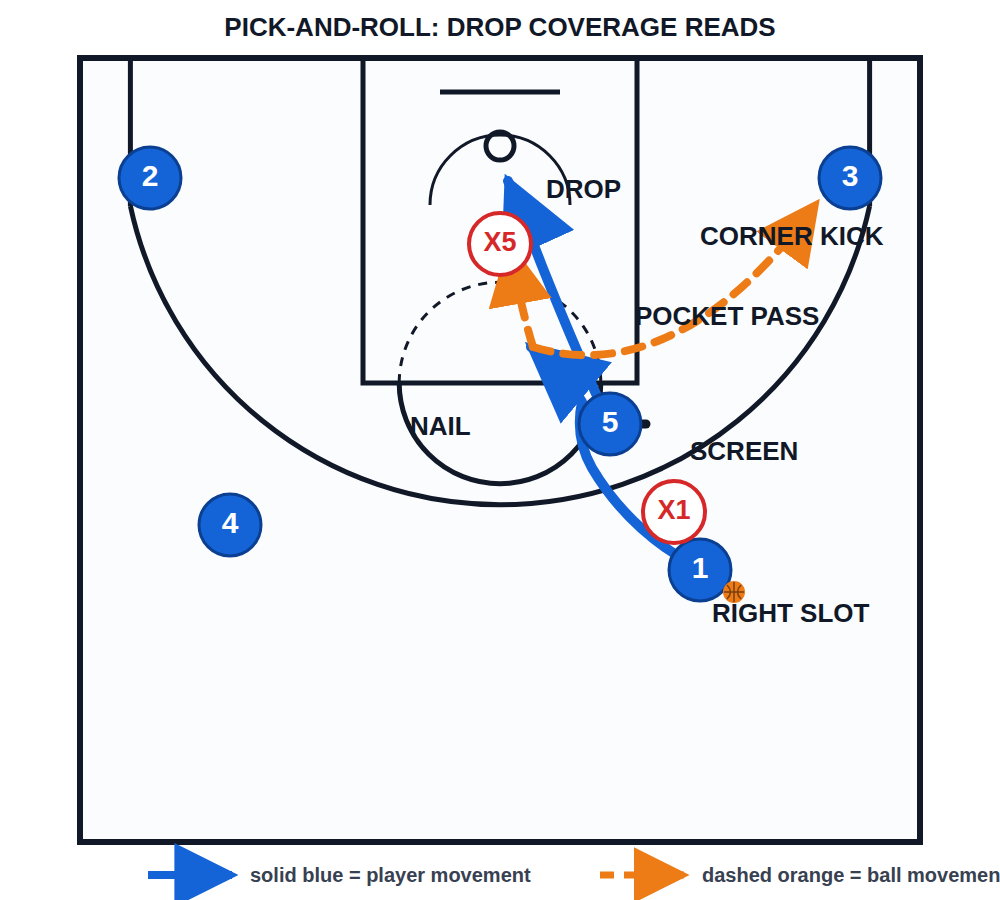
- Live finish and rotation (5 minutes). Play the final phase live, with one shot only. Offence earns one point for a paint finish, a pocket-pass lay-up, or a made corner three; defence earns one point for a stop, deflection, or forced turnover. Rotate 1 to 5, 5 to X5, X5 to X1, and X1 to the next perimeter queue. The corner and weak-side players rotate after every two possessions. Coach one correction between possessions and save longer feedback for the block break.
Key Coaching Points
| Coaching point | What to demand |
|---|---|
| Set-up dribble | 1 must move X1 away from the screen first; a static entry lets the defender go under or squeeze through. |
| Shoulder-to-hip use | 1 brushes past 5’s outside hip, with no daylight between ball-handler and screener. Wide turns erase the advantage. |
| Legal screen | 5 arrives early, is balanced on two feet, and does not lean or re-screen while X1 is making contact. |
| Roll timing | 5 rolls only after 1 has cleared the screen. Early rolling removes the screen; late rolling closes the pocket-pass window. |
| Eyes and pace | 1 gets eyes to X5 at the nail, keeps a controlled two-foot or one-two-foot stop option, then makes a decisive read. |
| Spacing discipline | 2, 3, and 4 remain outside the arc and do not creep toward the ball. Their job is to make help expensive. |
Coach’s language: “Set it, use it tight, get to the nail, read the big, then make the simple pass.” Repeat the same cue every block so players can play fast without guessing.
Common Mistakes
The most common error is 1 rejecting the screen before the defender has committed. Correct this by requiring one setup dribble and one shoulder-to-hip use before a rejection is allowed. A second error is 5 rolling before contact has occurred; freeze 5 at the screen and make the guard call “clear” on the first few reps. Third, guards often throw the pocket pass too late, after X5 has recovered. Use the six-second clock and demand the pass as 5 enters the dotted-circle area. Finally, corner players often drift up the sideline when the ball drives. Place a cone 0.5 m inside each corner and require their outside foot to stay behind it until the ball is passed.
Variations & Progressions
Make it easier: remove X1 and X5, use cones as defender landmarks, and allow 1 to take a stationary catch before beginning the action. This is especially useful when teaching the screen angle and the roller’s hands.
Build decision speed: add a coach standing at the nail who points to either the roller or the corner as 1 turns the screen. The cue changes late, forcing 1 to keep the eyes up and deliver the correct pass.
Make it harder: change X5’s coverage each rep—drop, hedge, switch, or show-and-recover—without announcing it. Award the offence a point only if 1 identifies the coverage before the second dribble and the team creates a paint touch or uncontested three.
Age Adaptations
For Under-10 players, use a 3-on-0 version with 1, 5, and one corner player. Shorten the action to the elbow, permit a jump stop before the pass, and praise the screen-and-roll timing more than shot outcome. For Under-12, use 3-on-1 with X1 chasing the guard and a cone representing X5; introduce the words “turn the corner” and “pocket pass.” For Under-14, run the full 5-on-2 structure but keep X5 in a predictable drop. For Under-16 and open-age groups, make the final phase 5-on-5, vary the coverage, and grade each possession for screen legality, paint touch, and decision quality—not simply makes.
Finish by taking the drill directly into 5-on-5: call “right slot” or “left slot,” require the same alignment, and chart whether the first pick-and-roll produces a rim attempt, free throws, or an uncontested catch-and-shoot three. That transfer is how the drill becomes an offence rather than an isolated passing pattern.