

Basketball
The X-Out Defensive Closeout and Recovery Drill
Master defensive rotations, closeout technique, and sprint recoveries to stop perimeter shooters and prevent baseline drives.
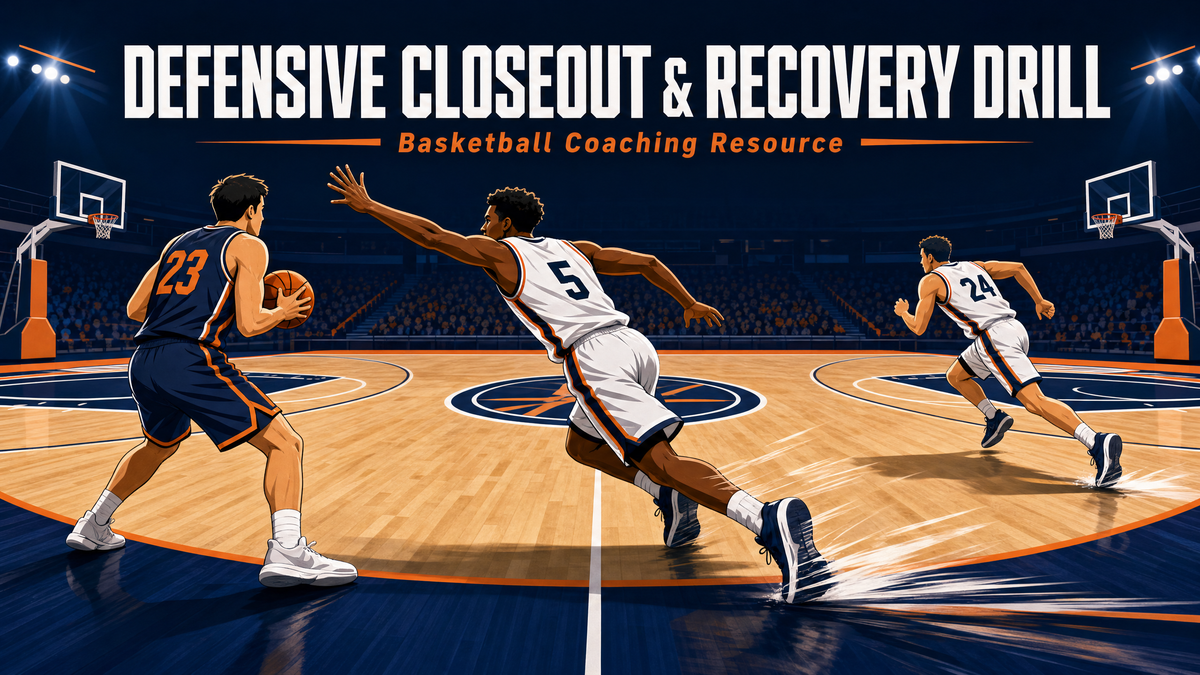
What you need
1 Basketball, 3 Cones (optional), Whistle
1. Overview
The X-Out Defensive Closeout and Recovery Drill is a high-intensity, multi-phase defensive exercise designed to teach players how to sprint to the perimeter, break down their steps, contest the shot, and immediately recover to help-side defense upon a ball reversal. In modern basketball, where the three-point shot is heavily utilized and ball movement is rapid, defenders cannot afford to rest after their initial closeout. This drill builds the conditioning, footwork, and defensive IQ necessary to sustain defensive pressure through multiple passes.
Coaches should use this drill to emphasize communication, proper closeout mechanics (chopping the feet and high hands), and the urgency of sprinting back to the split line or help position. It is highly effective during the pre-season to build defensive habits and conditioning, or mid-season to correct poor perimeter closeouts and slow rotations.
2. Setup
To run this drill effectively, you will need to utilize a half-court setting (standard FIBA 28m x 15m).
Equipment Needed:
- 1 Basketball
- 3 Cones (optional, to mark offensive spots if you don't have offensive players)
- Whistle
Court Setup and Player Positions:
- Place three offensive players (or cones) around the three-point arc: one on the left wing/corner (O1), one at the top of the key (O3), and one on the right wing/corner (O2).
- Place three defensive players inside the paint: Defender 1 (D1) at the left elbow, Defender 3 (D3) at the free-throw line, and Defender 2 (D2) at the right elbow.
- The coach stands out of bounds under the basket with the basketball.
3. Step-by-Step Instructions
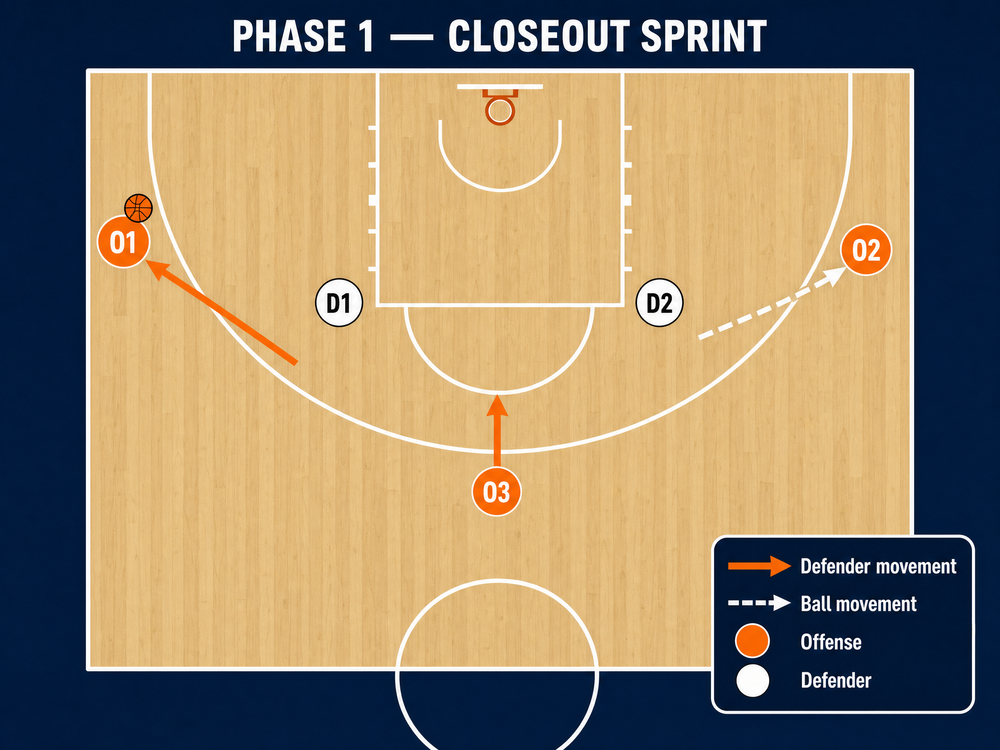
Phase 1: The Initial Closeout Sprint
- The Trigger: The coach slaps the basketball or blows the whistle to initiate the drill.
- The Sprint: All three defenders (D1, D2, D3) immediately sprint from their positions inside the paint toward their designated offensive assignments on the perimeter.
- The Breakdown: As the defenders approach within two strides of the offensive players, they must transition from a full sprint into short, choppy steps (stutter steps) to lower their center of gravity.
- The Contest: Each defender arrives in a balanced defensive stance, shouting "Ball!" or "Shot!" while extending their inside hand high to contest a potential shot, keeping the other hand lower to trace the crossover or pass.
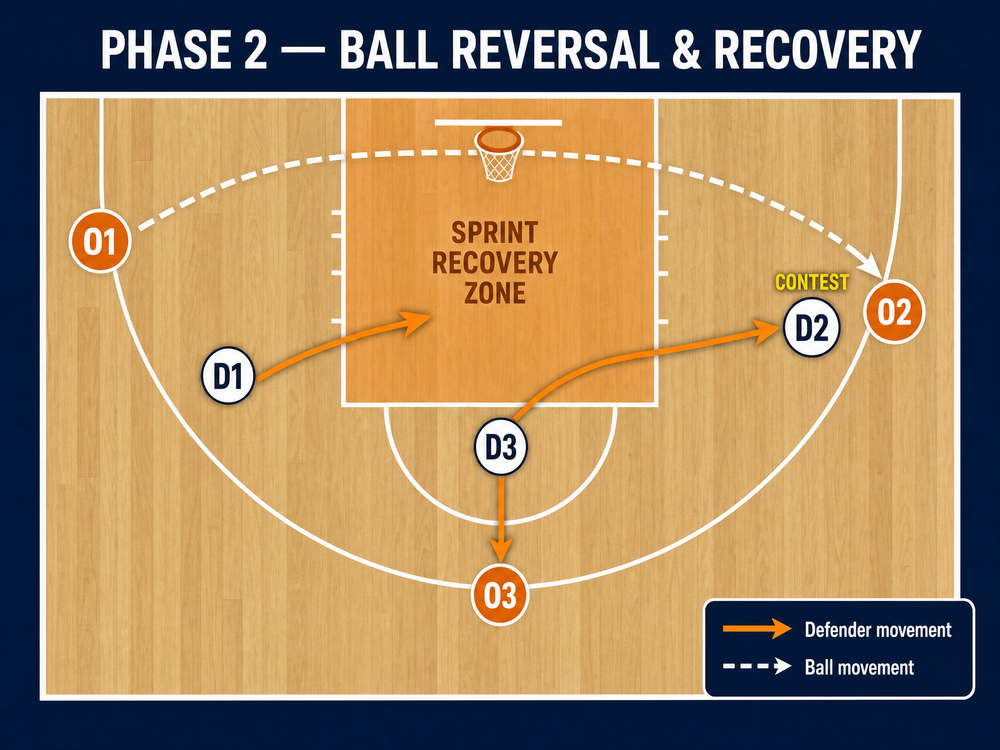
Phase 2: Ball Reversal and Recovery
- The Pass: The coach passes the ball to one of the offensive players (e.g., O1 on the left wing).
- The Skip Pass: O1 immediately throws a skip pass across the court to O2 on the opposite wing.
- The Recovery Sprint: Upon the pass leaving O1's hands, D1 (who was guarding O1) must immediately drop their stance, open their hips to the ball, and sprint back toward the paint (the Sprint Recovery Zone) to establish a help-side defensive position.
- The Rotation: Simultaneously, D2 must aggressively close out on O2 who just received the ball, while D3 adjusts their position at the top of the key to maintain the defensive triangle.
- Reset and Repeat: The ball is passed back to the coach, the defenders reset to the elbows, and the drill is repeated, alternating the direction of the skip passes.
4. Key Coaching Points
- Sprint to Stutter: Defenders must cover the first 70% of the distance at an absolute sprint, then use the final 30% to chop their feet, drop their hips, and establish balance. Coasting into the closeout will result in getting blown by.
- High Hands, Low Hips: Emphasize closing out with the inside hand high to contest the shot and take away the rhythm, while keeping the hips low to react to the drive.
- Fly with the Flight of the Ball: The recovery sprint must begin the moment the ball leaves the passer's hands. Defenders cannot wait to see if the pass is caught before moving to help-side.
- Vocal Communication: Defenders must loudly communicate their actions. Yelling "Ball!" on the closeout and "Help!" on the recovery builds a cohesive defensive unit.
5. Common Mistakes
- Flying By the Shooter: Defenders sprinting out of control and jumping past the offensive player, giving up an easy pump-fake and drive.
- Closing Out with Hands Down: Arriving at the shooter with hands at the waist, failing to contest the shot or disrupt the shooter's vision.
- Turning the Back to the Ball: During the recovery phase, defenders turning their back to the ball instead of opening their hips (vision on man and ball) as they sprint to the help position.
- Slow Recovery: Jogging back to the paint after the pass is made, leaving the middle of the floor exposed to secondary drives.
6. Variations & Progressions
- Live 3-on-3: After the skip pass, allow the offense to play live 3-on-3. This forces the recovering defender to sprint to the paint and immediately read the offensive action to provide actual help defense.
- The "Fly-By" Closeout: If coaching against a team with elite shooters, teach the "fly-by" closeout where the defender sprints past the shooter's shooting shoulder to heavily contest without fouling, while the recovering defender rotates to the driver.
- Added Disadvantage: Start the defenders on the baseline instead of the elbows, forcing a longer initial closeout sprint to increase conditioning and difficulty.
7. Age Adaptations
- Under 10s: Focus purely on the footwork of the closeout (sprint to stutter). Do not introduce the skip pass and recovery until the initial closeout mechanics are sound. Use cones instead of offensive players to reduce complexity.
- Under 12s / Under 14s: Introduce the ball reversal, but allow the pass to go around the perimeter (O1 to O3 to O2) rather than a long skip pass, giving defenders more time to understand the rotation.
- Under 16s / Open: Run the drill at full game speed with skip passes and immediately transition into live 3-on-3 play. Demand elite communication and flawless footwork.
