

Cricket
Batting Partnership Rotation: Soft Hands, Clear Calls & Pressure Twos
Build a decisive batting partnership that creates low-risk singles, judges pressure twos and rotates strike with clear communication.

What you need
balls, cones
Overview
This 20-minute batting partnership rotation play teaches two batters to manufacture low-risk singles and turn the right ball into a pressure two. The set play is built around the soft-handed deflection behind square and the controlled push wide of cover: scoring options that keep the strike moving without forcing a boundary shot. The routine is simple: read the field early, call at contact, run the first hard, then judge the second from the ball and nearest fielder.
Setup
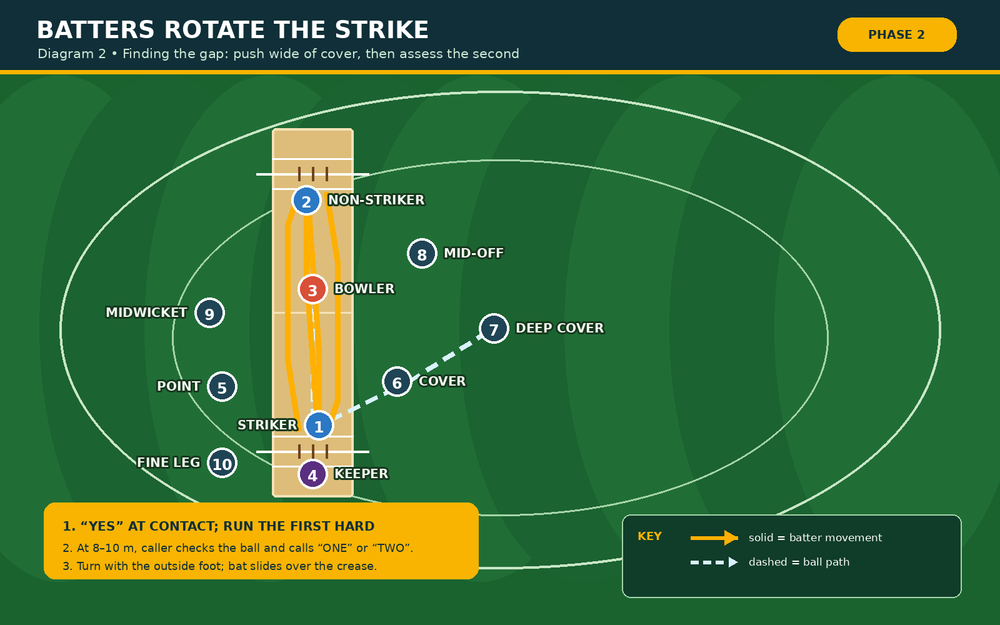
Use one full 22-yard pitch and an oval or marked outfield. This version needs 10 players: 1 striker, 2 non-striker, 3 bowler, 4 wicketkeeper, and fielders at 5 point, 6 cover, 7 mid-off/deep cover, 8 midwicket, 9 square leg and 10 fine leg. Put a pair of cones 8 metres either side of the pitch to create the leg-side deflection channel and the cover gap. A coach feeds or bowls a stock 3/4-length ball on off stump at a controlled medium pace; use a normal ball only when batters are technically ready.
Run the practice as 3 minutes to explain, two 4-minute blocks for the scoring options, 6 minutes of live decision-making, then 3 minutes of review. Batters rotate after six balls. The striker owns the call in front of square; the non-striker is louder behind the striker or when the striker turns away from the ball.
Step-by-Step Instructions
1. Scan and agree before the run-up. Before each ball, both batters name the obvious gap: “leg”, “cover”, or “straight”. They also agree that the first run is automatic only when the ball is played with soft hands into a clear channel. As bowler 3 reaches the top of the bowling action, batter 2 takes a balanced half-metre backing-up step, stays side-on and watches the striker. Batter 1 stays still until release and selects a low-risk scoring option rather than premeditating a big shot.
2. Create the first single behind square. Against a ball on the pads or hip, batter 1 closes the face late and uses relaxed hands to work the ball into the square-leg/fine-leg channel. The bat path is short; the aim is to take pace off the ball, not whip it hard at fielder 9. The striker calls “YES” at contact, loud enough for the partner and keeper to hear. Batter 2 responds with “YES” immediately, then runs hard. Both players take their first two steps with the bat in the inside hand, keep their eyes on the far crease, and run past it before slowing.

3. Own the first run. Once the ball passes the inner fielder, neither batter hesitates to watch it. The player running towards the ball is responsible for a quick check; the other runs through their crease. At 8–10 metres from the far end, the caller gives a second instruction: “ONE” if the pickup is clean, “TWO” only if the ball has travelled beyond the inner ring or the fielder must move to their non-dominant side. A call of “NO” means both batters stop immediately and return to the crease they have just left; no hopeful half-turns.
4. Use the cover gap to pressure the field. On a slightly fuller ball outside off, batter 1 presents the full face and pushes with soft hands wide of cover 6. The contact point is under the eyes, with the front knee flexed and the head still. Call “YES” on contact and make the first run as if only one is available. The moment the ball reaches the cover gap, the incoming batter looks at fielder 7 and the ball, not at the striker. If deep cover is moving laterally or collecting on the run, call “TWO” before the batters reach 8–10 metres from the far crease.
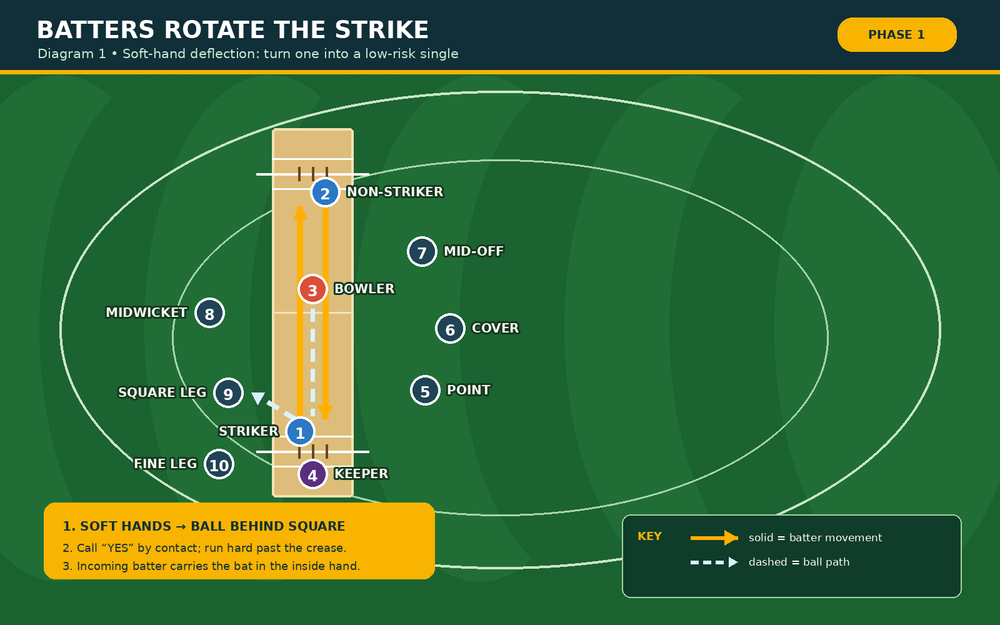
5. Turn safely for the second. At the far end, the turning batter grounds the bat over the line first, pivots off the outside foot and leaves on a straight line down the pitch. Do not arc around the stumps or drift into the partner’s lane. The returning batter keeps the bat low and slides it into the crease rather than lunging. Finish every delivery with a one-sentence check: “First was on because…”, or “Second was no because…”. This forces the pair to learn the picture, not merely remember a call.
6. Add live pressure. In the final 6-minute block, fielders 5–10 may move one step after release and bowlers can vary line within a safe channel. Award one point for a clean, correctly called single; two points for a correctly judged two; subtract one for a run-out, collision, or a call changed after commitment. The batting pair sets a target of 12 points from 12 legal balls.
Key Coaching Points
- Call at contact, then confirm the second early. “Yes” is a commitment, not a question. The word must be made before the fielding pickup; “one” or “two” is delivered before the turning crease.
- Soft hands create time. A quiet grip and a late, short bat path deaden the ball and make the single safer than a hard hit straight to an inner-ring fielder.
- Run the first with intent. The first 5 metres are explosive. Both batters run past the far crease, bat grounded, before checking whether a second exists.
- Use clear lanes. Outgoing and incoming batters stay on their own side of the pitch, carry the bat in the inside hand and communicate with eye contact only after the call is made.
Common Mistakes
The usual error is a striker admiring the shot and delaying “yes” until the ball has reached a fielder. Correct it by making the call part of the contact drill: no call, no run. A second mistake is backing up too far and losing balance; use a half-metre lead, then explode only after contact. Finally, batters often call two because the ball is in a gap, rather than because the retrieval is slow. Coach the second run as a fielding-and-ball decision, not a reward for a tidy push.
Variations & Progressions
For the first variation, remove deep cover and challenge the pair to identify when a one becomes an automatic two. For the second, put a strong throwing fielder at cover and a keeper with a target stump; this rewards a sharp first run but punishes casual turns. Progress to a six-ball over where the bowler chooses leg stump, off stump or a defensive line and the batters must reject the scoring option if it is not on. In an advanced version, give the fielding side one planned trap—such as a fine leg moving squarer—and ask the batters to name the counter-option before the over begins.
Age Adaptations
For under-8s, use underarm feeds, a tennis ball and only the first single; praise loud calls and grounding the bat. For under-10s and under-12s, add a gentle bowler, named fielders and the “one or two” decision after a clear first run. For under-14s and above, use normal bowling, live fielders and a scoring target under time pressure. Keep the same language across all ages: see the gap, call early, run hard, turn safely.
