The Box Kick Chase & Press: A Masterclass in Territorial Pressure
Master the art of the box kick chase to turn a defensive exit strategy into an aggressive, turnover-generating attacking platform.

Equipment Needed
1. Overview
The box kick is no longer just a desperate clearance to relieve pressure; in the modern game, it is a highly calculated attacking weapon. The Box Kick Chase and Press Play is designed to execute a perfectly weighted kick from the base of a ruck, followed by an organized, aggressive chase line that immediately puts the receiving player under immense physical and psychological pressure.
When executed correctly, this play achieves three critical outcomes: it flips field position, disrupts the opposition's counter-attack before it begins, and frequently results in a turnover or a penalty in the opposition's half. This resource provides a step-by-step guide to mastering the setup, the chase, and the ensuing contest.
2. Setup
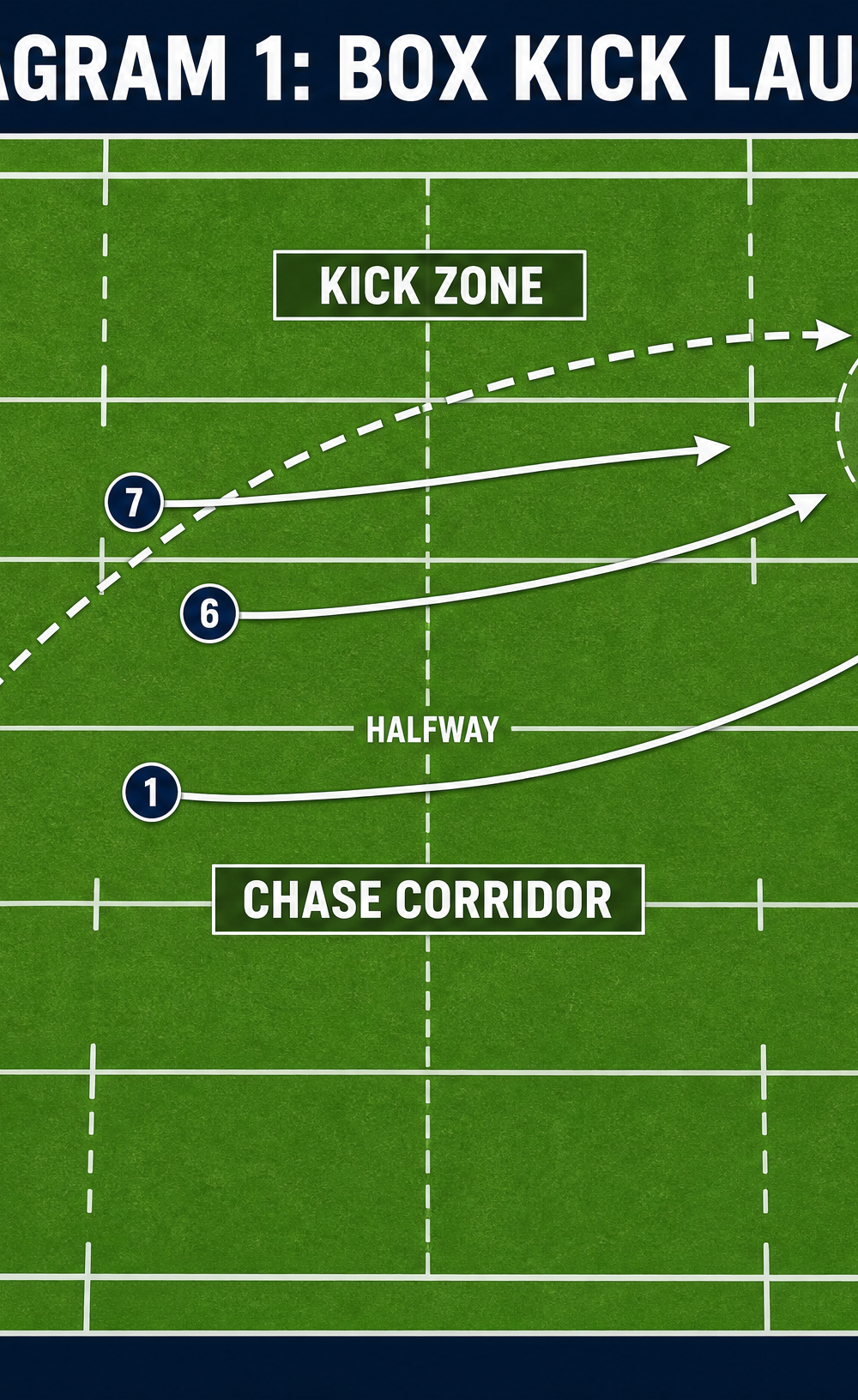
To effectively run this set play in training, you will need to establish clear zones on a standard 100m x 70m pitch to simulate match conditions.
Equipment Needed:
- 5-8 Rugby balls (to ensure continuous repetitions)
- Cones (to mark the 'Kick Zone', 'Chase Corridor', and 'Contest Zone')
- Tackle shields or hit shields (optional, for the receiving players to simulate a contested catch safely during early progressions)
Pitch Setup & Player Positions:
- The Ruck (Kick Zone): Set up a simulated ruck approximately 15 metres in from the touchline, ideally between your own 22-metre line and the 10-metre line.
- The Kicker: Number 9 (Scrum-half) positions themselves at the base of the ruck, ready to execute the box kick.
- The Chase Line: Numbers 7 (Openside Flanker) and 6 (Blindside Flanker) position themselves on the fringes of the ruck, forming the primary chase line. Number 1 (Loosehead Prop) or a designated fast tight-five forward positions slightly wider to act as the secondary chase/cover.
- The Support: Numbers 10 (Fly-half) and 12 (Inside Center) hold a deeper position (10-15 metres back) to receive any recycled ball or defend a poor kick.
- The Receivers: Position opposition players (e.g., 15 and 14) in the 'Contest Zone'—typically between the opposition's 22-metre line and 10-metre line, near the opposite touchline.
3. Step-by-Step Instructions
Phase 1: The Launch

- Secure the Base: The forwards must provide a stable, 'caterpillar' ruck to protect the Number 9 from charge-downs. The last foot in the ruck dictates the offside line; chasers must hold their discipline and stay behind this line until the ball is kicked.
- The Kick Execution: The Number 9 takes a step back to create an angle, dropping the ball precisely onto the boot. The goal is a high, hanging kick (aiming for 3.5 to 4.5 seconds of hang time) that travels diagonally toward the 15-metre line in the opposition's half. Distance is less important than hang time; the ball must land in the designated 'Contest Zone'.
- The Sprint: The instant the ball leaves the boot, the primary chasers (7 and 6) explode off the mark. They must run a direct, aggressive line down the 'Chase Corridor' toward the predicted landing spot.
Phase 2: The Press and Contest
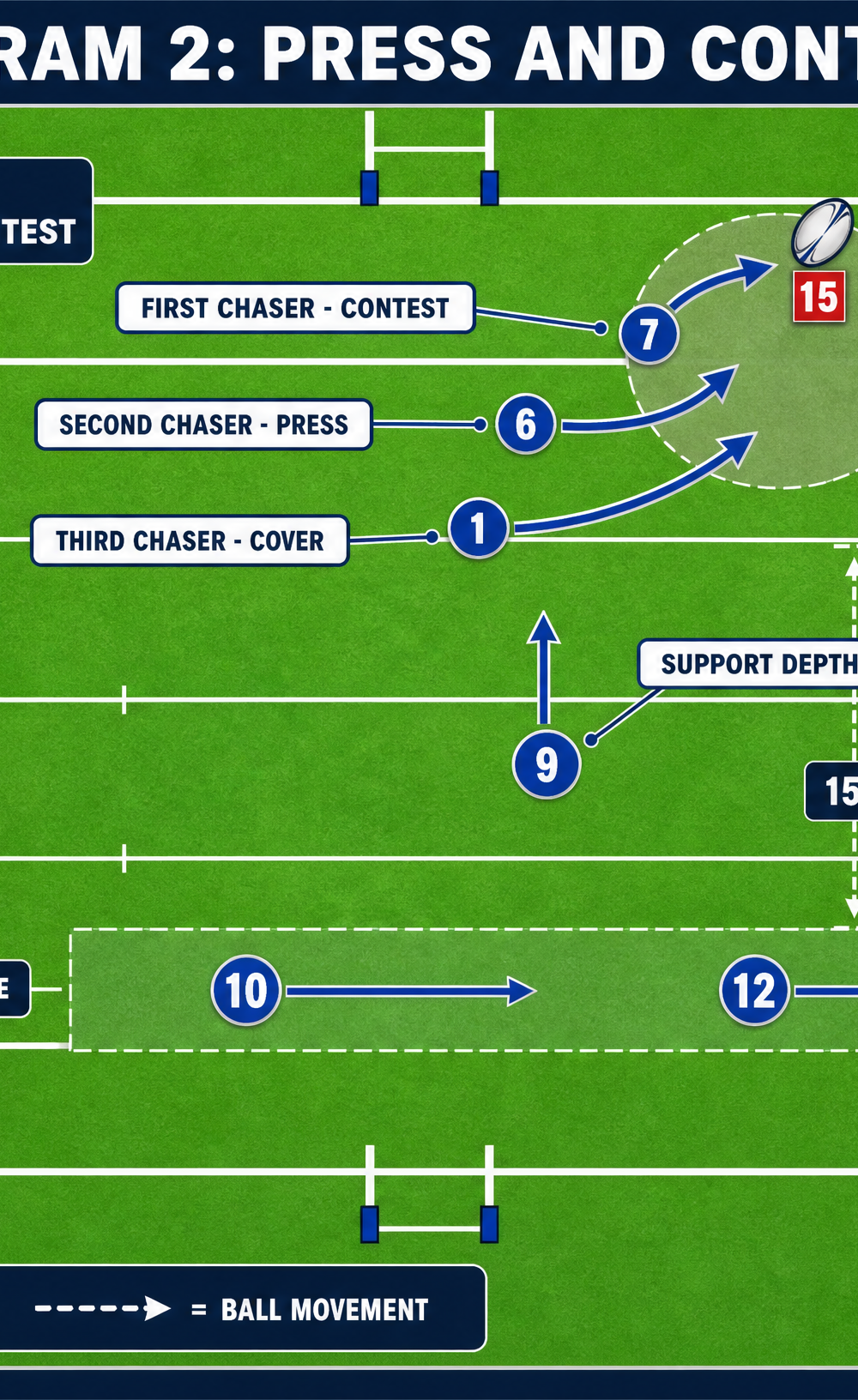
- The First Arrival (The Contest): The fastest chaser (usually the 7) arrives just as the ball is coming down. Their primary role is to contest the catch in the air. If they cannot win the ball cleanly, they must tackle the receiver the millisecond their feet touch the ground, driving them backward.
- The Second Arrival (The Press): The second chaser (usually the 6) arrives a split-second later. If the first chaser makes the tackle, the second chaser immediately targets the ball, aiming for a jackal turnover or to aggressively counter-ruck and disrupt the opposition's 9.
- The Cover and Fold: The third chaser (e.g., the 1) arrives on the outside shoulder to prevent any wide offloads or line breaks. The rest of the forward pack advances rapidly to form a defensive wall or provide attacking support if the ball is won.
Phase 3: Exploiting the Turnover
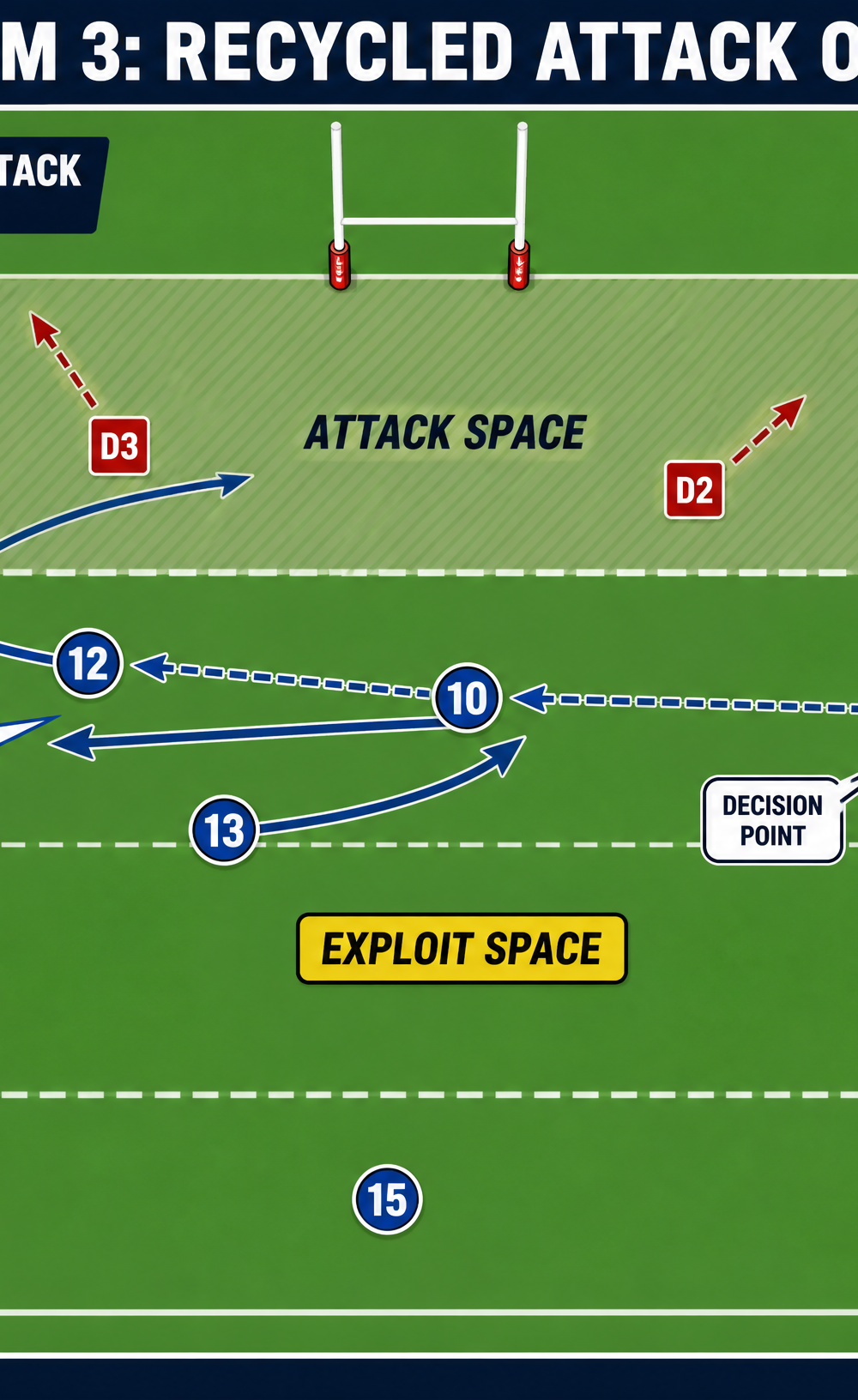
- Rapid Recycling: If the chase line successfully turns the ball over or forces a knock-on, the attacking team must react instantly. The Number 9 (who has followed the kick) arrives to distribute the ball.
- The Strike: The opposition defense will be scrambled and out of position. The 9 distributes quickly to the 10 or 12, who can either run a crash ball line to exploit the disorganized defense (Option A) or arc wider toward the posts where space has opened up (Option B).
4. Key Coaching Points
- Hang Time is King: A kick that travels 40 metres but only hangs for 2 seconds is a bad kick. A kick that travels 25 metres but hangs for 4 seconds allows the chase line to arrive and is a great kick. Prioritize height over distance.
- Discipline on the Chase: Chasers cannot leave early. An offside penalty completely negates the purpose of the play. Drill the timing of the sprint to coincide exactly with the sound of the boot striking the ball.
- The 'V' Formation: The chase line should form a 'V' or an arrowhead. The point of the arrow contests the ball, while the wings of the arrow shut down the escape routes for the receiver.
- Immediate Transition: Players must mentally switch from 'kicking' to 'attacking' the moment the ball is in the air. The press must be violent and purposeful.
5. Common Mistakes
- Kicking Too Long: The 9 kicks the ball too far downfield, outkicking the chase line. This gives the opposition fullback time to catch, assess, and launch a counter-attack.
- Fragmented Chase: Chasers run at different speeds or in disorganized lines, allowing the receiver to step past the first defender and break the line.
- Failing to Compete: The first arriving player slows down before contact, allowing the receiver to catch the ball cleanly and set their feet. The contest must be genuine and aggressive.
6. Variations & Progressions
- Progression 1: The Contested Catch: Introduce a live defender with a hit shield to contest the ball in the air against the primary chaser, simulating match-day physical pressure.
- Progression 2: The Scramble Attack: Once the chase line secures a turnover, blow a whistle and give the attacking team exactly 5 seconds to score against a disorganized defense, emphasizing rapid transition.
- Variation: The Short Box: Instead of aiming for the 22, the 9 executes a very short, high dink just over the defensive line (10-15 metres), allowing a tall forward to simply jump and catch it cleanly to restart the attack.
7. Age Adaptations
- Under 10s/12s: Focus heavily on the technique of the kick itself (dropping the ball correctly) and the concept of running forward together as a line. Do not emphasize the mid-air collision; focus on making the tackle immediately after the catch.
- Under 14s/16s: Introduce the concept of the 'jackal' and counter-rucking for the second arriving player. Begin practicing the timing of the jump to contest the ball in the air safely.
- Open/Senior: Full contact, emphasizing the violence of the press, the speed of the transition, and complex set-piece strikes following a successful turnover.