

Cricket
Cricket Death Overs Bowling Plan: Yorker, Wide Yorker & Pace-Off Sequence
A coach-ready six-ball death-overs plan that aligns yorker execution, field placement, pace variation and clear team communication to defend the boundary under pressure.

What you need
Regulation 22-yard Cricket pitch or marked practice strip, 2 sets of stumps, 8–12 Cricket balls, 10–14 flat cones, Bibs, Stopwatch, Scoreboard or scoring sheet
Overview — Death Overs Bowling Plan: Yorker–Wide Yorker–Pace-Off Sequence
This is a defensive set play for the last four overs of a limited-overs innings, when batters are looking to manufacture boundaries and force bowlers away from their best length. It gives the captain, bowler, wicketkeeper and ring fielders one repeatable answer: protect the straight boundary, deny the clean hitting arc, and make the low-risk single the only obvious option. Use it against a right-handed hitter setting early for leg-side power; mirror the calls for left-handers.
Establish the base-of-stump yorker, then use the same full-length intent 0.5–0.8 m outside off stump before removing pace. A regulation Cricket pitch is 22 yards (20.12 m) long and 10 ft (3.05 m) wide.1
Coach’s outcome: before every ball, players know the ball call, protected boundary, stop line and first throw-in end.
| Ball phase | Primary ball | Purpose | Desired outcome |
|---|---|---|---|
| 1–2 | Base-of-stump yorker | Remove the swing and protect straight | Dot, jammed single, bowled/LBW chance |
| 3–4 | Wide yorker | Pull the hitting zone outside off stump | Toe-end, miss or single to deep cover |
| 5 | Slower yorker/off-cutter | Punish premeditated swing | Mis-hit into cover or long-off |
| 6 | Highest-percentage ball | Finish with clarity, not novelty | Dot or one-run boundary denial |
Setup
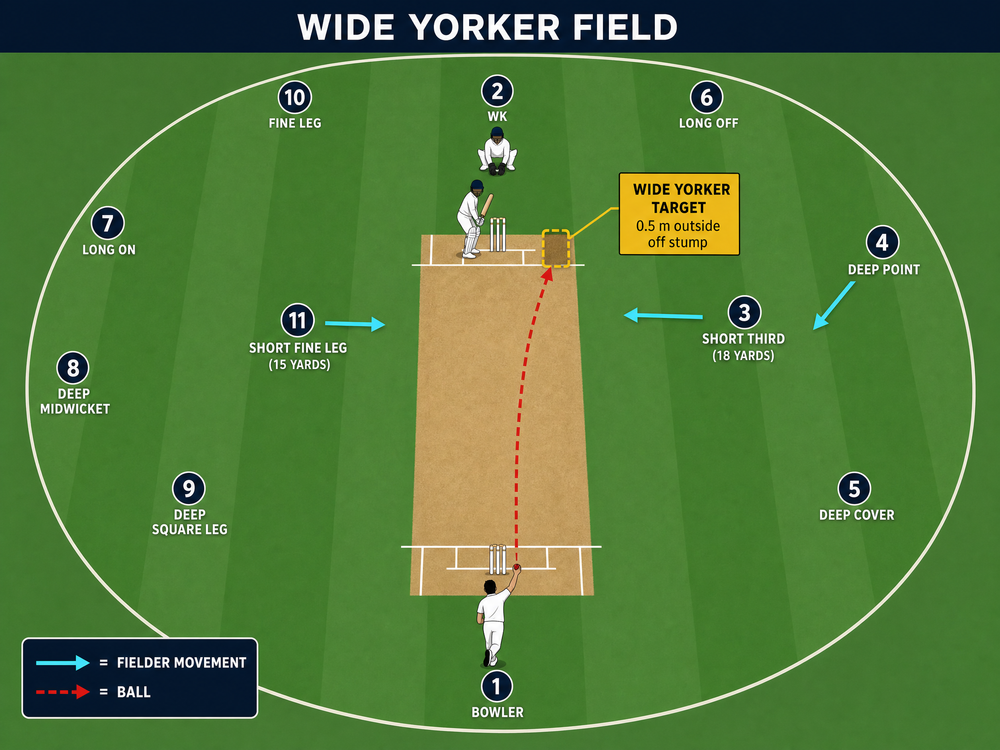
Use one oval or a marked 60–70 m practice boundary, a regulation 22-yard pitch, two sets of stumps, 10–14 flat cones, 8–12 balls, bibs and a stopwatch. Mark a 30-yard reference circle only as a coaching guide; always confirm the competition’s fielding restrictions. Place a 60 cm × 60 cm cone box at the striker’s popping crease for the yorker and a second box 0.5–0.8 m outside off stump for the wide yorker.
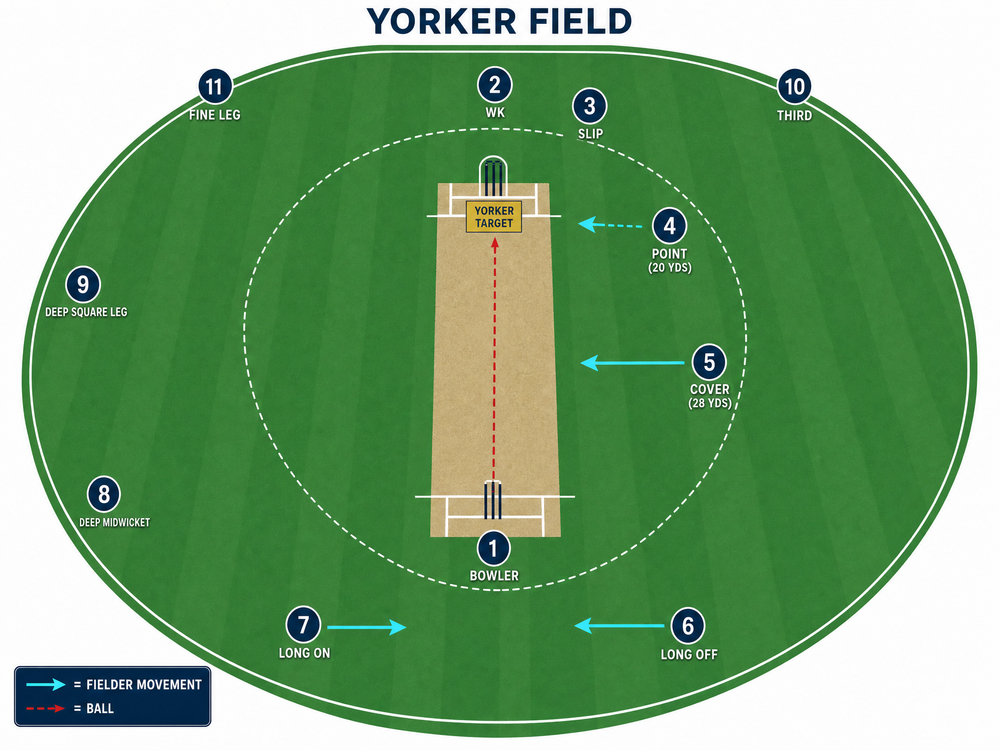
Number the field from the bowler’s end: 1 Bowler; 2 Wicketkeeper; 3 Slip/short third; 4 Point; 5 Cover; 6 Long-off; 7 Long-on; 8 Deep midwicket; 9 Deep square leg; 10 Third; 11 Fine leg. For the straight yorker, protect the ‘V’ with 6 and 7, the leg-side miss with 8 and 9, and edges/mishits with 10 and 11. Point and cover work 20–28 yards from the striker, ready to deny the pushed single.

Diagram 1: Base-of-stump yorker field. The dashed red line is the ball; solid cyan arrows are final fielder adjustments. The bowler calls “straight”. The wicketkeeper repeats it, the captain checks the two straight boundary riders, and then the bowler starts their run-up.
| Position | Start line | Non-negotiable job |
|---|---|---|
| 2 Wicketkeeper | 2–3 m behind stumps; adjust for pace | Collect low, then attack the stumps on a scrambled single |
| 4 Point | About 20 yards, square | Close the open face and force the run to the non-striker’s end |
| 5 Cover | 25–28 yards, one step straighter | Cut off the drilled one; relay to the keeper’s end |
| 6 Long-off & 7 Long-on | 5–8 m inside boundary | Guard straight; field side-on and throw flat |
| 8 Deep midwicket & 9 Deep square leg | 5–8 m inside boundary | Defend the hack and call early to avoid crossover |
Step-by-Step Instructions
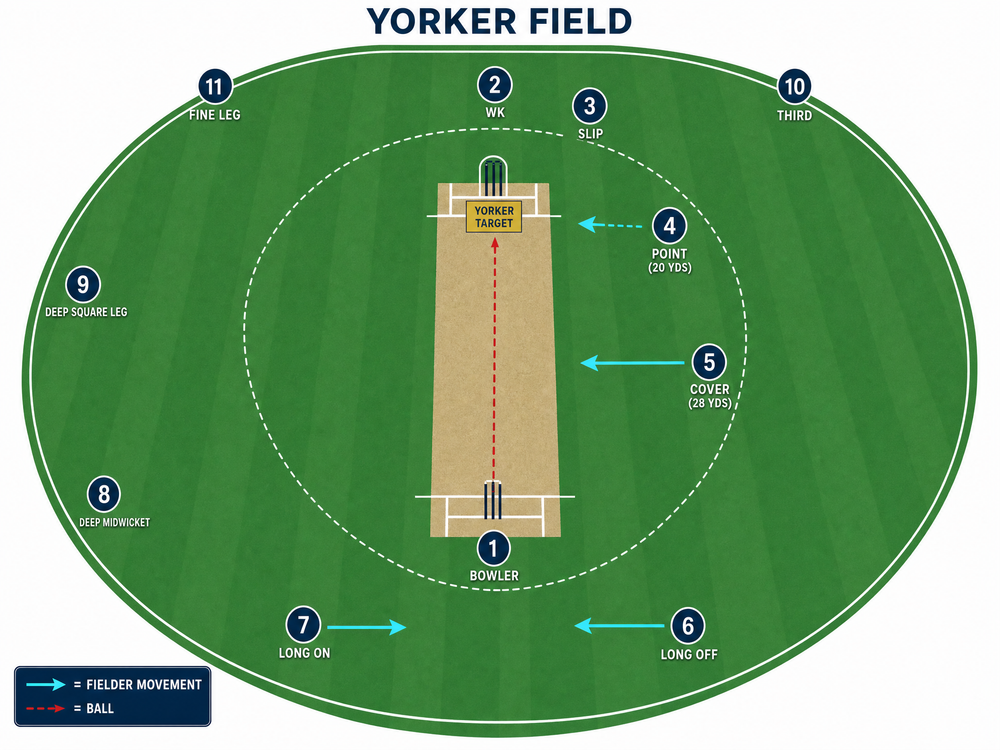
Brief the over in 20 seconds. Name the batter’s strong side, the two boundary zones to protect and the default ball. Use one call—“straight”—rather than a discussion at the bowling mark.
Set the field before run-up. Captain positions 6 and 7 first because straight is the shortest, most damaging boundary. Set 8 and 9 next, then the ring. Each fielder points to their stop line and names their relay end.
Calibrate the yorker. With no batter, the bowler delivers four balls at the 60 cm box. The ball must land at, or inside, the popping-crease line; it is not enough simply to bowl “full”. If more than one misses by a bat-length, reduce run-up pace and rebuild control.
Run balls 1–2 live. Bowl base-of-stump yorker. The nearest ring fielder attacks on contact; boundary fielders hold the rope until the ball passes the inner ring. Demand one loud call—“mine”, “two”, or “keeper”—on every ball.
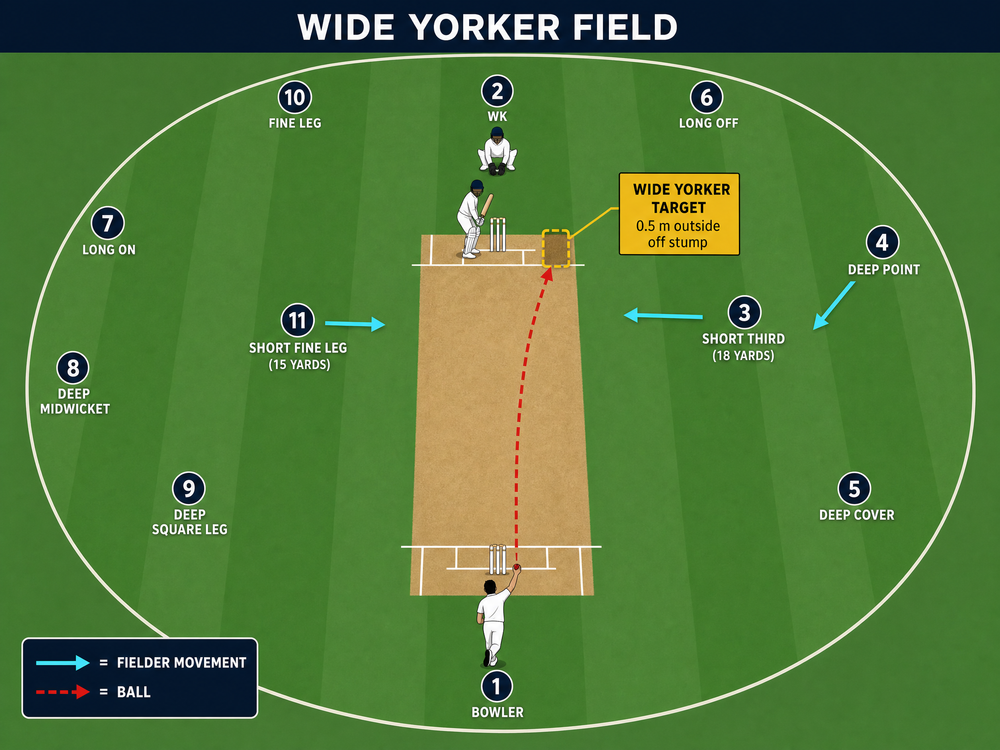
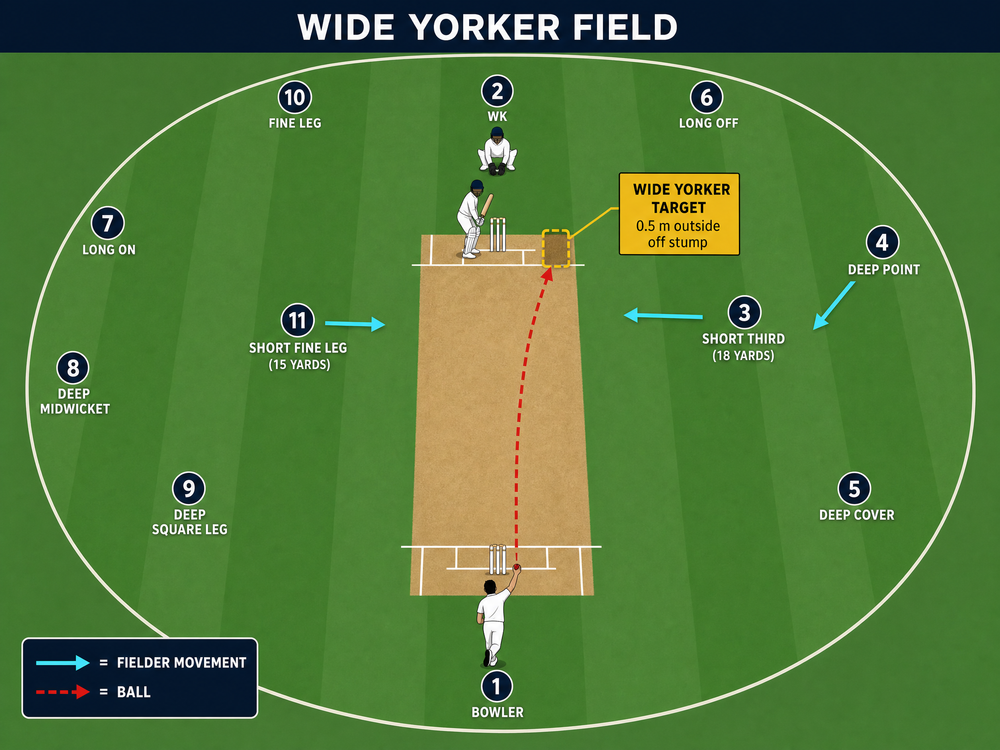
Switch for balls 3–4. Captain signals “wide”. Point becomes squarer, short third is active, and deep point/deep cover own the off-side boundary. The bowler changes line, not their full-length commitment.
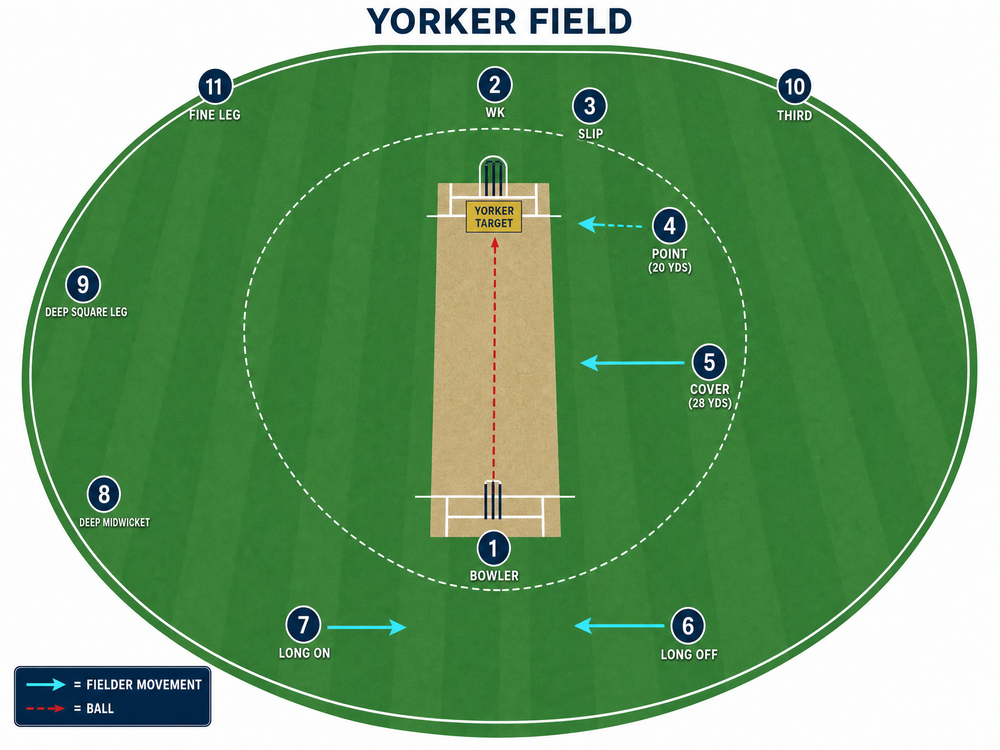
Diagram 2: Wide-yorker field. The target sits just outside off stump at the striker’s crease. It makes the batter reach, while deep point and deep cover protect the off-side slice. The wicketkeeper confirms whether a ball is too wide; never rehearse an illegal wide as a ‘good’ ball.
Use pace-off only after control is established. On ball 5, deliver a slower yorker or off-cutter at the same target corridor and with the same arm speed. Do not drag it back of a length unless the field has changed. Cover and long-off expect the checked drive; deep midwicket expects the early slog.
Finish with a repeatable ball. Ask the bowler: “What have you executed twice today?” Reset the field and choose that ball for number six. The death over rewards conviction, not a last-ball trick.
Score and review. Award 2 points for a legal yorker in the target box and 1 for a dot or single denied at the boundary; subtract 2 for a no-ball or wide. In a 45-second review, give one technical cue and one communication cue only.
Key Coaching Points

- Length is the foundation. A full ball missing by 30 cm can be a half-volley. Measure success by landing zone, not effort.
- Field to the miss. A leg-side yorker miss is pulled; a wide yorker miss is driven. Boundary riders protect the realistic mistake, not only the perfect ball.
- Close the communication loop. Captain calls, wicketkeeper repeats, bowler acknowledges with a hand signal. If a link is missing, reset before the run-up.
- Keep the ring athletic. Point and cover start weight-forward, hands below knee height, first step towards the ball. A static ring concedes the cheap single.
- Train the return. Boundary players gather outside the ball line and throw to a named relay. The keeper is the default end when batters turn for two.
- Reward legal pressure. No-balls and wides hand control back to the hitter. Discipline is execution.
Common Mistakes
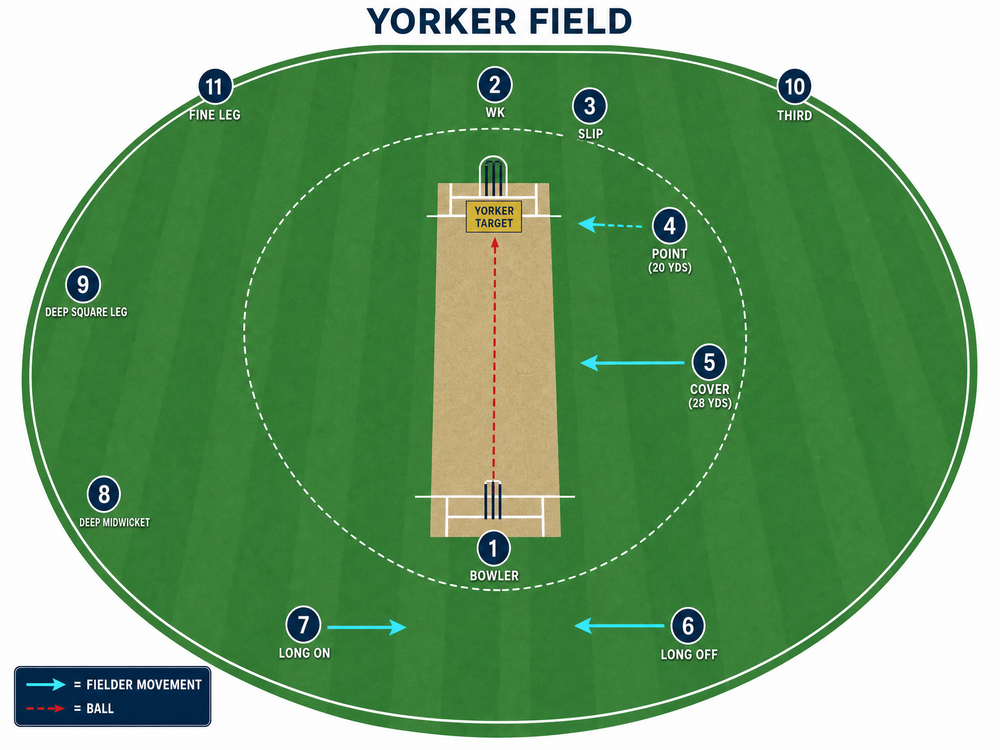
| Mistake | Why it costs runs | Immediate correction |
|---|---|---|
| Bowler aims at toes, not crease | Becomes a low full toss | Re-mark the 60 cm target at the popping crease |
| Long-on/long-off are too square | Straight boundary is open | Walk both 8–12 m straighter |
| Field changes after bowler commits | Players drift; bowler loses clarity | Complete calls before run-up begins |
| Slower ball is dragged short | Batter swings through the line | Keep release window; shorten run-up one stride if needed |
| Boundary fielder attacks too early | Ball beats them behind | Hold saving line until ball passes the inner ring |
Variations & Progressions
Begin technically: no batter, bowler, keeper and two fielders. Success is 8 of 12 legal balls in the correct corridor. Add six active fielders, then a full eleven and a batter restricted to one attacking shot. Finish under pressure: defend 12 from six with a visible scoreboard and a 20-second changeover. Deduct a point for late movement or missing backup as well as for a boundary.
Against a batter who charges early, bowl the slower ball at ball 2, then return immediately to the straight yorker. Against a strong cover hitter, retain the wide-yorker field but keep long-off straighter and move deep cover 5 m squarer. For a left-hander, physically walk players to their mirrored locations.
Age Adaptations
| Group | Modification | Coaching priority |
|---|---|---|
| Under 10 | 16–18-yard pitch, soft ball, five fielders; one full-and-straight target | Safe action and simple stopping lines |
| Under 12 | 18–20 yards, seven fielders, 1 m target box; two calls only | Full length, loud calls and first throw-in |
| Under 14 | Full 22 yards, nine to eleven fielders, 60 cm box | Field-to-miss discipline and repeatable yorker |
| Under 16 / Open | Match conditions, live scoreboard and batter-specific plans | Six-ball sequencing and legality under pressure |
Coach’s Finish
Run the set play for 35 minutes, then finish with competitive overs. Rotate bowlers after one cue and a second attempt. The plan works when the unit creates uncertainty for the batter but certainty for itself: every ball has purpose, every fielder has a lane, and no one is surprised by the hit.
