

Football
The Decoy Curve: Advanced Direct Free Kick Set Play
Master a deceptive direct free kick routine that utilizes a decoy run to disrupt the defensive wall and create multiple scoring opportunities from 20-25 metres out.
What you need
Football, Mannequins (for defensive wall practice), Cones (to mark starting positions)
1. Overview
The "Decoy Curve" is an advanced direct free kick routine designed for central or slightly offset positions, approximately 20-25 metres from the goal. This set play leverages a deceptive overlapping run to fracture the defensive wall's structural integrity, obscure the goalkeeper's line of sight, and create a momentary hesitation in the defensive line. By employing a decoy runner (Player 10) who curves around the wall just before the strike, the attacking team forces the defence into a split-second decision: track the runner or hold the line. This hesitation often provides the primary taker (Player 7) with the necessary window to curl the ball into the top corner, or alternatively, slip a low pass to the decoy runner if the wall jumps prematurely.
2. Setup
Location: 20-25 metres from goal, central or slightly offset (left or right).
Players Involved: 5 primary attackers.
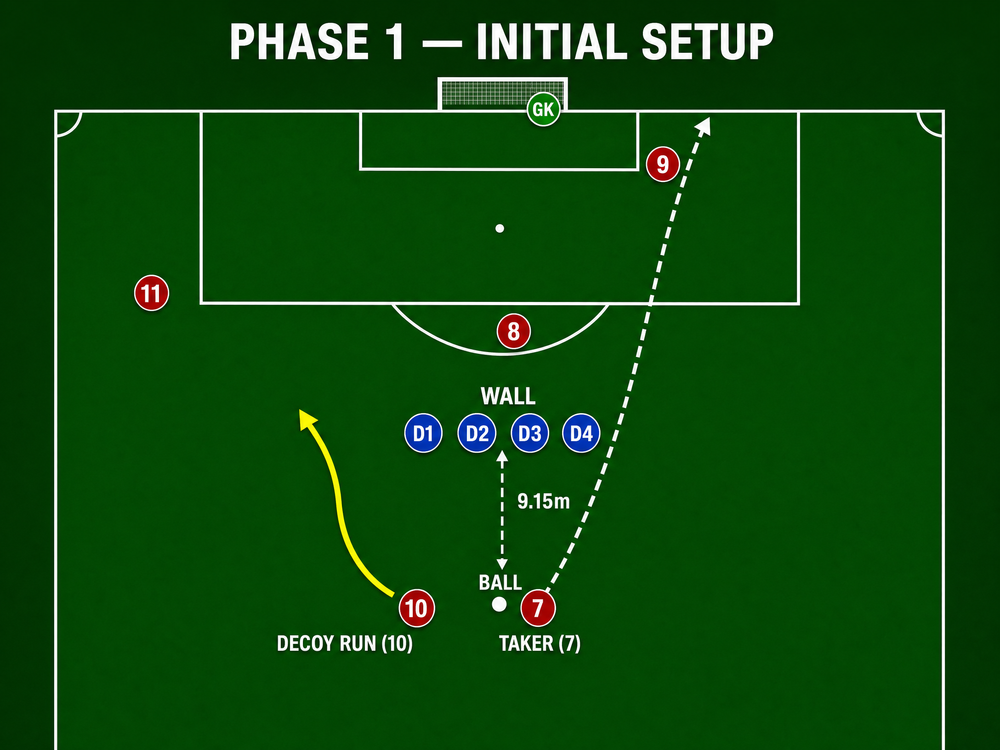
- Player 7 (Primary Taker): A player with excellent technique for curling the ball over the wall.
- Player 10 (Decoy Runner): A quick, agile player positioned right next to the taker.
- Player 9 (Near-Post Runner): A strong aerial threat positioned near the far post initially.
- Player 11 (Back-Post Runner): Positioned wide on the opposite side of the ball.
- Player 8 (Second Ball/Edge of Box): Positioned centrally at the edge of the penalty area to recycle possession or strike rebounds.
3. Step-by-Step Instructions
- Initial Positioning: Player 7 and Player 10 stand over the ball, creating ambiguity about who will take the kick. Player 10 should be positioned slightly ahead and to the side of the ball, indicating they might take a left-footed strike or a short lay-off.
- The Trigger: Player 7 initiates the routine with a subtle visual cue (e.g., adjusting socks, a specific hand signal, or a slight nod).
- The Decoy Run: Player 10 sprints forward, curving their run tightly around the outside of the defensive wall. This run must be aggressive and convincing, drawing the attention of the defenders on the end of the wall.
- The Strike: Exactly as Player 10 clears the ball and begins to curve around the wall, Player 7 begins their run-up. The timing is crucial; Player 7 strikes the ball just as the wall's attention is divided and their line of sight is partially blocked by Player 10's movement.
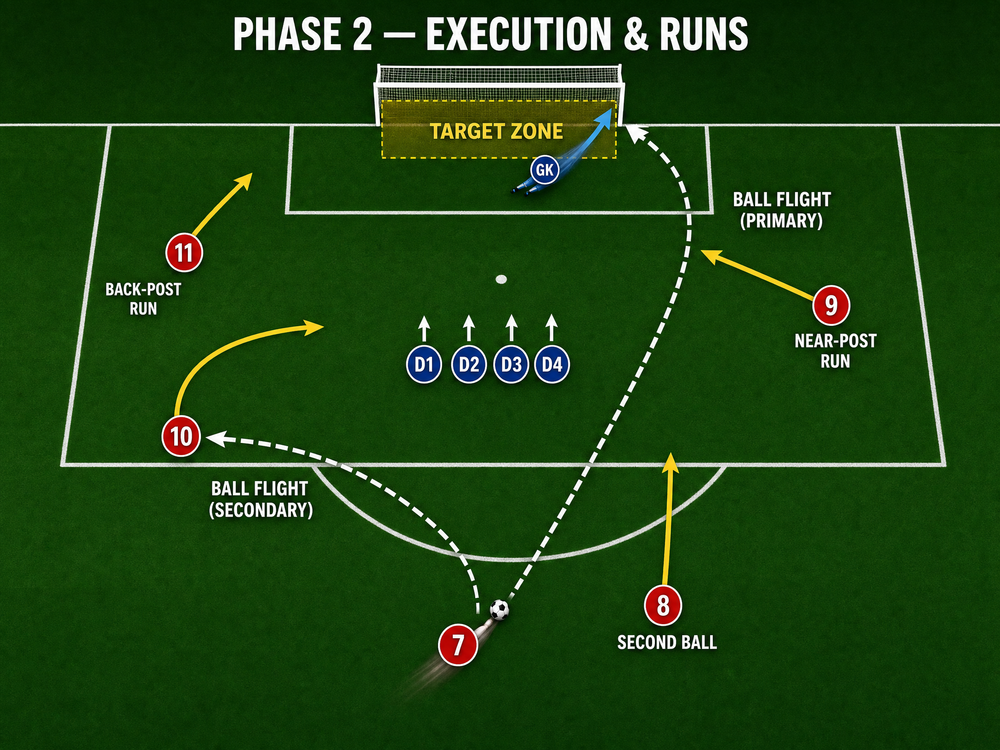
- Attacking Runs: Simultaneously with Player 7's run-up, Player 9 makes a sharp darting run from the far post toward the near post, aiming to distract the goalkeeper and potentially flick on a low delivery. Player 11 crashes the back post for any over-hit crosses or rebounds.
- The Secondary Option: If Player 7 observes the wall jumping early or shifting significantly to block the shot, they have the option to play a disguised, low pass into the path of Player 10, who is now in a crossing or shooting position inside the penalty area.
4. Key Coaching Points
- Conviction in the Decoy: The success of this play hinges entirely on Player 10's run. It cannot be a jog; it must be a full-speed sprint that demands a defensive reaction.
- Impeccable Timing: Player 7 must strike the ball at the exact moment Player 10 eclipses the goalkeeper's view. If the strike is too early, the deception fails; if too late, the goalkeeper has time to reset.
- Disguise the Intent: Both players over the ball must maintain body language that suggests either could strike it. Avoid telegraphing the play with obvious glances or predictable run-ups.
- Commitment to the Rebound: Players 9, 11, and 8 must anticipate a save or a block. Following up on the shot is non-negotiable; many goals from set pieces come from the second phase.
5. Common Mistakes
- Poor Timing: The most frequent error is the taker striking the ball before the decoy runner has created the necessary visual disruption, rendering the play ineffective.
- Lack of Decoy Intensity: If Player 10's run is slow or unconvincing, the defensive wall will simply ignore it and focus entirely on the taker.
- Telegraphing the Pass: When executing the secondary option (the low pass to Player 10), the taker often gives away their intent by looking directly at the runner before striking the ball.
- Static Attacking Runs: Players 9 and 11 remaining stationary while the ball is struck, making them easy to mark and useless for rebounds.
6. Variations & Progressions
- The Lay-Off: Instead of a decoy run, Player 10 can lay the ball off slightly to the side for Player 7 to strike a moving ball, changing the angle and potentially bypassing the wall.
- The Double Decoy: Introduce a third player over the ball. The first player runs over the ball, the second player (Player 10) makes the curving run, and the third player (Player 7) strikes it.
- The Under-Wall Strike: If the defensive wall consistently jumps, Player 7 can opt to strike the ball low and hard under the jumping defenders.
7. Age Adaptations
- Under 10 - Under 12: Focus purely on the technique of striking the ball over the wall. Introduce a simple two-player setup where one player lightly touches the ball for the other to strike.
- Under 14 - Under 16: Introduce the decoy run, focusing heavily on the timing between the runner and the taker. Ensure players understand the concept of disrupting the goalkeeper's line of sight.
- Open/Senior: Implement the full routine with all secondary options and attacking runs. Focus on the psychological aspects of deception and reading the defensive wall's reaction in real-time.
