

Football
The Decoy Split: Direct Free Kick Routine
Master this deceptive direct free kick routine designed to manipulate the defensive wall and create high-percentage scoring opportunities from 20-25 meters out.
What you need
Football (Size 5), Training bibs (2 colors), Mannequins or training poles (for the defensive wall), Full size goal
1. Overview
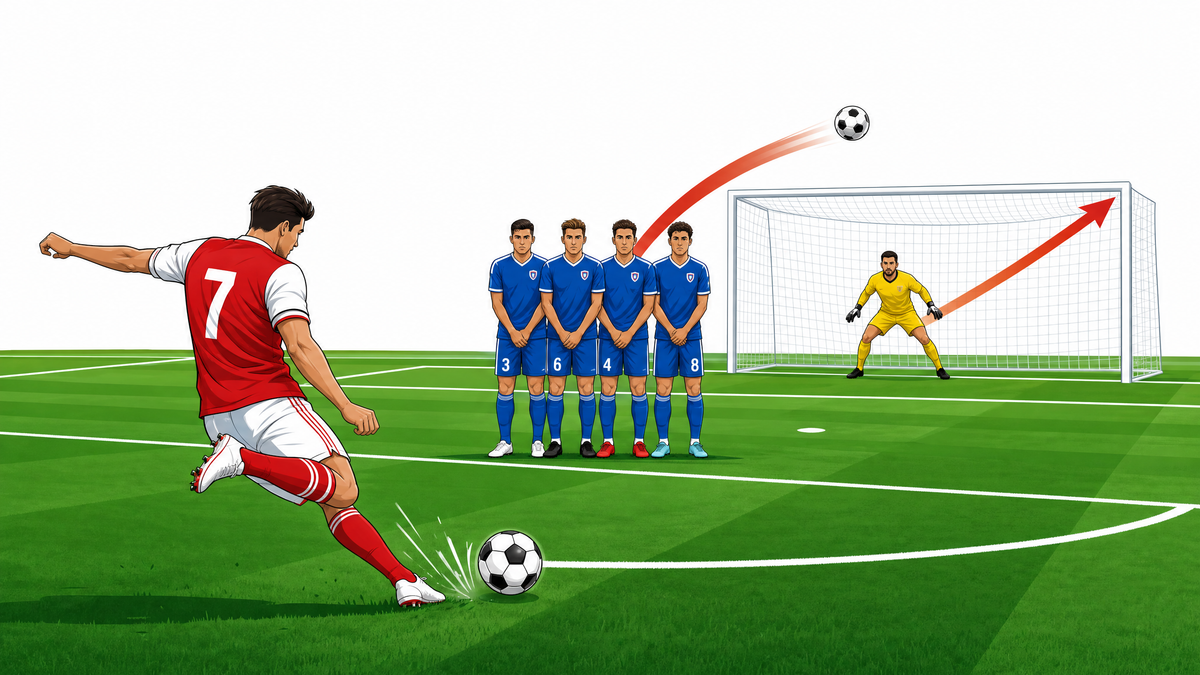
The 'Decoy Split' is a highly effective direct free kick routine designed to exploit the defensive wall's natural instinct to react to movement. When awarded a free kick in the central zone (20-25 meters from goal), the defensive team will typically set a 4 or 5-man wall. This routine uses a dummy runner to pull a player out of the wall or force the goalkeeper to shift their weight, creating a clear shooting lane for the primary taker.
This play is particularly effective when you have a free kick taker capable of generating significant curl, and when facing a disciplined but reactive defensive wall.
2. Setup
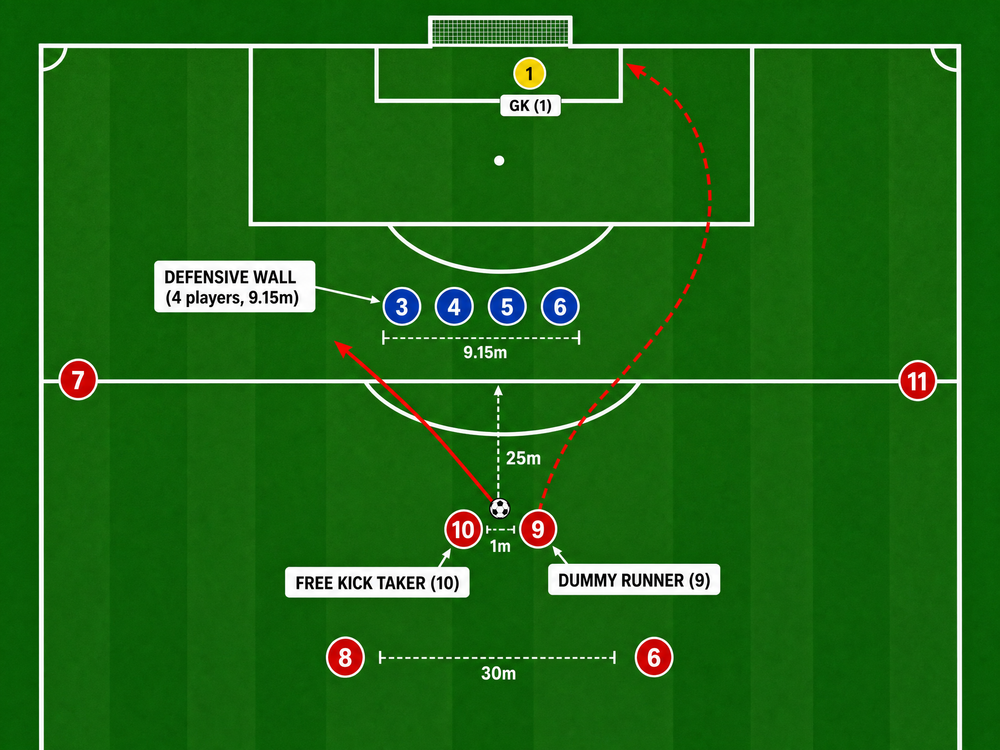
Pitch Area: Central zone, 20-25 meters from the goal line, just outside the penalty arc.
Players Required: 5 attacking players directly involved (1 kicker, 1 dummy runner, 3 box runners).
Initial Positioning:
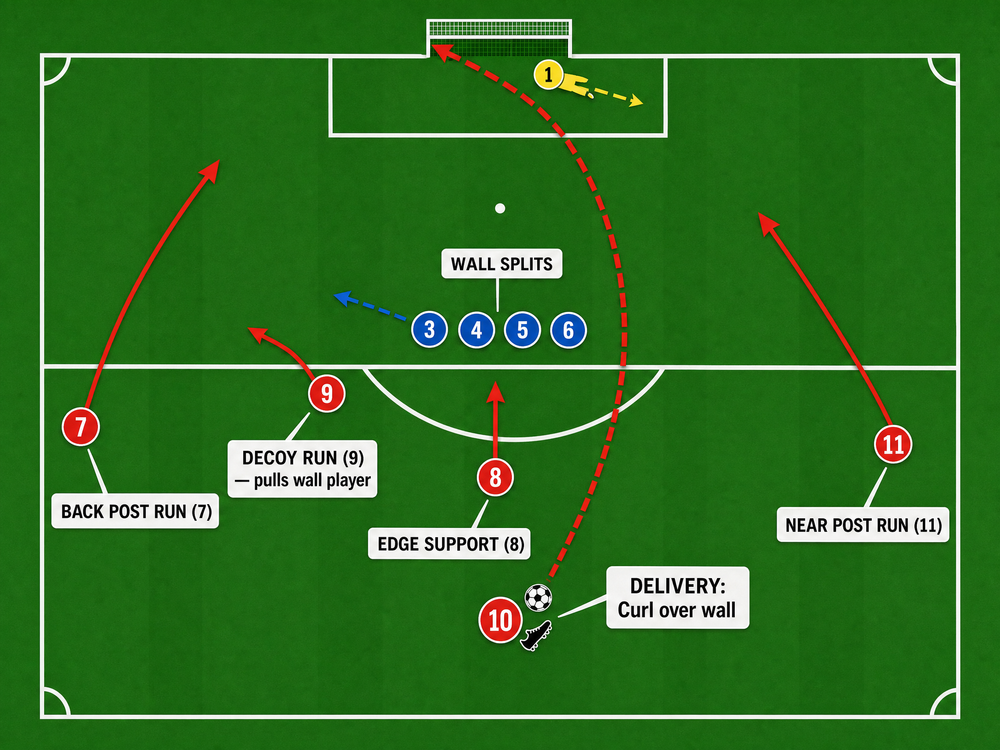
- Player 10 (Primary Taker): Standing directly over the ball, angled for a curled strike.
- Player 9 (Dummy Runner): Standing 1 meter to the side of the ball, positioned as if they will strike it with their opposite foot.
- Players 7 & 11 (Wide Runners): Positioned wide on the edges of the penalty area, ready to crash the back and near posts respectively.
- Player 8 (Edge Support): Positioned centrally, 30 meters from goal, ready to collect clearances or second balls.
3. Step-by-Step Instructions
- The Set: Player 10 and Player 9 stand over the ball, discussing the play to sell the deception. Both players must look like credible threats to strike the ball.
- The Trigger: Player 10 gives a subtle visual cue (e.g., adjusting socks, a specific hand gesture) to initiate the routine.
- The Decoy Run: Player 9 begins their run-up aggressively. Instead of striking the ball, they run over it and sprint diagonally toward the outside edge of the defensive wall.
- The Wall Reaction: The aggressive run by Player 9 is designed to cause the outside player in the wall to flinch, turn, or step out, creating a micro-split or a gap in the defensive structure.
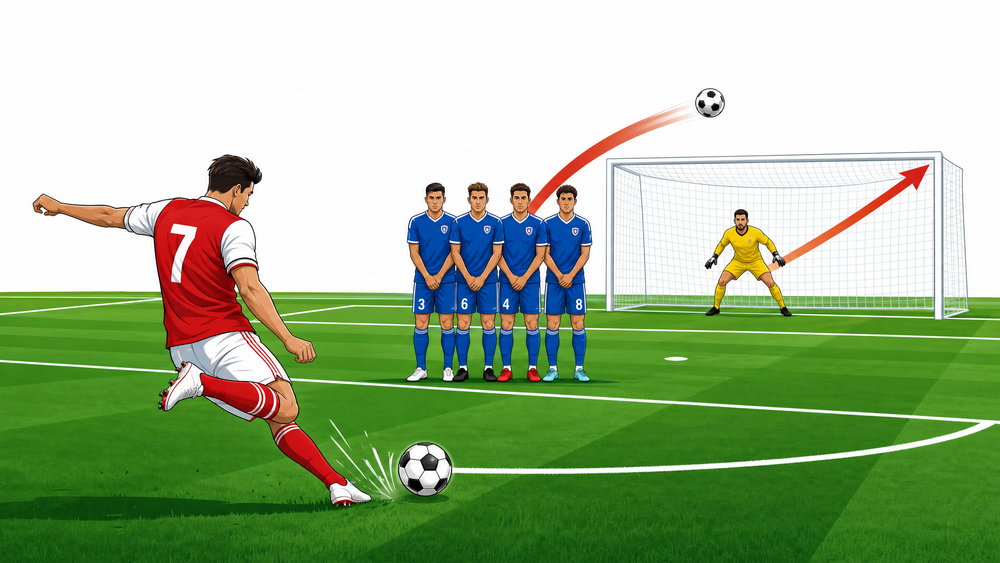
- The Strike: Immediately after Player 9 clears the ball, Player 10 begins their run-up and strikes the ball. The aim is to curl the ball over or around the newly created gap in the wall, targeting the near top corner.
- The Box Crash: As the ball is struck, Players 7 and 11 make explosive diagonal runs toward the back post and near post respectively, anticipating a save, a rebound off the post, or a deflection.
- The Second Phase: Player 8 moves forward to the edge of the penalty arc (the 'D') to lock the edge of the box and recycle possession if the ball is cleared.
4. Key Coaching Points
- Sell the Decoy: The success of this play hinges entirely on Player 9's acting. The run-up must be aggressive and convincing. If the wall doesn't believe Player 9 is shooting, they won't react.
- Timing is Everything: Player 10 must strike the ball the exact moment Player 9 clears the path. If Player 10 waits too long, the wall will recover its shape. If they go too early, they risk hitting Player 9.
- Target the Weak Link: Identify the weakest or most reactive player in the opposition's wall (often the shortest player or an attacker placed in the wall) and aim the decoy run to exploit them.
- Follow the Shot: Players 7 and 11 must treat every free kick as a pass to the goalkeeper. They must be moving before the ball reaches the goal to capitalize on any spilled saves.
5. Common Mistakes
- Poor Decoy Execution: The dummy runner jogs or looks unconvincing, failing to move the wall.
- Hesitation by the Taker: The primary taker pauses after the decoy run, allowing the goalkeeper to reset and the wall to close the gap.
- Static Box Runners: Players 7 and 11 stand and watch the shot instead of anticipating the rebound, missing easy tap-in opportunities.
- Ignoring the Second Ball: Player 8 drops too deep or gets sucked into the box, leaving the edge of the area exposed for a counter-attack if the ball is cleared.
6. Variations & Progressions
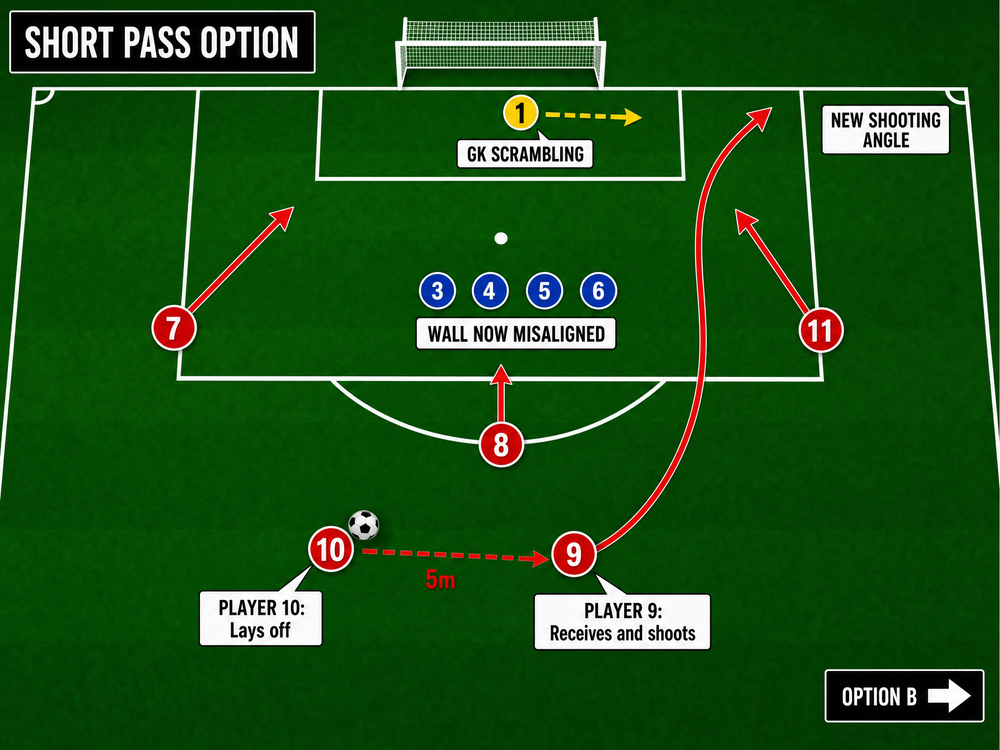
Variation A: The Short Lay-off (Option B)
If the wall is completely static and doesn't bite on the decoy run, Player 10 can opt for a short lay-off. Instead of shooting, Player 10 passes the ball 5 meters laterally to Player 9, who has stopped their run and opened their body. This immediately changes the shooting angle, often forcing the goalkeeper to scramble and the wall to break apart, allowing Player 9 to strike a moving ball toward the far corner.
Progression 1: Add a Wall Blocker
Place an attacking player directly in front of the defensive wall. As Player 10 strikes the ball, the attacking player ducks or rolls away, creating an unexpected visual disruption for the goalkeeper.
7. Age Adaptations
- Under 10 - Under 12: Focus purely on the timing between the two kickers. Don't worry about complex box runs. Ensure the decoy runner understands why they are running.
- Under 14 - Under 16: Introduce the box runners (Players 7 & 11) and emphasize the importance of following in for rebounds. Begin practicing the short lay-off variation.
- Open/Senior: Execute the full routine with all variations. Analyze opposition walls to identify specific players to target with the decoy run.
