

Basketball
Flex Offense Continuity Play
Master the classic Flex offense, a relentless continuity system designed to create high-percentage layups and open jump shots through constant screening and cutting.

What you need
1 Basketball, Half-court
1. Overview
The Flex offense is a classic, pattern-based continuity offense that relies on constant movement, screening, and passing to break down man-to-man defenses. It is highly effective because it forces defenders to constantly communicate and navigate through a maze of screens. The primary goal is to generate high-percentage layups off the 'flex cut' along the baseline, or open jump shots off the subsequent down screen. It is an excellent system for teams lacking a dominant post player, as it requires all five players to interchange positions and share the ball.
2. Setup
- Equipment: 1 Basketball, half-court setup (28m x 15m FIBA standard dimensions).
- Initial Alignment: The offense begins in a 4-out, 1-in or a 3-out, 2-in set, depending on the entry. For the standard continuity, we start with a 1-4 high or a 2-1-2 look that quickly transitions into the flex shape. The standard setup places the Point Guard (1) at the top of the key, the Shooting Guard (2) and Small Forward (3) on the wings, and the Power Forward (4) and Center (5) on the low blocks.
3. Step-by-Step Instructions
Phase 1: The Initial Entry and Flex Cut
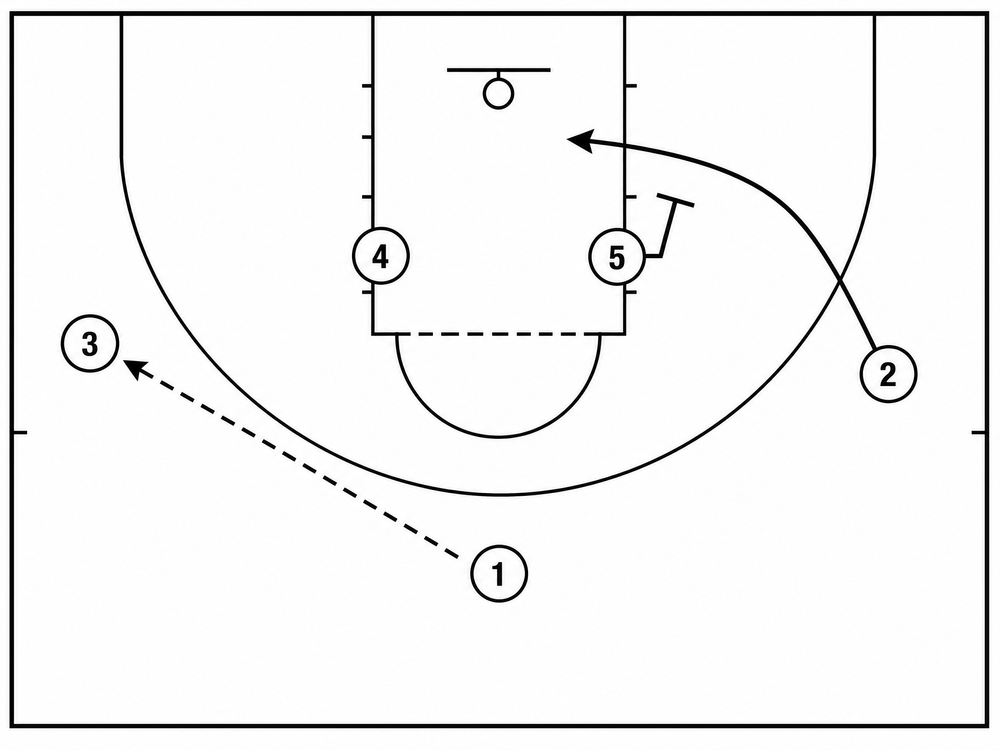
- The Point Guard (1) initiates the offense by passing to the wing, in this case, the Small Forward (3).
- As the pass is made, the player on the opposite low block, the Center (5), sets a baseline screen for the Shooting Guard (2).
- Player 2 uses the screen (the 'flex cut') to cut aggressively across the baseline towards the strong-side low block, looking for a quick pass from 3 for a layup.
Phase 2: The Down Screen (Screen the Screener)
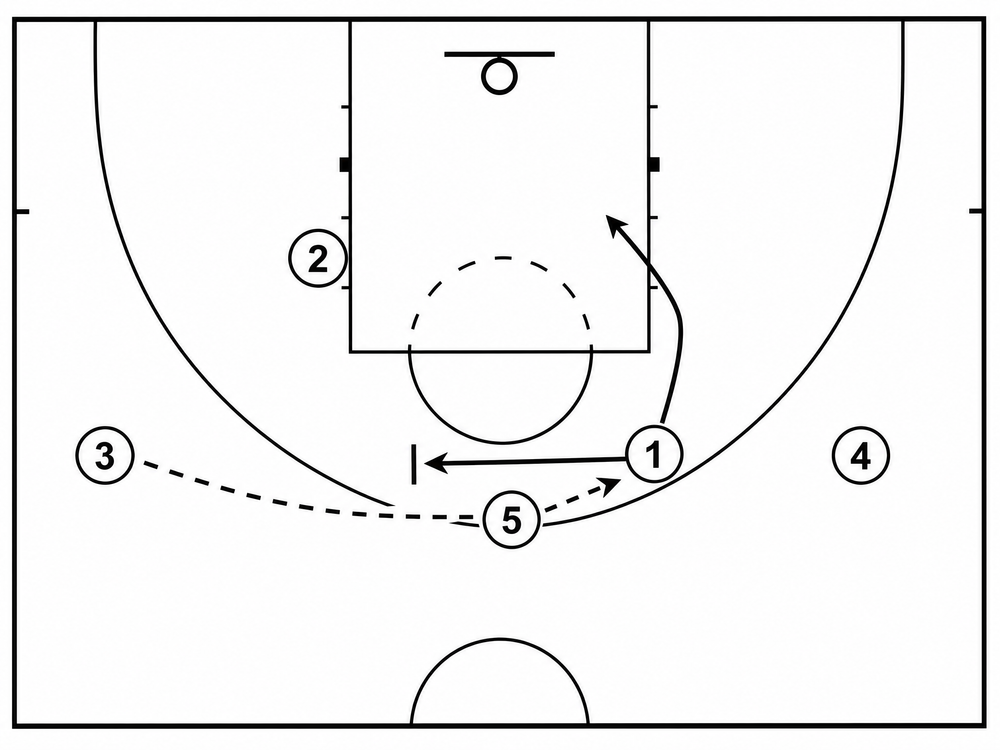
- If the pass to 2 is not available, 2 posts up briefly on the strong-side block.
- Immediately after setting the flex screen, Player 5 receives a down screen from the Point Guard (1) at the top of the key. This is the 'screen the screener' action.
- Player 5 cuts hard to the top of the key, looking for a pass from 3 for an open jump shot.
- After setting the down screen, Player 1 opens up to the weak-side wing or low block, balancing the floor.
Phase 3: The Continuity
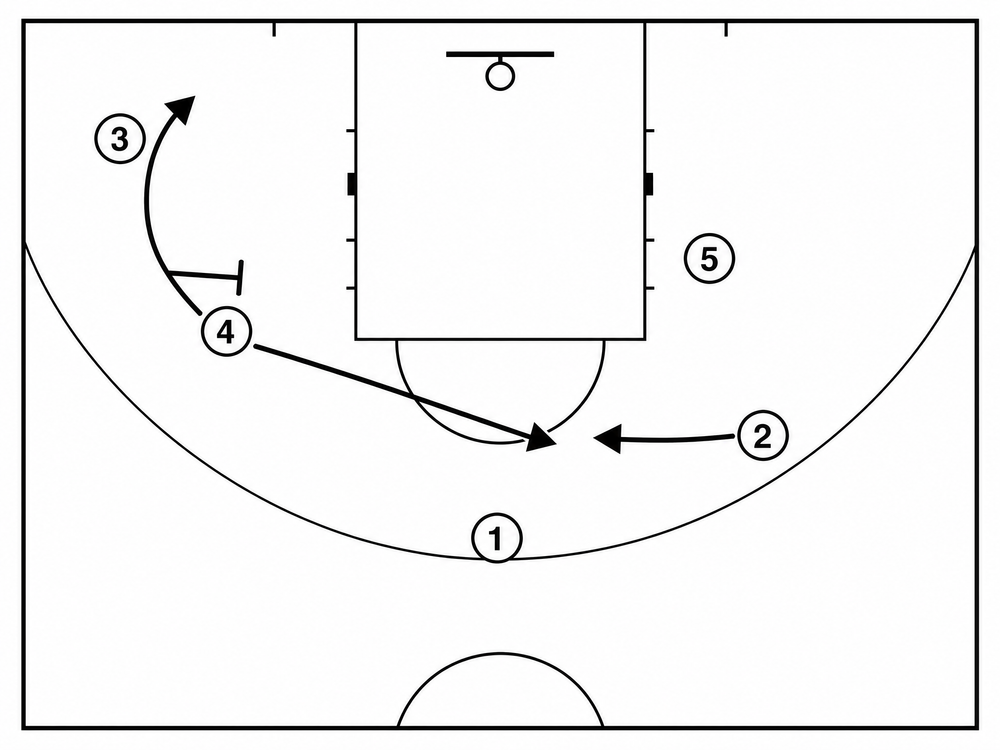
- If Player 5 does not have a shot at the top of the key, they reverse the ball to the opposite wing (Player 1 or 4, depending on the rotation).
- The action now mirrors the first phase on the opposite side. Player 4 sets a flex screen for Player 3 along the baseline.
- Player 3 makes the flex cut to the new strong-side block.
- Player 4 then receives a down screen from Player 2 (who was on the block), popping to the top of the key.
- The pattern continues indefinitely until a high-percentage shot is created.
4. Key Coaching Points
- Patience and Timing: Players must wait for the screens to be set before cutting. Rushing the cut ruins the spacing and timing.
- Setting Solid Screens: Screeners must have a wide base and remain stationary. The cutter is responsible for running their defender into the screen.
- Cutting Hard: Cutters must sprint shoulder-to-shoulder off the screen to prevent defenders from slipping through.
- Reading the Defense: Players must read how the defense is playing the screens (switching, fighting over, or going under) and react accordingly, such as slipping the screen or fading.
5. Common Mistakes
- Poor Spacing: Players creeping too close to the paint, clogging the cutting lanes.
- Weak Screens: Setting 'brush screens' that fail to impede the defender, resulting in contested cuts.
- Staring Down the Cutter: The ball handler telegraphing the pass, allowing the defense to anticipate and intercept the ball.
- Standing Still: Players stopping their movement if they don't get the ball, breaking the continuity of the offense.
6. Variations & Progressions
- Flex to Pick and Roll: Instead of the standard continuity, transition directly into a high pick-and-roll if the initial flex cut is denied.
- Post Entry Variation: Enter the offense by passing directly to the post, then initiate the flex cuts off the post player.
- Dribble Entry: Initiate the offense with a dribble hand-off (DHO) on the wing instead of a pass to trigger the first flex screen.
7. Age Adaptations
- Under 12s: Focus heavily on the basic mechanics of setting and using screens. Simplify the offense to just the baseline flex cut without the complex 'screen the screener' action.
- Under 14s: Introduce the full continuity, emphasizing spacing and the timing of the passes.
- Under 16s & Open: Teach advanced reads, such as slipping screens against switching defenses, and incorporate specific set plays that flow seamlessly into the flex continuity.
