

Basketball
SLOB Rip 45: Front-Rim Lob and Safety Flash Counter
Create a quick front-rim lob against man-to-man and flow instantly into a 45-degree safety-flash counter when the first window is denied.
What you need
balls, cones
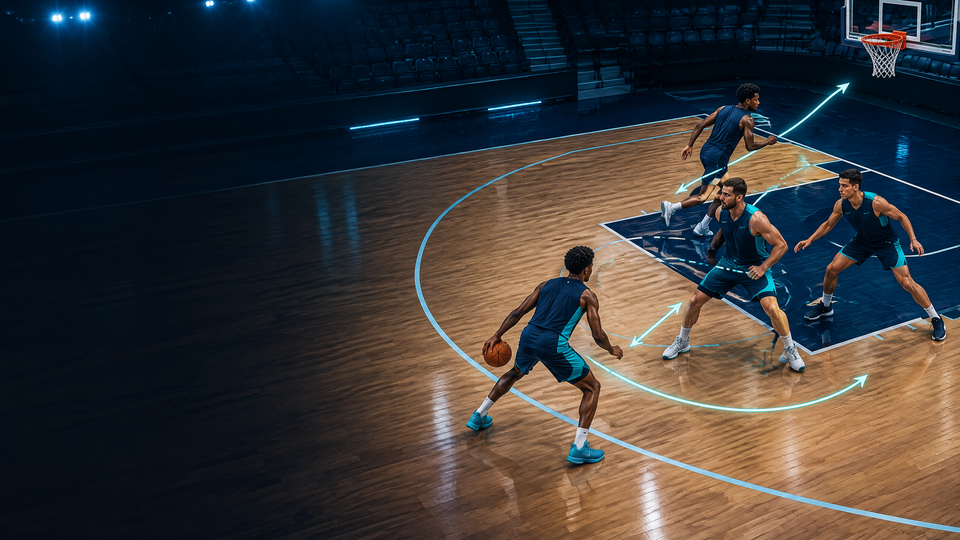
{{asset:header_image.png}}
Overview
SLOB “Rip 45” is a front-court sideline inbound that creates a fast lob at the front of the rim against man-to-man coverage, then flows into a high-low counter when the defence takes away the first look. Use it after a timeout, on a dead ball in the scoring half, or when you need a two-point look without spending several seconds of the possession. The action uses a legal cross-screen from 4 to free 2, while 3 clears and 5 becomes the safety receiver at the 45-degree window.
The passing order is deliberately simple. 1 reads the rim at 0.7 seconds, reads 5 by 1.2 seconds, and enters the next action. Against a switch, 4 seals the smaller defender; against a trail, 2 owns the front rim. Reverse the alignment and the cutting angles to run it from either sideline.
Setup
Attack the right-hand basket on a 28 m × 15 m FIBA court. Use 1 as the inbounder and best decision-maker. Put 2, your most explosive cutter, on the ball-side elbow just outside the lane line. Place 4 one stride below and inside 2, square and ready to screen X2. Start 3 on the weak-side low block/corner line, prepared to clear to the deep corner. Put 5 at the weak-side dunker spot, ready to flash to the 45-degree safety window above the lane.
Each defender is matched straight up: X1 pressures the inbound, X2 denies 2, X3 protects 3’s route, X4 bodies 4, and X5 takes 5. The call is “Rip 45”. “Rip” means 2 cuts shoulder-to-hip off the screen; “45” tells 5 to flash to the passing angle, not drift to the three-point line.
{{asset:diagram_1.png}}
Step-by-Step Instructions
0.0–0.2 seconds — Trigger. As the official presents the ball, 1 takes a wide stance outside the sideline and gets eyes on 2. 2 gives a small V-cut toward the sideline, then plants the outside foot to sell an escape. 4 closes the gap to X2 with hands tucked and feet set. The screen must be stationary before 2 arrives.
0.2–0.55 seconds — Screen and rip. 4 screens X2 on the inside shoulder. 2 brushes tightly, turns the hips to the basket and sprints to the front rim. It is a true rim run, not a fade under the backboard. 3 sprints to the weak-side corner, pulling X3 out of the paint. 5 lifts diagonally into the 45-degree safety window, showing both hands and arriving on balance.
0.55–0.9 seconds — Lob. If X2 trails or dies on the screen, 1 throws a soft, high lob to the front rim. The ball should land above 2’s outside shoulder, between the front of the ring and the backboard; never throw it flat across the lane. 2 goes two hands where possible, chins the catch and finishes before help rotates. If X4 helps, 4 follows the screen with a hard roll and is ready for a drop-off or offensive rebound.
0.9–1.25 seconds — Read denial. If X2 jumps the route, the defence switches, or the lob window is not clean by one second, 1 does not force it. 1 delivers a firm chest pass to 5 at the 45-degree safety flash, away from X1’s hand. After passing, 1 steps inbounds, takes two hard steps toward the middle and becomes a reversal option.
1.25–1.75 seconds — High-low counter. 5 catches on two feet, chins the ball and looks inside before dribbling. 4 rolls to the front of the rim and seals the switched or recovering X4 on the defender’s back. 5 feeds 4 with a short bounce pass or a high-low chest pass to the target hand. 3 stays deep in the corner and 2 drifts below the ball to stretch help. 4 scores with a power finish or one controlled pivot.
1.75–2.5 seconds — Finish. If 4 is covered, 5 reverses to 1, now live inbounds, or skips to 3 when X3 tags the roll. The rule is: rim, seal, corner, then reset. The remaining players must shoot, rebound or sprint into defensive balance as the shot goes up.
{{asset:diagram_2.png}}
Key Coaching Points
- Make the screen legal and physical: 4 arrives early, is balanced, keeps the chest square and absorbs contact without moving.
- Demand shoulder-to-hip cutting. If 2 leaves space around 4, X2 can slip between screener and cutter and the lob disappears.
- Coach 1’s feet. The inbounder may pivot for a passing lane but must keep both feet outside the sideline until release.
- Use a verbal clock: call “lob” through the first second and “safety” at one second. It prevents the forced pass.
- Require 5 to flash to the ball, not sideways. It shortens the pass and protects the ball from X1.
- Finish at the rim: lob catch is two-foot landing or direct finish; roll catch is chin, read, power up.
Common Mistakes
The usual error is 4 arriving late, turning the screen into a moving block or leaving X2 no separation. Second, 2 rounds the cut or runs underneath the basket, making the lob angle impossible. Third, 1 stares at the first option and ignores the five-second count. Finally, 3 drifts up from the corner, allowing X3 to help on 4’s seal. Correct with a freeze-and-replay: screen angle, cutter’s shoulder, passer’s clock, then spacing.
Variations & Progressions
For a switch-beater, have 4 slip the screen when X4 jumps out early; 1 hits 4 before 2 arrives. For a corner counter, keep 3 in the corner and ask 2 to set a flare screen for 3 after the denied lob; 5 can skip straight to the corner if X3 tags 4’s roll. Against a top-lock, call “backdoor”: 2 rejects the screen and cuts straight to the rim while 4 pins X2 behind.
Progress from 5-on-0 with a visible four-second countdown, to guided 5-on-5 where X2 trails, then to live reads where the defence may trail, switch, top-lock or deny 5. Film the inbounder’s first two seconds; the correct decision matters more than whether the first shot falls. In late-game practice, award the defence a point for a five-second violation or a stolen inbound.
Age Adaptations
For under-12 players, simplify to one read: 2 cuts off 4’s screen and 1 passes to 2 or 5. Use a bounce pass to 5 rather than a lob if players cannot safely throw and catch above the rim. For under-14 groups, introduce the one-second read clock and teach the legal screen. At under-16 and open age, add the switch-beater, corner skip and live scout rule. Rehearse both sides so players recognise the geometry rather than memorising one picture.
